Balls in the ballroom — what a concept! I know one time Princess Diana and John Travolta danced together at the White House. Was it a full scale ball? Where are the balls of today? It seems that we only have red carpet arrivals and then people sitting around at tables. So this passage jumped out at me as I was reading James Traub's "John Quincy Adams: Militant Spirit" (commission earned)("Her" = Adams's wife, Louisa):
Her fortnightly teas became so popular that she tried to restrict the crowd by decreeing that henceforward no dancing would be permitted, but Washington society came and insisted on dancing. Washington now had a little bit of the dazzle the Adamses had known in foreign capitals. When Congress was in session, balls and fine dinners were held almost every night. The most magnificent house in Washington had been empty since its owner, Commodore Stephen Decatur, the great naval hero of the War of 1812, had been killed in a foolish duel in March 1820. But now Baron Hyde de Neuville had purchased the three-story mansion on Lafayette Square and threw splendid parties there. For a time, the Adams house was filled with music and dancing and even giggling and flirting.... A dancing master came for as much as three hours a day to teach all the young folk.
Key words: almost every night. Nowadays, it seems you only hear of balls — the dancing kind of balls (not the "Big Balls" kind of balls) — during inaugurations. I'd like to see Trump's new ballroom used for dancing, and perhaps he's the person to get people dancing. It took a person to incite all that dancing that was going on in Washington circa 1820. Of course, the person was not John Quincy Adams, and it wasn't his wife Louisa. It was Dolley Madison.
A scene in Billy Wilder’s breakthrough movie, “The Major and the Minor” (1942), starring Ginger Rogers, pokes fun at Lake’s famous hairdo:
“There’s an epidemic in [this] school…. They all think they’re Veronica Lake.”
Amazing! Look:
To quote myself again (with an added link, to Glamour):
That was way back in 1942. That was still going on in the 1960s and beyond.
These days, there's a big fad for parting the hair straight down the middle. We had that in the 1960s too. But hysteria over a side part is really very funny. Lake didn't pull the hair back, though. That was a big thing about it. She let it fall over her eyes.
It was the hair in your eye/eyes that drove people crazy. I got the impression they thought it was one thing for one actress — Veronica Lake — to perform that insanity in movies, but no one else can try that — certainly not in real life, where you've got to watch where you're going — and if you do, we're going to discipline you by calling you out for copying Lake. Like this was a hairstyle for one person and one person alone.
I think it was just over-the-top policing of young women. And I'm saying that as someone who, in junior high, was sent to the vice principal's office for having excessively long bangs. I mean, what are eyebrows for if not to tell you here is the line that must not be crossed?
As you may remember from Part 1, I am not reading Hillary Clinton's book ("What Happened"). I put it into our Kindle because Meade wanted to do some proto-blogging. That's my term for his reading and searching and talking to me and sending me links. That sometimes gets me to things I want to blog, and that's what we're doing with this book.
For Part 2 in the "Reading Hillary's book" series, my note for getting to the material I want to talk about is "wax." Beginning at page 5, Hillary writes about what I would call her friendship with Donald Trump. As you can see she denies that she was ever friends with him, even though she and her husband, former President of the United States Bill Clinton, attended Trump's wedding:
I had known Donald Trump for years, but never imagined he’d be standing on the steps of the Capitol taking the oath of office as President of the United States. He was a fixture of the New York scene when I was a Senator—like a lot of big-shot real estate guys in the city, only more flamboyant and self-promoting.
In 2005, he invited us to his wedding to Melania in Palm Beach, Florida. We weren’t friends, so I assumed he wanted as much star power as he could get. Bill happened to be speaking in the area that weekend, so we decided to go. Why not? I thought it would be a fun, gaudy, over-the-top spectacle, and I was right. I attended the ceremony, then met Bill for the reception at Trump’s Mar-a-Lago estate. We had our photo taken with the bride and groom and left.
She makes it sound as though she's all about having "fun," but then why get your photograph taken and then bug out? If you came to the big lavish party for fun, wouldn't you have wanted to eat the food and dance to the music and so forth? You just had your photo taken with the couple and left? That sounds kind of mean and rude. Why are you saying it like that? It seems as though you just want to elbow us into believing that you were never friends and assume we won't be thinking that this is a game of extracting money from a rich guy by making him think he was your friend.
The next year, Trump joined other prominent New Yorkers in a video spoof prepared for the Legislative Correspondents Association dinner in Albany, which is the state version of the more famous White House Correspondents’ Association dinner. The idea was that the wax figure of me at the Madame Tussauds museum in Times Square had been stolen, so I had to stand in and pretend to be a statue while various famous people walked by and said things to me. New York Mayor Mike Bloomberg said I was doing a great job as Senator—then joked about running for President in 2008 as a self-funder. When Trump appeared, he said, “You look really great. Unbelievable. I’ve never seen anything like it. The hair is magnificent. The face is beautiful. You know, I really think you’d make a great President. Nobody could come close.” The camera pulled back to reveal he wasn’t talking to me after all but to his own wax statue. It was funny at the time.
It's actually pretty funny now. And Trump was gamely self-deprecating (while also, until the punchline is revealed, gushing compliments at her). Maybe he only did that to get attention, but I think it shows that they had a friendly relationship. She goes into no detail denying that they were friends. Trump's making a joke at the Legislative Correspondents Association dinner immediately becomes segue to: "When Trump declared his candidacy for real in 2015, I thought it was another joke, like a lot of people did." And the book is off into a discussion of Trump's political rise.
But I want to stop at the comic sketch that has Hillary playing the part of her own wax dummy. It's an old comedy idea, documented at TV Tropes. It's a subcategory of a trope called "Paper-Thin Disguise":
A character that the other characters should recognize (or at least recognize as out of place) dons a disguise and is treated as neither recognizable nor conspicuous. This disguise is so completely transparent that the audience wants to shout "For the love of God, it's him!"...
While not a Dead Horse Trope, these days Paper Thin Disguises are parodied as often as they are used seriously. The trope is still an important dramatic convention in live theater and opera productions — where a really good disguise would render the character unidentifiable from the cheap seats, and be beyond the scope of the prop budget to boot — but is usually employed along with some kind of nod to audience acknowledging the absurdity. This can sometimes be exaggerated for comedic effect, for example wearing bunny ears and becoming indistinguishable from a real rabbit, or pretending to be an ancient statue by simply standing still in a specific pose. Children's shows still employ this trope regularly without any parody element.
The link on "standing still in a specific pose" goes to "Nobody Here but Us Statues":
Alice tries to hide from Bob, so she pretends to be a statue (or, in more cartoonish settings, even a painting or a relief) in a museum, art gallery etc. Sometimes she has to Walk Like an Egyptian to fit in, or get in a suit of armour, or end up holding an empty picture frame in front of herself. Bob typically doesn't catch on, though he looks at Alice suspiciously (bonus points if he says "I'll never understand this modern art" or "What an ugly statue!").
In the Legislative Correspondents Association dinner sketch, Hillary didn't pretend to be a wax statue of herself to hide. Rather, the set-up had her enlisted to cover up the problem that the real wax figure had been stolen. It's a nice sketch and it was funny — I can tell even from reading the leaden waxen prose — because Trump was funny. He was funny in part because he made fun of himself, and Hillary didn't have to do anything except stand there. She didn't have to stand still for any jokes at her expense. Nobody said "What an ugly statue!" or anything like that but Trump allowed himself to seem like a ridiculous narcissist for saying "I really think you’d make a great President. Nobody could come close."
They all laughed...
ADDED: The first comment on this post, from sodal ye, is: "Hillary just broke a toe in the UK." I do a quick search and get to The Daily Mail and the headline begins: "I was running downstairs in heels with a cup of coffee and fell backwards!" I sincerely hope she's feeling better, but I've got to say that strikes me as really freaky — falling backwards in high heels — just after I've made a big leap from Hillary Clinton to Ginger Rogers, whose most famous quote is that she did everything that Fred Astaire did but "backwards and in high heels."
And I've already written about "backwards and in high heels" — and it was in a post that began by being about Hillary Clinton and then leaped into Ginger Rogers. It was September 4, 2016 and people were questioning whether Hillary was doing enough when her favorability rating had dropped as low as Donald Trump's. ABC News chief political analyst Matthew Dowd said:
[Hillary] is judged -- she is judged a little bit, I have to say, all of the controversy surrounding her and they're both -- Donald Trump and her, she's judged a little bit on a Ginger Rogers standard, which is, is that the bar is so low for him. I mean, Ginger Rogers, the famous like she did everything Fred Astaire did but backwards and in heels.
I said: "Suddenly, Trump is the Fred Astaire, judged by an easier standard when what his opponent/partner is doing is actually harder?"
There's more good stuff at that old post, including the debunking of the idea that Ginger Rogers is the source of the quote, the Ann Richards use of the quote, and Trump on "SNL" dancing like Fred Astaire Drake.
"She's not comfortable in that position. That's only going to make her look more staged, more strategic and less authentic. And so, it's a purposeful strategy why she's not doing press conferences, because that will only add to her unfavorabilities. Look, the email thing, is just terrible, in my opinion, especially when you start looking at the rationale. You know, Matthew and I were joking. She thought the 'c' was to help her put things in alphabetical order. But there's no 'a,' there's no 'b,' and there's no 'd.'"
Said ABC news contributor LZ Granderson today on ABC's "This Week," after the host Martha Raddatz asked him whether Hillary Clinton is "doing enough" about her problem of her favorability rating being at "an all-time low among registered voters, now on par with Donald Trump at 59 percent and 60 percent respectively." Granderson began his answer with: "Well, I they think what they're doing is not adding to the problem."
That is, Hillary is being kept under wraps, because if we see her, we'll only like her less.
And then ABC News chief political analyst, Matthew Dowd attempts to do gender politics:
[Hillary] is judged -- she is judged a little bit, I have to say, all of the controversy surrounding her and they're both -- Donald Trump and her, she's judged a little bit on a Ginger Rogers standard, which is, is that the bar is so low for him. I mean, Ginger Rogers, the famous like she did everything Fred Astaire did but backwards and in heels.
Suddenly, Trump is the Fred Astaire, judged by an easier standard when what his opponent/partner is doing is actually harder?
She said Obama had noted that she looked rested since she ended her campaign against him for the Democratic nomination, and she told him she’d been exercising for a change.
“During the campaign … Barack would get up faithfully every morning and go to the gym. I would get up and have my hair done,” she said as she introduced him. “It’s one of those Ginger Rogers and Fred Astaire things.”
She can't use that getting-my-hair done line in 2016, Trump's hair being what it is. (And by the way, what is it?)
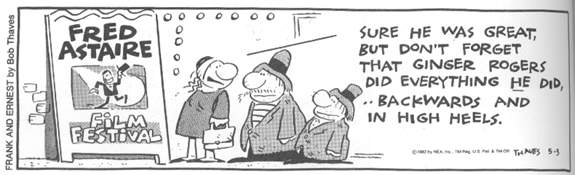
Anyway, the political use of the old Ginger Rogers line goes back to at least 1988, when the future governor of Texas, Ann Richards, gave the keynote address at the Democratic National Convention: "[I]f you give [women] a chance, we can perform. After all, Ginger Rogers did everything that Fred Astaire did. She just did it backwards and in high heels." (The pre-political use came not from Ginger Rogers herself, but from Frank and Ernest.)
But, I'm sorry, I sure don't see Hillary getting judged by a tougher standard than Donald Trump. It's the other way around. It's quite obvious. So it's a cliché, which is another reason not to say it. But it doesn't even serve your purpose, Matthew Dowd, because it's patently inapt and only draws attention to the fact that the backwards here is the bending over that the media have been doing for Hillary.
Now, let's see if Donald Trump can dance like Fred Astaire:
26. How long is this darned thing? I thought 2 hours. Then I thought 2 and a half. Now, I'm thinking it's going to go on for 3 hours. This is madness!...
35. After the debate, in an interview, Trump says what he learned is that he can stand for 3 hours. Yeah, that was a severe challenge — having to stand there for 3 hours. It was hard enough to sit through!
And the woman has to do the standing in heels, as HuffPo pointed out after the 3-hour GOP debate:
"I watched eagerly when Carly Fiorina first walked on stage to see how high her heels were," said our very own Arianna Huffington. "I immediately recognized the heels she was wearing, as I have the same Manolo Blahnik pumps in black. They're high -- 3 1/2 inches! I personally wear them when I know I'm sitting down! I love them and completely understand why she chose them, in terms of style. But, as the debate dragged on, I wondered how uncomfortable she must have been, especially since she didn't just have to stand there looking elegant but being alert and firing on all cylinders...."
But the height of the heel aside, it reminds us of what was once said about actor/dancer Fred Astaire and his legendary dance partner: "Sure he was great, but don't forget Ginger Rogers did everything he did backwards ... and in high heels!"
Who originated that Ginger Rogers line? Ann Richards? No. Frank and Ernest:
On Monday, I took Josh Marshall (and Nancy Pelosi) to task for resorting to constitutional argument by laughter. They were addressing the "individual mandate" — the federal law requiring private citizens to buy health insurance, which a federal judge said is beyond the reach of Congress's enumerated powers. In my post, I chided liberals and lefties about using their own sense of ridiculousness as a legal argument because "There was a time when people laughed at the idea of gay rights."
An emailer reminds me of the precise language that appeared in the Supreme Court's case that ruled that states could criminalize homosexual sodomy. In Bowers v. Harwick, Justice Byron White (a JFK appointee) wrote for the majority:
Proscriptions against that conduct have ancient roots.... In 1868, when the Fourteenth Amendment was ratified, all but 5 of the 37 States in the Union had criminal sodomy laws. In fact, until 1961, all 50 States outlawed sodomy, and today, States and the District of Columbia continue to provide criminal penalties for sodomy performed in private and between consenting adults.... Against this background, to claim that a right to engage in such conduct is "deeply rooted in this Nation's history and tradition" or "implicit in the concept of ordered liberty" is, at best, facetious.
When Bowers was reversed 17 years later, in Lawrence v. Texas. Justice Scalia — the liberals' least (or second-least) favorite Justice — saw fit to quote those words in his dissenting opinion.
We recall a conversation with a young liberal lawyer we met at an event in late March, a few days after the House passed ObamaCare. When we pointed out that there were likely to be court challenges to the new law, particularly the mandate to purchase insurance, she was dismissive. She asserted that the constitutional questions were well settled. When we offered arguments to the contrary, she did not engage them but became emphatic to the point of belligerence, insisting that it was "crazy" to harbor any doubts about the constitutionality of ObamaCare.
Our position was not that ObamaCare was clearly unconstitutional or that it was likely to be struck down, merely that there were serious constitutional arguments against it that had some possibility of prevailing. This modest claim so shocked our new acquaintance that an initially pleasant encounter turned rancorous and left us feeling she had insulted our intelligence....
Well, you'll feel better if you dance like Fred Astaire:
Here's Fred with the words to the Gershwins' "They All Laughed."
They all laughed at Rockefeller Center
Now they're fighting to get in
They all laughed at Whitney
and his cotton gin
They all laughed Fulton and his steamboat
Hershey and his chocolate bar
Ford and his Lizzie
Kept the laughers busy
That's how people are
They laughed at me wanting you
Said it would be, "Hello, Goodbye."
But oh, you came through
Now they're eating humble pie
But speaking of Robert Fulton and his steamboat, and who gets the last laugh, Fulton was a famous loser in the most famous Commerce Clause case of them all, Gibbons v. Ogden, and Fulton was on the side that argued for the narrow interpretation of Congress's enumerated power. Chief Justice John Marshall laid down the broad interpretation:
This power, like all others vested in Congress, is complete in itself, may be exercised to its utmost extent, and acknowledges no limitations other than are prescribed in the Constitution.... [T]he sovereignty of Congress, though limited to specified objects, is plenary as to those objects....
The wisdom and the discretion of Congress, their identity with the people, and the influence which their constituents possess at elections are, in this as in many other instances, as that, for example, of declaring war, the sole restraints on which they have relied to secure them from its abuse.
This is the beginning of the line of expansive interpretation of the Commerce Clause that the proponents of health care reform will rely on as they take their case up on appeal to the 4th Circuit and, presumably, to the Supreme Court. We'll see who's dancing and who's eating humble pie then.
I'm supposed to be judging that "ATL Idol" contest. (Part 1. Part 2.) What have I got myself into? What if I hate everything? Somebody will still win, become the new Above the Law blogger, and I'll never get traffic-building links from there again!
Damn, maybe I should be the Paula. But I was going to be the Simon! Why coddle bloggers? If there's anyone that shouldn't be coddled it's a blogger. Nothing more disgusting than a coddled blogger.
That fish smells almost done.
UPDATE: I got my act together and wrote my first comment:
The most important part of blogging is —— to use an American Idol expression —— song selection. You should be spending much more time looking for good things to blog than actually writing up the post. But you've had your stories imposed on you, and they are stories that don't interest me at all. I clicked on the links, took a look, and couldn't be bothered. And why are they all about black people getting into trouble? Is that supposed to be funny?
But that's not the contestants' responsibility. You got stuck with that. It's like Mariah Carey night. I hate the songs, so how can I care how you sing them? You'd better do something very smart and tricky or I'm gone in a second. This is blogging! You have less than a second to reel me in. One thing I hated about the original articles is that they are complicated and about people I don't know and have no motivation to learn about. Why should I figure out what damned thing happened? So the least you could do is make it very short and funny in some way that didn't require me to understand a lot of crap I don't care about. But you all went long. And putting it in list form or as a series of steps doesn't fool me. It's still long and boring. Blah. I hate everything. You did not amuse me. I would never buy this record.
Some specifics:
Part 1: Exley. That lap dance picture. I was trying to read this sitting in the middle seat on an airplane between two large Harley Davidson bikers from New Zealand. That was an element of entertainment I didn't need. Then, I scrolled down to Alex's post and got a picture of some law books. Yeesh! It's one extreme or the other. And everyone runs with the photo of the smiling black man in happier days. That made me sad. But speaking of things women don't like, Alex, it's not cool to snark "lovers' quarrel" if a man has punched a woman in the stomach. And you've got that right next to a breast-emphasizing photo of the woman. Ugh.
Part 2: Frolic and Detour, only one phrase stood out: "groups of bridesmaids bonding as they make babies' footprints into tiny butterfly wings." Would I read a blog that offered me insight and entertainment in that form? No. You're sneering at ordinary women. Why? Who are you? Sophist falls back on the old device of how-to steps. I never find that funny. Seems like you could program a computer to turn news stories into a list of how-to steps. Here's a phrase: "back-end of the Lee gene pool." 1. Pools don't have a "back-end." You mean "shallow end." 2. Racism alert. Marin —— my eyes glazed over but I did see the phrase "picked himself up, dusted himself off." That made me want to run off to YouTube and watch Fred Astaire and Ginger Rogers. Now, that was entertaining, but surely not the effect you want.
I am a participant in the Amazon Services LLC Associates Program, an affiliate advertising program designed to provide a means for me to earn fees by linking to Amazon.com and affiliated sites.
Encourage Althouse by making a donation:
Make a 1-time donation or set up a monthly donation of any amount you choose:




 પોસ્ટ્સ


