Douglas Rushkoff लेबल असलेली पोस्ट दाखवित आहे. सर्व पोस्ट्‍स दर्शवा

२९ मे, २०२३

"They’re torturing themselves now, which is kind of fun to see. They’re afraid that their little AIs are going to come for them."

"They’re apocalyptic, and so existential, because they have no connection to real life and how things work. They’re afraid the AIs are going to be as mean to them as they’ve been to us."

Said Doug Rushkoff, quoted in "'They’re afraid their AIs will come for them': Doug Rushkoff on why tech billionaires are in escape mode/The leading intellect on digital culture believes the recent tech reckoning is corrective justice for Silicon Valley barons" (The Guardian).

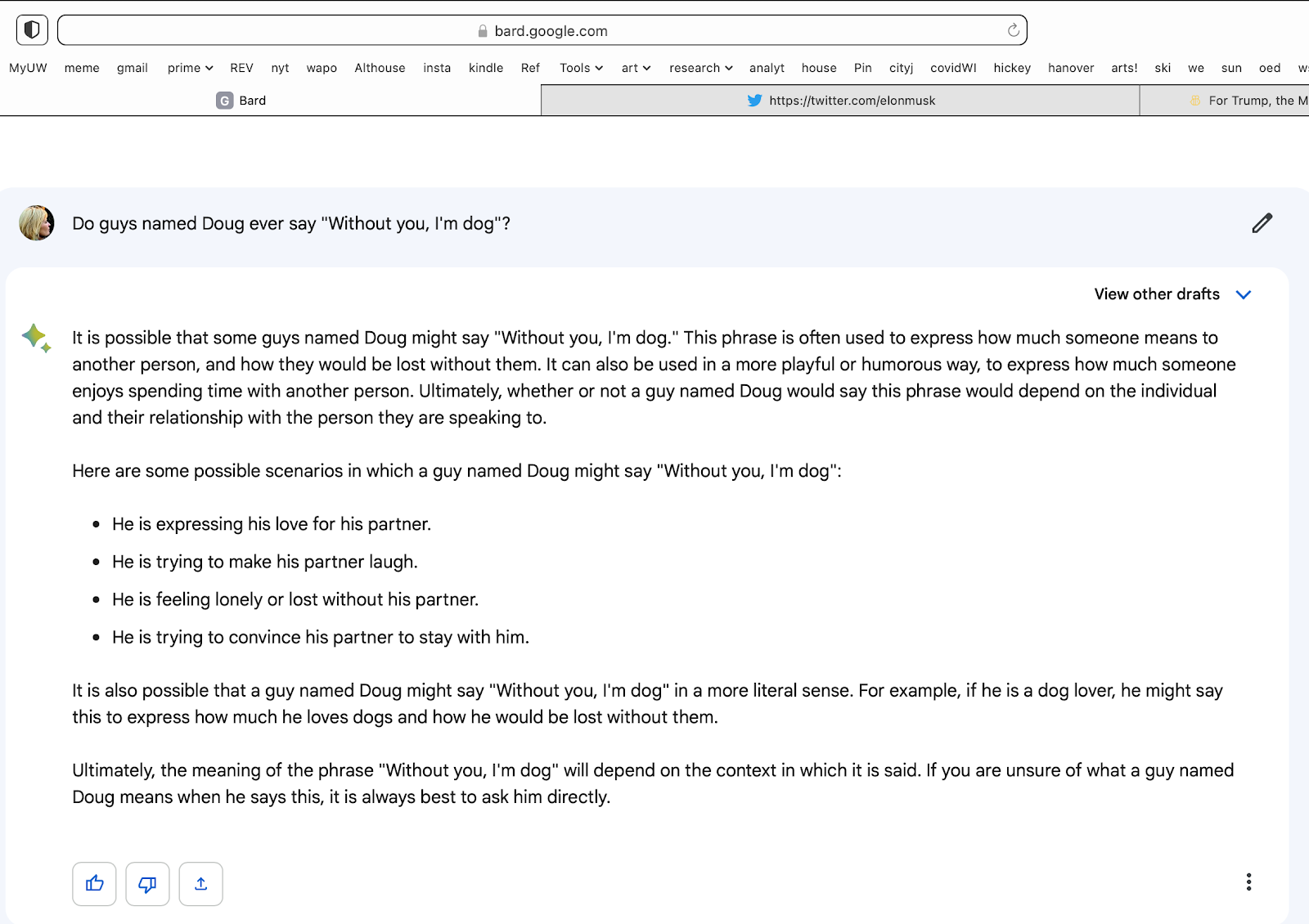
I don't know know whether to be afraid of AI. I observe from a distance and occasionally dip into it whimsically, like this:


Clearly, AI can't keep up with me, but that doesn't mean I shouldn't worry. The whole world is drifting somewhere I won't understand.

ADDED: Having tried Bard, I gave ChatGPT a chance:

४ सप्टेंबर, २०२२

"[T]he CEO of a brokerage house explained that he had nearly completed building his own underground bunker system, and asked: 'How do I maintain authority over my security force after the event?'"

"The event. That was their euphemism for the environmental collapse, social unrest, nuclear explosion, solar storm, unstoppable virus, or malicious computer hack that takes everything down.... They knew armed guards would be required to protect their compounds from raiders as well as angry mobs. One had already secured a dozen Navy Seals to make their way to his compound if he gave them the right cue.... [W]hat would stop the guards from eventually choosing their own leader? The billionaires considered using special combination locks on the food supply that only they knew. Or making guards wear disciplinary collars of some kind in return for their survival. Or maybe building robots to serve as guards and workers – if that technology could be developed 'in time.'... I made pro-social arguments.... The way to get your guards to exhibit loyalty in the future was to treat them like friends right now, I explained.... They rolled their eyes at what must have sounded to them like hippy philosophy. This was probably the wealthiest, most powerful group I had ever encountered. Yet here they were, asking a Marxist media theorist for advice on where and how to configure their doomsday bunkers.... For them, the future of technology is about only one thing: escape from the rest of us....."
१ नोव्हेंबर, २०२१

3 takes on Zuckerberg's "metaverse."

1. "Facebook wants to be The Matrix" by Kevin T. Dugan (Fortune).
Zuckerberg still puts bringing people together as his guiding principal [sic], and this is how to do it, even if it just has them interact more with sensors and goggles than with other living, breathing people. It all seems kinda bleak, like when you first see how people are harvested to make up The Matrix. As Morpheus says, channeling the French postmodern philosopher Jean Baudrillard, “welcome to the desert of the real.” But as Facebook’s continued dominance in social media attests, you don’t really even need people to like your product very much in order for it to be extremely powerful and widely-used.
In the virtual and augmented future Facebook has planned for us, it's not that Zuckerberg's simulations will rise to the level of reality, it's that our behaviors and interactions will become so standardized and mechanical that it won't even matter.... We learn to downgrade our experience of being together with another human being to seeing their projection overlaid into the room like an augmented reality Pokemon figure... Now, just as we're waking up to ways Facebook has knowingly eroded our social, mental and civic well-being, Zuckerberg is back with a new offering: a way out.... But... to go in the direction that Zuckerberg is pushing us, we must leave our humanity behind.
[M]any companies that see the approaching catastrophe and dutifully try to adapt fail to do so. Kodak invented the digital camera in 1975, and nonetheless went bankrupt in 2012 thanks to digital photography.... If you wanted to create a digital photography company, you probably wouldn’t staff it with 145,000 employees of a company that made cameras and film....

When Zuckerberg founded Facebook, he was one 19-year-old college student with a computer, among millions. A decade ago, when he was pushing the company to focus on mobile rather than desktop and buying Instagram for $1 billion, he was a 28-year-old entrepreneur. Now he’s a billionaire, one of only thousands, and he has aged out of the coveted 18- to 34-year-old demographic..... [I]t seems more likely that the future belongs to people we’ve never heard of — those without a legacy business to worry about or a thick layer of money and fame insulating them from the longings of ordinary users.

२५ जून, २००९

२३ जून, २००९

A new Bloggingheads, in which I talk to Douglas Rushkoff about his book "Life, Inc."

Is "corporatism" the structure of our lives?


You can buy the book here. It's good. And I really read it!