David Mamet लेबल असलेली पोस्ट दाखवित आहे. सर्व पोस्ट्‍स दर्शवा

१२ ऑगस्ट, २०२५

Tuesday "Authenticity" Watch.

1. "'Authenticity' can be the goal only of the inauthentic. Only those removed and fool enough to think they can get over on actual people by imposture try to 'project' authenticity, which can mean only 'to lie in a way someone you paid told you would be effective.'" — David Mamet in "Back When We Gave a Fuck" (Free Press)(and thanks to tcrosse in last night's open thread for bringing that quote to my attention and prompting this authenticity watch). 

2. "Democrats try a new tone: Less scripted, more cursing, Trumpier insults/Party leaders are swearing more, recording more direct-to-camera videos and trying to project an authenticity many voters have come to associate with Trump" (WaPo)(free link)(proving Mamet's point (or, given that this was published a few weeks ago, giving Mamet the idea to problematize WaPo's point)).

3. "Why 4?," asks Meade. "Why do you need 4 items to make it solid?" He's reacting to the notice I had here before, that I would need 4 "authenticity" items to make "a solid 'Authenticity' Watch post." He challenges: "Why not 3? Wouldn't 3 be solid?" Me: "Mmm... semi-solid."

4. [TO COME, AT LEAST IF THIS IS TO BECOME A SOLID AND NOT MERELY SEMI-SOLID "AUTHENTICITY" WATCH. I NOTE THAT THE LAST "AUTHENTICITY" WATCH 2 DAYS AGO WAS ONLY SEMI-SOLID.]

"The speech of the American middle class is largely the attempt to impress, obfuscate, or placate. That of the streets is..."

"... in my experience, to express. For example: Middle class: 'What a nice dress.' Street: 'Hey, baby, any more at home like you?'... Iambic pentameter, five feet to the line. I was filming Heist with Gene Hackman; my wife, Rebecca Pidgeon; and Danny DeVito. Danny’s line to Gene, his rival, is, 'Are you fucking with me, are you fucking with me, or are you done fucking with me?'... I was concerned that [Danny] would (incorrectly) accentuate the word done at the end of the phrase, which would have branded him, sadly, with a merely academic understanding of actual American idiom. But I need not have worried, as he accentuated the final fucking and all was well. Per contra, Becca was raised in Edinburgh, and educated at the Royal Academy of Dramatic Art. In the early days of our association she flatteringly strove to adopt my Chicagoan vocabulary. Our great friend, Shel Silverstein, corrected her: 'Becca, when you say motherfucker, it’s like someone is trying to fuck your mother.'"

Writes David Mamet in "Back When We Gave a Fuck" (Free Press).

I love the sudden appearance of Shel Silverstein and the use of the phrase "per contra." And I considered taking out the clarifying "[Danny]" and putting back the "he" — wasn't it obvious that Mamet meant Danny and not Gene" — because I wanted to preserve the number of syllables. I didn't want to intrude on  Mamet's rhythm. I even asked Grok to analyze the text and tell me to what extent it approached iambic pentameter. Was "per contra" chosen for the meter or because boring people begin sentences with "By contrast"/"Conversely"/"On the other hand"?  Is Shel Silverstein "Our great friend, Shel Silverstein" for the meter or because Mamet is the sort of person who wants you to know he was especially close to that celebrity he's name-dropping. 

१७ जून, २०२५

"Civilizations age and die. It’s acknowledged in one of the most beloved charades of wokeism: apologies to (selected) preliterate civilizations..."

"... that once were based in the area now inhabited by the apologists. What, however, would the enlightened have happen? Their fantasy casts them as champions of the Stone Age folks who once enjoyed the real estate we currently inhabit. But stone axes and buffalo hunting could have continued only as behaviors protected by a civilization not only technologically superior but of sufficient surplus of goods and Christianity to still the westward American migration in service of an ideal. The fantasy, in effect, of a historical reenactment or theme park. The fantasy was attempted in 1870 when the U.S. Department of the Interior put the Quakers in charge of various Indian reservations for the maintenance and order and the distribution of government welfare. The results were malfeasance and theft greater than the previous administration’s crony capitalism, since the peaceful Quakers were laissez-faire fools. Do homo sapiens seek out descendants of Neanderthals and apologize?"

Writes David Mamet, in "The Disenlightenment: Politics, Horror, and Entertainment" (p. 230)(commission earned).

१० जून, २०२५

"I don’t know how one changes the minds of others. Through fifty years of writing, I’ve regularly heard that film and drama..."

"... should be enlisted in the service of good works; but no one has ever had his mind changed by a play or movie. That’s not how they function—they’re entertainment, with as little ability to alter ones thinking as does a meal. Exodus no more reduced anti-Semitism than tacos clarify the border crisis.... Islamists at home and abroad have been demonizing the Jewish State since 1948: Why would a bunch of septuagenarian Jews in Hollywood conclude they could be defeated by 'changing the narrative'? The answer: they did not conceive of them being defeated; they merely wanted peace, which to their minds might be achieved rationally, without war, through mere dialogue, as if murderous savagery were the result of misunderstanding...."

I'm reading "The Disenlightenment: Politics, Horror, and Entertainment" by David Mamet (Amazon Associates link).

Wait. What about "The Birth of a Nation"? Did Mamet consider the movies and plays that have changed people for the worse? How about all the pornography? 

६ जून, २०२५

"What craft is in playwriting is where in the end someone stands and says, Oh my God, it was in front of me the whole time!'"

"Everything that I thought — this doesn't make sense, this doesn't make sense — ah, now it makes sense!... That's what Aristotle said. He wrote the book called The Poetics a little while ago. He said, the ending has gotta be surprising and inevitable.... So if we know that, as dramatists, it's no different than a joke. The ending's gotta be surprising — oh, aha! — and inevitable.... That's why we laugh.... Because it re-convinces us, happily, that we really aren't that fucking smart.... The joke and the good play frees us from our self-absorption. I'm so smart or why am I not doing better? Or someone's trying to fuck me.... I'm too lazy. I'm too this and that.... And da, da da da da. That's what we do on our stupid minds all day long. So a joke frees us from that. Yeah."

Said David Mamet, when he was talking with Bill Maher the other day.

I thought about that discussion when I clicked on The New York Times and got a glimpse of the play written by Donald Trump and Elon Musk:


We're in the audience, and it's the this doesn't make sense phase of the play, but I trust that the end will come and we'll be all "Now it makes sense!" We'll get it later and laugh and be re-convinced, happily, that we really aren't that smart.

Of course, I'm thinking I'm smart and can predict the end, but if the geniuses are geniuses, I'll be surprised, even as I recognize that where we ended up was inevitable.

२ जून, २०२५

"Yeah. I mean, man, each book, you get more right wing. I have to say, you get, like, the last one. I remember you were on my show, and it was, like..."

"... one line in it that was — and I said to you on the air — like, are you implying that that, Trump, that election was stolen by Biden... you were kinda like hedging it. And now you're like, you, you...."

Bill Maher lapses into near-babbling in the presence of David Mamet, who remained calm and quietly eloquent. The quoted part begins around 5 minutes in. 


It gets quite awkward, and Mamet finally — close to the 16-minute mark — frames a question: "How would you like this part of the conversation to end so that we can move on to something else? What would end it to your satisfaction?"

It's such a writerly — multi-level — phrasing. An ordinary person would continue the decline, carping in the usual lefty-against-righty fashion. Someone with a little more distance and self-possession might say, Can't we talk about something else? But Mamet creates the scene in which he's the character who's doing something cagey with the Maher character. He's insulting him in a devious way with this sarcastic notion that he might be there to please him: What would Maher like, what would give him satisfaction? And the key word is end: "How would you like this part of the conversation to end... What would end it...?" Is he threatening to walk out? The dramatic tension is sublime. Maher, you idiot! You have the great dramatist beside you. He's giving you so many points of entry into a beautiful dialogue. Take one! 

So frustrating! Worth listening to though, for Mamet. Here's his new book: "The Disenlightenment: Politics, Horror, and Entertainment" (commission earned).

१ एप्रिल, २०२५

"In 1984, the play gave memorable shape to a growing understanding that the underworld of sleazy small business was merely a microcosm of the bigger, more polite variety"

"It suggested the way social Darwinism lay at the root of our economic system, with its zero-sum games and dominance pyramids. There’s a reason Mitch and Murray, the owners of the agency and creators of the contest, are never seen, like golden-parachuters or two-bit Godots.... [David Mamet's] ideas have become conventional in the process of being overtaken and one-upped by reality. The whole world, many feel, is now a consortium of thugocracies, some even sanctioned by popular acclaim. In that context, two-bit players are too puny to worry about, and greed at the scale of a Cadillac unremarkable."

Writes Jesse Green, in "'Glengarry Glen Ross' Review: Caveat Emptor, Suckers!/Kieran Culkin, Bill Burr and Bob Odenkirk star in a bumpy revival of David Mamet’s play about salesmen with nothing worth selling" (NYT).

११ ऑक्टोबर, २०२४

"What is drama? Mamet says it 'is the quest of the hero to overcome those things which prevent him from achieving a specific, acute goal.'..."

"That suggests that [Kamala] Harris needs to show the American people her strongest, most acute and controlling desire, the ruling passion of her soul. I know what Trump wants. He wants to dismantle the elites who he thinks have betrayed regular Americans. It’s unclear what Harris wants most deeply, other than the vague chance to do good and to be president. You don’t communicate your deepest desire when your campaign is run by a committee. Candidates who are not driven by a single, specific, compelling desire become reactive. They hedge and trim according to the polls. People can sense their cautious, calculating nature. On the other hand, those who are compelled by a single strong desire are obsessed with a well-defined problem, which touches the taproot of their soul. They are on the attack, on the move."

Writes David Brooks, in "How Harris Can Finish Strong" (NYT).

Why are we talking about drama? David Mamet's idea was about how to command the attention of the audience. If Harris is reduced to the level of needing to get us to pay attention, she is already falling far short of what it takes to become President. And somehow this brings us back to a topic that's annoyed me for a long time, which I mark with my tag "how does Kamala feel." The election is not about her feelings, and there has always been something insane about acting like it is.

The convention went so well, we were told, because the theme was joy, and Kamala was joyful. No, she wasn't, but they seem to have thought they could keep that bubble bouncing for her super-short run to Election Day. What about our feelings?

११ ऑगस्ट, २०२४

"Kieran Culkin, Bob Odenkirk and Bill Burr to Star in... revival of 'Glengarry Glen Ross,' David Mamet’s classic play...."

The NYT reports.

Just yesterday, we were talking about Keanu Reaves in "Waiting for Godot" on Broadway.

From the "Glengarry" piece:
“Glengarry” is one of the plays that solidified Mamet’s reputation as a great American dramatist.... Mamet has become a polarizing figure in recent decades — his later plays have not been well-received, and his rightward political turn has alienated some onetime fans. But his early plays remain admired....

Theater people wring their hands and humbly request permission to stage Mamet plays. What if they stick to his early plays, written in the days before his rightward political turn?

८ ऑगस्ट, २०२४

"[Chef Thomas Keller] inspired the chef Rob Rubba to display a plaque — 'always be knolling' — near the pass at his award-winning restaurant, Oyster Oyster..."

"... in Washington, D.C. The phrase, popular in the world of art and design, refers to arranging objects so they are parallel or at 90-degree angles. At Oyster Oyster, it’s meant to encourage chefs to organize their work spaces, and, by extension, their minds, 'like an opening yoga sequence or tuning a guitar,' Mr. Rubba said. 'As people in hospitality, we look to things to keep us inspired, to motivate us,' said William Bradley, the chef and director of the Michelin-starred San Diego restaurant Addison. Especially for a restaurant staff that is 'performing at the highest level.' After Addison earned its second star in 2021, Mr. Bradley huddled with his staff and agreed to install an engraved plaque in the kitchen with the Navy SEAL call and response, 'All in, all the time.'"

From "Live, Laugh, Lowboy: Fine Dining’s Love Affair With Inspirational Quotes/Sayings from Navy SEALs, furniture designers and Steve Martin are just a few examples of how restaurants use signs to motivate their staffs" (NYT).

It's funny to see these word wall signs presented as cool when hung by men in restaurant kitchens. For years, people have been mocking women who put up these signs in their homes. I can see from the article — not from my own TV habits — that the coolness has something to do with the show "The Bear" (the restaurant in that show has a sign that says "Every Second Counts").

Reminds me of: "I should get one of those signs that says 'One of these days I'm gonna get organizized...."/"... like those little signs they have in offices that say 'Thimk'":


"I know that Tom Sachs is where it proliferated," says Amy Auscherman, director of archives and brand heritage at MillerKnoll..... "It’s a point of pride to be able to say the company name is also a verb." While the blue-chip artist laid out the rules for knolling and championed the concept into the creative world, sculptor Andrew Kromelow originally invented it. Both men worked in Frank Gehry’s Santa Monica studio during the late 1980s; Kromelow was in charge of keeping the workshop tidy as a janitor and would feverishly organize so that workers could quickly and clearly see all the tools at once. At the time, the Gehry studio was constructing a bent-plywood chair for Knoll. The name stuck.

From the internal link:

HOW TO KNOLL

  1. Scan your environment for materials, tools, books, music, etc. which are not in use.
  2. Put away everything not in use. If you aren't sure, leave it out.
  3. Group all 'like' objects.
  4. Align or square all objects to either the surface they rest on, or the studio itself....
Sachs’ studio mantra was instituted - ABK - ‘Always Be Knolling', a riff on the salesmen’s ‘ABC - Always Be Closing’ recited by Alex Baldwin in the screen adaptation of David Mamet’s Glengarry Glen Ross. It is an exquisite subversion of the capitalist creed into a sense of creativity in the display of the tools of craft. It is a riposte to the real estate snake-oil sales culture in the form of a celebration of making and order.  

३ फेब्रुवारी, २०२४

"The grand perception of psychoanalysis, for the dramatist, is that all actions are performed FOR A REASON..."

"... and that one may reason backward from the action, however absurd or self-destructive, to a cause. The determination may be arbitrary, or indeed wrong, but it may be made. Further, that, for the dramatist, the process may be reversed, the cause postulated first, and its development to a conclusion graphed—at which point (in the tragedy only; and in the drama previously) the cause of the progression is clear." 


I'm interested in the thought processes of psychoanalysts and dramatists, but that discussion of the study of causation made me think of the testimony of Abraham Wyner at the ongoing Mark Steyn trial. 

१ जानेवारी, २०२४

"If it were badly written how could it be a great book?" — said David Mamet, answering the question "Can a great book be badly written?"

"Perhaps if it contained Great Ideas? According to whom? The writer? Who died and left him boss? In the estimation of the reader? If I am he, nope, for why should I credit any ideas of a lox who didn’t realize he couldn’t write? Reading great prose is one of my chiefest joys. When I find myself rewriting the book I’m reading, I not only throw it away, I do not recycle it."

From an interview in The New York Times.

Is reading great prose one of your chiefest joys?

Do you credit any ideas of a lox?

Do you infuse your recycling decisions with considerations irrelevant to the process of recycling?

८ डिसेंबर, २०२३

"The man who wrote 'Glengarry Glen Ross' knows a thing or two about salesmanship. But what he’s selling comes delivered in rhetoric so broad-brush..."

"... it’s hard to determine the line between truth-telling and hot air. Hollywood is 'flogging nonsense,' populated by 'criminal dolts' in a 'lickspittle racket' policed by 'Diversity Capos' Sometimes the complaint is delivered in the form of tortured metaphors... Sometimes it arrives in the twitterpated grievance patter of the anti-PC crowd: 'We knew [a movie villain] of old by his Black Mustache, or his Black Hat; and today by his white skin.' Often it is laced with very Mamet-ian profanity. Sometimes, alas, it comes in cartoon form.... A depiction of Disney’s 'early attempts at animation' shows a hand lowering a mouse into a film projector. One drawing likens an Oscar statuette to a vibrator. The less said about the ones featuring Cookie Monster, 'Shoah' and Harvey Weinstein, the better...."

Writes Mark Athitakis, in "David Mamet is mad at Hollywood. His new book yells why. In an essay collection, ‘Everywhere an Oink Oink,’ the writer and director spews insults at Tinsel Town, especially at the filmmakers who rejected him" (WaPo).

And here's the book — "Everywhere an Oink Oink/An Embittered, Dyspeptic, and Accurate Report of Forty Years in Hollywood" (commission earned).

I bought it.

२४ ऑक्टोबर, २०२३

"We New York Jews have always voted for the Democrats.... Why do Jews vote Democratic?..."

"But there is no more cosy mystery in the antisemitism of the Democratic Party; Representatives are affiliated with the Democratic Socialists and pro-Palestinians, calling for the end of the state of Israel — that is, for the death of the Jews. And Democrat Representatives repeat and refuse to retract the libel that Israel bombed a hospital, in spite of absolute proof to the contrary, and will not call out the unutterable atrocities of Hamas. The writing is on the wall. In blood.... The Jews had no protection whatever: from Cossacks, peasants, pogroms, the Crusades, Hitler, Stalin, and so on. And, so, we were convenient victims as we were powerless, in effect the battered wife of the West.... The position of the Jews changed in 1948 with the foundation of the Jewish State. But the habits of 2,000 years, now of Liberal Jews (in the diaspora and in Israel) have not changed. These appeal, in the name of humanity, to powers which may believe in humanity, but, unfortunately, do not consider Jews human...."

१८ एप्रिल, २०२२

"This crackling revival of 'American Buffalo' highlights by contrast the devolution of Mamet’s craft that coincided with the shift in his worldview, from red-diaper baby to apologist for billionaires."

"How could the man who showed us how the powerless are crushed by the lessons of the powerful now argue, both in plays and on television, that the problem flows in the other direction?"

From the NYT review of the current Broadway revival of "American Buffalo" — "Review: In ‘American Buffalo,’ Grift Is the Coin of the Realm/Sam Rockwell, Laurence Fishburne and Darren Criss star in an electric revival of the David Mamet play about capitalism in a junk shop." 

Here's the second-highest-rated comment over there: "No no no. I am happy to cancel this bit of culture out of my life. I will not reward this man. His insanity is detrimental to society at large. My choice. He is the epitome of a ruined legacy." 

And here's something from David Mamet's new book "Recessional: The Death of Free Speech and the Cost of a Free Lunch":

१७ एप्रिल, २०२२

"Albert Hackett and Frances Goodrich... took an adolescent girl’s diary and raped it into The Diary of Anne Frank, a sitcom...."

"The Frank family, you will recall, have been hiding from the Nazis and squabbling about 'whose turn it is to feed the cat.' At the end, the Nazis show up to take them all to their (offstage) deaths. The Hacketts’ play ends with Anne’s line: 'I believe people are still good at heart.' I’d always considered this merely loathsome twaddle.... For whether or not the line was scribbled by Anne Frank, the Hacketts adopted it as the punch line for their play, that is, that by which they wished their vision to be remembered. But the line brings to mind that of Joseph Goebbels. Addressing the Gestapo, he said, 'History will note that we did these things while still preserving our essential humanity.' The Hacketts’ line, similarly, can be understood as 'These monsters are basically good at heart, despite what they have done to the Jews.'"

Writes David Mamet, in "Recessional: The Death of Free Speech and the Cost of a Free Lunch."

I don't think Mamet means to question whether those words appear in the diary (as it was published), just the placement of those words at the conclusion of the play. Here's the full text of the diary, and here's the context of the line that the Hacketts chose to put at the end of their play: 

१५ एप्रिल, २०२२

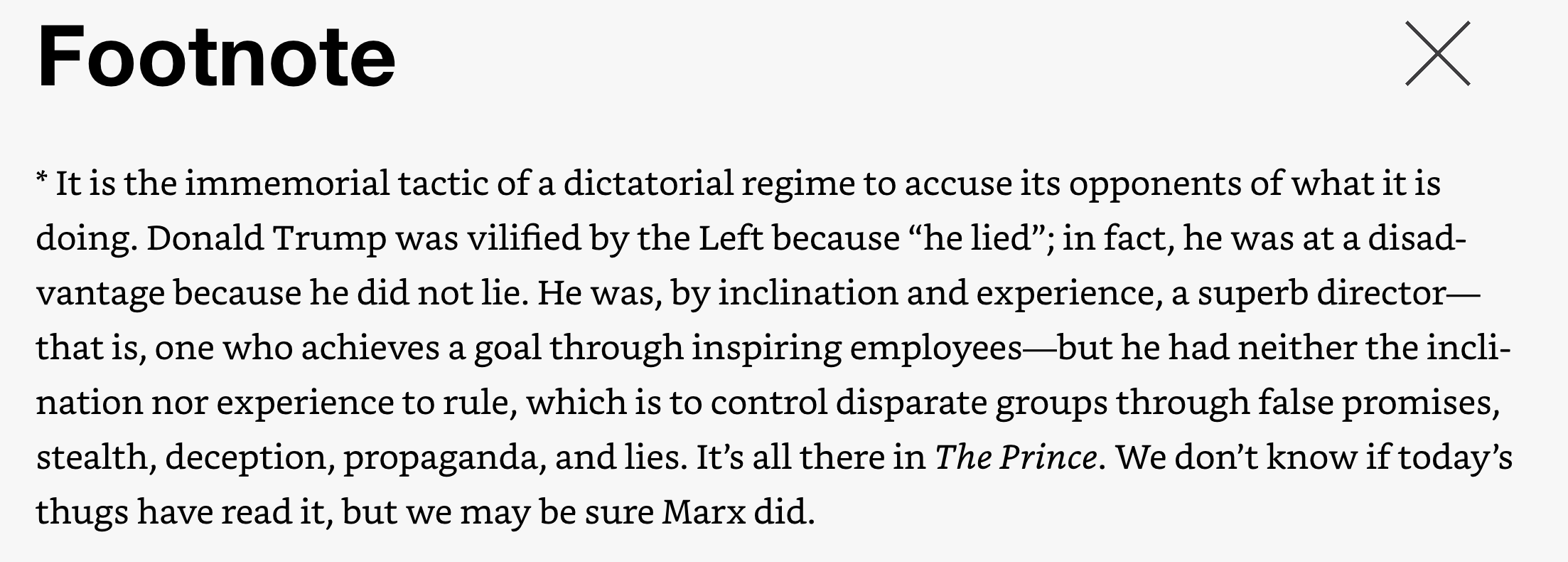
"Part of the Left’s outrage at Trump was his refusal to speak in hieratic language.* He’s spent his life buying and selling politicians, negotiating with construction unions, bureaucrats, and The Boys."

"He speaks American, and those of us who also love the language are awed and delighted to hear it from an elected official."

Writes David Mamet, in the essay "Attention Must Be Paid," collected in "Recessional: The Death of Free Speech and the Cost of a Free Lunch." 

Here's the footnote, which is the main reason I'm blogging this:


Those people who got so mad at Trump for lying — in Mamet's view, what really made them mad was that he did not lie. Consider that. It's the language he eschewed — the "hieratic language" — that's full of lies.

१४ एप्रिल, २०२२

"Margaret Sanger believed in euthanasia and sterilization of 'unfortunates,' the mentally challenged, and Blacks. She was the founder of Planned Parenthood, which, like all organizations..."

"... expanded its brief (originally one of control of subhumans) into control of all conception. Her insights were taken up in the 1960s when 'hygiene' classes became 'sex education,' educators holding that because perhaps the children were not taught at home, the higher orders needed to take charge. And now we have kindergartners trained in a bizarre catechism of sexual identity politics. How could a school be a complete community? The church or synagogue was not, neither was the shop or business. Each was understood to be a part of a community, a community that would thrive as each of its components contributed its own unique efforts. A school could be a complete community only if all other aspects of the community were destroyed. The Hitler Youth could be a complete community. It was a gang. The gang exists to supplant both the family and the marketplace, as we now see with education, having taken upon itself schooling not only in sexual practices but in political (and so economic) direction...."

Writes David Mamet in "Recessional: The Death of Free Speech and the Cost of a Free Lunch."

"If there’s no community control of the schools, what we have is kids being not only indoctrinated but groomed in a very real sense by people who are, whether they know it or not, sexual predators."

Said David Mamet, quoted in "David Mamet slammed over claim that many male teachers are ‘inclined’ to be pedophiles" (NY Post).

“Are they abusing the kids physically? No, I don’t think so. But they’re abusing them mentally and using sex to do so,” he added. “This has always been the problem with education – teachers are inclined, typically men because men are predators, to pedophilia,” the 74-year-old said....

“People have gone nuts and people are frightened because there’s huge changes in society, that are brought about by the people in power,” Mamet said. “The people in power, as always, are to a large extent, parasites who are feeding off of the decaying flesh."

७ एप्रिल, २०२२

David Mamet talks to Joe Rogan about why we need the Bible.


"To go back to the Enlightenment... If the human being is the measure of all things, what does that mean? Our reason. And our reason is completely flawed. All of us do things every day which are unreasonable, sinful, wrong, and absurd. Right? And the reasonable person says, wait a second, why'd I do that? What do I have to refer to in my confusion and my self-loathing? Well, the Bible was a pretty good bet.... Let's talk about human nature: You really aren't that smart. You really aren't in charge of the world. You really aren't. Although you think you are. You think that 'cause you're human. But God's in charge of the world, and there's a certain way things are, and if you'd like to get out of your wretched self-consciousness and self-delusion, you'd better get your ass into church."