I've got a homophone gap in my relationship with The New York Times.
ADDED: The trendy use of the word "gap" began in the 1950s, with anxiety over the Cold War. There was talk of the "bomber gap" and the "missile gap." This was satirized in "Doctor Strangelove" (1964):
"I think it would be extremely naive of us, Mr. President, to imagine that these new developments are going to cause any change in Soviet expansionist policy. I mean, we must be increasingly on the alert to prevent them from taking over other mineshaft space, in order to breed more prodigiously than we do, thus, knocking us out of these superior numbers when we emerge! Mr. President, we must not allow a mine shaft gap!"
We boomers remember the talk of the "generation gap" in the 1960s, but that got started with a Look magazine article in 1967 titled "The Generation Gap" — in a deliberate play on "missile gap."
That's not the L&M commercial I'm searching for. And neither is this, though it does have an amazing performance by Teri Garr:
That first video shows what it meant to "live modern" in the 1950s. The couple reminds me of my parents. The Teri Garr commercial shows the ordeal of living in the 1970s and the pathetic hope that cigarettes could bring 2 decent struggling humans together for a tiny moment.
But the one I was looking for is a 1960s commercial with a jingle singing "They said it couldn't be done." The thing that supposedly couldn't be done was to put a filter on a cigarette and have it still taste good. The ad began by showing a few things that "they" said couldn't be done that really were done. The only example I remember is showing Florida as a big swamp followed by images of glorious Florida real estate. The logic of the commercial was that if other supposedly impossible things happened, then this other one probably happened too. See how 1960s that was?
I didn't watch it live for the same reason I didn't watch "Dragnet" when it was on at 9 p.m. on Thursdays in 1954. It was past my bedtime. I was 3.
I'm 73 — 8 years younger than Biden — and I'm in the Central Time Zone. He gave that speech at age 81 at 10 p.m. at night and went on until midnight, and I see he was feisty....
I wasn't feisty. I was lying down in my sleep position — a complicated arrangement involving 4 down pillows — and planning to more or less listen, listen until I entered the world of dreams — a place not necessarily more pleasant that the House chamber (last night I woke up screaming at nonexistent crocodiles) — but a place where I sojourn for 7 hours rebuilding the strength of a body that naturally rises at 4 a.m., maybe 3.
As I say, I am 73. I am not feisty at 9 at night and certainly not at midnight. If something were important enough though — stand here in front of millions and read this teleprompter in a dramatic, masterful style — I'd do it properly. I wouldn't yell irascibly. You wouldn't have to shoot me with drugs. In fact, that would be dangerously risky. I might behave erratically. I might yell irascibly. Yell irascibly for 2 hours? What would people think? Is the press on my side? Give me the drugs then! The press is on my side! They'll say I was "feisty."
Calling an old person "feisty" is like calling an African American person "articulate"....
We know what you mean. You're revealing that you have a stereotype and you're giving this person credit for setting himself apart from it.
But I was embracing the old-person stereotype, embracing my pillows, drifting off to sleep, and not really appreciating the irascible tone of voice. But I got to sleep. I've slept through the night. I did not wake up screaming. I'm well rested and perfectly lucid — I think! — composing these remarks before setting out to commune with the sunrise.
I knew I would have the video of the full speech. What's so special about watching it live? Looking up what was on TV on Thursday at 9 in 1954 — so I could write "Dragnet" in the first sentence of this post — I happened upon this:
Despite hit filmed programs such as I Love Lucy, both William S. Paley of CBS and David Sarnoff of NBC were said to be determined to keep most programming on their networks live. Filmed programs were said to be inferior to the spontaneous nature of live television.
Take away the magic of live television, and what is the State of the Union address? We are perfectly free to watch the entire thing on YouTube the next day. Or never. Or in sliced out snippets — a highlight reel or a collection of verbal slips or biggest applause lines. Or we can just read about it. Did anything happen? Did some grieving mother hear her daughter's name said aloud? Was the name precisely correctly pronounced? Did the President hold up a button? Did he recharge his campaign?
Was he feisty?
***
"Feisty," the OED tells us, is based on the familiar word "fist." It's a punch-in-the-nose concept. Fisty. Definition: "Aggressive, excitable, touchy." We're told it's American slang, originally dialect, and the OED has the quotes to prove it:
1913 Feisty means when a feller's allers wigglin' about, wantin' ever'body to see him, like a kid when the preacher comes.
H. Kephart, Our Southern Highlanders 94
1926
That-there feisty bay mare jumped straight upwards and broke the tongue outen the plow.
E. M. Roberts, Time of Man 152
1965
Luther gets a little feisty after a few drinks, and he began to argue with him.
‘D. Shannon’, Death-bringers (1966) xiii. 162
1968
He couldn't shake her loose—she hung on to his arm, feisty as a terrier.
J. Potts, Trash Stealer xiii. 148
***
Post-sunrise opinion: The morning after, it is possible to see that the SOTU was a campaign speech. Every morning, there was a campaign speech yesterday.
In the comments: I'm getting a lot of pushback on the etymology of "feisty." It's not the fist that is the hand in an aggressive clench? It's a dog, you say? Well, let's go back to the OED. I see I made an assumption. What I was seeing at the OED entry "feisty" was:
I had not clicked on the boldface "fist." But if I had, I would not have gone to the entry for the kind of "fist" that is the clenched hand. I'd have gone to a separate entry, with 3 things together: a fart, a puffball fungus, and a dog:
1. A breaking wind, a foul smell, stink. Obsolete....
2. The fungus usually known as puff-ball.... Obsolete....
3. U.S. dialect. A small dog....
The etymology pointed us to #3, so — no matter how much we might enjoy thinking "feisty" means farty — we must accept that the comparison is to a small dog. Yappy, hopping around, over-excited. Still farty though. You see the connection. It's always the dog.
"... and whose top-selling 1955 single, 'The Ballad of Davy Crockett,' remains seared into the memories of the baby boom generation, died on Jan. 12 at his home in Studio City, Calif. He was 98" (NYT).
He went off to Congress an' served a spell/Fixin' up the Governments an' laws as well/Took over Washington so we heered tell/An' patched up the crack in the Liberty Bell....
"Folk," meaning people in general, goes back to Old English.
The Oxford English Dictionary traces it back as far as 999: "Þa elkede man fram dæge to dæge, & swencte þæt earme folc þe on ðam scipon lagon." Chaucer used it, in Middle English, c1405, that's surprisingly readable: "Vp on thise steedes, grete and whyte Ther seten folk."
And here's Alexander Hamilton, with American terseness: "There were Folks killed in 1723." That made me think of Ilhan Omar's "Some people did something."
IN THE COMMENTS: James K said:
Incidentally, the Alexander Hamilton who said "There were Folks killed in 1723" is not the Alexander Hamilton who co-wrote the Federalist Papers. It was some other guy with the same name.
And I see at the link that the other Alexander Hamilton was not an American, but a Scot. So that must be Scottish terseness. And I am retrospectively less reminded of Ilhan Omar.
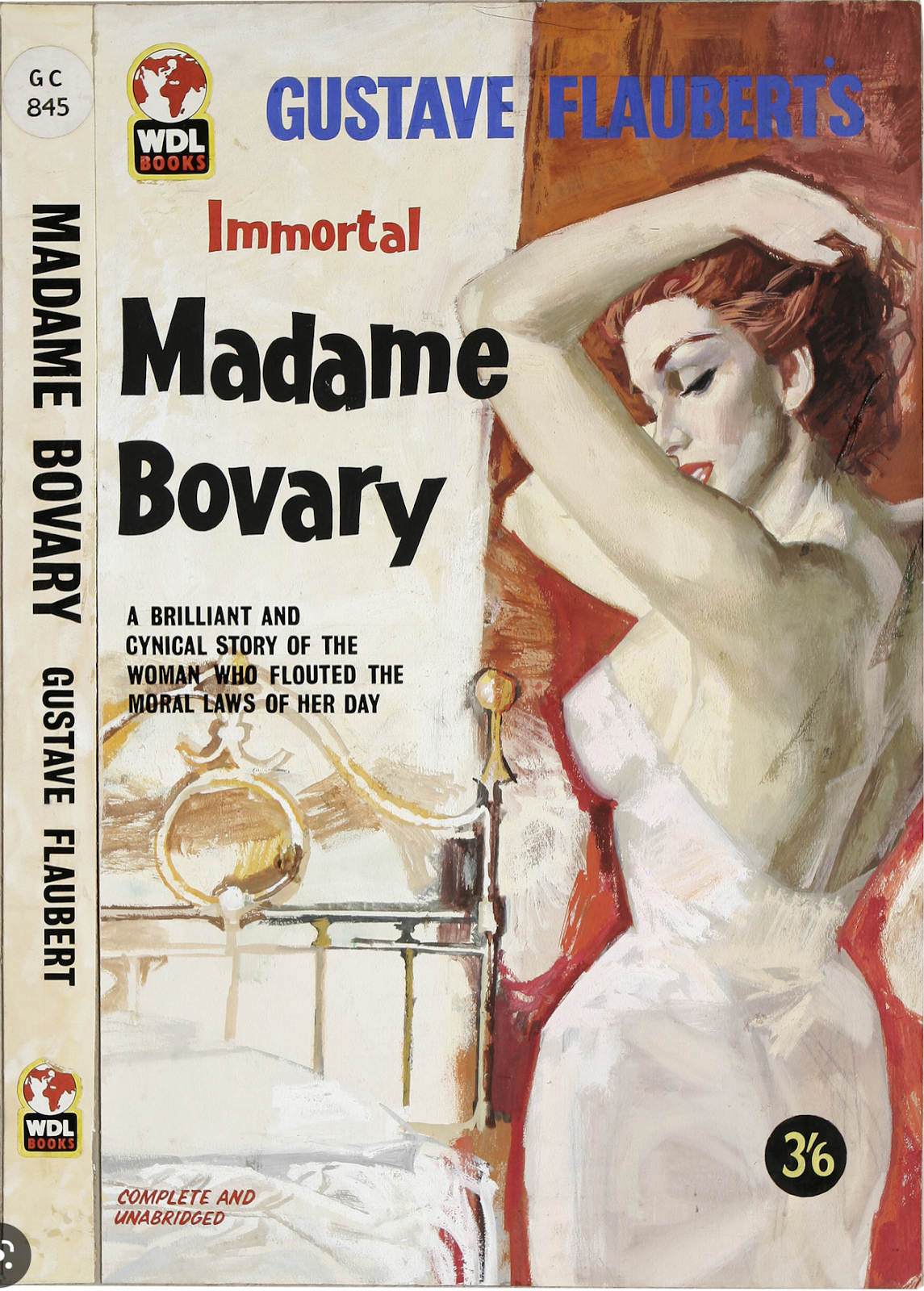
"... histories of rock and roll treat what accompanied it on the airwaves of the fifties as if the music were all 'Sing Along with Mitch' and 'How Much Is That Doggie in the Window?,' when it was also Sinatra’s concept albums, Sarah Vaughan’s collaborations with George Treadwell, and Dave Brubeck’s million-selling recording of a jazz instrumental in five-four time. And so we remember paperback books, pre-Push Pin, as either clinically bare, as with Modern Library editions, or outlandishly lurid, as with an edition of 'Madame Bovary' featuring an Ava Gardner-style femme fatale, complete with slipping negligee....There was, in truth, much ambitious 'art' illustration in those years, including Ben Shahn’s covers for S. J. Perelman and Kauffer’s cover for Ralph Ellison’s 'Invisible Man.'"
"... drawn across the top of the lid which flicks up at the corner—left the confines of a makeup trend and became ubiquitous, boomeranging from runways in Paris to red carpets in Venice and across the cultural landscape... on television and in film, trending on TikTok and Instagram.... Usually, a cat eye feels nostalgic, even a bit cliché, evoking... Edie Sedgwick, or... Sophia Loren.... In the past year, though, the style evolved into something much more dynamic and confrontational. Suddenly, there were spiky cat eyes, reverse cat eyes, double-winged cat eyes, bejewelled cat eyes, smoky cat eyes, and more—the bolder the line, the better... Why this year? Our body is a battleground, as Barbara Kruger famously warned us, thirty-three years ago. The cat eye might be an attempt, however superficial, to draw a line...."
We're told the 2022 "cat eyes" — the "much more dynamic and confrontational" kind — are "Less Jean Patchett on the cover of Vogue in 1950, more Dua Lipa in bustier minidress, fishnets, and rhinestones." There a lot of photos at the link, but not of that particular contrast. So, here, I've dug out the 2 images:
Try to understand the difference. To me, the 1950 woman seems mysterious, sophisticated, and haughty, and the 2022 woman looks looks weary and about to barf.
"I could easily fill an entire day reading library books, creating new outfits for my Barbie out of candy wrappers, or practicing crochet chains with the giant ball of yarn my grandma gave me. Inside was full of wonder, mystery, and the life of the mind. Outside was a hellscape of insects, rusty nails, and scraped knees.... Wildness can exist indoors, but it’s not as fun.... Indoor creativity pushes the boundaries of parental patience far quicker than outdoor wildness.
In the past year, as we received the indoor-kid dream directive to stay inside, I’ve never felt lonelier, less focused, or more anxious.... I’ve started to look back on those childhood summers with more fondness, making promises to my future self that I would recapture those fleeting moments of freedom whenever possible.... I’ve watched enough true-crime documentaries to want to keep my goddaughter heavily chaperoned until she turns 50, but after the year we’ve all had, I hope there’s some room for kids to take a cue from the 1980s and explore this summer."
4) The only workout item mentioned multiple times was the weighted Hula-Hoop.
A respondent named Aida bought this Hula-Hoop after seeing it on TikTok. “I like it because it’s not an intense workout and instead it’s a more relaxed one you do for a long period of time,” she says. “I watch TV while I do it sometimes.” Just don’t expect to magically get a waist like the girl in the video, Aida says: “Definitely not the realistic outcome of hula-hooping for, like, 30 mins a day.” Plus, she added, TikToks like that one “are quite triggering,” and the platform is “very toxic when it comes to body positivity.”
The hula hoop is a workout item?! I was a kid in the late 1950s, when the hula hoop became a big fad in the United States. I had a hula hoop, and I was pretty good at it.* It was all for fun — fun and some thinking about Hawaii, which was about to come in as a state (and my young head envisioned "coming into the United States" as the islands floating steadily toward California and about to connect).
No one talked about "working out" back then, and certainly no one — no one anywhere around me — regarded the hula hoop as an exercise device. It was play and a display of skill that was amusing to watch, because it was like doing the hula, which was not treated with politically correct cultural respect in those days, but seen as an entertaining dance, like the twist, that entailed hip wiggling with accompanying arm movements.
And, of course, no one talked about "triggering" and being "toxic" or "body positivity" back then. Here's this toy that was perfectly fun for young people in the days when Baby Boomers were kids, and now it's part of a grim agglomeration of everything but fun, where you have to work on your body, worry about it, and also worry about worrying about it. Did you watch the linked TikTok video? It's all about tape-measuring your waist over and over and earnestly attempting to reduce the number by hula hooping.
I know I'm old, and I'm even giving this post my tag "these kids today," so I'm aware that I'm speaking like a stereotypical old person, but what are we doing to our culture? The NY Magazine column purports to represent coolness, but it's only finding out what teenagers are buying and assuming that things going on with teenagers are cool. I wish they were!
__________________________
* If you told me Wikipedia's photograph — by George Garrigues, at the top of its article "Hula hoop" — is in fact a photograph of me, I could not with 100% certainty say that it is not:
"[In 1957, one theorist said Pop Art should be] popular, transient, expendable, gimmicky, glamorous, and—he used the term explicitly—big business. Such a frank alliance between avant-garde art and capitalism was made possible by the cold war. The rivalry with communism gave consumerism an appearance of depth. It was not, as elitist critics had long maintained, shallow and meretricious. Consumerism stood for what Harry Truman called, in the 1947 speech that inaugurated the cold war, a 'way of life.' Communism imposed everything from above. But capitalism—in its own self-image—created infinite choice. Its claim (seldom borne out in reality) was that it allowed the consumer to make all the decisions. Coke or Pepsi, Gillette or Wilkinson Sword, Max Factor or Revlon—it’s entirely up to you... It is not the artist but the viewer, listener, reader, or audience member who creates the meaning of the work. The aim of aesthetic creation is to make the producer disappear and leave only the object and the consumer.... At the heart of the self-image of the West in the cold war was a powerful but often amorphous idea: freedom....What, in any case, was freedom, and to whom did it belong? The desire for the art object to be free came easily enough to artists who were male and white...."
I kept the book for my own library after my parents were gone, and I knew exactly where to find it in my disorganized shelves when the author's name came up in conversation here at Meadhouse. The conversation began with a report of something funny that had happened outside in the snow, and a confession of mine about being too concerned about embarrassment when I was a child, which led Meade to engage in a type of transgressive humor that I associated with Louis CK, whom Meade contrasted to Red Skelton, a sweet, gentle comedian we both remember loving back in 1950s TV.
I guessed — for no reason other than his on-screen niceness — that Red Skelton might have been a terrible person in real life. I went looking for dirt on his Wikipedia page. I didn't read every word, and I didn't find any dirt, but I got interested in the subject, so timely today, of censorship:
On April 22, 1947, Skelton was censored by NBC two minutes into his radio show. When he and his announcer Rod O'Connor began talking about Fred Allen being censored the previous week, they were silenced for 15 seconds; comedian Bob Hope was given the same treatment once he began referring to the censoring of Allen.
[FOOTNOTE] Fred Allen was censored when he referred to an imaginary NBC vice-president who was "in charge of program ends". He went on to explain to his audience that this vice-president saved these hours, minutes and seconds that radio programs ran over their allotted time until he had two weeks' worth of them and then used the time for a two-week vacation.
And then I was reading the Wikipedia article on Fred Allen, whose book I played with when I was a child and have kept all these years but never read:
"Mr. Bernstein was considered untouchable both in Hollywood and in the fledgling television industry in New York once his name appeared in 'Red Channels,' an anti-Communist tract published in 1950 by the right-wing journal Counterattack. 'I was listed right after Lenny Bernstein,' Mr. Bernstein recalled. 'There were about eight listings for me, and they were all true.' He had indeed written for the leftist New Masses, been a member of the Communist Party and supported Soviet relief, the Loyalists in the Spanish Civil War and civil rights."
Presented for your contemplation, in a tribute to Ken Osmond ("Eddie"):
Osmond died yesterday. Here's the NYT obituary. Everyone easily took the prompt to loathe Eddie Haskell, who was the trickster and outsider to the conventional family, the Cleavers, back when TV was teaching us Baby Boomers the timeless values of honesty and domesticated sexuality. Think I'm exaggerating? Here's Mrs. Cleaver smacking down young Eddie's sexuality:
20 years later, as we Baby Boomer were rebellious young adults, TV served up the trickster-outsider we got the message to love — Fonzie. Many of us had outgrown TV sitcom messages however, and Fonzie seemed stupidly squishily lovable, but maybe if you're a few years younger than me, Fonzie worked on you and is part of the foundation of your psyche.
But I look back now and see how TV treated Eddie, and I think — they set Eddie up. We were the bullies, hating Eddie. What did Eddie want? How did he suffer? What made Eddie Eddie? I'd like to see a movie like "Joker," explaining the origin of Eddie. I think he had intelligence and desire and he was hemmed in by the stifling culture that "Beaver" celebrated for the humble people of America, who wanted to feel comfortable and rested in the evenings, as we did our TV.
I feel for Eddie, now, as I see that Ken Osmond has died. I'm in the mood to suggest: What if you had to argue that Eddie was the real hero of "Leave It to Beaver"? But of course, Eddie was hilariously awful, and we remember this secondary sitcom character 6 decades later — we remember him because we loathed him. That guy meant a lot to us! Our hate was specific and important enough that we took it to heart and remembered it all our life.
"... Will you serve a lunch, in the garden, of prosciutto and melon and a wonderful green salad ... or sit in the St. Regis’ pale-pink roof and eat truite bleue?'... It is the 'Make Up Your Mind' issue: Vogue’s editresses are gently pressing the reader, in the vise of these velvet alternatives, to choose the looks that will 'add up' to her look, the thing that is hers alone. 'Will you make the point of your room a witty screen of drawings cadged from your artist friends ... or spend your all on a magnificent carpet of flowers that decorates and almost furnishes the room itself?' Twenty years ago, when Vogue was on the sewing-room table of nearly every respectable upper-middle-class American house, these sapphic overtures to the subscriber, this flattery, these shared securities of prosciutto and wonderful and witty had no place in fashion’s realm. Vogue, in those days before Mademoiselle and Glamour and Charm and Seventeen, was an almost forbidding monitor enforcing the discipline of Paris."
"Twenty years ago" was 88 years ago, because I'm reading a 1950 essay by Mary McCarthy "Up the Ladder from Charm to Vogue," found in the collection "On the Contrary: Articles of Belief." I just put that in my Kindle because I needed to search for something I knew was there, because the Oxford English Dictionary said it was there, even though Google books said it was not there.
I love the use of "sapphic" to describe the voice of Vogue seducing readers to the pleasures of long narrow velvet ribbon and prosciutto. But it's something else in that essay that I needed, something that relates to the third post of the day, "It's Orwellian the way it's always the other side that looks Orwellian."That Mary McCarthy essay contains the first appearance of the word "Orwellian." I mean, I am fascinated by the whole subject. Click on my "women's magazines" tag and you'll see. But I really wanted to see the context of this first use of "Orwellian" — the squib in the OED being merely "A leap into the Orwellian future." Let's read:
The girl "has no interest in dating, driving, working for pay or drinking alcohol - and the rising costs of college keep her up at night," and the mother says: "On the one hand, I know she’s safe, she’s not out getting pregnant or smoking pot or drinking or doing all kinds of risky stuff that I can imagine would be age appropriate... [But i]s that stuff necessary for human development, do you have to be risk-taking as a teenager in order to succeed as an adult?"
Teens not getting into trouble. That's the news. That's the man bites dog. Teenagers, they're supposed to be trouble.
This makes me want to quote a passage from one of my favorite books "The Life and Times of the Thunderbolt Kid: A Memoir" by Bill Bryson. Bryson — born, like me, in 1951 — is talking about the 1950s, when fear of teenagers raged:
Teenagers smoked and talked back and petted in the backs of cars. They used disrespectful terms to their elders like “pops” and “daddy-o.” They smirked. They drove in endless circuits around any convenient business district. They spent up to fourteen hours a day combing their hair. They listened to rock ’n’ roll, a type of charged music clearly designed to get youngsters in the mood to fornicate and smoke hemp. “We know that many platter-spinners are hop-heads,” wrote the authors of the popular book USA Confidential, showing a proud grasp of street patois. “Many others are Reds, left-wingers or hecklers of social convention.”
Movies like The Wild One, Rebel Without a Cause, Blackboard Jungle, High School Confidential!, Teen-Age Crime Wave, Reform School Girl, and (if I may be allowed a personal favorite) Teenagers from Outer Space made it seem that the youth of the nation was everywhere on some kind of dark, disturbed rampage. The Saturday Evening Post called juvenile crime “the Shame of America.” Time and Newsweek both ran cover stories on the country’s new young hoodlums. Under Estes Kefauver the Senate Subcommittee on Juvenile Delinquency launched a series of emotive hearings on the rise of street gangs and associated misbehavior.
Anyway, I love the mom in the new WaPo story, worrying that her daughter isn't out getting into teenager trouble because — who knows? — even that might have something to do with Success as an Adult.
Said Meade, upon hearing Letterman's "David Letterman's Top Ten Guys Indiana Governor Mike Pence Looks Like" routine, which begins: "This is not the Indiana I remember as a kid. I lived there for 27 years, and folks were folks, and that’s all there was to it. We all breathed the same air, we were all carbon-based life forms. We didn’t care."
Meade was born in Indiana in 1954 and lived there until 1971. "I don't remember anyone, ever, saying it's okay to be gay or that you should treat gay people the same as anyone else. The only thing I ever heard was disparaging or it was joked about and behind the joking was pretty thinly veiled fear. There were no 'out' gays." Meade called Letterman "delusional" and repeats something I said the other day: "Stop otherizing Indiana."
I'm going to defend Letterman a bit, even though I'm sure Meade is right about Hoosiers and homosexuality in the 1950s. One thing is, Letterman makes no effort to understand what RFRA actually says and how it is likely to work in practice: "Honestly, I don't know what [Mike Pence] is talking about." He's operating at a higher level of abstraction, where Hoosiers are stereotypically friendly and nice to everybody. That's what he remembers, and that is the Hoosier brand. Ironically, Mike Pence — in his disastrous turn on ABC's "This Week" — relied on the same branding:
Hoosier -- come on. Hoosiers don't believe in discrimination. I mean the way I was raised, in a small town in Southern Indiana, is you're -- you're kind and caring and respectful to everyone. Anybody that's been in Indiana for five minutes knows that Hoosier hospitality is not a slogan, it's a reality. People tell me when I travel around the country, gosh, I went -- I went to your state and people are so nice....
Yeah, you're the nice people... unlike those people in other states. Well, I just have 2 things to say about that: 1. You're otherizing the people of the other states who have to be less nice for it to be noticeable that your people are so nice, 2. Niceness is a superficial quality, and it's a quality that makes it hard to tell whether the seemingly nice person thinks ill of you or not. Those stereotypical Hoosiers might hate your kind. How would you know?
By the way, has David Letterman ever said disparaging things about gay people on his show? All the jokes in there over the years, going back to the "Tonight" show appearances? I think it would be extraordinary if he didn't. Mocking gay people was, of course, absolutely the norm for Johnny Carson, who expected and got endless laughs over men who are — his words — "light in [their] loafers."
AND: The "Guys Indiana Governor Mike Pence Looks Like" routine isn't consistent with an ethic of friendly kindness and equality. You put up a picture of a man and then throw 10 shots at him for the way he looks. Letterman made a point of not even attempting to understand what Pence was talking about. Let's just make fun of how he looks. Letterman was teaching us that it's just fine to have a gut reaction to a person, to reject the stage in human relations where you see things from the other person's point of view, and to mock him for superficial reasons that have no substance at all.
IN THE COMMENTS: Laslo Spatula came up with 2 answers to my question "By the way, has David Letterman ever said disparaging things about gay people on his show?"
1. In 2011, Letterman joked about Rosie O'Donnell: "The woman she is marrying, her fiancée, was driving... and her car broke down. And guess what happened? Rosie pulls up right behind her in her tow truck." Rosie wondered what motivated him and added: "I don't remember making fun of you when you had sex with all your interns, Dave. I didn't do that. I didn't make fun of your rampant, throbbing heterosexuality, did I Dave?"
2. In 2008, Letterman had a Top 10 list of "things Jim Carrey will always say 'yes' to" including "A Fan Asking for a Hug, Unless He's a Dude" and then a shot Carrey taking a bath with Larry King and Letterman saying "Those guys are so gay!"
That's a Washington Post headline for a piece written by Max Ehrenfreund — "a blogger on the Financial desk [who] writes for Know More and Wonkblog." Didn't you assume they'd have a woman writing such a thing? This promise-of-the-Crock-Pot stuff is under the heading "Wonkblog," which I think of as Ezra Klein, but Ezra Klein relocated to that place that I've forgotten the name of... oh, yes, Vox. I wonder what's... cooking at Vox?
I have no idea who ever took the Crock-Pot seriously as a "symbol of women’s equality," and the idea that it made a promise — like a political candidate — is truly silly, though I feel as though I've seen political cartoons depicting a candidate for office as an inanimate object, a toaster perhaps. In Bill Bryson's wonderful memoir about growing up in the 1950s, he talks about the simple, post-war enthusiasm for household appliances that took on a certain anthropomorphism:
Suddenly [Americans] were able to have things they had never dreamed of having, and they couldn’t believe their luck. There was, too, a wonderful simplicity of desire. It was the last time that people would be thrilled to own a toaster or waffle iron. If you bought a major appliance, you invited the neighbors around to have a look at it. When I was about four my parents bought an Amana Stor-Mor refrigerator and for at least six months it was like an honored guest in our kitchen. I’m sure they’d have drawn it up to the table at dinner if it hadn’t been so heavy.
But what did the refrigerator say? Did it make any promises, like the upstart appliance from the 1970s, which aped the spirit of the time and boasted of its activism in the Women's Liberation Movement?
The Wonkblog piece is kind of all over the place, not focused on the "unfulfilled promise" and "unlikely symbol[ism]" in the silly headline. There's quite a bit about how much men like to use slow-cookers. But the most interesting thing about the Crock-Pot is its origin in Judaism:
Nachumsohn, who went by the surname "Naxon," invented the slow cooker to be able to cook cholent, a traditional stew eaten by Jews in eastern Europe on the Sabbath. Since they were forbidden from cooking, the Jews would bring pots of stew to a nearby bakery the day before. They would cook slowly in the residual heat from the ovens, his daughter Lenore told NPR last year.
So a Crock-Pot was immensely useful for people with a religious need not to work during the part of the day when they wanted a nice, hot meal. With no such need myself, I never believed fussing with an appliance and dinner foods was a good use of time in the morning. You can cook quick dinners in the evening right before you want to eat — all that pasta and stir frying. Come on. That was easier than paying attention to what you were going to eat long before you were going to eat it. I like stew and pot roast too, but that was always easy to make the night before and then reheat.
I never bought a slow cooker in my life. I always thought of it as another junky appliance to clutter up the counter. The 1970s were the heyday of countertop appliances — a device that did nothing but heat hot dogs, the ludicrous "Salad Shooter," the (cannibalistic?) "FryDaddy." Who believed these things would fulfill any promises of liberation?
Does The Washington Post think we women of the 1970s imagined that smoking a menthol cigarette would change the weather?
"Harum Scarum" was filmed on the set Cecil B. DeMille used for the 1927 movie "The King of Kings" and uses some of the story from the 1921 Rudolph Valentino movie "The Sheik."
"Harum Scarum" was the only Elvis movie I ever saw in the theater. This was 1965, a year after "Hard Day's Night," where money can't buy you love.
We were free, in the modern world, so what the hell was Elvis doing? He was so ridiculous. We went to the movie to laugh at him. We were like George Harrison, turning down the sound and saying rude things. We'd seen an ad in the teen magazines for "Harum Scarum" and had taken to saying "Harum Scarum" just to make each other laugh.
It seemed so funny that we thought it would be fun to watch the movie as a joke. But it was dreadfully boring. Anyway, the ad is still hilarious — the phallic symbols, the ethnic nonsense, the absurd image of 1950s Elvis blithely unaware — he thinks he's "swingin'" — as Elvis in a Sheik costume is about to poke him in the ass with a knife. As for Mary Ann, she's down there somewhere amongst the little people at his feet. If it's supposed to be a harem, they can't give one woman prominence. So stick her down there between 1950s Elvis's legs, and — because you can't have too many Elvises — put another Elvis down there. "It's Elvis" say the letters across the top, bigger than the movie title. And what was the point of misspelling "harem"? It's not as if matching "scarum" was the idea, "scarum" being a misspelling of "scare 'em." And "You won't believe it when you see it!" Why the hell not? What could possibly be hard to believe about a dumb Elvis movie. He's in a costume? There are a lot of "harem" girls for him? After seeing the damned thing, we said: "You won't believe it when you see it? You won't believe how boring it is."
I am a participant in the Amazon Services LLC Associates Program, an affiliate advertising program designed to provide a means for me to earn fees by linking to Amazon.com and affiliated sites.
Encourage Althouse by making a donation:
Make a 1-time donation or set up a monthly donation of any amount you choose:






 Posts
Posts


