Back in the 1970s, before I went to law school, I worked in a job that required me to read a lot of magazines, and I read all the mainstream women's magazines every month, so I know what Glamour was back then: The hippie era is over. The no-makeup look requires makeup. Here's how to transform your office outfit into a nighttime getup that will wow onlookers. Oh, to have had a blog! But back then, you just made jokes with co-workers. I considered Glamour horrendously outdated, but who knew it would take 50 more years to die? And it's not even completely dead yet. It's still squeezing dollars out of Amazon Affiliates links, like a one-person self-publishing writing operation in a remote outpost in the Midwest.
women's magazines লেবেলটি সহ পোস্টগুলি দেখানো হচ্ছে৷ সকল পোস্ট দেখান
women's magazines লেবেলটি সহ পোস্টগুলি দেখানো হচ্ছে৷ সকল পোস্ট দেখান
২ জুন, ২০২৬
"Condé Nast started the magazine as Glamour of Hollywood in 1939... but shortened its name when World War II reshaped the lives and ambitions of American women."
"It instead focused on 'the girl with a job,' which would guide coverage for decades. Its glossy pages contained fashion, beauty and sex tips but also coverage of abortion, sexual violence and women’s growing financial independence.... The magazine’s Women of the Year awards, introduced in 1990, became a cultural touchstone.... Those it recognized included Anita Hill... 'I don’t know very many magazines, neither Time nor Newsweek, that gave me that much interest,' Ms. Hill, now a professor at Brandeis University, said in an interview, adding that it had given her hope. It took a place like Glamour, she said, 'to understand what the moment could mean to women.' But like its peers, the magazine got pinched by the digital age...."


২০ এপ্রিল, ২০২৬
"There’s always two poles in any movement. There’s this pull toward being post-human, shinier, newer, cloned, etc., the sense that people have elevated the lacquered surface of the machine over the body."
"[And there's this pull toward] I’m real. I think we’re like old stone houses. We have the value of antiquity. If you haven’t tweaked yourself, it’s like you have a working fireplace that’s been going since 1680. We’re authentic.... For all women, there’s that line between choosing to be malleable and pleasing and to conform with the collective norms or refusing it.... No, I’m not playing that game."
Said the 77-year-old French Vogue editor Joan Juliet Buck, quoted in "Why Fashion Suddenly Loves Older Women/Representation of women of a certain age has never been higher. What’s going on?" (NYT).
The article is by Vanessa Friedman, who continues: "Authenticity is, of course, one of the current buzzwords not just in fashion, but in culture generally. It’s a reflection of the fear that individual style has been lost to the algorithm.... It’s not just influencers and celebrities who have become the vehicles for this version of ageless sameness. It’s political figures, too.... As many MAGA women have embraced the plumped and smoothed 'Mar-a-Lago face,' it has become an expression of a larger social swing toward exaggerated norms and old-fashioned patriarchal gender roles rather than simply a cosmetic fad."
১৭ মার্চ, ২০২৬
"My client’s magazine is a parody that features humorous pictures of dogs, while Vogue is a fashion magazine that features serious photographs of human models."
"I don’t think anyone would have difficulty recognizing the difference."
Said the lawyer for Dogue, quoted in "Vogue Says There’s Only Room for One Top Dogue/The creator of Dogue, a small canine fashion magazine (circulation: under 100), is being sued by Condé Nast, the publisher of Vogue, for trademark infringement" (NYT).
And here's a quote from Olga Portnaya, the creator and editor in chief of Dogue: "Art and culture have always evolved through reinterpretation and dialogue. For me, this is a larger fight: I’m not just fighting for my own work and our community, but for other independent creators."
Well, there is Teen Vogue, so you might think there'd also be a Dog Vogue — some people buy expensive clothes and accessories for their dogs — if Vogue had a dog magazine, it might very well be called Dogue, so I do think there's some potential for confusion.
৫ জুন, ২০২৪
"The most cynical interpretation sort of feels like you chose two of your buddies to come in and help run the Post, and we now have four white men running three newsrooms."
Said one reporter, to Washington Post publisher Will Lewis, at a meeting on Monday about the "the abrupt exit of Sally Buzbee, who had led the paper since May 2021."
Quoted in "'I Can’t Sugarcoat It Anymore': Will Lewis Bluntly Defends Washington Post Shake-Up/Addressing a rattled newsroom in the wake of Sally Buzbee’s resignation, the Post’s CEO and publisher stressed the need for taking 'decisive, urgent action to set us on a different path,'" by Charlotte Klein in Vanity Fair.
Later in the meeting, another reporter asked Lewis whether “any women or people of color were interviewed and seriously considered for either of these positions,” a question that prompted applause. Lewis said there will be “significant opportunities” within the new organizational structure. Asked by another staffer about which people he met with, Lewis said, “It was an iterative, messy process, which I don’t want to go into the details of.”...
At one point Lewis was asked whether he was intentionally bringing in people who come from a different culture than the Post. “We are losing large amounts of money. Your audience has halved in recent years. People are not reading your stuff. I can’t sugarcoat it anymore,” Lewis said.
১৮ জানুয়ারি, ২০২৪
"[E. Jean] Carroll was also in the courtroom on Tuesday. She is eighty years old. She made her name as a sassy, knowing, charming advice columnist..."
"... for Elle in the heyday of women’s magazines. All Tuesday morning, she calmly sat a few feet from the man who’d attacked her, who has promised to take revenge on his enemies if he is reëlected President this November. [Her lawyer] said that Carroll now sleeps with a loaded gun next to her bed."
From "The Donald Trump Doom Loop/Sitting in a courtroom, feet away from the woman he sexually assaulted, the ex-President keeps trying to outrun the consequences of his own bad acts" (The New Yorker).
***
Yesterday, someone sent me the video I'm embedding below. I can see that people on X have been sharing it and saying it shows E. Jean Carroll is "a nut job."
I disagree. Judge for yourself:
I see a woman with a cute/cutesy, quirky self-presentation who is leaning into an arty, hippie vibe.Donald Trump is not allowed to call his accuser E Jean Carroll a nut job. So we can do it for him. pic.twitter.com/X6kPqOsHdY
— Big Fish (@BigFish3000) January 17, 2024
I have no idea what really happened between her and Trump, but I do think that once the first trial ended, and she won (to some extent), he needed to accept the outcome of the legal process. It was a defamation case, brought on by his accusing her of lying. To go back to the assertion that she lied about their encounter is a new defamation, and now he needs to pay for that.
Even if you were trying anew to prove that she lied about the encounter, her literary shed, Annie Hall clothing, and painting rocks and trees blue have precious little probative value.
৪ ফেব্রুয়ারি, ২০২৩
If you can't get rid of your gas stove, use the microwave more! Use the "toaster oven, air fryer, Instant Pot... or an electric kettle or hot water heater."
I'm reading "Worried about having a gas stove? Here’s how to limit risks" in The Washington Post.
I think most people with a gas stove are saying they have it because they like it and they're just worried the government will take it away, not looking for workarounds because they can't afford to replace it voluntarily.
But maybe you'd like to shun your own stove and maximize cooking on the various electric appliances you already have. There's a section of this article that reads like the chirpy women's magazines I read in bulk in the 1970s (because it was my job).
We're told that there are "creative ways" to use these appliances. The uncreative use of the microwaves is to heat foods — that is, "zap cold leftovers." So what's creative? Apparently it's "creative" to "bake (remember mug cakes?), steam vegetables and in some situations even toast, fry or caramelize food." This is the kind of thing I found depressing reading about in the women's magazines in the 70s. The idea that you could feel clever by frying something in the microwave.
By the way, what's a "hot water heater"? Aside from the common silly redundancy that makes a smart ass want to say, Why do you need to heat water that's already hot?, what is this appliance if it's not an electric kettle? You've named the electric kettle, so what are we talking about? An immersion heater?!
Are you suggesting running the tap until it yield hot enough water from the only thing I ever call the "water heater," that thing that gives me a nice hot bath? I thought you weren't supposed to drink that.
You've got me thinking of Glenda Jackson in the 1971 movie "Sunday Bloody Sunday":
I have remembered that coffee-making — and the audience gasping in horror — for over half a century!
২২ সেপ্টেম্বর, ২০২২
"[Jia] Tolentino, a millennial essayist and New Yorker staff writer, said that she had not read Ms. Didion until her 20s, but immediately realized..."
"... that 'through the words of others, I had been reading her my entire life.' At a memorial where so many of the eulogies came from writers who have been paid a lot to complete sentences, it came as little surprise that the guests spent much time debating about who’d given the best one.
But the funniest, many people said, belonged to [Susannah] Moore, who vividly recalled some of Ms. Didion’s one-liners, among them, 'Whatever you do, you’ll regret both,' and 'evil is the absence of seriousness.'
That one arrived following a dinner Ms. Didion hosted. Among the guests, Ms. Moore said, was Bianca Jagger, who ignited scorn from Ms. Didion by proceeding to pick the magazines up off the coffee table and read them one after the other. The editor Joan Juliet Buck described a conversation she had with Ms. Didion, who had told her how to deal with a stalker: 'Move into the Carlyle.' Annabelle Dunne, Ms. Didion’s niece, reported that her aunt had advised: 'Don’t forget to have a baby. It’s easy to forget.'
[David] Remnick started his speech with his misgivings about giving it: 'How do you speak about someone who was in her time the foremost enemy of canned cliché and falsehood?' he asked, before going on to praise her 'authority of tone' and the way she led by example."
৬ সেপ্টেম্বর, ২০২২
"In the past, of course, Thiel has personally expressed some attention-grabbing thoughts about both women and health technology."
"In a 2009 essay, he famously expressed the opinion that giving women the right to vote made the country less libertarian and thus worse. And as Inc. magazine reported in 2016, Thiel reportedly expressed an interest in having young people’s blood transfused into his own body as a potential fountain of youth; a year later, people connected with Thiel Capital began making the rounds to deny that story, not very convincingly. (Disclosure: Thiel also funded a lawsuit against Gawker Media, the company where I used to work, that successfully bankrupted the company.)
That—and Thiel’s traditional interest in panopticon technology—makes Thiel Capital a curiously appropriate choice...."
১২ মে, ২০২২
"As second-wave feminism bled into a third, women seemed to rack up nothing but wins."
"First, in the ’70s, women saw a series of legal victories in addition to Roe: Title IX was passed (1972), housing discrimination was outlawed (1974), the pregnancy-descrimination ban was passed (1978).... By the ’90s, we could 'do it all'... Feminism, by this point, had traded in its quest for 'liberation of women' to fully pursue parity with men, all while attempting to remain appealing to them. In short, both professionally and privately, we were chasing victories defined on male terms. (Little defines this era so clearly as feminists confidently siding with Bill Clinton in the Monica Lewinsky affair.) Since then, the language may have changed—there were the sexual-empowerment aughts where we could have 'sex like men' (think: Sex and the City), then the career-empowerment teens (think: #Girlboss). But ultimately, each decade finds us led by a feminism that has abandoned ameliorating the struggles of our collective lives as women in lieu of chasing individual wins on playing fields drawn up by men.... The language of feminism is not working for us, not in the arena of the patriarchy or even in our own private lives.... We need to regroup and reframe our language away from 'defending' the individual and toward protecting the collective. Because yes, protecting women’s reproductive rights benefits me, but equally important is that a pro-woman reproductive policy benefits us all: men, children, our economy, and our national security."
Writes Xochitl Gonzalez in "Patriarchal Feminism Led Us to This Moment. The feminist conversation around abortion rights has gotten women nowhere. We need a new language" (The Atlantic).
Xochitl Gonzalez, a novelist, is 44. I had to look that up to get a sense of how much radical feminism she might have lived through. A lot of the linked essay is about what the mainstream women's magazines have been saying to women. Who doesn't know those things are a con? If you have any true feminist spirit, you should hypothesize that whatever the mainstream is pushing is a patriarchal scheme, especially if it's boosting women's spirits and bolstering their alliance with men.
The last sentence quoted above sounds like the very women's-magazine boosting and bolstering that she seemed to be criticizing. The sentence before that sounds like raw left-wing politics that isn't centered on women at all but simply promises incidental benefits. How is that not patriarchal?
১৬ এপ্রিল, ২০২২
"Many people wish there wouldn’t be this huge pressure on 'What’s the next big "It" plant?' It has this peak where it’s $400..."
"... and then Costa gets it, it goes out to all Walmarts and Ikeas and whatever across the country, and so now it’s $19.99 and nobody wants it anymore."
Said Katie Dubow, president of Garden Media Group, quoted in "The Fiddle Leaf Fig Is Dead/Meet the man working to put the next big 'It' plant on every windowsill in North America" (NYT).
This gets my "interior decoration" tag, because we're talking about decorating with plants, and as I explained a few years ago...
২৫ ডিসেম্বর, ২০২১
"In one of her first moves, Ms. Mirabella had the red walls of Vreeland’s office repainted in shades of beige — her favorite color."
"She jettisoned Elizabeth Taylor and Cher from the cover of Vogue in favor of models such as Lauren Hutton, Patti Hansen and Lisa Taylor, who wore little makeup and had natural, unfussy hairstyles. Hutton’s gaptoothed smile replaced the closemouthed gaze and white eyeliner of Vogue models of the 1960s. 'It was make-believe, the wilder shores of love,' Ms. Mirabella said of the magazine she inherited from Vreeland. 'I was a great fan of hers, and I followed her around like a bird dog. But when I took over, that wasn’t wanted anymore.' Ms. Mirabella occupied a front-row seat at the fashion shows in Paris and New York, but her sense of couture leaned more toward outfits that women could wear at work or at parties. She had little interest in passing trends. Rather than looking to Europe for fashion cues, she preferred the straightforward approach of American designers such as Bill Blass, Geoffrey Beene, Calvin Klein, Ralph Lauren and Donna Karan.... 'She’s a very practical woman in her point of view, and she thinks of women in their clothes and how they’re wearing them,' Beene once said of Ms. Mirabella. 'She’s been sort of a martyr for modern women.'"
From the WaPo obituary for Grace Mirabella, who edited Vogue from 1971 to 1988. She replaced Diana Vreeland, when Vreeland was abruptly ousted, and she herself was ousted, replaced by Anna Wintour.

From the WaPo obituary for Grace Mirabella, who edited Vogue from 1971 to 1988. She replaced Diana Vreeland, when Vreeland was abruptly ousted, and she herself was ousted, replaced by Anna Wintour.
It was during the Mirabella years that I read Vogue — read it because it was one of the scores of magazines that I read every month (for a job I had back then). It seemed as though fashion had come to rest in that natural, human place occupied by Lauren Hutton and Patti Hansen — the models who laughed and seemed freewheeling, not pissed off or haunted or abused and in bondage.
In retrospect, this is too plain and ordinary to last as a fashion magazine concept:
That's Patti Hansen, who absolutely exemplified the look of that time — "pretty!" She's still pretty, at the age of 65, living with her husband, Keith Richards, in Connecticut.
২৬ জানুয়ারি, ২০২১
"After years of smuggling his obsessions into reviews or radio programmes, he was finally able to publish whatever was on his mind..."
"... from racism, propaganda and freedom of speech to make-up, birdwatching and the price of clocks. The most sombre topics rubbed up against brainteasers, jokes and nuggets of trivia. Orwell had opinions about everything under the sun and they were all worth reading even if you disagreed with them, which many Tribune readers did, loudly and often."
IN THE COMMENTS: Leland said: "I think you are referring to 'As I Please'" — yes, I am — "so perhaps his column on American Fashion Magazines?" Maybe. Here's that full essay, from 1946. It mentions lipstick and nail polish, but though it's heavily opinionated, he doesn't really opine on makeup. It's more about the natural physical attributes of the models, the clothing, the style of writing, and the absence of men :
I'm reading Dorian Lynskey's "The Ministry of Truth/The Biography of George Orwell's 1984."
George Orwell wrote an essay about makeup?! I like the way his Tribune column sounds like a blog, but what I really want is to find that essay about makeup. I've looked, but so far, no success.
২১ সেপ্টেম্বর, ২০২০
Fact-checking Alan Alda.
In the 70s I wrote a piece for MS. magazine on why men should support the ERA. A law professor fact-checked it and said, “Whoever wrote this seems to know nothing about constitutional law.” So, instead, I interviewed HER. She was brilliant. And kind. She was Ruth Bader Ginsburg.
— Alan Alda (@alanalda) September 21, 2020
২৯ ডিসেম্বর, ২০১৯
"Guys, we have an unspoken social contract going here: I pretend that I don't know your beauty recommendations are coming from 22-year-old rich kids and..."
"... you help me maintain my suspension of belief by not explicitly mentioning that your beauty recommendations are coming from 22-year-old rich kids. We live in a society!"
A comment on "The Best Thing I Bought This Decade Was Bobbi Brown Lipstick" by Chloe Anello (at NY Magazine).
A comment on "The Best Thing I Bought This Decade Was Bobbi Brown Lipstick" by Chloe Anello (at NY Magazine).
২ আগস্ট, ২০১৯
"... Playboy was quietly relaunched this year — this time as a thick-stock, matte-paper, ad-free quarterly. It is edited by a millennial triumvirate..."
"... the openly gay Mr. Singh, 31; Erica Loewy, 26, the creative director; and Anna Wilson, 29, who oversees photography and multimedia.... The summer issue, out now, features an interview with Tarana Burke, the activist who founded the MeToo movement, conducted by Dream Hampton, whose documentary about R. Kelly led to multiple charges against the singer. There is a queer cartoon and a feature on gender-neutral sex toys. The fall issue will feature a photo feature by the artist Marilyn Minter celebrating female pubic hair. 'We have red hair, blond hair, black hair — it’s basically every color of the rainbow,' said Liz Suman, 35, the magazine’s arts editor. She added that elsewhere in the publication, 'I’ve been sneaking in some penises, too.'.... In the office, members of the staff use terms like 'intersectionality,' 'sex positivity,' 'privileging' and 'lived experience' to describe their editorial vision — and tout their feminist credentials. Two editors are former employees of Ms.... 'We talk a lot about what’s the Playboy gaze and how we need to diversify that,' said Rachel Webber, 37, the chief marketing officer.... 'It’s a little like being in a gender studies class,' she added."
From "Can the Millennials Save Playboy?/The Hefners are gone, and so is the magazine’s short-lived ban on nudity — as well as virtually anyone on the staff over 35" (NYT).
Playboy is just a brand name. You can completely change a product under a name. Will it work? Was there enough value in the old version of the product that it's not good business to repurpose the name? Look at this big NYT article they got out of it!
Remember Cosmopolitan magazine?
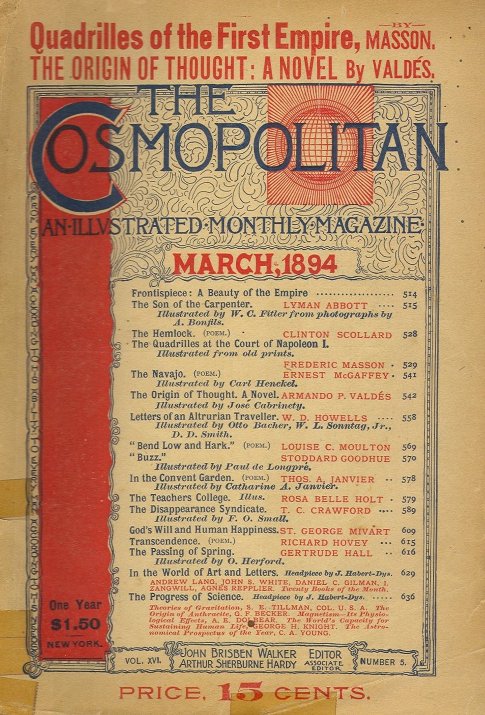
It had been around since 1886 when Helen Gurley Brown took over in 1965. Originally, it was introduced as a "first-class family magazine" with articles on fashion, interior decoration, childcare, and cooking. In 1905, William Randolph Hearst took over and changed it into a place with articles like "The Growth of Caste in America" and writers including George Bernard Shaw and Upton Sinclair, and Ida Tarbell. By the 1950s, the circulation was way down and it was considered very dull.
Helen Gurley Brown took over and completely changed it into an active promotion of sex for the single woman.
From "Can the Millennials Save Playboy?/The Hefners are gone, and so is the magazine’s short-lived ban on nudity — as well as virtually anyone on the staff over 35" (NYT).
Playboy is just a brand name. You can completely change a product under a name. Will it work? Was there enough value in the old version of the product that it's not good business to repurpose the name? Look at this big NYT article they got out of it!
Remember Cosmopolitan magazine?
It had been around since 1886 when Helen Gurley Brown took over in 1965. Originally, it was introduced as a "first-class family magazine" with articles on fashion, interior decoration, childcare, and cooking. In 1905, William Randolph Hearst took over and changed it into a place with articles like "The Growth of Caste in America" and writers including George Bernard Shaw and Upton Sinclair, and Ida Tarbell. By the 1950s, the circulation was way down and it was considered very dull.
Helen Gurley Brown took over and completely changed it into an active promotion of sex for the single woman.
In Brown's early years as editor, the magazine received heavy criticism. In 1968 at the feminist Miss America protest, protestors symbolically threw a number of feminine products into a "Freedom Trash Can." These included copies of Cosmopolitan and Playboy magazines. Cosmopolitan also ran a near-nude centerfold of actor Burt Reynolds in April 1972, causing great controversy and attracting much attention....ADDED: One nice thing about the new Playboy website is access to old Playboy interviews. I once subscribed to Playboy, the website, just because I wanted to read the Allen Ginsberg interview (from 1969). But here it is now, free: "A poet, a mystic, a homosexual, a psychedelic proselyte, a revolutionary, a bearded prophet of doom for what he considers society's 'sick' values, he is among the most famous and certainly the most controversial of living poets." There was plenty of detail about homosexuality in that interview (which I read when I was 18, in my family home, where Playboy was always openly available):
Victoria Hearst, a granddaughter of William Randolph Hearst..., has lent her support to a campaign which seeks to classify Cosmopolitan as harmful under the guidelines of "Material Harmful to Minors" laws. Hearst, the founder of an evangelical Colorado church called Praise Him Ministries, states that "the magazine promotes a lifestyle that can be dangerous to women's emotional and physical well being. It should never be sold to anyone under 18."...
Would you explain what you mean when you say there's a natural element of homosexuality in every man?
There's homosexuality in every Playboy reader. To say that in a Playboy Interview is interesting because obviously every Playboy reader expects me to say that; so I'll say it and liberate him from his fear that somebody will say it sooner or later.
৪ ডিসেম্বর, ২০১৮
"There’s no drumroll for the 'goodbye to paper,' no editor’s letter extolling the virtues of the more immediate future — we’re off the newsstand but on all your devices!"
"There are no clues that this is a milestone moment in the struggle for survival of old media, and how women relate to the sisters-in-arms-advice-over-wine voice of the magazine, one that is now moving from their mailboxes to their inboxes. It is, consequently, both an anthropologist’s treasure, a perfect example of what exactly the problem is with legacy fashion magazines in the early 21st century — stories that can’t get published until well past their relevancy date (hasn’t everyone done that Meghan Markle piece?), fashion we’ve all seen before (hello, Instagram!) — and one that is entirely disposable, despite some smart articles. But thus does print go out: not with a bang, but a fizzle."
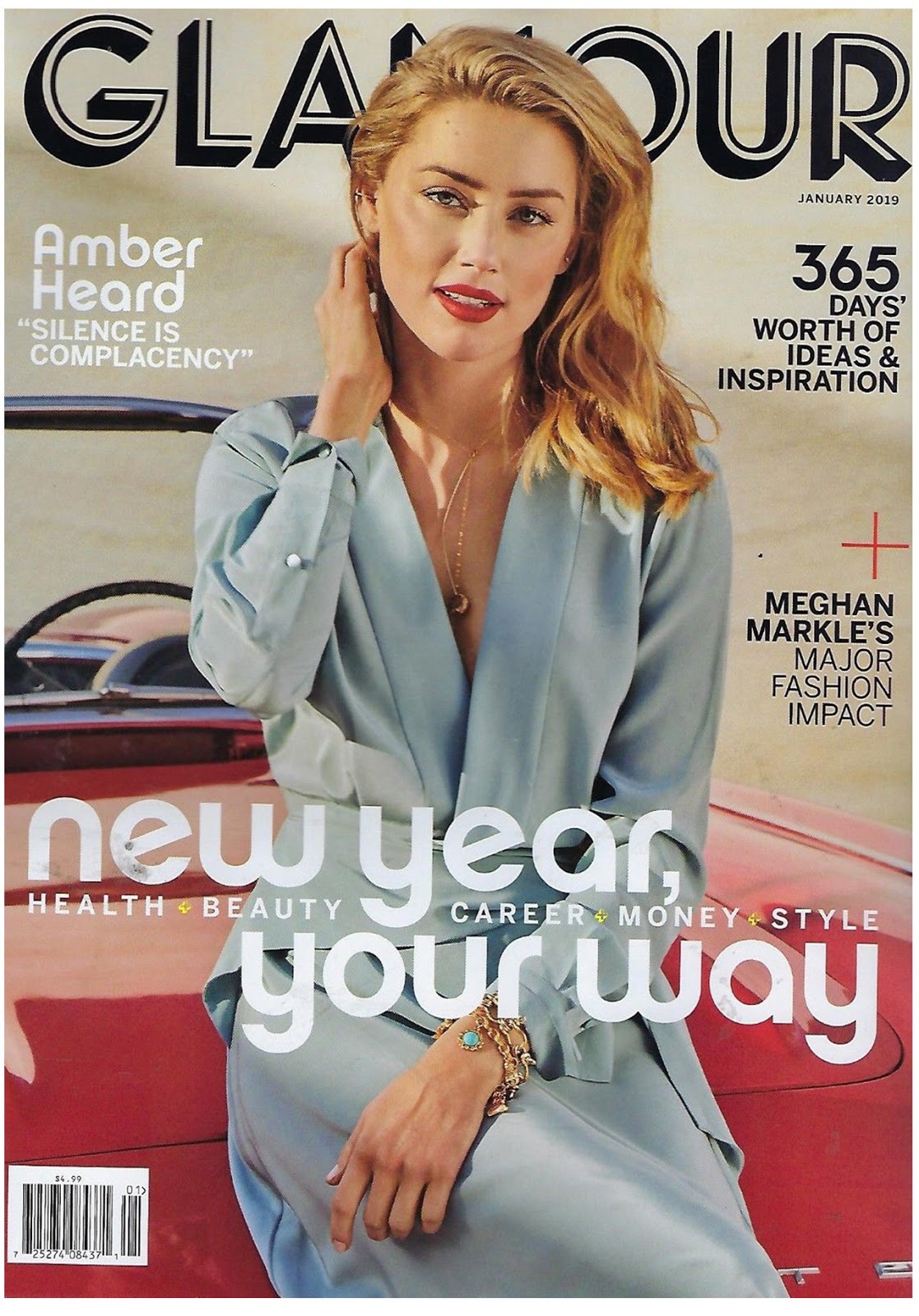
Writes Vanessa Friedman in "Saying Goodbye to Glamour/The glossy magazine is pivoting to digital. It should have gone out of print with a bigger bang" (NYT).
Here's the sad final print cover of Glamour:
I was a fan of Glamour magazine in the 1960s, when I was a teenager. I even subscribed. The fashion was Mod. Loved it. But Glamour didn't adapt to the hippie movement. It even proclaimed the hippie movement had died, and it was pretty obvious that from the magazine's point of view, it had to die, because hippies didn't buy makeup, didn't get their hair done, and wore jeans and various thrift-shop rags. It was stylish and fun not to spend any money. Looking back, with a perspective of half a century, I'm sad that women of today wear more makeup than ever, torture their hair into ludicrous "beachy waves," and spend money on glitzy, uncomfortable clothes. I said go to hell to Glamour in about 1968, and I still say go to hell.
(I also read Glamour every month for 2 years in the early 70s, when I worked in a market research firm that did a report on magazines, and we had a lot of fun mocking the drivel in that and many other magazines.)
Writes Vanessa Friedman in "Saying Goodbye to Glamour/The glossy magazine is pivoting to digital. It should have gone out of print with a bigger bang" (NYT).
Here's the sad final print cover of Glamour:
I was a fan of Glamour magazine in the 1960s, when I was a teenager. I even subscribed. The fashion was Mod. Loved it. But Glamour didn't adapt to the hippie movement. It even proclaimed the hippie movement had died, and it was pretty obvious that from the magazine's point of view, it had to die, because hippies didn't buy makeup, didn't get their hair done, and wore jeans and various thrift-shop rags. It was stylish and fun not to spend any money. Looking back, with a perspective of half a century, I'm sad that women of today wear more makeup than ever, torture their hair into ludicrous "beachy waves," and spend money on glitzy, uncomfortable clothes. I said go to hell to Glamour in about 1968, and I still say go to hell.
(I also read Glamour every month for 2 years in the early 70s, when I worked in a market research firm that did a report on magazines, and we had a lot of fun mocking the drivel in that and many other magazines.)
২ সেপ্টেম্বর, ২০১৮
"A magazine like that has never put someone like me, an actual fat body, on the cover of a magazine."
"To be on a glossy where you can actually see my body, they haven't altered how I look, makes me really, really proud. It not only meant a lot to me, but the work that I'm doing, which would therefore impact millions of bodies that look like mine.... I'm saying that I love myself and because that happens to be coming from a fat body and a bigger body like mine, people then equate it saying 'I'm promoting obesity and that I'm unhealthy.' Even if it was what I do with my body it's no-one's business."
Said Tess Holliday, quoted at BBC.
Here's the cover:
Yes, that's a Miss Piggy tattoo on the right forearm.
What to make of the top story, "Is Success an Illness"? I can't find the article on line, so you'll just have to go with the title and its context on that cover. And the subtitle: "The high-fliers 'killing it' at work." And I'd put that in the context of this NYT article, "How to Retire in Your 30s With $1 Million in the Bank/Fed up with their high-pressure jobs, some millennials are quitting and embracing the FIRE movement. (It stands for financial independence, retire early)":
Here's Cosmo's own story about Holliday. Her Instagram hashtag campaign is #effyourbeautystandards. From the Cosmo article:
Said Tess Holliday, quoted at BBC.
Here's the cover:

Yes, that's a Miss Piggy tattoo on the right forearm.
What to make of the top story, "Is Success an Illness"? I can't find the article on line, so you'll just have to go with the title and its context on that cover. And the subtitle: "The high-fliers 'killing it' at work." And I'd put that in the context of this NYT article, "How to Retire in Your 30s With $1 Million in the Bank/Fed up with their high-pressure jobs, some millennials are quitting and embracing the FIRE movement. (It stands for financial independence, retire early)":
Carl Jensen experienced what he calls “the awakening” sometime around 2012. He was a software engineer in a suburb of Denver, writing code for a medical device. The job was high-pressure.... Mr. Jensen was making about $110,000 a year and had benefits, but the stress hardly seemed worth it. He couldn’t unwind with his family after work; he spent days huddled over the toilet. He lost 10 pounds.He was losing weight. He figured out how to retire at 43. No word on his current weight. Hey, this is a great article on a subject I love and it does mention the old book I would have called it remiss not to mention. So I'll do a new post about this article. Please save you comments on the precise topic of retirement and concentrate on the fat cover model and what it means. (My tag for the subject has always been "fat," and I've been criticized for it, but I believe that calling fat "fat" has been the right word ever since the 1970s, when I picked up the book "Fat Is A Feminist Issue" at a friend's house and read it straight through while she was cooking dinner. And I note that Holliday said "fat" — "someone like me, an actual fat body.")
Here's Cosmo's own story about Holliday. Her Instagram hashtag campaign is #effyourbeautystandards. From the Cosmo article:
The five-foot-three model explained: "I was a US size 16 to 18 my entire life before I had Rylee [her first son, who she had at 20]. I look back on those photos now and I don’t wish I was that size, but what I wish is that I loved myself 120 pounds ago.... I’m at the heaviest I’ve ever been in my life now and it took me being the heaviest to finally love myself... I have had people say to me: 'Shut up already with your diversity. You’ve already made it.' But I’m not talking about me and my career. I’m talking about the tonne of models out there who don’t have the opportunity because they don’t have three million followers on social media."Tonne? Is it just British Cosmopolitan? Yes. At American Cosmopolitan, I'm reading "Can You Tell None of These Balmain Models Are Real?/Take a closer look":
I confess to staring at the picture long enough to muse about getting my haircut like the one on the right. It didn't occur to me that these weren't real people until I read the headline. That's how ruined my mind is! Despite reading "Fat Is a Feminist Issue" in the 1970s.

১ জুলাই, ২০১৮
"Holliday identifies as a fat woman; we chose to give her a platform because she has insightful things to say about thriving in a world that devalues bodies of size."
I like that Tess Holliday's fat positivity gives support to a choice I made many years ago: to use the word "fat" as my tag for the topic of being fat. I've been criticized for using the word as if the word itself is an insult. "Thin" isn't considered an insult. Likewise, "skinny." Say "fat" for fat.
৩ এপ্রিল, ২০১৮
"'Will you wear a star in your hair at night ... or a little embroidered black veiling hat? ... Will you wear a close little choker of pearls or a medal on a long narrow velvet ribbon?"
"... Will you serve a lunch, in the garden, of prosciutto and melon and a wonderful green salad ... or sit in the St. Regis’ pale-pink roof and eat truite bleue?'... It is the 'Make Up Your Mind' issue: Vogue’s editresses are gently pressing the reader, in the vise of these velvet alternatives, to choose the looks that will 'add up' to her look, the thing that is hers alone. 'Will you make the point of your room a witty screen of drawings cadged from your artist friends ... or spend your all on a magnificent carpet of flowers that decorates and almost furnishes the room itself?' Twenty years ago, when Vogue was on the sewing-room table of nearly every respectable upper-middle-class American house, these sapphic overtures to the subscriber, this flattery, these shared securities of prosciutto and wonderful and witty had no place in fashion’s realm. Vogue, in those days before Mademoiselle and Glamour and Charm and Seventeen, was an almost forbidding monitor enforcing the discipline of Paris."
"Twenty years ago" was 88 years ago, because I'm reading a 1950 essay by Mary McCarthy "Up the Ladder from Charm to Vogue," found in the collection "On the Contrary: Articles of Belief." I just put that in my Kindle because I needed to search for something I knew was there, because the Oxford English Dictionary said it was there, even though Google books said it was not there.
No, it wasn't "sapphic." That word has been used to mean lesbian since 1766 — according to the OED — when it appeared in "Genuine Memoirs of the Celebrated Miss Maria Brown Exhibiting the Life of a Courtezan in the Most Fashionable Scenes of Dissipation Published by the Author of a Woman of Pleasure": "She whispered to me the plan of bliss which these extraordinary letchers had chalked out to themselves, and which they stiled the indulgence of the Sapphic passion."
I love the use of "sapphic" to describe the voice of Vogue seducing readers to the pleasures of long narrow velvet ribbon and prosciutto. But it's something else in that essay that I needed, something that relates to the third post of the day, "It's Orwellian the way it's always the other side that looks Orwellian." That Mary McCarthy essay contains the first appearance of the word "Orwellian." I mean, I am fascinated by the whole subject. Click on my "women's magazines" tag and you'll see. But I really wanted to see the context of this first use of "Orwellian" — the squib in the OED being merely "A leap into the Orwellian future." Let's read:
"Twenty years ago" was 88 years ago, because I'm reading a 1950 essay by Mary McCarthy "Up the Ladder from Charm to Vogue," found in the collection "On the Contrary: Articles of Belief." I just put that in my Kindle because I needed to search for something I knew was there, because the Oxford English Dictionary said it was there, even though Google books said it was not there.
No, it wasn't "sapphic." That word has been used to mean lesbian since 1766 — according to the OED — when it appeared in "Genuine Memoirs of the Celebrated Miss Maria Brown Exhibiting the Life of a Courtezan in the Most Fashionable Scenes of Dissipation Published by the Author of a Woman of Pleasure": "She whispered to me the plan of bliss which these extraordinary letchers had chalked out to themselves, and which they stiled the indulgence of the Sapphic passion."
I love the use of "sapphic" to describe the voice of Vogue seducing readers to the pleasures of long narrow velvet ribbon and prosciutto. But it's something else in that essay that I needed, something that relates to the third post of the day, "It's Orwellian the way it's always the other side that looks Orwellian." That Mary McCarthy essay contains the first appearance of the word "Orwellian." I mean, I am fascinated by the whole subject. Click on my "women's magazines" tag and you'll see. But I really wanted to see the context of this first use of "Orwellian" — the squib in the OED being merely "A leap into the Orwellian future." Let's read:
৭ মার্চ, ২০১৮
"The Lily, a publication of The Washington Post, elevates stories about women" — The Lily!
What's this? Promoted on the front page of The Washington Post:
1. Why are you calling this "The Lily"? It's so white.
2. What's with "elevates"? Are you suggesting that you are making stories about women more uplifting or that it's a way of giving affirmative action to stories about women? They're not really such important stories, and they'd be lost on the regular WaPo front page, so you've got to give them a separate place where they can have some stature. Put them on a pedestal.
3. "Stories from... Lily" — it sounds so babyish! Like a little girl chattering about what's important to her. Let women tell their stories. (That's a refrain of the #MeToo movement, by the way.) Let women talk. Over there, where it's not annoying the regular readers.
4. "Pictures of Lily" is a Who song. "Merely a ditty about masturbation and the importance of it to a young man."
5. Yeah, I'm old. I see "Stories from The Lily" and think of "Pictures of Lily" — a 1967 recording. But that means I'm old enough to have read the newspaper when it had a section that was frankly and openly called "the women's pages." "Give me the women's section," the wife might say as the man took the front section with all the hard news. Give the wife the easy non-news. I'd be saying, back then, "Give me the comics." It's all mixed together now.

1. Why are you calling this "The Lily"? It's so white.
2. What's with "elevates"? Are you suggesting that you are making stories about women more uplifting or that it's a way of giving affirmative action to stories about women? They're not really such important stories, and they'd be lost on the regular WaPo front page, so you've got to give them a separate place where they can have some stature. Put them on a pedestal.
3. "Stories from... Lily" — it sounds so babyish! Like a little girl chattering about what's important to her. Let women tell their stories. (That's a refrain of the #MeToo movement, by the way.) Let women talk. Over there, where it's not annoying the regular readers.
4. "Pictures of Lily" is a Who song. "Merely a ditty about masturbation and the importance of it to a young man."
5. Yeah, I'm old. I see "Stories from The Lily" and think of "Pictures of Lily" — a 1967 recording. But that means I'm old enough to have read the newspaper when it had a section that was frankly and openly called "the women's pages." "Give me the women's section," the wife might say as the man took the front section with all the hard news. Give the wife the easy non-news. I'd be saying, back then, "Give me the comics." It's all mixed together now.
এতে সদস্যতা:
পোস্টগুলি (Atom)


 পোস্টগুলি


