Showing posts with label redness. Show all posts

February 1, 2026

"The weekly gatherings of knitters at Needle & Skein, a yarn store in Minneapolis, are typically filled with giggles and storytelling."

"But, earlier this month, a heaviness hung in the air. 'It was just collective exhaustion,' said Paul Neary, a shop employee. 'Minnesotans — we're not going to say the big thing, but we often know what the big thing is just by looking at each other.'... They pulled out their knitting needles and got to work. Neary created the pattern that has now become the well-known 'Melt the ICE' hat, a red beanie-shaped cap topped with a braided tassel.... As a history buff, Neary chose the pattern based on a Norwegian hat used to protest the Nazi occupation of Norway in the 1940s. The hats were called 'nisselue,' which roughly translates to Santa hat...."

From "A red hat, inspired by a symbol of resistance to Nazi occupation, gains traction in Minnesota" (NPR).

"Peter Fritzsche, a history professor at the University of Illinois, said the Nazis were operating on 'obviously a very, very different scale,' but with ICE's presence in Minnesota, people can still feel 'occupied.'... Wendy Woloson, a history professor at Rutgers University at Camden and fellow knitter, said the red hats are a classic response of the crafting world. When knitters want to help in their community, they put their hands to work, she said.... She recalled the pink 'pussy hats' from the 2017 Women's March...."

It's poignant, this urge to do something that finds its release in knitting. It's something very calm indoor people can do when they want to feel they too are engaging in activism. 

ADDED: Speaking of hats in Minnesota, I just ran across this fascinating passage in a NYT article from April 2025:

November 11, 2025

Cheryl Hines does a fabulous job of establishing rapport with Bill Maher right at the beginning of this Club Random podcast.

I'm listening to the whole thing, but only 26 minutes in.

She's fascinatingly skillful at personal interaction... and he appreciates it. He raises the dumb subject of wearing orange — because it's "right before Halloween" — and somehow she's got him talking about women in "blood red" lingerie and how he doesn't want to be touching a woman wearing leather in the middle of the night....


They talk about Bobby and Trump too. Watch it for yourself.

October 3, 2025

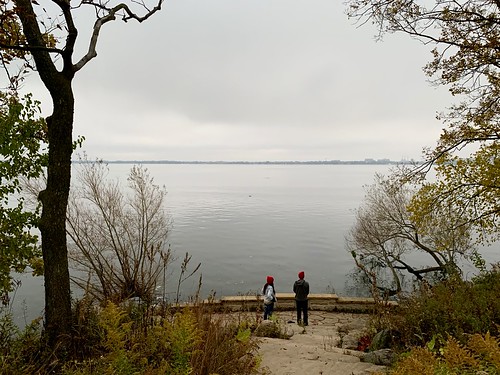
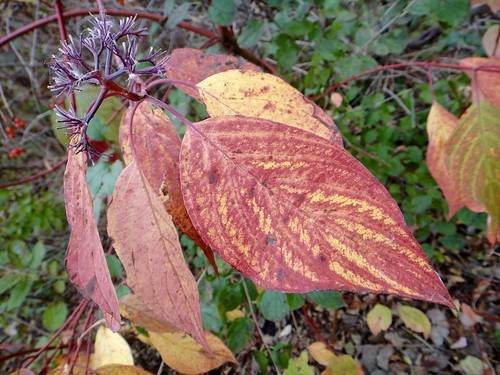
A tinge of red arrives in the forest.

IMG_4084

Yesterday, near Lake Mendota, around 2 in the afternoon.

March 14, 2025

Did you go outside at 1 a.m. to watch the lunar eclipse?

IMG_1007 (2)

We did, but not with a tripod and telephoto lens. That's just my iPhone pic. We had binoculars, so we saw a bit more than what you're seeing there. We talked about the moon — its history, its phases, whether it looked red — the "blood moon" — or fashionably brown.

For the annals of Things I Asked Grok (after thinking of the question while watching the worm moon): "How exactly did the moon come into existence and what would Earth be like now if that had not happened?" In the total eclipse, we could not arrive at a total answer, but then neither could Grok, queried just now. But it did sketch out 6 things that would be different about Earth if the event that produced the moon never happened. I could only think of No Tides. And no moonlight. 

December 22, 2024

"The architect Helen Fong played a major role in designing some of the most well-known and eye-catching Googie buildings, including the first Norms, the Holiday Bowl and Pann’s Restaurant."

"Ms. Fong was known for being meticulous, and she loved a pop of red: Just as Pann’s was about to open to the public, she thought one of the walls looked too blank, so she took out her red nail polish and started painting some of the tiles, said John English, a historic preservationist and a friend of Ms. Fong...."

September 10, 2024

Another year has passed in The Althouse Sunrise Project.

Yesterday was the 5th anniversary of my daily photographs of the sunrise. A few days were skipped for bad weather and once or twice I overslept, but the ritual practice is nearly every single day. I try to get good pictures, but many days are like other days and simply doing it is more important to me than getting a distinctive photograph. Still I rejoice on those days when it looks especially great, and I take this annual occasion to repost a few of the best.

Like this one, with the most unusual color, from May 21:

IMG_6605

And this, from April 26, where white showed its worth as a sunrise color:

IMG_6112

And just last week, on September 3, brown was a delicate delight:

August 1, 2023

"Restaurants across the United States are opting for red lighting as a way to sell intimacy, danger and, sure, food."

That's the subtitle of the NYT article "Meet the Latest Dining Aesthetic: Darkroom-Core" — about restaurants lit entirely with red lighting, making it hard to read the menu and hard to see what the hell you are eating.

We're told "spinach could look more black, because there’s less energy reflecting off it." And to keep the food from looking bad, it is "plated cheekily."

This gets my "redness" tag, and for the first time, I'm noticing that sounds like a symptom.

September 2, 2022

"MAGA Republicans seemed to think that the scary setting for Biden’s alarming message was somehow beneficial to them..."

"... and they soon began sharing images of the dramatic black-and-neon-red scene. 'I can’t believe this is a real photograph,' J. D. Vance, the Trump-backed Republican nominee for Senate in Ohio, tweeted. 'It depicts the president of our nation, as he took to the airwaves and spoke about his fellow citizens as if they were sewer rats.' Rick Scott, the Republican Senate campaign chief, tweeted the photo and dismissed Biden as a 'raving lunatic' who 'attacked half the country tonight.' Mike Huckabee, the former governor of Arkansas, called it a 'hate speech.' Over on Fox News, Tucker Carlson was very, very angry about the 'blood-red Nazi background' and the Marine honor guard in front of Independence Hall, a setting that he termed a 'complete outrage.' Even before Biden spoke, Kevin McCarthy—the House Minority Leader, whose slavish devotion earned him the sobriquet 'my Kevin' from Trump—gave a prebuttal, in which he said that the President should 'apologize for slandering tens of millions of Americans as fascists.'"

Writes Susan B. Glasser in "Joe Biden’s This-Is-Not-Normal Speech on the Rising Danger of MAGA Trumpists/The President calls out Trump and his Republicans, and they see red" (The New Yorker).

Glasser's penultimate sentence: "How telling it is that, when the President of the United States today speaks of threats to the nation, he is warning not about adversaries abroad but the danger within."

She means that to read pro-Biden, strangely enough. 

December 27, 2019

The puzzling anger of Elizabeth Warren's brother.

I'm reading "Elizabeth Warren’s Brother Reportedly ‘Furious’ She Claims Their Father Was a Janitor" (Mediaite). I'm picturing him getting red in the face. His name is David Herring, so that would make him a red herring.
A red herring is something that misleads or distracts from a relevant or important question. It may be either a logical fallacy or a literary device that leads readers or audiences toward a false conclusion. A red herring may be used intentionally, as in mystery fiction or as part of rhetorical strategies (e.g., in politics), or may be used in argumentation inadvertently.  The term was popularized in 1807 by English polemicist William Cobbett, who told a story of having used a kipper (a strong-smelling smoked fish) to divert hounds from chasing a hare.
But let's chew over this fish that Mediate serves up today.

October 20, 2019

September 13, 2019

Cory Booker misused the term "red badge of courage."

At last night's debate (transcript), Booker said:
[W]e know Donald Trump's a racist, but there is no red badge of courage for calling him that. Racism exists. The question isn't who isn't a racist. It's who is and isn't doing something about racism.
In the classic American novel "The Red Badge of Courage," the term appears exactly once and is easily understood:
The mob of men was bleeding.... At times he regarded the wounded soldiers in an envious way. He conceived persons with torn bodies to be peculiarly happy. He wished that he, too, had a wound, a red badge of courage.
The "red badge of courage" is a war wound. That's why it's red. It's not a medal you get in recognition of courage. It is physical damage to your fleshly body that may be taken — rightly or wrongly — as evidence that you were courageous in battle.

Booker was right that you don't deserve a courage medal for calling Donald Trump a racist. It's an easy — even pusillanimous — move. ("Pusillanimous" is the opposite of "courageous.") But even if it were courageous and we were inclined to give you a medal for courage, we shouldn't be giving you a red badge of courage! That would mean we should shoot you!

A basic American education should include reading "The Red Badge of Courage." I was forced to read it in high school, and though I found it hard to understand at the time and a half century has passed since I read it, I have not forgotten what "red badge of courage" means. It makes me sad to hear Cory Booker get that wrong. He is one of the best-educated individuals in American politics today. He went to one of the finest high schools, received a BA and an MA from Stanford University, studied at  Oxford University on a Rhodes Scholarship, and then went to the most illustrious law school in the country, Yale. Yet he doesn't know "The Red Badge of Courage." What does that say about American education? This makes me sad.

Even sadder is the low standard for what courage means. Of course, Booker is right that there's no courage in calling Donald Trump a racist. But what did he think was courageous? He said:
We have to come at this issue attacking systemic racism, having the courage to call it out, and having a plan to do something about it. If I am president of the United States, we will create an office in the White House to deal with the problem of white supremacy and hate crimes.
It's not courageous to express belief in "systemic racism." It's the basic ideology of the left. It would be more courageous to critique the dogma than to repeat the usual incantations.

Elsewhere in the debate transcript, we see the impoverishment of the concept of courage: Kamala Harris said: "Beto, God love you for standing so courageously in the midst of that tragedy." Beto was not on site during the El Paso shooting. He visited the city afterwards. What was courageous? Opposition to murder and shooting people?!

Booker said Beto showed "such courage" for supporting supporting gun licensing. Warren talked about "courage" to fight Trump on immigration. Buttigieg talked about the "courage" it would take for Congress to vote on military interventions. Harris credited Barack Obama with "courage" for his work on Obamacare. There is no serious effort to engage with the idea of courage.

It's an empty, blather word.

***
It rained. The procession of weary soldiers became a bedraggled train, despondent and muttering, marching with churning effort in a trough of liquid brown mud under a low, wretched sky. Yet the youth smiled, for he saw that the world was a world for him, though many discovered it to be made of oaths and walking sticks. He had rid himself of the red sickness of battle. The sultry nightmare was in the past. He had been an animal blistered and sweating in the heat and pain of war. He turned now with a lover's thirst to images of tranquil skies, fresh meadows, cool brooks, an existence of soft and eternal peace.

Over the river a golden ray of sun came through the hosts of leaden rain clouds.

February 12, 2019

The answer to a very old question is: 9.

In the comments to the previous post — "Things to do with cigarettes," which looked at some fabulous vintage ads for a long forgotten cigarette brand, Murad — Laslo Spatula was inspired to rewrite some of the sentences that were part of my old "Gatsby" project (where I'd take a sentence from "The Great Gatsby" and we'd talk about it out of context).

So Laslo was posting things like:
"A tray of cocktails floated at us through the twilight, and we sat down at a table with the two girls in yellow and three men, each one smoking a Murad."
Here's the old post from "Gatsby" project, where you see the original sentence from the novel was: "A tray of cocktails floated at us through the twilight, and we sat down at a table with the two girls in yellow and three men, each one introduced to us as Mr. Mumble."

The first commenter on that post asks "How many times does the word 'yellow' come up in a search of 'The Great Gatsby'?"

Within the half hour, I give him my answer: 24. And that makes me want to count the rest of the colors. Is yellow the dominant "Gatsby" color? What's most likely to beat it? The other primary colors. Using the search function in Kindle, I found 22 appearances of "blue," but...
Red can't be counted via Kindle, which includes the letters "red" within other words, like "declared," "considered," and "incredulously."
I proceeded to the rest of the colors:
Purple: 0
Orange: 4
Brown: 7
Black: only 13 (very surprising)
White: 50 (the book is racist!)
Green: 19
Pink: 6
Lavender: 6
Seeing that old post today, I wondered if the Kindle software had changed since then (January 2013). And yes, it had! I got my answer. 9!

Only 9 for "red." Surprisingly low considering 24 for "yellow" and 22 for blue. Was F. Scott Fitzgerald aversive to red for some reason? There are 19 "red"s in "The Last Tycoon" and 25 in "Tender Is the Night," so the avoidance of red seems to be "Gatsby" specific.

There are only 9, so I will quote them all for you, and let's think about how "red" was used and why it was used sparingly:

1. "I bought a dozen volumes on banking and credit and investment securities, and they stood on my shelf in red and gold like new money from the mint, promising to unfold the shining secrets that only Midas and Morgan and Mæcenas knew."

2. "Their house was even more elaborate than I expected, a cheerful red-and-white Georgian Colonial mansion, overlooking the bay."

3. "Already it was deep summer on roadhouse roofs and in front of wayside garages, where new red gas-pumps sat out in pools of light, and when I reached my estate at West Egg I ran the car under its shed and sat for a while on an abandoned grass roller in the yard."

4. "The sister, Catherine, was a slender, worldly girl of about thirty, with a solid, sticky bob of red hair, and a complexion powdered milky white."

5. "One of the girls in yellow was playing the piano, and beside her stood a tall, red-haired young lady from a famous chorus, engaged in song."

6. "We passed Port Roosevelt, where there was a glimpse of red-belted ocean-going ships, and sped along a cobbled slum lined with the dark, undeserted saloons of the faded-gilt nineteen-hundreds."

7. "I had on a new plaid skirt also that blew a little in the wind, and whenever this happened the red, white, and blue banners in front of all the houses stretched out stiff and said tut-tut-tut-tut, in a disapproving way."

8. "She asked me if I was going to the Red Cross and make bandages."

9. "There was a faint, barely perceptible movement of the water as the fresh flow from one end urged its way toward the drain at the other. With little ripples that were hardly the shadows of waves, the laden mattress moved irregularly down the pool. A small gust of wind that scarcely corrugated the surface was enough to disturb its accidental course with its accidental burden. The touch of a cluster of leaves revolved it slowly, tracing, like the leg of transit, a thin red circle in the water."

We see red in various objects in ##1 (money), 2 (a mansion), 3 (gas pumps), 6 (ships), 7 (the American flag) and twice — ##4 and 5 — in women's hair. #8, as part of a proper name, might deserve little attention, but it is about blood and points to #9, the really important one, which really is blood, though the word "blood" doesn't appear.

Spoiler alert... it's Gatsby's blood. He's shot dead in the swimming pool. The "mattress" is the flotation device he's lying on, and we learn of his death in that 9th appearance of "red" — "a thin red circle in the water." It's just color and geometry. You figure out that it's blood.

That distancing contrasts with the one appearance of the word "blood" in "The Great Gatsby":
The other car, the one going toward New York, came to rest a hundred yards beyond, and its driver hurried back to where Myrtle Wilson, her life violently extinguished, knelt in the road and mingled her thick dark blood with the dust. 
No use of the tightly hoarded word "red" is expended on Myrtle. Her blood is "dark blood" — as it mixes not with water but with dust.

Such are the colors of "Gatsby," and a long-unfinished count is completed. The answer is: 9.

I imagine the first commenter cranking me up again and asking "How many times does the word 'nine' come up in a search of 'The Great Gatsby'?"

The answer is 6, and every single one is the time of day.

May 21, 2018

"Socialism Is on a Winning Streak."

It's John Nichols, at The Nation.
From the 1910s through the 1940s, Socialist Party members served as state legislators, mayors, city councilors and school board members. The Pennsylvania party, with its deep roots in Reading, produced national Socialist leaders, including candidates for president and vice president....

But the dry spell is over. Socialists have been on an electoral winning streak in some parts of the country for a number of years—Socialist Alternative’s Kshama Sawant made her electoral breakthrough in 2013, winning a major race for the Seattle City Council—but the results from western Pennsylvania in the past two years have been particularly striking. And, now, national observers are starting to take note. “Democratic Socialists scores big wins in Pennsylvania,” declared CNN this week, while The New Yorker announced: “A Democratic-Socialist Landslide in Pennsylvania.”

... “We’re turning the state the right shade of red tonight,” declared Arielle Cohen, the co-chair of the Pittsburgh chapter of DSA....

Official logo of the Democratic Socialists of America via Wikipedia.

ADDED: About that official logo. I presume the white and black outlines for the shaking hands are intended to represent white and black people coming together in socialism. Why then is white the color for the outlining of the rose? It seems to convey the dominance of white. You might try to defend the design by saying the socialists want to say that there is white supremacy and it needs to be recognized in order to be fought, but portraying white supremacy as a rose would suggest that it's good. And, in any event, the red rose (according to the above-linked Wikipedia article) is a traditional symbol of socialism. The logo infuses the symbol of socialism with whiteness, the whiteness that is the white hand that shakes the black hand. It seems to say that white people welcome black people into what is a white enclave.

March 14, 2018

A pigment that "we think is the blackest material in the universe, after a black hole."

Writing about Anish Kapoor — in that post about "The Bean" and "The Clenched Fist of Truth" — got me to an article that reminded me that I need to write about the death of Stephen Hawking. I'm going to write about Hawking in the next post, but first I want to read this 2016 Guardian article "'You could disappear into it': Anish Kapoor on his exclusive rights to the 'blackest black'/Artist defends controversial deal with developers of Vantablack, the blackest material ‘after a black hole.'"
The pigment is comprised of microscopic stems of colour that are 300 times as tall as they are wide, so that about 99.6% of all light “just gets trapped in the network of standing segments”, he explains. “It’s literally as if you could disappear into it.” The pigment was being developed for scientific and military use due to its “masking ability”....

But when Kapoor won exclusive rights to the material in February, it came with backlash from the artistic community. “I’ve never heard of an artist monopolising a material,” the artist Christian Furr told the Daily Mail. “All the best artists have had a thing for pure black – Turner, Manet, Goya … This black is like dynamite in the art world. We should be able to use it. It isn’t right that it belongs to one man.”

Kapoor defended his exclusive use of the material: “Why exclusive? Because it’s a collaboration, because I am wanting to push them to a certain use for it. I’ve collaborated with people who make things out of stainless steel for years and that’s exclusive.” He believes much of the debate comes down to emotion. “The problem is that colour is so emotive – especially black ... I don’t think the same response would occur if it was white.”

Kapoor, who has had two decades of psychotherapy, said it’s the “psycho side” of black that makes us want to possess it. “Perhaps the darkest black is the black we carry within ourselves,” he says. “It’s not the night where you switch the lights off – it’s the night where you close your eyes. There’s a psycho side to blackness that we don’t associate with other colours readily. I suspect red does the same. I’ve worked with red a great deal, for not dissimilar reasons.”
A psycho side to blackness.... That sounds wrong, but he's an artist; what does he have to do with politics? Read in that post about "The Bean" and "The Clenched Fist of Truth" and find out.

Can you own a color? You can have a color as a trademark (like UPS has brown), but obviously Kapoor can't own "the blackest black." But what he got was a particular substance, a pigment, that allows black to be seen in way that reflects no light at all. There's a distinction between pigment and color. Color is what is perceived in your brain when light enters your eye. Pigment is stuff that light can hit before bouncing into your eye.

ADDED: Also missed by me back in 2016, the maker of the "pinkest pink" retaliated against Kapoor for hogging the Vantablack:
To keep Kapoor away from PINK, buyers of the paint were asked to sign a legal declaration at checkout to ensure that the artist and his associates would not be able to buy it for him.
And here's Kapoor's response:

October 30, 2016

At the Red Leaf Café...

DSC04534

... you can talk about whatever you want.

And, please, if you've got some shopping to do, use the Althouse Amazon Portal.

Photo taken this afternoon at Picnic Point.

August 29, 2016

"The color of a lobster is no more important than the color of a person. This lobster is like all the others in the ways that matter."

"And all that matters is that lobsters want to be free to live their natural lives just like us, not cooked alive and eaten. Sending a yellow lobster to an aquarium while killing the rest isn’t praise worthy except in a society that fails to grasp the concept that all animals matter equally."

But people do care intensely about the color of their various pets and often choose one or the other based on color. Should we stop that because of the actual real-world human problem of racial prejudice?

Even with respect to human beings, we have lots of color preferences that aren't part of the race-prejudice problem. You might love seeing a woman in a red dress. You might want to dye your hair blue. You might want to see multicolored tattoos on other people's arms. You might adore Elizabeth Taylor because her eyes were a color that it seemed nobody else had.

Are all these pleasures something about which we should become self-critical?

If you want to be be self-critical, how about being self-critical about your precious attention to your own morality — that wonderfully named sin called scrupulosity — and consider whether likening the everyday joys of color perception to the age-old suffering of racism is itself a racist error.

August 22, 2016

Red and yellow.

What Meade texted me from his bike ride:

IMG_2025

What I texted Meade from my walk:

IMG_1238