"... they have no idea what they'll do with their diploma once they graduate, they have no particular interest in the program they're in.... My own son was ... pretty lost, after struggling in studies to be a software developer (constantly at home, alone, in front of a computer), then working in customer support for an insurance company (constantly at home, alone, in front of a computer). It wasn't that he couldn't do the work, but he procrastinated, felt many tasks were pointless, and just wasn't happy. But his dad and I both have PhDs and his sister is an MD, and it seemed he felt he 'should' be in university. Then he found out about an opportunity to train as a baker. 8 months of classes and practice in a very good gov't run program (free), then a month as a trainee at a bakery. He lucked into a popular local artisanal place, very well known for their baguettes, croissants and sourdough. They hired him as soon as he was finished, and he's SO HAPPY there! He's interacting with others all day, he's always on the move and always learning, and can see the results of his work immediately (and eat it too!)...."
From a comment at the NYT, on the article "Mom, Dad, I Want to Be a Welder/Gen Z is increasingly turning to trade schools in hopes of future-proofing their careers against A.I. But getting their parents and peers on board can be a challenge."
Showing posts with label bread. Show all posts
Showing posts with label bread. Show all posts
July 14, 2026


July 6, 2026
"Every summer, my husband, my daughter, and I stay with my mother out East so my child can spend time outside the city in an area I remain attached to from my childhood."
"Without my mom’s generosity, we could not afford to be there. I realize that having access to all this when I haven’t made the right career choices, shorted the market at a moment of crisis, or robbed a bank to be able to afford my own Hamptons house is deeply fortunate. And yet, as I’m often reminded during a flare-up with my mother over how to properly cut a $13 Il Buco filone (apparently, I saw bread too 'wavily' and ruin the rest of the loaf for straight-slicers), Chekhov’s greatest dramas were multigenerational tragicomedies set in country homes."
Writes Lucy Boyle, in "'I’m Sorry You’re in This Beautiful House We Pay For!'/There’s a glut of middle-aged children living with their parents in the Hamptons for the summer" (New York Magazine).
I'm interested in this tale of petty woe not because I've ever stayed at any beach house owned by my parents — I have not — but because we — in the midst of our summer here in our year-round home — took the half-hour drive out to the American Players Theater last week and saw "Uncle Vanya."
The troubles in "Uncle Vanya" were nothing like what we're seeing with these "middle-aged children" in the Hamptons. They're irked by rules about using coasters, taking out the trash, and not stealing things. Boyle gets a psychotherapist to analyze the parents: "When the house is full of the grandkids and the grandkids’ and kids’ friends, they’re kind of in the background. One way they can become the foreground and say ‘I am here’ is to foreground their ownership and possession.'"
June 20, 2026
"You don't have to tip. You wanna tip."
An Aussie discovers Texas Road House for the first time. Epic!
— Buzz Patterson (@BuzzPatterson) June 19, 2026
The World Cup needs to be permanently held in the US. It offers the most for the teams and the fans. 🤣🇺🇸🇦🇺 pic.twitter.com/5AFbUVWrFZ
Culture shock… Europeans in America pic.twitter.com/fxxgdHqKng
— Meidas_Charise Lee (@charise_lee) June 19, 2026
June 21, 2025
"Punks had earned a reputation for evil and expressed it in their outfits and in their music. But back then, within certain circles, evil was used colloquially as good."
"I was intrigued by the bad guys and wanted to see what happened when a woman photographed a man, as the opposite was the norm in those days."
Said Marcia Resnick, quoted in "Marcia Resnick, photographer of punk’s heyday, dies at 74/She also took photos of actor John Belushi before his fatal drug overdose" (WaP)(free-access link, so you can see the photographs).
There was also this 1978 book "Re-visions" — "an autobiographical book of photography exploring female adolescence... One image showed a loaf of bread held against a woman’s groin, with the accompanying text: 'She first learned the facts of life from a friend while on a class trip to the bread factory.'
Said Marcia Resnick, quoted in "Marcia Resnick, photographer of punk’s heyday, dies at 74/She also took photos of actor John Belushi before his fatal drug overdose" (WaP)(free-access link, so you can see the photographs).
There was also this 1978 book "Re-visions" — "an autobiographical book of photography exploring female adolescence... One image showed a loaf of bread held against a woman’s groin, with the accompanying text: 'She first learned the facts of life from a friend while on a class trip to the bread factory.'
July 26, 2024
"I would cry real tears of joy if I was drunk and a boy showed up [at a party] with homemade cinnamon bread."
Writes Nell — commenting on a TikTok video — and it's "extremely validating" to the man who was treated as though he'd done something hopelessly weird.
December 1, 2022
"Still, the baguette is under threat..."
"... with the country losing 400 artisanal bakeries a year since 1970 — a decline that is especially significant in France’s rural areas, where supermarkets and chains have overtaken traditional mom-and-pop bakeries. To make matters worse — and in a sting to French pride — sales of hamburgers since 2017 have exceeded those of jambon-beurre, sandwiches made with ham on a buttered baguette."
The article links to this 2007 discussion of the deep cultural meaning of bread:
September 17, 2022
For Saturday, take a journey through 12 TikToks, arranged meaningfully... or so some people think.
1. Maybe you'll say "I remember the old pole."
2. London women who don't like American women are not too likable themselves.
3. How you would love it if your candidate were this loved.
7. The meaning of life in eating your toast.
8. The butter board?!
10. When Anne Bancroft met Mel Brooks.
11. Saving a seal.
12. A dog carps about the stuck traffic.
May 28, 2022
"Despite the camp absurdity of her scenes, she is not a clown, and despite her nakedness, her work doesn’t straightforwardly concern..."
"... either masochism or self-love. Instead, fat stigma is toyed with, embodied, and satirized, sometimes through sexualized caricatures of gluttony. 'Good Morning' shows her—with her underpants pulled down and stuffed with a loaf (or more) of sliced white bread—holding a knife and a jar of Nutella.... A fat woman is by cultural default already an object of ridicule; inviting laughter by clenching a baguette between her legs, or ironing a pizza to her chest, could easily spin out of her control. Perhaps Susiraja’s blank affect is the key to her peculiar power to retain the upper hand. Indifference is one of the purest forms of defiance, but her disciplined impassivity, her refusal to cue the viewers’ reaction, is more than that. Her unwillingness to feed us meaning is more provocative, and disquieting, than an obvious dare, and it leaves a more lasting impression."
Writes Johanna Fateman, in "Iiu Susiraja’s Self-Portraits Are More Than a Dare/The photographer uses her own body without straightforward interest in either masochism or self-love" (The New Yorker). Lots of stunning/hilarious photos there. Perhaps a paywall will stop you, but here's her webpage. You can see the same photos there — and even more.
Wait. How do we know "she is not a clown"? It can't be the "blank affect." One of the prime ways of clowning is to do ridiculous things while maintaining a flat facial expression. There's a special and well-known word for it: deadpan.
The OED tips me off that "pan" was once American slang for "face" or "mouth." To quote "Great Comics" (1924): "Open yer pan afterwards about this and you'll be in stir for the next thousand years."
And I see that Nathanael West used "dead pan" in "Miss Lonelyhearts":
September 28, 2021
"The colors of our flag are intended to stand for unity, valor and justice. The gray, monochrome flag represents America surrendering..."
"... to its fall from power and loss of the ideals it once stood for. The American dream is being washed away."
Writes Na Kim at "REDESIGNING AMERICA’S FLAG/Six New Takes on Old Glory" (NYT).
Take that into account as you decide how to understand the proffered flag.
Writes Na Kim at "REDESIGNING AMERICA’S FLAG/Six New Takes on Old Glory" (NYT).
Here's her redesign: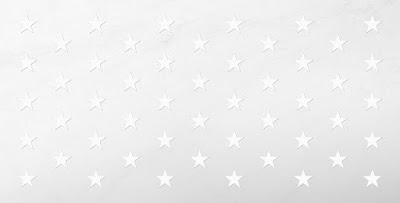
Here's a webpage showing more work from Na Kim. She's mainly a book cover designer, but she's also been prominent in social media, including in this Instagram account Panolo Blahnik, which is photographs of shoes made of bread (or... should I say bread made into shoes?):
August 29, 2021
"The spurious prudence, making the senses final, is the god of sots and cowards, and is the subject of all comedy."
"It is nature's joke.... Prudence does not go behind nature, and ask whence it is. It takes the laws of the world, whereby man's being is conditioned, as they are, and keeps these laws, that it may enjoy their proper good. It respects space and time, climate, want, sleep, the law of polarity, growth, and death. There revolve to give bound and period to his being, on all sides, the sun and moon, the great formalists in the sky: here lies stubborn matter, and will not swerve from its chemical routine. Here is a planted globe, pierced and belted with natural laws, and fenced and distributed externally with civil partitions and properties which impose new restraints on the young inhabitant. We eat of the bread which grows in the field. We live by the air which blows around us, and we are poisoned by the air that is too cold or too hot, too dry or too wet. Time, which shows so vacant, indivisible, and divine in its coming, is slit and peddled into trifles and tatters. A door is to be painted, a lock to be repaired. I want wood, or oil, or meal, or salt; the house smokes, or I have a headache; then the tax; and an affair to be transacted with a man without heart or brains; and the stinging recollection of an injurious or very awkward word, — these eat up the hours."
From "Prudence" by Ralph Waldo Emerson, stumbled across this morning after Emerson and comedy happened to pop up in one post, the previous post. It was just a haphazard sequence, not any connection between Emerson and comedy. So I went looking, on the theory that there was none.
February 21, 2021
Hot from the oven at 5 a.m.

Meade made bread... for the second day in a row. He even milled the grains and seeds — wheat, oats, teff, sunflower seeds, flax seeds, sesame seeds.
Teff?! I had never heard of it.
Eragrostis tef, also known as teff, Williams lovegrass or annual bunch grass, is an annual grass, a species of lovegrass native to the Horn of Africa, notably to modern-day Ethiopia. It is cultivated for its edible seeds, also known as teff.... The name teff is thought to originate from the Amharic word teffa, which means “lost”. This probably refers to its tiny seeds, which have a diameter smaller than 1 mm....
So teff was one of the seeds, not one of the grains? What is the difference between a grain and a seed? I realize I don't know. From the Wikipedia article "Grain":
A grain is a small, hard, dry seed, with or without an attached hull or fruit layer, harvested for human or animal consumption.... Grains and cereal are synonymous with caryopses, the fruits of the grass family. In agronomy and commerce, seeds or fruits from other plant families are called grains if they resemble caryopses.
So teff is a grain (and a seed) and wheat is a seed (and a grain). It's good to know these terms and facts. Also good: Fresh Meade-made bread in the house!
August 5, 2020
"Thousands of videos quickly popped up using the audio, with people carrying, caring for and kissing loaves of bread. But they picked the wrong carbohydrate."
From "Mi pan, su su su: how a dancing llama and a nonsensical song captivated TikTok/Acoustic remix of Miel Pops Russian cereal jingle becomes a strange anthem for a stranger time" (The Guardian).
By the way, I knew all about this days ago — from sitting around gazing at TikTok! If you don't understand what's so lovable about TikTok, that article might help.
By the way, I knew all about this days ago — from sitting around gazing at TikTok! If you don't understand what's so lovable about TikTok, that article might help.
November 1, 2019
September 21, 2019
"They'll rue the day they made fun of these bad boys. Woe to those who make fun of the cargo shorts and then suddenly need some snacks, a multitool, a first-aid kit, or a Johnny Cash CD. Yeah, I've got all that stuff in here and more."
Said Brent Barden, quoted in "Family Gonna Be Sorry When They Want Some Trail Mix From Dad's Cargo Shorts They Just Made Fun Of" (in The Babylon Bee, which apparently has heard of my disparagement of it and decided to try to appeal to me by using my well-known "men in shorts" issue).
ADDED: "Yeah, I've got all that stuff in here and more." Care to rewrite that, Babylon Bee? It's a father, humorously addressing children, and you've unwittingly got him sort of threatening them with his genitalia! And that's right after he's talking about them getting into his pants to find something to eat. So ham-handed!
OH? You've got ham hands? Can I have a ham-hand sandwich, Dad?
HEY: A guy once did make a ham-hand sandwich of sorts...
WELL: That video sure made me laugh a lot. I'm ready to watch all videos by I Did a Thing. You know, there's no arguing with taste, especially in humor... and in bread gloves.
ALSO: "Mad respect for a man willing to strap a laundry basket to his back, put flippers on his hands, and get in a bathtub just to reenact a sea turtle getting a straw stuck in his nose and then slowly dying."
ADDED: "Yeah, I've got all that stuff in here and more." Care to rewrite that, Babylon Bee? It's a father, humorously addressing children, and you've unwittingly got him sort of threatening them with his genitalia! And that's right after he's talking about them getting into his pants to find something to eat. So ham-handed!
OH? You've got ham hands? Can I have a ham-hand sandwich, Dad?
HEY: A guy once did make a ham-hand sandwich of sorts...
WELL: That video sure made me laugh a lot. I'm ready to watch all videos by I Did a Thing. You know, there's no arguing with taste, especially in humor... and in bread gloves.
ALSO: "Mad respect for a man willing to strap a laundry basket to his back, put flippers on his hands, and get in a bathtub just to reenact a sea turtle getting a straw stuck in his nose and then slowly dying."
June 2, 2019
"I get a coffee, egg whites and a bowl of grits. I’m trying to cut out bread. Oh, I have one slice of buttered, whole-wheat bread with grape jelly."
"I go to a place across the street. It’s called Academy. Coffee, cream and three natural brown sugars. No more sugar for me."
From "How Spike Lee Spends His Sundays" (NYT).
There must be a Greek term for the rhetorical device he uses twice in that quote. I really enjoyed that. The Times has a regular feature on how somebody or other spends their Sunday. I enjoy the feature, but I especially like this Spike Lee one, because he doesn't fit their pattern, doesn't treat Sunday as special. The usual celebrity has some fussy Sunday particularity to it, and he so delightfully unspecial about Sunday: "I wake up, brush my teeth, take a shower, put my clothes on, and I go to work. It’s not like for me Sunday is the Sabbath. I got work to do."
From "How Spike Lee Spends His Sundays" (NYT).
There must be a Greek term for the rhetorical device he uses twice in that quote. I really enjoyed that. The Times has a regular feature on how somebody or other spends their Sunday. I enjoy the feature, but I especially like this Spike Lee one, because he doesn't fit their pattern, doesn't treat Sunday as special. The usual celebrity has some fussy Sunday particularity to it, and he so delightfully unspecial about Sunday: "I wake up, brush my teeth, take a shower, put my clothes on, and I go to work. It’s not like for me Sunday is the Sabbath. I got work to do."
December 23, 2018
How to eat like a medieval peasant.
It's pretty great:
And I learned that "potage" originally meant whatever you're cooking in a pot.
And I learned that "potage" originally meant whatever you're cooking in a pot.
November 24, 2018
Throwed rolls.
I learned about the throwed rolls at Lambert's Cafe...
... from the Oxford English Dictionary, which has this in the sidebar today:
... from the Oxford English Dictionary, which has this in the sidebar today:
"Throwed" — unless you're talking about "throwed silk" — is "colloq. or nonstandard," the past tense of "throw," and one of the quotations selected by the OED is:

1995 Midwest Living Apr. 185/1 Fun family restaurant and home of ‘throwed rolls’ (for laughs, owner Norm Lambert tosses warm dinner rolls around the cafe to customers).The oldest published use of the word the OED found is:
1861 H. M. G. Smythies Daily Governess I. xiii. 113 He was a selfish brute, and she a throwed-away angel.
July 29, 2018
"The internet has always been lawless, but the chaos of the Trump era has worsened online nastiness to the point where even I, a verifiably snarky internet writer..."
"... have grown sick of it all. Desperate for an antidote, I started dabbling in wholesome activities: bicycling, crossword puzzles, baking and writing in my journal. 'Oh no! You’re becoming a hippie,' my mother said after I informed her of my new hobbies. In these efforts to self-soothe, I made a life-changing discovery: Making sourdough bread is the opposite of using the internet...."
From a NYT essay by Eve Peyser, "I Wanted a Dog. I Bake Bread Instead." The headline highlights the dog/bread alternatives as opposed to the escape-from-the-internet theme. I'm guessing that's because dog gets hits... on the internet.
Anyway, I'm blogging this because of the mother's concept of "hippie" and the idea that it could include crossword puzzles. But I like the idea of the younger generation rediscovering the hippie lifestyle, especially if it's envisioned in positive ways — with "wholesome activities."
Also, this article fit with something else I was just reading, "In a divided U.S., therapists treating anxiety are hearing the same name over and over: Donald Trump/'Trump Anxiety Disorder' may not be an official diagnosis, but therapists know the symptoms" (Politico), which chimed with something I'd already blogged this morning, Trump himself using the term Trump derangement syndrome.
Isn't it interesting that therapists are seeing the reaction to Trump as a disorder?! And that Politico framed it that way.
Maybe mainstream media is noticing a lot of people who feel the way I do, that the antagonism to Trump is so over-the-top that it's weirder than Trump. We turn away... and toward the man we originally resisted because he was too weird.
I tried to find a picture of a hippie doing a crossword puzzle, but my search had the serendipitous effect of turning up this New Yorker humor piece from last February: "Former Hippies Put in Horrible Position of Rooting for F.B.I." ("'I always dreamed I’d spend my retirement surrounded by my grandchildren, telling them that the F.B.I. were fascist pigs,' Carol Foyler, a former hippie who lives in Santa Cruz, said. 'That dream has been shot to hell.'").
From a NYT essay by Eve Peyser, "I Wanted a Dog. I Bake Bread Instead." The headline highlights the dog/bread alternatives as opposed to the escape-from-the-internet theme. I'm guessing that's because dog gets hits... on the internet.
Anyway, I'm blogging this because of the mother's concept of "hippie" and the idea that it could include crossword puzzles. But I like the idea of the younger generation rediscovering the hippie lifestyle, especially if it's envisioned in positive ways — with "wholesome activities."
Also, this article fit with something else I was just reading, "In a divided U.S., therapists treating anxiety are hearing the same name over and over: Donald Trump/'Trump Anxiety Disorder' may not be an official diagnosis, but therapists know the symptoms" (Politico), which chimed with something I'd already blogged this morning, Trump himself using the term Trump derangement syndrome.
Isn't it interesting that therapists are seeing the reaction to Trump as a disorder?! And that Politico framed it that way.
Maybe mainstream media is noticing a lot of people who feel the way I do, that the antagonism to Trump is so over-the-top that it's weirder than Trump. We turn away... and toward the man we originally resisted because he was too weird.
I tried to find a picture of a hippie doing a crossword puzzle, but my search had the serendipitous effect of turning up this New Yorker humor piece from last February: "Former Hippies Put in Horrible Position of Rooting for F.B.I." ("'I always dreamed I’d spend my retirement surrounded by my grandchildren, telling them that the F.B.I. were fascist pigs,' Carol Foyler, a former hippie who lives in Santa Cruz, said. 'That dream has been shot to hell.'").
November 20, 2017
Trump, hitting back at Jeff Flake, calls him "Flake(y)."
Here's the tweet, which is funny for a few reasons:
There's also some rock solid content. Flake has decided not to expose himself to an actual election process in Arizona, where a GOP incumbent should be able to win, and instead — with no judgment of the electorate to worry about — he's just speaking out against Trump. Flake's speaking has struck me as vain and attention-seeking, and the love he's getting from liberals would never translate into support in an actual political contest.
The "(purposely)" is funny, because who doesn't believe that Flake meant for his remark to be heard? Making it seem secret was a way to amplify it. That was my opinion and my favorite President agreed. Good. I also like that he used the "mike" spelling and not "mic." (Maybe Laurence Tribe will apply his massive brain to the question whether "mike" is a "distinctly Jewish" spelling.)
"Toast" is funny because "toast" popped up in Flake's open mike remark "If we become the party of Roy Moore and Donald Trump, we are toast." So Trump is just flipping the insult back. Reminds me of "Puppet? No Puppet. You’re the Puppet" at that debate with Hillary:
It is childish, but Trump doesn't have time for longer statements.
And on a deeper, emotional level, "toast" is a warm, delicious word. Toast! We're toast! I love toast! Mmmm, toast! A toast to toast!
But what I really came here to opine about is the name-calling: Flake(y). Should a President be sticking names on everyone? I don't know but Trump doesn't do it to everyone. Only to those who hit him with a low blow. It is undignified, and I prefer the idea of going high when they go low, but that's not Trump. That's not what our favorite President does. (That's the name he's gotten me to start using for him. It's sticky.)
So let's move on to the question whether Flake(y) is a good name for Jeff Flake. "Flake" was already a funny name — already connoting flakiness — and Flake has lived and achieved with it. How can you make it more of an insult by adding "y"? Is it worse to be "flaky" than to be a "flake"? I think it's worse to be a flake, since it suggests it's the entirety of what you are as opposed to merely one of your attributes. (Reading the definition of "flaky/flakey" in the OED, I see that President Reagan called Qaddafi "flaky.")
But when I think about "Flakey," my first association is Flakey Foont!
Sen. Jeff Flake(y), who is unelectable in the Great State of Arizona (quit race, anemic polls) was caught (purposely) on “mike” saying bad things about your favorite President. He’ll be a NO on tax cuts because his political career anyway is “toast.”The funniest thing about it to me is Trump calling himself "your favorite President." It's absolutely accurate, because he is our only President. I mean, you might try to write a screwball comedy — in the manner of "My Favorite Wife" — where some strange occurrence causes there to be 2 Presidents, but even if you think Hillary was cheated out of the presidency, there's no way she is the President. And if you try to say, but my favorite President is Abraham Lincoln or Franklin Roosevelt, I'm going to say it depends on what the meaning of the word "is" is.
There's also some rock solid content. Flake has decided not to expose himself to an actual election process in Arizona, where a GOP incumbent should be able to win, and instead — with no judgment of the electorate to worry about — he's just speaking out against Trump. Flake's speaking has struck me as vain and attention-seeking, and the love he's getting from liberals would never translate into support in an actual political contest.
The "(purposely)" is funny, because who doesn't believe that Flake meant for his remark to be heard? Making it seem secret was a way to amplify it. That was my opinion and my favorite President agreed. Good. I also like that he used the "mike" spelling and not "mic." (Maybe Laurence Tribe will apply his massive brain to the question whether "mike" is a "distinctly Jewish" spelling.)
"Toast" is funny because "toast" popped up in Flake's open mike remark "If we become the party of Roy Moore and Donald Trump, we are toast." So Trump is just flipping the insult back. Reminds me of "Puppet? No Puppet. You’re the Puppet" at that debate with Hillary:
It is childish, but Trump doesn't have time for longer statements.
And on a deeper, emotional level, "toast" is a warm, delicious word. Toast! We're toast! I love toast! Mmmm, toast! A toast to toast!
But what I really came here to opine about is the name-calling: Flake(y). Should a President be sticking names on everyone? I don't know but Trump doesn't do it to everyone. Only to those who hit him with a low blow. It is undignified, and I prefer the idea of going high when they go low, but that's not Trump. That's not what our favorite President does. (That's the name he's gotten me to start using for him. It's sticky.)
So let's move on to the question whether Flake(y) is a good name for Jeff Flake. "Flake" was already a funny name — already connoting flakiness — and Flake has lived and achieved with it. How can you make it more of an insult by adding "y"? Is it worse to be "flaky" than to be a "flake"? I think it's worse to be a flake, since it suggests it's the entirety of what you are as opposed to merely one of your attributes. (Reading the definition of "flaky/flakey" in the OED, I see that President Reagan called Qaddafi "flaky.")
But when I think about "Flakey," my first association is Flakey Foont!
Do you know what I'm talking about? Are you not up on Mr. Natural comics?

Mr. Natural has strange, magical powers and possesses cosmic insight; but he is also moody, cynical, self-pitying, and suffers from various strange sexual obsessions. He is endlessly being accosted by would-be disciples seeking the truth (among them such long-running Crumb characters as Flakey Foont and Shuman the Human). He typically regards them with amused condescension and a certain grudging affection, although his patience often wears thin and he takes sadistic pleasure in making them feel like idiots. While he is typically very cool and in control, he sometimes ends up in humiliating predicaments like languishing for years in a mental institution.The really weird thing is thinking of Trump as Mr. Natural!
September 11, 2017
I really just wanted to know if Whole Foods has ciabatta today. They don't always have it.
I'm not confusing it with art, but I am a little confused about finding the answer to my question on the internet. I mean, my search found me this:
That's from "All The Houses: A Novel," by Karen Olsson.

Subscribe to:
Posts (Atom)


 Posts
Posts


