Showing posts with label banjo. Show all posts
Showing posts with label banjo. Show all posts


March 28, 2017
"I'm a heading out Wisconsin ways/2000 miles to go/Madison, Milwaukee, sets my heart aglow."
"I'm a coming to that dairy state/My heart's a beating fast/I'll pick my banjo gently there/And twiddle my mustache...."
He never performed it and we don't seem to have the music for it, but Bob Dylan wrote 3 verses of lyrics for a song about Wisconsin. The handwritten lyric sheet — which you can see here — is being offered for sale.
I like that he mentions Madison — along with Milwaukee — and also says his home's in "Wow Wow Toaster" — presumably Wauwatosa (the home of Governor Scott Walker).
Also at the link is a facsimile of a Wisconsin State Journal article about a concert Dylan played in Madison when he was 23:
He never performed it and we don't seem to have the music for it, but Bob Dylan wrote 3 verses of lyrics for a song about Wisconsin. The handwritten lyric sheet — which you can see here — is being offered for sale.
I like that he mentions Madison — along with Milwaukee — and also says his home's in "Wow Wow Toaster" — presumably Wauwatosa (the home of Governor Scott Walker).
Also at the link is a facsimile of a Wisconsin State Journal article about a concert Dylan played in Madison when he was 23:
With a vocal style resembling an 80-year-old man with a nasal condition, Dylan still does the near-impossible when he belts out his self-written tirades again the ills of the world....In other Dylan news:
In no song, however, does he present a solution.
The Bob Dylan archive in Tulsa, Oklahoma is now open to select groups and individuals with qualified research projects. Those hoping to view and use the archive at the Helmerich Center for American Research at the Gilcrease Museum will have to submit a Research Associate Application to the librarian and a list of relevant items from the archive's online finding aid.
February 1, 2014
The night The Beatles first lit up our black and white TVs.
It was 50 years ago today...
[CORRECTION: No, it's 50 years ago on February 9th. I'm writing too early in the morning and misreading the notation on my calendar. Today, is the 50th anniversary of The Beatles first hitting #1 in the U.S.]
.... and you're probably seeing lots of clips of the very familiar part of the show when The Beatles stamped the look of 1964 into our permanent memory, including the second-hand memory of those yet to be born, but do you remember what the evening of February 1, 1964 really looked liked?
Back then, everyone watched "The Ed Sullivan Show." And there was no fast-forwarding. You had to watch the commercials and whatever mix of performances Ed had for us that week. The TV schedule was studded with "variety shows," and Ed's was the biggest. You could see rock and roll, and your parents could have rock and roll inflicted on them, but you had to listen to opera or jazz and watch plate-spinning acrobats and whatever else Ed had decided was appropriate, including Ed himself, on stage and introducing and vouching for everyone.
Can you endure the complete Ed Sullivan shows with The Beatles? Back in the earliest days of this blog, 10 years ago, I willingly submerged myself in the first show, the one that's 50 years old today:
[CORRECTION: No, it's 50 years ago on February 9th. I'm writing too early in the morning and misreading the notation on my calendar. Today, is the 50th anniversary of The Beatles first hitting #1 in the U.S.]
.... and you're probably seeing lots of clips of the very familiar part of the show when The Beatles stamped the look of 1964 into our permanent memory, including the second-hand memory of those yet to be born, but do you remember what the evening of February 1, 1964 really looked liked?
Back then, everyone watched "The Ed Sullivan Show." And there was no fast-forwarding. You had to watch the commercials and whatever mix of performances Ed had for us that week. The TV schedule was studded with "variety shows," and Ed's was the biggest. You could see rock and roll, and your parents could have rock and roll inflicted on them, but you had to listen to opera or jazz and watch plate-spinning acrobats and whatever else Ed had decided was appropriate, including Ed himself, on stage and introducing and vouching for everyone.
Can you endure the complete Ed Sullivan shows with The Beatles? Back in the earliest days of this blog, 10 years ago, I willingly submerged myself in the first show, the one that's 50 years old today:
January 25, 2013
I was so tired when I wrote last night's "Gatsby" post.
It was a real struggle with that sentence:
I'll leave you to untangle the strands of colored lights that festoon the Christmas tree sentence, because I need to get back to what people said about yesterday's sentence. I must say I laughed out loud when McTriumph said:
And now, it's your turn to dance. Dance all night in the comments, backward in eternal graceless circles, tortuously, fashionably, individualistically.
There was dancing now on the canvas in the garden; old men pushing young girls backward in eternal graceless circles, superior couples holding each other tortuously, fashionably, and keeping in the corners — and a great number of single girls dancing individualistically or relieving the orchestra for a moment of the burden of the banjo or the traps.You might say I wrestled with that sentence. The commenters — whom I read this morning, after I conked out and slept for 10 hours — helped me make the connection to wrestling. Terry said: "The key phrase, I think, is 'on the canvas.'" That affects how you think of the men pushing the young girls, the gracelessness, and the tortuously. Dancing is like wrestling here. In the "Gatsby" project, we look into one sentence, in isolation, but I just looked back into the text to get a better picture of that canvas, which I took to be a way to transform lawn into dance floor. I get to this sentence:
At least once a fortnight a corps of caterers came down with several hundred feet of canvas and enough colored lights to make a Christmas tree of Gatsby’s enormous garden.So let that be today's sentence. Lots of Cs: corps, caterers came, canvas, colored, Christmas. Christmas replacing the garden evokes the New Testament supplanting the Old. From the Garden of Eden to the salvation of Christ. By the way, that is the sentence just before the "crowded hams" sentence that made me angry 3 days ago.
I'll leave you to untangle the strands of colored lights that festoon the Christmas tree sentence, because I need to get back to what people said about yesterday's sentence. I must say I laughed out loud when McTriumph said:
Professor Ann, your first thought was musicians using the girls as instruments? You should write a novel, "Fifty Shades of Banjo."And then betamax3000 introduced Naked Andy Kaufman Robot. Betamax has done this "naked robot" routine before, but the Andy Kaufman iteration blew my mind, because I was still admiring Terry's wrestling insight, with men wrestling/dancing with woman, and then to bring up Andy Kaufman — when Kaufman not only had a comic act that was about wrestling with women, but he had a routine that consisted of taking the stage and reading, in its entirety, "The Great Gatsby." But it's not as if betamax3000 just said, "Hey, this is so Andy Kaufman — the wrestling and 'The Great Gatsby.'" No, betamax did a series of comments that twisted the "Gatsby" text into things that would be said by the Naked Andy Kaufman Robot:
I have pushed many women gracelessly backwards on canvas. It has been both tortuous and fashionable, leaping high from the corners of the ring onto the contestant below: in that moment there is Truth, Sweat and Cheers. Many people assume the urge to wrestle women is sexual. As a wrestler of women I can definitively say that this is untrue. Mostly. In the main it is about the defining moment of being Superior, of recognition of the Pinner and the Pinnee.
A few moments on Etiquette.And:
A sportsman never uses the Banjo or the Traps on a female wrestler. While he is allowed to use the Piledriver it is not to be done from a height greater than a women's modest skirt: below the knees only, gentlemen.
Danny DeVito did not understand. He would ask "Andy, why don't you stop wrestling women?" and I would reply "Danny, why don't you stop being so short and disheveled?"
Shirt tucked or not, in the ring Danny would've been able to stand as tall as his Courage would allow him to be, but -- sadly --he did not understand.
Tony Danza would argue "I'm a boxer. What would be so different if I boxed women?"
I could only shake my head. He did not comprehend the difference between wrestling and fighting. A punch is anger, but only through grappling do we experience the common ground between the sexes: the canvas ring is where the true colors are painted, like a woman's red nails or a man's 1969 orange Camaro.
I once wrestled a woman who smelled of avocado. In the midst of our grappling a moment was frozen as that scent overpowered my senses, psychically and spiritually. Was the avocado Fear or Power? How could I pin this woman down, this woman who smelled of avocado? How could I keep her soul and buttocks confined beneath me when the Avocado was everywhere? In the end I won the match, but the avocado defeated me on a far grander level.
Every woman has the Avocado inside her -- this, a true wrestler knows -- knows and respects...
The first time I wrestled a woman was practically a religious experience. At the end I laid on the canvas pinned, defeated and euphoric: through my bell-rung eyes I saw God through the rafters wink at me. I do not remember her name but I remember the look of Victory in her eyes and how I peed a little.And:
Women have soft elbows. When you are elbowed in the solar plexus by a woman it is different than a man's elbow: there is Understanding. There is Forgiveness.And:
When pinned between a woman's headstrong knees a man has no choice but to understand: it is the Silent Conversation, and the chafing will heal.And:
To repeat: wrestling a woman is not sexual. Excitement is for the Soul and the Arms and the Thighs, not the Loins. To have an erection in the ring is to give the Devil a Handle.There's more, but enough of the quoting of the Naked Andy Kaufman Robot. Let's turn to the wonderful commenter Chip Ahoy, crisply quipping:
Later, following the death of Gatz, the same canvas was turned over to modern dance.I remember that modern dance GIF. It was back in 2009, when I wrote about "Lawrence Halprin... 'the tribal elder of American landscape architecture'" whose wife was a dancer who, he said, "could not be contained by a rectangle," so he built her a dance deck that was the "odd, improvised shape" you see in the photo. Back then Chip Ahoy said:
But that didn't last. The dancers, bored of dancing set off in pairs to the beach, to break up and pair off again and break up and pair off.
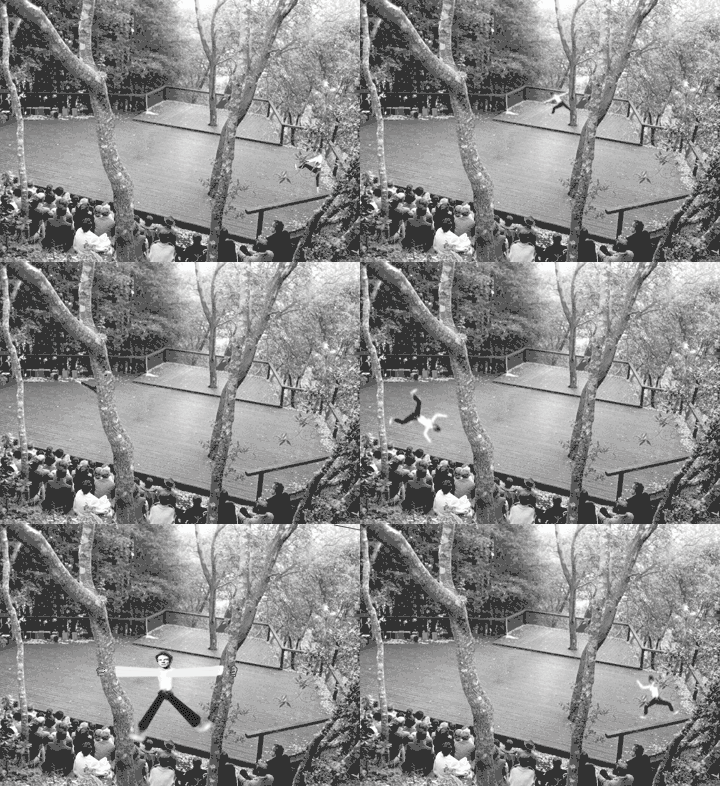

I too knew that my wife could not be contained on a rectangular deck for she is uncontainable, so I improvised with an deck area that could be danced on several levels. The outer levels tilt so that anything placed on them slide off toward the center, and built with portals that promise escape but all lead circuitously back to the main dance area, rather like a hamster habitat. I rounded the edges and varied the angles for nature has few straight lines and fewer right angles and my wife is nature personified, and that made the whole deck railing more difficult, you see, which I then electrified because I knew she would make several attempts at an over-the-rail vault. The deck areas are also surrounded by a moat that I populated with piranhas that I feed regularly by dropping in a steak so they're veritably trained to converge en mass, along with back up electric eels and those really gross blood-sucking slugs, all to discourage wandering beyond the safety of boundaries I set forth with my architecture. The deck itself is fitted with sprinklers at its farthermost points that spray a mist with power hose force to warn the little sylph-like dancing scamp whenever her dance gives the appearance of breaking loose or she nears the end of her retractible chain.And then Chip proceeded to animate a dancer for the odd, improvised dance deck.
And now, it's your turn to dance. Dance all night in the comments, backward in eternal graceless circles, tortuously, fashionably, individualistically.
January 24, 2013
"There was dancing now on the canvas in the garden; old men pushing young girls backward in eternal graceless circles..."
"... superior couples holding each other tortuously, fashionably, and keeping in the corners — and a great number of single girls dancing individualistically or relieving the orchestra for a moment of the burden of the banjo or the traps."
Tortuously, fashionably... on the canvas in the garden, keeping in the corners (of the canvas)...
So there's a big square of canvas, maybe on top of the grass, that makes a dance floor, and the couples, with the women going backwards, don't overstep the boundary, whether they're young and pushed by old men or part of a couple of superior dancers. And then there are the females who dance alone. Individualistically or... what? They are bending over the knees of the drummers in the orchestra and allowing themselves to be strummed or beaten upon like a banjo or a drum. Or do you think they oust the band-member and do some drumming or strumming themselves? I'm thinking the latter. But the first image I got from today's "Great Gatsby" sentence was of single ladies becoming the instruments, offering up their voluptuous buttocks as a substitute for conventional instruments. On reflection, I merely see them grabbing an instrument and pretending to be a member of the band.
Tortuously, fashionably... on the canvas in the garden, keeping in the corners (of the canvas)...
So there's a big square of canvas, maybe on top of the grass, that makes a dance floor, and the couples, with the women going backwards, don't overstep the boundary, whether they're young and pushed by old men or part of a couple of superior dancers. And then there are the females who dance alone. Individualistically or... what? They are bending over the knees of the drummers in the orchestra and allowing themselves to be strummed or beaten upon like a banjo or a drum. Or do you think they oust the band-member and do some drumming or strumming themselves? I'm thinking the latter. But the first image I got from today's "Great Gatsby" sentence was of single ladies becoming the instruments, offering up their voluptuous buttocks as a substitute for conventional instruments. On reflection, I merely see them grabbing an instrument and pretending to be a member of the band.
March 29, 2012
Goodbye to Adrienne Rich and Earl Scruggs.
She was 82. He was 88. Famous people die in 3s — it has been noted — but who could complete the triad that begins with Rich and Scruggs?
He was the ultimate banjo player...
That's what poured into our ears back in the 60s, lubricated by banjo music. Adrienne Rich got her cultural foothold in the 60s:
I'm sure it was all about freedom, but I'm free of that now. Since I'm quoting Bob Dylan today:
He was the ultimate banjo player...
... best known for performing alongside the guitar-playing Lester Flatt with the Foggy Mountain Boys. Among their signature songs were “Foggy Mountain Breakdown,” which was used as the getaway music in the 1967 film “Bonnie and Clyde,” and “The Ballad of Jed Clampett,” the theme song of the 1960s television sitcom “The Beverly Hillbillies.”For TV and movie watchers of the 60s, this was the sound of freedom — Jed moves away from there, there being wherever it was that the poor mountaineer "lived," and Bonnie, she follows Clyde, who said to her:
You're different.... You know, you're like me. You want different things. You got somethin' better than bein' a waitress. You and me travelin' together, we could cut a path clean across this state and Kansas and Missouri and Oklahoma and everybody'd know about it. You listen to me, Miss Bonnie Parker. You listen to me.And later, she says: "You know what, when we started out, I thought we was really goin' somewhere. This is it. We're just goin', huh?"
That's what poured into our ears back in the 60s, lubricated by banjo music. Adrienne Rich got her cultural foothold in the 60s:
Once mastered, poetry’s formalist rigors gave Ms. Rich something to rebel against, and by her third collection, “Snapshots of a Daughter-in-Law,” published by Harper & Row, she had pretty well exploded them. That volume appeared in 1963, a watershed moment in women’s letters: “The Feminine Mystique” was also published that year.
In the collection’s title poem, Ms. Rich chronicles the pulverizing onus of traditional married life.....I'm going to pulverize your onus, baby. The funny thing though: Rich was a lesbian. And yet she married a man:
In 1953 Ms. Rich had married a Harvard economist, Alfred Haskell Conrad, and by the time she was 30 she was the mother of three small boys....I think I once bought one of her books. It seemed like something in the spirit of the times that one should partake of, but I never read it. I find most poetry annoying, and hers was no exception. I did read that essay "Compulsory Heterosexuality and Lesbian Existence," which all the radical feminists were taking terribly seriously circa 1990. It was the assigned text in one of the law school radical feminist reading groups I participated back in those days. There were all these earnest, intelligent, heterosexual women who studied that text and gabbed about it until they genuinely got their minds around the amazing realization that they should not be heterosexual. Not that they should be having sex with women, but in some other, conceptual way. I'd tell you what the concept was but my mind is not longer around that particular realization, and I don't have the time right now to redo all that hard intellectual work that I did amongst the feminists in 1990/1991.
By 1970, partly because she had begun, inwardly, to acknowledge her erotic love of women, Ms. Rich and her husband had grown estranged. That autumn, he died of a gunshot wound to the head; the death was ruled a suicide. To the end of her life, Ms. Rich rarely spoke of it.
I'm sure it was all about freedom, but I'm free of that now. Since I'm quoting Bob Dylan today:
A self-ordained professor’s tongue
Too serious to fool
Spouted out that liberty
Is just equality in school
“Equality,” I spoke the word
As if a wedding vow
Ah, but I was so much older then
I’m younger than that now
October 14, 2011
PBS effort to expand arts coverage yields "the usual safety-first pledge-week fare."
Says Terry Teachout (in a very amusing WSJ column). Excerpt:
This week the network launches its new arts initiative with a "festival" of nine arts-related programs...
Except for [one dance show], all nine programs are carefully designed to please those members of the gray-ponytail set who prefer politically correct popular culture to high art. Straight plays? Who needs 'em? Jazz? Bor-ing. As for the visual arts, they don't even exist in the unserious, unchallenging world of the PBS Arts Fall Festival. Instead we get recycled Puccini, goosed-up Gilbert and Sullivan and yesterday's grunge rock....Ha. I'm on the same page as Teachout, including being kinda interested in "Give Me the Banjo."
[I]n theory, PBS isn't commercial—except, of course, that it really is. It's an audience-driven business that dons the discreet fig leaf of public service in order to justify the government subsidies, corporate contributions, foundation grants and individual donations that keep it afloat. And what do we get for all that money? "Antiques Roadshow" and "Masterpiece Mystery!"
July 25, 2011
"And if the elevator tries to bring you down/Go crazy (Punch a higher floor!)."
Prince lyric, which just occurred to me in the context of the feminist-in-the-elevator-at-the-atheist-convention incident. Prince was telling us to live now, because we're all going to die, which he sometimes said clearly — "You better live now/Before the grim reaper come knocking on your door" — and sometimes said absurdly — "Let's look for the purple banana/Until they put us in the truck." He also expressed a clear belief in the afterlife. ("In this life/Things are much harder than in the afterworld/In this life/You're on your own.") He's no atheist. How he behaves in an actual in-this-life elevator, as opposed to a metaphorical elevator, I have no idea. I bet he silently occupies his corner and avoids eye contact, in classic elevator etiquette, and waits for his floor.
Sorry I can't link to a Prince "Let's Go Crazy" video. Prince is super-possessive about his songs and doesn't appreciate the value of letting people like Althouse win him new fans. So here's 1. Beck, "Elevator Music" and 2. Eminem, "Elevator." Beck says:
ADDED: Actually, for now, at least, here's Prince, "Let's Go Crazy."
AND: For the sake of completeness, there is at least one more elevator/banana song.
Sorry I can't link to a Prince "Let's Go Crazy" video. Prince is super-possessive about his songs and doesn't appreciate the value of letting people like Althouse win him new fans. So here's 1. Beck, "Elevator Music" and 2. Eminem, "Elevator." Beck says:
All the dudes with banjosEminem says:
Chicks with wicks
Animals with bananas...
That’s a no no who even she knows dada’s f-cking crazyWhether those are purple bananas, I don't know.
Fucking animal, cookoo, bananas, fucking AP
ADDED: Actually, for now, at least, here's Prince, "Let's Go Crazy."
AND: For the sake of completeness, there is at least one more elevator/banana song.
May 1, 2010
"A panic surged through me as I realized there were only two weeks until taping — and over two hundred countries whose capitals and major geographical landmarks had to be committed to relatively long-term memory."
My colleague Shubha Ghosh writes about his experience on "Jeopardy":
The coolest thing about Mr. Hannan — Joseph Hannan — was not that he went on "Jeopardy." It was that he wrote a novel about being a teacher — "Never Tease a Dinosaur" — and it was made into a TV pilot — "Hey, Teacher" — that starred Dwayne Hickman. Dwayne Hickman was Mr. Hannan. So, practically, Mr. Hannan was Dobie Gillis!
It's sad that there's so little trace on line of the things from that era. I wish I could find the full text of "Never Tease a Dinosaur." I wish I could find a video clip of "Hey, Teacher." (The pilot aired in1964 — back when the networks filled in the summer schedule with pilot episodes of shows that never got sold.) I did find a tiny obituary for my old guidance counselor. The obit spells his name 2 ways — Hannon and Hannan — and makes me wonder now if I got it right.
Teachers and TV quiz shows. It's all good.
ADDED: A reader sends me the January 13, 2008 obituary in The Record (nicely written by Jay Levin). This isn't otherwise available on line, so I can't give a link. Text after the jump:
I also had to start watching the show again. The program guide on the Jeopardy web site indicated that the show aired at the same time accident attorneys, payday loan makers, and diet doctors advertise on the airways, and I set the DVR accordingly. The show used to be on after dinner, a nice way to end the day and begin the evening. Re-engaging with Jeopardy, I asked myself: What had I committed to by agreeing to be a contestant? Was I a part of a desperate franchise? Such thoughts were put aside quickly as I worked through, among other lists, the countries in the Commonwealth of Independent States and the names of people who would succeed President Obama. VP, Speaker of the House, Secretary of State, and so forth....That's from part 1. The series continues, but the show aired yesterday, so we already know what happened. I won't spoil it for you, but it set my thoughts flowing back to my junior high school guidance counselor, Mr. Hannan. He was on "Jeopardy" in the early 1960s, and it was horrifying when he lost because he confused cirrus and cumulus clouds — probably on a big "Double Jeopardy" bet. We'd all learned the different kinds of clouds, and Mr. Hannan had even taught science! How could it be! But he was good natured about it, and we accepted that you've got to understand what it's really like trying to think and remember things when you're caught in the bright camera lights. [CORRECTION: The teacher I'm remembering wasn't Mr. Hannan, but a science teacher whose name I've forgotten. The material that follows, however, about Mr. Hannan, is, as far as I know, correct.]
The coolest thing about Mr. Hannan — Joseph Hannan — was not that he went on "Jeopardy." It was that he wrote a novel about being a teacher — "Never Tease a Dinosaur" — and it was made into a TV pilot — "Hey, Teacher" — that starred Dwayne Hickman. Dwayne Hickman was Mr. Hannan. So, practically, Mr. Hannan was Dobie Gillis!
It's sad that there's so little trace on line of the things from that era. I wish I could find the full text of "Never Tease a Dinosaur." I wish I could find a video clip of "Hey, Teacher." (The pilot aired in1964 — back when the networks filled in the summer schedule with pilot episodes of shows that never got sold.) I did find a tiny obituary for my old guidance counselor. The obit spells his name 2 ways — Hannon and Hannan — and makes me wonder now if I got it right.
Author Joseph Hannon died at age 84. Mr. Hannan wrote the book 1961 "Never Tease a Dinosaur." The book dealt with his experiences as an elementary school teacher in the 1950s. His observation of a man working in what was then a mainly woman's job. The book was the basis for the 1964 "Vacation Playhouse" TV pilot "Hey, Teacher." Dwayne Hickman starred as Mr. Hannan. Mr. Hannan served his country in the US Coast Guard during WWII.So I don't have a clip of Shubha missing his shot on "Jeopardy," and I sure don't have a clip of Mr. Hannan fluffing the cloud names on "Jeopardy," and I don't have a clip of Dwayne Hickman playing Mr. Hannan in "Hey, Teacher," but I do have a clip of Dwayne Hickman screwing up on "The Match Game":
Teachers and TV quiz shows. It's all good.
ADDED: A reader sends me the January 13, 2008 obituary in The Record (nicely written by Jay Levin). This isn't otherwise available on line, so I can't give a link. Text after the jump:
December 12, 2009
October 24, 2008
WaPo on "racial attitudes" in Wisconsin.
Jeez, they really made Wisconsinites look like a bunch of hicks!
IN THE COMMENTS: Original George said:
Dust Bunny Queen said:
Meade said:
IN THE COMMENTS: Original George said:
A clown making balloon-animals. Big-wheel bikes. An ol' timey band. Cloggers.
Looks like the Village from an episode of "The Prisoner."
Needs a big bouncing bubble-gum bubble....
Dust Bunny Queen said:
Oh, and they make you look like a bunch of hicks, because that's what they really really think you are.
Bitter and clinging to your guns and religion, banjos.....and cheese!!!
Meade said:
The Hick race, from which I descend, has a long proud history of tolerance for banjo players from every race, creed, and religion.
October 20, 2008
Eddie Adcock plays the banjo while undergoing brain surgery.
A perfectly sensible thing to do: "During the brain-implantation stage of the surgery, he was kept conscious in order to be able to play his Deering GoodTime banjo and assist the team of surgeons in directing the fine-tuning of their placement of electrodes in the brain -- an operating-room 'first.'"
December 18, 2007
Rubberbandjo.
I just noticed it would be really easy to become the #1 Google search result for "rubberbandjo." But if you really want to make a rubberbandjo, this looks like a plausible method. Or do you think "rubberbanjo" is a better spelling? Might as well capture the #1 for that too. Aw, come on. Don't tell me you're not fiddling with the office supplies as we wind down toward Christmas. Hmmm.... fiddling.... what have we got here....
IN THE COMMENTS: There's an effort to assemble the Alt House Band with everyone playing instruments concocted out of various items. I mention the washtub bass, and then matthew points us to the gas tank bass:
Loved it! Let me offer up one of my favorite songs with some of my favorite washtub bass:
AND: Let's have some whamola in this band:
MORE: Here.
IN THE COMMENTS: There's an effort to assemble the Alt House Band with everyone playing instruments concocted out of various items. I mention the washtub bass, and then matthew points us to the gas tank bass:
Loved it! Let me offer up one of my favorite songs with some of my favorite washtub bass:
AND: Let's have some whamola in this band:
MORE: Here.
February 7, 2004
So I watched the first of the Ed Sullivan Shows with the Beatles, intriguingly intact, including commercials. How strangely sedate the commercials of that time were! Each one emphasized closeups of the product with a voice earnestly, quietly making assurances about how well it would perform. A "shoe wax" would make your shoes look like they had been coated with a new layer of leather, shaving cream would stay moist for the entire duration of a shave, pancakes would rise quickly after flipping. A headache was represented by a closeup of a man's face with one white dot after another appearing on it as the voiceover intoned "pain, pain, pain." The headache remedy ad came on immediately after The Beatles had opened the show with three peppy songs, and surely gave many parents around the country the chance to make wisecracks about rock and roll causing headaches. At the end of the commercial, his headache gone, the man tightens up his tie and combs his thinning hair--as if he had never heard of The Beatles! But he was happy, in a pleasantly serene way, because he didn't have a headache, and he didn't know that he looked all outmoded after the three songs that had preceded him that night.
After the ads, Ed tells the kids in the audience to be good and pay attention to the other acts, because The Beatles would be back in the end of the show. Then out comes a comic magician in white tie who does a long card trick that depends heavily on the continued reappearance of a black card in a group of red cards. But it's black and white TV! And The Beatles were just on! Then he does a long trick involving pouring salt from a salt shaker!
The next act is the cast of Oliver! No, I'm not excited. The exclamation point is part of the title, Oliver! The first person to sing is Davy Jones, future Monkee, who played the Artful Dodger in the musical. How sweet that little Davy is the first person to sing on TV after The Beatles. He does just fine.
Next is Frank Gorshin who does about ten impressions in his few minutes, turning into one celebrity after another in a routine based on the wacky notion, what if movie stars held political office? He starts with Broderick Crawford, in an impression that I've also seen Jim Carrey do. Jim Carrey clearly copied Gorshin's Broderick Crawford, though Carrey, when I saw him do it, made it seem as though it was a special Carrey sort of madness that he would make a weird choice like Broderick Crawford to impersonate--especially interesting since Carey played a role Gorshin had made famous, The Riddler. Anyway, Gorshin was just brilliant, doing Brando, Kirk Douglas, Burt Lancaster, Dean Martin, and more.
The true horror of the evening is Tessie O'Shea, a very large woman who belted songs and played the banjo in a way that must have made sense when people still remembered vaudeville. The strange time overlap represented by this show reaches its height as Tessie tosses her white fur boa about and sings about her "curves" while stroking her huge abdomen.
Then there's a comedy routine, a lesser Stiller & Meara called McCall & Brill, and finally The Beatles come back for two more songs, ending with "I Want to Hold Your Hand." But there's still more time on the clock, so out comes a comic acrobat, a woman encased in a costume that makes her torso appear to be a face. Somehow she's able to make the eyes look back and forth as she does a little dance and ends by taking off the costume hat, which had been covering her head. Great! Then The Four Fays come out and do comic acrobatics for a few minutes, ending with their finale: one woman lies down on a table, gripping its edges, and two other women each grab one of her feet and run around the table several times in opposite directions. The audience loves it!
That's the big show!
UPDATE: I revisit this post on the 50th anniversary of this episode of the show in 2014 and provide some links to YouTube and more.
After the ads, Ed tells the kids in the audience to be good and pay attention to the other acts, because The Beatles would be back in the end of the show. Then out comes a comic magician in white tie who does a long card trick that depends heavily on the continued reappearance of a black card in a group of red cards. But it's black and white TV! And The Beatles were just on! Then he does a long trick involving pouring salt from a salt shaker!
The next act is the cast of Oliver! No, I'm not excited. The exclamation point is part of the title, Oliver! The first person to sing is Davy Jones, future Monkee, who played the Artful Dodger in the musical. How sweet that little Davy is the first person to sing on TV after The Beatles. He does just fine.
Next is Frank Gorshin who does about ten impressions in his few minutes, turning into one celebrity after another in a routine based on the wacky notion, what if movie stars held political office? He starts with Broderick Crawford, in an impression that I've also seen Jim Carrey do. Jim Carrey clearly copied Gorshin's Broderick Crawford, though Carrey, when I saw him do it, made it seem as though it was a special Carrey sort of madness that he would make a weird choice like Broderick Crawford to impersonate--especially interesting since Carey played a role Gorshin had made famous, The Riddler. Anyway, Gorshin was just brilliant, doing Brando, Kirk Douglas, Burt Lancaster, Dean Martin, and more.
The true horror of the evening is Tessie O'Shea, a very large woman who belted songs and played the banjo in a way that must have made sense when people still remembered vaudeville. The strange time overlap represented by this show reaches its height as Tessie tosses her white fur boa about and sings about her "curves" while stroking her huge abdomen.
Then there's a comedy routine, a lesser Stiller & Meara called McCall & Brill, and finally The Beatles come back for two more songs, ending with "I Want to Hold Your Hand." But there's still more time on the clock, so out comes a comic acrobat, a woman encased in a costume that makes her torso appear to be a face. Somehow she's able to make the eyes look back and forth as she does a little dance and ends by taking off the costume hat, which had been covering her head. Great! Then The Four Fays come out and do comic acrobatics for a few minutes, ending with their finale: one woman lies down on a table, gripping its edges, and two other women each grab one of her feet and run around the table several times in opposite directions. The audience loves it!
That's the big show!
UPDATE: I revisit this post on the 50th anniversary of this episode of the show in 2014 and provide some links to YouTube and more.
Subscribe to:
Posts (Atom)


 Posts
Posts


