Showing posts with label Wordsworth. Show all posts

February 7, 2025

"Bliss was it in that dawn to be alive...."

Wrote William Wordsworth, in "The French Revolution as It Appeared to Enthusiasts at Its Commencement."

The famous old line came to mind as I was listening to "The Joe Rogan Experience" and Joe, talking about the first days of the new Trump administration, exclaimed: "Wild times! Just wild! Like what a fun time to be alive!"


Bret Weinstein followed on:
"It just feels different. I have to tell you, I don't know what's coming, but it's at least, it's at least delightful not to know what to think."
He's got delight, as Wordsworth's French revolutionaries had bliss, but Weinstein professes to find his delight in not knowing what to think. He's distancing himself and enjoying his distance. I think of the spectators who lined the Place de la Révolution. Did they have reservations about the guillotine? Did they think I don't know what to think and find that unknowingness delightful? 

Weinstein's thoughtfulness continued:
"The cynicism that was required to understand what was going on two months ago is now no longer required. You actually have to think about what you're, what you're told is coming down the pike and think, well, I don't know. Is that a solution? Is it, is that, yeah. Is it a negotiating tactic or is it a solution that's actually being proposed and would it work?"

Withhold judgment. Meanwhile, 10 more heads will have rolled.

September 26, 2024

"You would have to hike for days to catch the same views they saw travelling through.... She likens a moving train to 'the ultimate dolly'..."

"... the wheeled cart that allows a film camera to capture travelling, panoramic shots. It was 'bonkers' to discover how close the tracks ran to the rivers; on the west coast they were so close to the sea they were practically in it. There’s a snobbery, too, about certain states, which is both political and aesthetic. The central states are often dismissed as the 'flyover states' — miles and miles of cornfields worth seeing only from 35,000ft. But, Edwards says, the 'middle of nowhere' often gave her the most exciting shots. 'You could just see such a long way.... And when you did see something significant, it made it almost more unbelievable that it might be able to exist so far from all other activities.' The emptiness sometimes made her feel anxious.... 'Have I got enough shots? Is this interesting enough? Where is everybody? Where are all the animals?'"

From "Why I spent 180 hours on a train across America (with my dad)/Katie Edwards travelled 10,000 miles on Amtrak, taking 20,000 photographs on the way. She tells Laura Freeman what she saw out of the window" (London Times).

Edwards grew up in the Lake District in England, which makes me think of William Wordsworth and his dedication to walking. Walking, you can always stop and look at whatever you want. It's easy to take photographs (or, if you must, write a poem in your head, stomping out the meter). But I like Edwards's train photography project. It was easy to catch sight of many more things, but difficult to get the shots at the right time (and to deal with reflections in the window glass). 

I like seeing the outsider's view of America:

June 24, 2024

"Alvin Bragg, the Manhattan district attorney, last week dropped most of the 46 cases against pro-Palestinian demonstrators charged..."

"... in the April 30 siege of Hamilton Hall at Columbia University because prosecutors had little proof that the cases would stand up at trial. There was limited video footage of what took place inside the campus building.... The protesters wore masks and covered security cameras, preventing prosecutors from identifying those who had barricaded the doors and smashed chairs, desks and windows during the 17-hour occupation.... For similar reasons, prosecutors also dismissed charges against nine of the 22 students and staff members at City College who were arrested inside a campus building and charged with burglary during a protest that took place on the same night as the arrests at Hamilton Hall."

The NYT reports.

"Representative Jerrold Nadler, also a Democrat and the longest-serving Jewish member of the House of Representatives, said he had 'the uttermost faith in D.A. Bragg.'"

AND: What deep emotions stirred within Nadler that caused him to... utter... the strange word "uttermost"? My instinct was to regard it as not a word at all, but a whiffed attempt at "utmost." But I looked it up, and it's a word. The OED has it used by Hobbes ("From the uttermost parts of the Earth") and Milton ("To the uttermost convex Of this great Round") and Shelley ("From the corners uttermost Of the bounds of English coast") and Wordsworth ("A voice of uttermost joy") and Ruskin ("To speak with uttermost truth of expression") and Carlyle ("His accounts lie all ready, correct in black-on-white to the uttermost farthing"). Yes, I can answer my question "What deep emotions...?" The answer: the urge to bullshit.

June 19, 2024

"Another acquaintance he made in Paris [in 1792] was John Stewart, an eccentric figure known as 'Walking Stewart.'"

"His nickname came from the fact that he had walked halfway round the world, from Madras, through Persia, Arabia, Abyssinia, much of North Africa, and every country in Europe as far as Russia. He refused to take carriages because they were both elitist and cruel to horses. He came to believe that there was an impending 'universal empire of revolutionary police terror' that would 'bestialize the human species and desolate the earth.' The police state would ban his books, so he urged readers to translate them into Latin (a precaution against the supposed decay of the English language) and bury them seven feet underground. Their locations would be passed down orally until the dawn of the age of the Stewartian man made their disinterment possible. Despite these bizarre beliefs, Thomas De Quincey, who wrote a wonderful essay about him, said that his political views ‘seemed to Mr Wordsworth and myself every way worthy of a philosopher.'"

June 18, 2024

"These are my 2 ravens. They're not actually mine. I'm just taming them...."


1. Is this a political message in metaphor?


2. Is this just exactly what it is — a man interacting with wildlife that happens to frequent his backyard?


3. The use of "taming" prods us to read the relevant section of "The Little Prince"

March 25, 2023

"William Wordsworth swore by walking, as did Virginia Woolf. So did William Blake."

"Thomas Mann assured us, 'Thoughts come clearly while one walks.' J.K. Rowling observed that there is 'nothing like a nighttime stroll to give you ideas,' while the turn-of-the-20th-century novelist Elizabeth von Arnim concluded that walking 'is the perfect way of moving if you want to see into the life of things.' And ask any deep thinker about the benefits of what Bill Bryson calls the 'tranquil tedium' walking elicits. Jean-Jacques Rousseau admitted, 'There is something about walking that animates and activates my ideas.' Even the resolutely pessimistic Friedrich Nietzsche had to give it up for a good saunter when he allowed, 'All truly great thoughts are conceived while walking.'"

From "Whatever the Problem, It’s Probably Solved by Walking" by the writer Andrew McCarthy (NYT).

October 18, 2022

It's not early spring but mid-fall, and I have no idea why Spotify decided I ought to listen to a reading of "Lines Written in Early Spring"...

I'd just finished listening to my old favorite radio show, Jean Shepherd — a great episode, "Prison Life" — and I was out running in the woods at sunrise and had not even touched my iPhone, when I heard a sonorous voice launch into what I now know is Wordsworth:

August 8, 2022

"Rather than working late on a Friday evening, organising the annual team-building trip to Slough or volunteering to supervise the boss’s teenager on work experience..."

"... the quiet quitters are avoiding the above and beyond, the hustle culture mentality, or what psychologists call 'occupational citizenship behaviours.'... TikTok posts about quiet quitting may have been inspired by Chinese social media: #TangPing, or lying flat, is a now-censored hashtag apparently prompted by China’s shrinking workforce and long-hours culture.... 'The search for meaning has become far more apparent. There was a sense of our own mortality during the pandemic, something quite existential around people thinking "What should work mean for me? How can I do a role that’s more aligned to my values?"'"

From "Quiet quitting: why doing the bare minimum at work has gone global/The meaninglessness of modern work – and the pandemic – has led many to question their approach to their jobs" (The Guardian). 

I blogged about quiet quitting 2 weeks ago, here. And I blogged about tangping in June 2021, here. And click my tag "idleness" for various manifestations of my interest in this concept over the years — my blogging years. 

But I've been interested in it for as long as I remember. The Guardian article mentions "Bartleby, the Scrivener," which had a big impact on me when I was a high school student. Talk about a quiet quitter! 

Somewhat noisier examples from my high school English classes that got into my head: "Walden" and "The World Is Too Much With Us":

April 29, 2020

"While Wordsworth — who wrote of the French Revolution, which was raging when he was aged 19: 'Bliss was it in that dawn to be alive' — is recognised as a revolutionary..."

"... arguably his views on poetry were stronger.... In ['Radical Wordsworth: the Poet Who Changed the World,' Sir Jonathan Bate] cautions against popular assumptions about the poets. He writes that 'among those labelled Romantics, there were abolitionists, vegetarians, advocates for women’s rights and animal rights and what we would now call an environmental ethic.' Wordsworth, while championed as the inspiration behind the national parks movement and a believer in spiritual attachment to the environment, would balk at some of the aims of Extinction Rebellion. Bate... said that although Wordsworth may have lost the radicalism of his youth, he would also have had reservations about modern concepts, such as rewilding, which is letting nature rule unhindered by human intervention. 'He’d say that not just because, like so many of us, he went from youthful rebellion to aged conservatism but also because he believed that the conservation of the environment depends on respect for ancient traditions of stewardship, as exemplified by the hill farms of the Lake District.'"

From "William Wordsworth ‘would have marched with Extinction Rebellion’" (The London Times).

I had to look up "Extinction Rebellion."

It's funny to take a dead person and make assertions about what side he'd be on in some current dispute. But which version of this dead one is relevant? Might as well take your pick:
“The young Wordsworth would have marched with them,” Bate said. “But the older Wordsworth would have written sonnets saying, ‘Lock them up’.”

March 6, 2019

"Do we want a livid warrior or a happy one? Someone eager to name and shame enemies, the way Donald Trump does, or someone with a less Manichaean outlook?"

"Someone poised to reciprocate Trump’s nastiness or someone incapable of it? I’m not entirely sure which type is more likely to defeat him. But I know which gives us a better chance at healing America — if that’s even possible — and moving us past a juncture of crippling animosity. It’s the type that Hickenlooper represents and maybe even exemplifies.... Optimism, warmth and joy matter. They propelled Ronald Reagan to the presidency. I think they’re even a small part of the Alexandria Ocasio-Cortez phenomenon — the part that leavens the stridency and purity tests. She has a wide, dazzling smile. In a video that went viral, she dances. Some of the Democrats who are pursuing or seriously considering presidential bids are better at dancing, metaphorically speaking, than others. It doesn’t come easily to Bernie Sanders, which is why he added all that poignant family history to his big speech on Saturday, or to Elizabeth Warren, which is why she sipped a beer in an Instagram video that was part of her rollout. It’s effortless for Beto O’Rourke. It’s present in Cory Booker. It comes and goes with Kamala Harris, who’s still calibrating her temperature.... Hickenlooper sees a sunny approach — one that emphasizes aspirations over grievances — as the necessary balm for a grossly divided country and the most potent antidote to Trump...."

From "Does John Hickenlooper Have a Secret Weapon? Maybe nice guys finish Trump" by Frank Bruni (NYT).

The second-most-up-voted comment is from someone with the insight to adopt the screen name "Me":
Just no.

I’m done with “happy”, “consensus-building” Democrats. I’m still young, and I want to see transformational change in this country before I’m dead— enough with the baby steps.

Time to bring the fire.
Bruni uses but doesn't delve into the phrase "happy warrior." To me, it means Hubert Humphrey:
Humphrey's consistently cheerful and upbeat demeanor, and his forceful advocacy of liberal causes, led him to be nicknamed "The Happy Warrior" by many of his Senate colleagues and political journalists.... As Vice President, Humphrey was criticized for his complete and vocal loyalty to Johnson and the policies of the Johnson Administration, even as many of his liberal admirers opposed the president's policies with increasing fervor regarding the Vietnam War.... [H]is nickname, "the Happy Warrior", was used against him.... 
And I see that William Safire wrote one of his "On Language" (NYT) columns about the phrase. This was back in 2004, when John Kerry was running for President. A WaPo columnist had just written that Kerry was "dour" and no one would call him "the happy warrior," and a Democratic Senator had just insulted President George W. Bush as "the happy warrior" who "strutted" about his military adventures.

Safire informs us that the phrase originated in a William Wordsworth poem, "Character of the Happy Warrior" (1807)(''Who is the happy Warrior? Who is he/That every man in arms should wish to be?.... Whose high endeavors are an inward light/That makes the path before him always bright:/ . . . But who, if he be called upon to face/Some awful moment to which Heaven has joined/Great issues, good or bad for human kind,/Is happy as a Lover'').

Safire tells the story of how the phrase got from the Wordsworth poem into American political discourse. In 1924, Franklin Roosevelt had the task of putting the name Al Smith up for nomination at the Democratic National Convention. Smith campaign manager Joseph Proskauer had written a speech using the phrase, and FDR rejected it — saying "You can't give poetry to a political convention." So FDR drafted his own speech, but it was worse, and he ended up giving in.  Insisting that it would be "a flop," he gave Proskauer's "Happy Warrior speech." But it went well, so he claimed he'd given his own speech with that one bit from Proskauer ''stuck in.'' Proskauer sulked.

So much for happiness.

October 28, 2016

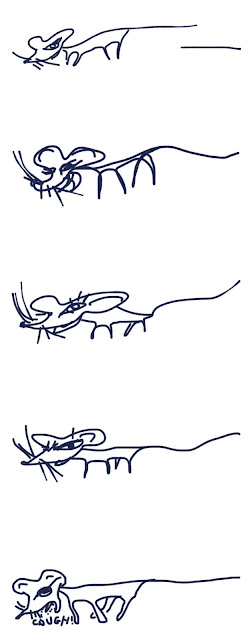
Last night's rats.


Drawn by finger in texts to Meade last night, without thinking.

I'm remembering them now as I read about rats in the NYT: "How the Brown Rat Conquered New York City (and Every Other One, Too)." I take the trouble to try to draw the rat in one of this pictures...


Ack! Too much detail.

Not enough room in the window for my favorite parts, the steppin'-out paws....


Too much detail to take account of. I need to look away, forget about it, and try again later going on whatever impression is left on my brain... the tiny paw-tracks of memory.

Makes me think of Wordsworth: "Poetry is the spontaneous overflow of powerful feelings: it takes its origin from emotion recollected in tranquility." Recollected. That's key.

July 14, 2014

Blogging from a small place, an experience in triplicate.

My colleague, the intrepid traveler, Nina Camic, is spending a lot of time on the little Scottish Isle of Islay, with lots of photographs, including plenty of stuff about whisky, which wasn't a particular passion of hers as I assume it is for most travelers who hop over to the isle for a day or 2. Go here and keep scrolling and scrolling, and when you get to the bottom, click "older posts" and scroll some more, and click "older posts" again. And if you're up for more intense attention to a Scottish island, here's the 2009 set of blog posts from the Isle of Skye.

I like this approach of really settling into a small place and needing to find more than the hot spots you'd tick off if you followed one of those New York Times "36 Hours in [Wherever]" articles.

It might be quite challenging, and you might get bored — especially if you're the sort of person who goes traveling because you get bored at home. But if you have a blog and the right Spirit of the Blogger, everything you see is triplicated: 1. The basic living-through-the-experience observation that all travelers have, 2. The recognition of bloggability that involves you in taking photographs and making mental notes and fluidly imagining how these things might later take form in a post, and 3. The experience relived as you discover the contents of your camera on your computer screen and compose the writing that will surround it with narrative. With this amplification of experience, a very minor experience like a couple sheep in the road becomes mythic.