I'm reading "Why Kids Are Starting to Sound Like Their Grandparents/The strange resurgence of words like 'yap' and 'skedaddle'" (NYT).
10 ఫిబ్రవరి, 2026
"The urge to bring back old words is evergreen..."
I'm reading "Why Kids Are Starting to Sound Like Their Grandparents/The strange resurgence of words like 'yap' and 'skedaddle'" (NYT).
25 జనవరి, 2025
"Herman Melville captured, without endorsing, the nationalist fervor in his novel 'White Jacket': 'We Americans are the peculiar, chosen people...'"
Writes David Brooks, in "How Trump Will Fail" (NYT).
I can see why this image of a wild, raw, aspiring America appeals to Trump....
Do you see why a tame, cooked, demoralized America appeals to his antagonists?
Not for delectations sweet/Not the cushion and the slipper, not the peaceful and the studious/Not the riches safe and palling, not for us the tame enjoyment....
19 డిసెంబర్, 2024
"You’re not actually finished until you do read poetry on the weekends for fun."
All of that was in an r/bobdylan discussion of this new clip of Timothée Chalamet, getting (too far?) into his impersonation of Bob Dylan:
Welcome to the Church of Bob, Timmy. 🙏🏻🎶❤️
— Melanie Young 🔧 (@FreewheelinMY) December 18, 2024
pic.twitter.com/g7N7S9DfBk
14 సెప్టెంబర్, 2024
"The Long Path is a 358-mile hiking trail that begins at the 175th Street subway station in Manhattan and runs to Thacher State Park, just south of the Adirondack Mountains."
Writes Casey Kelbaugh, in "Walking From Manhattan to the Catskills on the ‘Long Path’/Intrigued by a trail marker he spotted upstate, a photographer set out to follow a meandering — and little-known — hiking route north from New York City" (NYT)(free access link).
Afoot and light-hearted I take to the open road,
Healthy, free, the world before me,
The long brown path before me leading wherever I choose.
11 ఏప్రిల్, 2024
"In sharing her preferred title and pronouns, Ms Wood celebrates herself and sings herself – not in a disruptive or coercive way, but in a way that subtly vindicates her identity, her dignity, and her humanity."
I celebrate myself, and sing myself,
And what I assume you shall assume,
For every atom belonging to me as good belongs to you.
11 జూన్, 2023
"I grew up in South Korea, where there are two words that can roughly translate as 'laziness': geeureum and gwichaneum."
Is English lacking the words for this distinction between 2 types of laziness? I can see that I have a tag for "laziness" and a separate — and important! — tag for "idleness." There are also many English words in the general area: "apathy," "inertia," "lethargy," "sluggishness," "sloth," "lassitude," "loafing" (I loafe and invite my soul, I lean and loafe at my ease...)....
27 డిసెంబర్, 2022
Was Louisa May Alcott a trans man?
Alcott, we're told, "used the names Lou, Lu or Louy." And:
29 జూన్, 2022
You've heard of the smoking gun. Now comes the splattering ketchup.
He motioned for me to come in and then pointed towards the front of the room near the fireplace mantel and the TV, where I first noticed there was catsup dripping down the wall and there was a shattered porcelain plate on the floor. The valet had articulated that the President was extremely angry at the Attorney General's AP interview and had thrown his lunch against the wall, which was causing him to have to clean up. So I grabbed a towel and started wiping the catsup off of the wall to help the valet out. And he said something to the effect of, he's really ticked off about this. I would stay clear of him for right now. He's really, really ticked off about this right now..... There were — there were several times throughout my tenure with the Chief of Staff that I was aware of him either throwing dishes or flipping the tablecloth to let all the contents of the table go onto the floor and likely break or go everywhere.
Now that we know about the ketchup — "catsup" — what should we do? How off the norm is it to express anger in the White House by throwing an object?
I think first of Hillary Clinton throwing a lamp at Bill. Did that happen? I'm seeing "That ‘Hillary Clinton threw a lamp/book/Bible’ story has been circulating for ages" (WaPo):
21 సెప్టెంబర్, 2021
"This T-shirt has a straightforward message: 'i put ketchup on my ketchup.'"
From "An Accidental Collection/How I amassed more T-shirts than I can store" by Haruki Murakami (The New Yorker).
This could be the kind of joke I've seen many times over the years. I remember hearing it long ago when some character on TV (I think it was Gidget's unattractive female friend [Larue]) said she was so excited her "goosebumps have goosebumps."
That made a big impression on me when I was a teenager — "My goosebumps have goosebumps." Even at the time, I think, I wondered Is this a good template for humor or is it too dumb?
One answer is Who cares about being sophisticated! I’m gonna do what I want!
4 ఆగస్టు, 2020
Elegant split-screen editing as Nike hopes to inspire togetherness.
Details at AdWeek: "Clever Video Editing Portrays a Message of Unity in Nike’s Latest Powerful Spot/Wieden+Kennedy produced the third ad in 'You Can't Stop Us' campaign."
Like the other two spots in the campaign, “You Can’t Stop Us,” which has the same name as the overall campaign, draws on the sense of community from being socially isolated during a global pandemic. However, unlike the other two spots, the third 1.5-minute video also touches on the feelings stirred by the resurgence of the Black Lives Matter movement following the police killings of George Floyd in Minneapolis and Breonna Taylor in Louisville, Ky.The voiceover narration is done by Megan Rapinoe, the soccer player.
Ah! I'm glad to see that I didn't just imagine that I'd created a tag "oneness."
ADDED: I had to publish this post and click on the tag to see where I got the idea the idea that "oneness" was going to be important. I don't know whether to laugh or cry when I see that the last time I used it was on November 15, 2008 for "The Office of the President-Elect speaks!/Listen up!"
Oh, my Lord, did I think Obama was going to bring us together? No, no, actually not. I had my cruel neutrality:
31 డిసెంబర్, 2019
"The 20th-century German philosopher (and victim of the Nazis) Walter Benjamin warned how fascism engages an 'aestheticization of politics'..."
From "Why We Will Need Walt Whitman in 2020/With our democracy in crisis, the poet and prophet of the American ideal should be our guide" by Ed Simon (in the NYT).
What's so bad about boring? Some things — important things — you want to be boring (for example: the operation of your internal organs). I'd prefer a boring government. I don't like people getting all emotional about politics. Rather than pumping up the pro-democracy propaganda and rhetoric, why don't we give respect to boredom. Let politics be boring so our own individual life engages our interest.
I have a tag "I'm for Boring." I started that tag here (in 2014). Reacting to a WaPo columnist who fretted about low turnout in elections, I said:
Boring!... I mean hooray for boredom in politics.
4 జులై, 2019
"It is a sure sign that summer has arrived in China when men start rolling up their shirts, ideally resting them on the natural ledge of their beer belly."
From "A mainstay of the Chinese summer, the ‘Beijing bikini,’ is under threat" (WaPo). Top-rated comment:
"It’s as if they are taking the sky as their quilt and the earth their bed." — Beautiful language, but the ancient wisdom is captured in this story: "What are you doing meditating in your hut with no pants on?" "The whole world is my hut. This small room is my pants. What I want to know is, what are you doing in my pants?"I tried to track down that "ancient wisdom." I'm always dubious about references to "ancient Chinese wisdom." It's here, in one book at least... at most? I'm skeptical, but also, it's not an apt joke — that's all it is, a joke, not wisdom, even if it is ancient — because it's one thing to be naked in your home, another thing to inflict it on others in public. But as we say in American free speech analysis: Avert your eyes.
13 ఏప్రిల్, 2019
"Ten days after my surgery, I have to go back to work. I’ve been teaching through the months of chemotherapy, but..."
From "What Cancer Takes Away/When I got sick, I warned my friends: Don’t try to make me stop thinking about death" by Anne Boyer, a fantastically well-written essay in The New Yorker. Her book "The Undying: Pain, vulnerability, mortality, medicine, art, time, dreams, data, exhaustion, cancer, and care" will be out in September.
I've only copied a small extract, chosen not because it's the most impressively written part of the essay, but because: 1. The subject is teaching — the way the students don't know what is happening inside their teacher and a truly heroic carrying on would go entirely unnoticed (3 hours!), and 2. I love Walt Whitman, and I like how Boyer (a poet) follows the invocation of Whitman with a Whitmanesque list of her own.
Would you like Walt Whitman to read "The Sleepers" to you?
11 ఏప్రిల్, 2019
"I live here in a ruin of debris—a ruin of ruins."
... Traubel also sifted through the heap of manuscripts, letters, books, envelopes, magazines, and slips of paper strewn all over Whitman’s second-floor bedroom. “I live here in a ruin of debris—a ruin of ruins,” Whitman sheepishly admitted. If he proposed to burn or tear up a letter, Traubel intervened, and whenever the young man asked for some document, Whitman handed it over without protest....I'm blogging this because "a ruin of ruins" fits with something I've been thinking about: the rhetorical device seen a few days ago in the phrase "Shen’s cult following on social media had a cult following on social media." In the comments to my blog post, I said:
This could be the kind of joke I've seen many times over the years. I remember hearing it long ago when some character on TV (I think it was Gidget's unattractive female friend [Larue]) said she was so excited her "goosebumps have goosebumps."Clearly, "a ruin of ruins" is another example.
I was trying to think of other examples of the form. One would be: "My dog's fleas have fleas."
Anyway... I'm interested in Walt Whitman too. I liked this from the article:
Traubel was a committed socialist, which Whitman decidedly was not. “How much have you looked into the subject of the economic origin of things we call vices, evils, sins?” Traubel gently needled his friend. Smiling, Whitman replied with good humor, “You know how I shy at problems, duties, consciences: you seem to like to trip me with your pertinent impertinences.”And there's a big excerpt from the book, "Walt Whitman Speaks: His Final Thoughts on Life, Writing, Spirituality, and the Promise of America" (which you can buy at that link). I'll give you an excerpt of the excerpt.
This is all on a topic very much in the news these days. Can it change your mind?
10 ఫిబ్రవరి, 2019
Amy Klobuchar hears America singing.

The event is over now, so I've taken down the link to the live feed. I didn't get to hear much of the speech, but the heavy snowfall was a fantastic touch. Loved it. And loved the quoting of Whitman. She recited the first line of the poem that I'll reprint in full:
I hear America singing, the varied carols I hear,Beautiful... but I hear the poem crying out for parody. When I got to "The carpenter singing his as he measures his plank or beam," I wanted to rephrase that to include Jeff Bezos. Is that wrong? I feel that the nighttime party of Whitman's young, robust, friendly fellows would make that poem into a bawdy song lampooning the billionaires and politicians.
Those of mechanics, each one singing his as it should be blithe and strong,
The carpenter singing his as he measures his plank or beam,
The mason singing his as he makes ready for work, or leaves off work,
The boatman singing what belongs to him in his boat, the deckhand singing on the steamboat deck,
The shoemaker singing as he sits on his bench, the hatter singing as he stands,
The wood-cutter’s song, the ploughboy’s on his way in the morning, or at noon intermission or at sundown,
The delicious singing of the mother, or of the young wife at work, or of the girl sewing or washing,
Each singing what belongs to him or her and to none else,
The day what belongs to the day—at night the party of young fellows, robust, friendly,
Singing with open mouths their strong melodious songs.
ADDED: Here's the full video.
I'll watch it now and update with any useful thoughts that occur to me.
ADDED: She began with a lot of boring thank yous and an emphasis on the location on an island in the Mississippi River. Then there was a lot of talk about the Mississippi, which contained the names of many states, and lead to the observation that the river ties us together.
"As your President, I will look you in the eye, I will tell you what I think, I will focus on getting things done. That's what I've done my whole life. And no matter what, I'll lead from the heart." That seemed worth transcribing, but it doesn't mean much other than as a slight cue to think of her as pragmatic. She proceeds to a lot of policy positions, none of which stood out to me as especially striking. Health insurance. Big Pharma. Common-sense gun legislation. Respect our troops.
She says that if we see obstacles in our path, we should think of the obstacles as the path. That's not the practical way to walk over a real landscape.
She rejects "foreign policy by tweet." And — since we're alluding to Trump — "Stop the fear-mongering and stop the hate."
She botches the translation of "E pluribus unum" and says "Out of one..." before correcting herself to "Out of many, one." That motto seems politically incorrect, no? But she called it "our North Star."
She was reasonably okay. And I loved the snow! I wish she'd ad libbed some wisecracks about it. Imagine what Trump would say if he found himself in an ever-increasing snow storm? I know what Trump said about Amy in the snow:
Amy Klobuchar announced that she is running for President, talking proudly of fighting global warming while standing in a virtual blizzard of snow, ice and freezing temperatures. Bad timing. By the end of her speech she looked like a Snowman(woman)!
7 ఆగస్టు, 2018
"The Nation Magazine Betrays a Poet — and Itself/I was the magazine’s poetry editor for 35 years. Never once did we apologize for publishing a poem."
We followed a path blazed by Henry James, who in 1865 wrote a damning review of Walt Whitman’s “Drum Taps,” calling the great poem “arrant prose.” Mistaken, yes, but it was James’s view at the time. And it was never retracted....You can read the poem and The Nation's apology here. Give The Nation some credit: It left the poem up. It just has this heavy-handed "Editor's note" introducing it. I'll reprint the whole thing:
Last month, the magazine published a poem by Anders Carlson-Wee. The poet is white. His poem, “How-To,” draws on black vernacular.
Following a vicious backlash against the poem on social media, the poetry editors, Stephanie Burt and Carmen Giménez Smith, apologized for publishing it in the first place: “We made a serious mistake by choosing to publish the poem ‘How-To.’ We are sorry for the pain we have caused to the many communities affected by this poem,” they wrote in an apology longer than the actual poem. The poet apologized, too, saying, “I am sorry for the pain I caused.”...
As Katha Pollitt, a columnist for The Nation, put it, the magazine’s apology for Mr. Carlson-Wee’s work was “craven” and “looks like a letter from re-education camp.”...
It would not be proper for me to comment on the aesthetic merits of Mr. Carlson-Wee’s piece. That’s the job of the magazine’s current poetry editors. But going forward, I’d recommend they follow Henry James’s example. Just as he never apologized for his negative review of Whitman, they had zero reason to regret their decision.
25 ఏప్రిల్, 2018
"A hat is a celebration of oneself. It is about presenting one’s most adorned, spit-shined, upright self to God, social media or, in this case, the history books."
The hat was a "magnificent halo of pure white light perched atop first lady Melania Trump’s perfectly groomed head."
Nothing else mattered. There was nothing else.So, I'm seeing 3 things the hat does: 1. Showing off (yay, me, trumpets!!!), 2. Creating a religious aura (looks like a halo, like a lady in church), and 3. Keeping everyone away (force field!).
That hat, broad-brimmed with a high, blocked crown, announced the first lady’s presence as boldly and theatrically as a brigade of trumpeters. It was the bright white hat of a gladiator worn on an overcast day, a kind of glamorous public shield when sunglasses would not do at all. That hat was a force field that kept folks, the wrong folks, from getting too close.
It was a diva crown. A grand gesture of independence. A church hat. The Lord is my shepherd. Deliver us from evil. Amen.
As to #3, the first thing I think of is the kissing. I saw Macron and Trump kissing. This was the greeting ceremony. Was none of that cheek kissing to be aimed at Melania?
But Givhan emphasizes independence from Trump: "A grand gesture of independence." And she combines #2 and #3 by continuing: "A church hat. The Lord is my shepherd. Deliver us from evil. Amen."
Remember, according to Givhan, the hat says everything: "Nothing else mattered. There was nothing else."
Silent, stoic, statuesque Melania cries out to the Lord. Yea, though I walk through the valley of the shadow of death — the White House, with my satanic president-husband — I will fear no evil: for thou art with me; thy rod and thy staff they comfort me.
ADDED: Of course, hats were huge in Trump's campaign. No one ever made as much headway through a hat as Trump. And when Hillary wore a hat, Rihanna wore a picture of it — Hillary + hat — on a T-shirt. And Hillary very famously wore a hat — a big blue hat (presaging a blue dress?) — at the first Bill Clinton inauguration.
ALSO: Is that first line quoted in the post title an intentional reference to Walt Whitman's "Song of Myself"?
I celebrate myself, and sing myself,But Melania could not have felt at ease on the grass at that tree-planting ceremony (where Brigitte Macron grasped Trump's shovel shaft). She along with Madame Macron was wearing stilettos. In order not to sink completely into the sod and get stuck, they were both tasked to walk and stand entirely on their toes.
And what I assume you shall assume,
For every atom belonging to me as good belongs to you.
I loafe and invite my soul,
I lean and loafe at my ease observing a spear of summer grass.
26 ఫిబ్రవరి, 2018
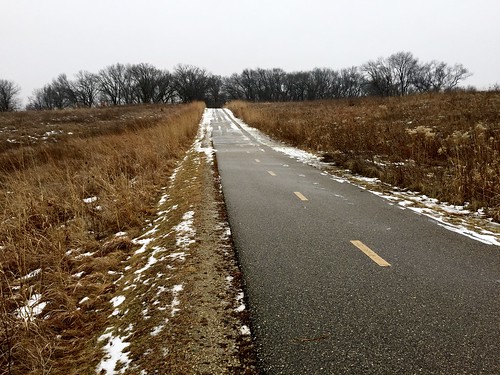
"A path is little more than a habit that comes with knowledge of a place. It is a sort of ritual of familiarity. As a form, it is a form of contact with a known landscape."

"... appears to be a bike path, not a road."
I love the Berry quote, and thanks to Etienne for bringing it to us. It perfectly explains why I, using that photograph and needing a title for the "café," could not bring myself to use the word "path," even though I knew for sure — what you were left guessing* — that it is the thing most people call a "bike path."**
___________________
* Danno observed that if it's not a bike path, it's got "a very wide stripe!"
** Actually, around here, the official term for a thing like that is "bike trail." So you may want to discuss the path/trail distinction or bring out evocative poetic quotes with "trail." There must be many, "trail" being an even more powerful word in the legend of America. The Chisholm Trail, the Appalachian Trail, etc. And yet "trail" refers to dragging something along behind you. The oldest meaning is the trail of a long robe. On the landscape, then, the "trail" is what those who've gone before have left behind. And "trail" has only meant "path" since the early 1800s. "Path" has referred to "A way or track formed by the continued treading of pedestrians or animals" for as long as we can find a language called English — the period the OED calls "early OE" (600-950). That's profound. And — here's where I change my mind and decide that "path" is more powerful than "trail" — the word "pathfinder" has special resonance (from the OED):
1840 J. F. Cooper (title) The pathfinder.4 great American names, clustered in the great English Dictionary.
1860 W. Whitman Leaves of Grass (new ed.) 425 The path-finder, penetrating inland, weary and long....
1847 R. W. Emerson Poems 169 Sharpest-sighted god.., Path-finder, road-builder, Mediator, royal giver.
1898 W. James Coll. Ess. & Rev. (1920) 408 Philosophers are after all like poets. They are path-finders. What every one can feel, what every one can know in the bone and marrow of him, they sometimes can find words for and express.
There is no word "trailfinder," though there is — we must give "trail" its due — "trail-blazer." But "trail-blazer" only arrives on the scene in the 20th century, and its earilest recorded usage cannot compare to the quadrumvirate of James Fennimore Cooper, Walt Whitman, Ralph Waldo Emerson and William James:
1908 Daily Chron. 19 May 3/2 Mrs. Hubbard's journey..with a small party of ‘trail blazers’ native to the ways of Labrador....The "trail-blazing development" was a planned suburban community in Miramar, Florida:
1957 V. Packard Hidden Persuaders xxi. 233 Tide, the merchandisers' journal, admonished America's merchandisers to pay attention to this trail-blazing development as it might be ‘tomorrow's marketing target.’
What does it mean to buy a "packaged" home in a "packaged" community? For many (but apparently not all) of the Miramar families it means they simply had to bring their suitcases, nothing more. No fuss with moving vans, or shopping for food, or waiting for your new neighbors to make friendly overtures. The homes are completely furnished, even down to linens, china, silver, and a refrigerator full of food. And you pay for it all, even the refrigerator full of food, on the installment plan.
13 జనవరి, 2018
"[I want] to treat this life, this massive datum which happens to be mine, as a specimen life, representative in its odd uniqueness of all the oddly unique lives in this world."
The quote in the post title came up in an interview with Terry Gross that I was just reading:
The behaviors you have to be comfortable with as the host of Fresh Air are behaviors that would be considered antisocial in almost every other context. Do you have to be weird to be the kind of interviewer you are?I wonder, is this the same usage of "specimen" as in Walt Whitman's "Specimen Days." I've to admit that I'd always compartmentalized that title with the knowledge that Whitman served as a nurse in the Civil War and therefore thought of "specimen" as a urine sample! But that can't be right!
You don’t have to be weird. I think what you have to do is really believe, as I do, that the interview serves a function.
What’s the function?
I like to quote John Updike on this. In his memoir, Self-Consciousness, which I really love, he said he wanted to use his life as “a specimen life, representative in its odd uniqueness of all the oddly unique lives in this world.” That’s kind of how I see interviews. When you’re talking to an artist, you can get insight into the sensibility that created his or her art and into the life that shaped that sensibility. I love making those connections. I think we all feel very alone. I don’t mean that we don’t have friends or lovers but that deep at our core we all have loneliness.
From "Specimen Days":
I suppose I publish... from that eternal tendency to perpetuate and preserve which is behind all Nature, authors included; second, to symbolize two or three specimen interiors, personal and other, out of the myriads of my time, the middle range of the Nineteenth century in the New World; a strange, unloosen'd, wondrous time....Though not about urine samples, this is not the same usage of "specimen" as Updike's. Whitman was saying this book has some samples of what has been in his life, but Updike was saying I am writing based on the idea that my life is an example of all lives.
You ask for items, details of my early life—of genealogy and parentage, particularly of the women of my ancestry, and of its far-back Netherlands stock on the maternal side—of the region where I was born and raised, and my mother and father before me, and theirs before them—with a word about Brooklyn and New York cities, the times I lived there as lad and young man. You say you want to get at these details mainly as the go-befores and embryons of "Leaves of Grass." Very good; you shall have at least some specimens of them all.....
7 ఆగస్టు, 2017
"The phrase well-rounded derives from phrenology..."
Whitman haunted the Phrenological Cabinet of Fowler & Wells.... On July 16, 1849, Whitman paid three dollars to have his skull read by Lorenzo Fowler. On a scale from 1 to 7, Whitman rated an exemplary 6.5 on such traits as benevolence, self-esteem, and firmness. He received one of his lowest marks for acquisitiveness, the pursuit of money and material gain. The low rating sat fine with Whitman, struck him almost as a veiled compliment. In his report, Lorenzo noted, “Size of head large . . . a certain reckless swing of animal will, too unmindful, probably, of the conviction of others.” He added, “You are yourself at all times.” Overall, Fowler painted a flattering picture of Whitman, casting him as a well-rounded modern man. (The phrase well-rounded derives from phrenology and is based on the notion that an actualized person has a nicely shaped head, without any distortive bumps.) The results greatly pleased Whitman.Is that really true? I'm seeing in the OED that "well-rounded" to refer to visible objects like trees and horse's hooves is very old, but in reference to a person's character it does go back only to the mid-19th century when phrenology was was the rage. The oldest quote comes from Henry Wadsworth Longfellow — "There was something so complete and well-rounded in his life." Longfellow was loathed by Whitman, enough so that — according to the above-linked book — Whitman once insulted a man by calling him "a young Longfellow." Whitman's crowd understood:
The jibe was brief, pithy, and a direct hit: where Poe was this crowd’s patron saint, Longfellow was its bête noire. As a sentimental poet, Longfellow was anathema to many in the Pfaff’s set. They snidely referred to him as “Longwindedfellow.”By the way, here's how Whitman (in 1856) insulted the President of the United States: "The President eats dirt and excrement for his daily meals, likes it, and tries to force it on The States."
Here's an article in The Atlantic — "The Shape of Your Head and the Shape of Your Mind" — that reinforces the claim that the term "well-rounded" comes from phrenology:
The national obsession with head size and shape... infected daily conversation. Many modern phrases trace their roots to phrenology, including “highbrow” and “lowbrow,” “well rounded,” and “shrink” (as in “shrinking” certain undesirable qualities). “Getting your head examined” also has phrenological roots. Though generally considered an insult today, in the past, it was just what most people wanted.....ADDED: Pfaff's:
"Pfaff’s was the Andy Warhol factory, the Studio 54, the Algonquin Round Table all rolled into one."