Showing posts with label Wagner. Show all posts

February 16, 2026

"She does not feel self-conscious when she is on stage. It is only when she returns to the wings that she feels a little shy."

I'm reading "Why I’m performing Wagner naked at the Royal Opera aged 81/Illona Linthwaite won’t let being nude in front of 2,200 people stop her from defying the ‘bad press’ given to older women" (London Times).
“The curtain goes up and there’s nothing happening, it’s just me. I thought that was really frightening and then when it happened, I thought, actually, this is brilliant,” she said.
The role is Erda, in "Siegfried."
Erda is usually “frocked her up to the nines” in gossamer gowns, Linthwaite said, but Barrie Kosky, the director, wanted the octogenarian’s body to symbolise nature and remind the audience of their mortality.... 

That's the director's view — an old woman reminds you of death — not the old woman's. She thinks she's there to remind you of life: 

She thinks her performance is something of a political act in a country she views as “spiritually arid” for its lack of empathy towards older people. Ultimately, she wants the audience to look at her and see the future not as a tragedy, but an adventure. She wants people to feel: “Hey, I’m looking forward to 80.”

I asked Grok: "If you saw Erda in 'Siegfried' portrayed by an old woman would she remind you of death or life?" [ADDED: The actual full question was "What views are attributed to the character Erda in 'Siegfried' and if you saw her portrayed by an old woman would she remind you of death or life?"

Answer:

March 17, 2023

"It goes back to a poem by Yeats," said the architect Eric Owen Moss...

"... citing The Second Coming, which includes the line 'the centre cannot hold.' It is one of the many references he casually invokes throughout our conversation, from Moby-Dick to Dionysus and Apollo, the paintings of Gustave Courbet and Wagner’s opera Tannhäuser. I ask him about deconstructivism, the 1980s style of architecture with which he is associated, to which he responds that he prefers the term 'dialectical lyric.'... Moss may like to operate on a higher conceptual plane, but why should we care about the hermetic theories behind his big steel pile? 'That’s a fair question,' he shrugs. 'Does anybody give a shit? Is anybody listening? Maybe three people we know, one in London, one in Shanghai. But I think the effect of it is what interests me. It’s an opportunity to show there are other ways to imagine.' He narrows his eyes, as if summoning a momentous truth. 'What you see isn’t all there is to see. Can you listen for things you haven’t heard?'... Moss is right: there is more to see than we have seen. But it might be better for all of us if it remained unseen...."

December 16, 2014

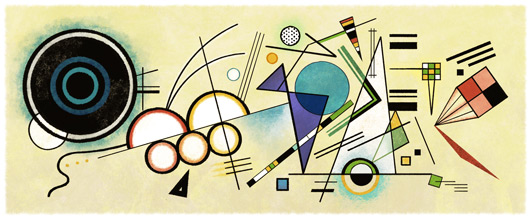
Beautiful job on that Google doodle for Wassily Kandinsky's 148th birthday.


The Guardian says:
Like symphonies, Kandinsky’s great abstract paintings speak directly to our senses and feelings. Their constellations of mysterious marks are like waves of sound that trigger emotions. For him, the world they pointed towards was a spiritual realm, a hidden truth.
The Telegraph says:
Despite the lack of medical proof for Kandinsky's synaesthesia, the correlation between sound and colour was a lifelong preoccupation for the artist. He recalled hearing a strange hissing noise when mixing colours in his paintbox as a child, and later became an accomplished cello player, which he said represented one of the deepest blues of all instruments.... Kandinsky discovered his synaesthesia at a performance of Wagner's opera Lohengrin in Moscow: "I saw all my colours in spirit, before my eyes. Wild, almost crazy lines were sketched in front of me."
The Independent:
Fifty seven of his paintings were confiscated by the Nazis during a raid on the Bauhaus art school and were later put on show in the State-sponsored exhibit “Degenerate Art” in 1937 before being destroyed.
I recommend Kandinsky's book "Concerning the Spiritual in Art" (free Kindle edition).

January 20, 2008

Intermission.

Intermission at the Metropolitan Opera:

IMG_0221.JPG

The ladies check their cell phones. From "Die Walküre" on Monday to "Jersey Boys" and "Wicked" on Friday and Saturday, I've spent the past week sitting in expensive chairs.

But Althouse, did you enjoy yourself? Review the shows!

Do I review shows? I think you'll find that I do not.

Not a shred of information? Of judgment?

I'm too afraid of being boring. I'm afraid to take those expensive seats because I'm afraid of being bored and I'm afraid to write about them because I don't want to be boring. I will say something about each show, but bear in mind that these are not reviews. These are just a few things I dare to say.

1. "Die Walküre." I never took Fricka seriously before. She seemed like the annoying wife who had to show up and sing once to make God do something he didn't want to do and set the tragedy in motion. But Stephanie Blythe made me really believe her point of view, a rock-solid ban on adultery. And isn't it fascinating to be so outraged by adultery, when there is also that brother-sister incest, which is what shocks the mortals in the audience? There are so many more adulterers in the audience than violators of the incest taboo.

2. "Jersey Boys." If you've been reading this blog from the beginning, maybe you know that back in 2004, I mourned that no one cared about The Four Seasons anymore. Less than 2 years later, a big Broadway show about them opened. But even though The Four Seasons were the first group I loved — and I loved them from the first few seconds of "Sherry" heard on the radio — I wasn't that eager to hear a singer impersonate Frankie Valli. I can't express how sublime that voice seemed to me when I was 11. Does Michael Longoria sound like him? Superficially, yes. But would I go to see a Four Seasons cover band? [ADDED: I mean tribute band.] Of course not. I love all the songs, but I'd rather play the originals. As for the story behind the songs, it's somewhat interesting and quickly told. But I'd rather play the originals and enter the deep emotional space of the past. Must I sit — contorting to see around the melon-headed man in front of me — to stare at the stage and and listen to a little man who is not Frankie Valli, who has a voice but no sex appeal?

3. "Wicked." Great set and costumes and neat, complicated story, but must every song in the show sound like those horrible, overblown pop songs they write for the finale of "American Idol"? Glinda and Elphaba got me thinking about Diana DeGarmo and Fantasia.
I'm through accepting limits
'Cuz someone says they're so
Some things I cannot change
But 'till I try, I'll never know
It's an "American Idol" song. And it goes on and on like that. Pursue your dreams! Be true to yourself! Don't let anyone stop you now! That's fine for you, but what about me?