March 24, 2024
"If I became a writer and artist of children’s books... it was not because I had in mind to create children’s books."
January 17, 2024
If not for homophobia, we could have had Utopia... through LSD.
November 13, 2022
Bob Dylan, rhapsodizing about blue.
About "Volare (Nel Blu, DiPinto Di Blu)" — "To Fly (In Blue, Painted Blue") — he writes:
You get the mental picture, Utopia, and it’s painted blue. Oil paint, cosmetics and greasepaint, frescoes with blue slapped on, and you’re singing like a canary. You’re tickled pink and walking on air, and there’s no end to space.... Supposedly it’s about a man who wants to paint himself blue and then fly away. Volare, it means, “Let’s fly away into the cielo infinito.” Obviously, the endless sky. The entire world can disappear but I’m in my own head.
About "Blue Suede Shoes":
These shoes are not like other shifty things that perish or change or transform themselves. They symbolize church and state, and have the substance of the universe in them, nothing benefits me more than my shoes.... They neither move nor speak, yet they vibrate with life, and contain the infinite power of the sun. They’re as good as the day I found them. Perhaps you’ve heard of them, blue suede shoes. They’re blue, royal blue. Not low down in the dumps blue, they’re killer blue, like the moon is blue, they’re precious. Don’t try to suffocate their spirit, try to be a saint, try to stay as far away from them as you possibly can.
There's other blue in the book — singing the blues, "Blue Bayou," "Blue Moon," "Blue Moon of Kentucky," blue veined, blue blooded, baby blue eyes, Bobby Blue Bland, Harold Melvin and the Blue Notes...
October 21, 2022
"Buckminster Fuller... was an American type—self-invented, overflowing with ideas and theories, eager to see the universe whole, and born to evangelize...."
From "Space-Age Magus/From beginning to end, experts saw through Buckminster Fuller’s ideas and theories. Why did so many people come under his spell?" by James Gleick (NYRB).
"He believed in a coming utopia. He thought no one should have to work
merely to earn a living. He had a gift for slogans: 'God is a verb.'
'Nature never fails.' 'Either war is obsolete, or men are.' 'Universe is
eternally regenerative.' One young listener said, 'When I listen to
Bucky talk, I feel I’ve got to go out and save the world. Then when I go
outside, I realize I don’t know how.'... Even Stewart Brand has come
to regret touting Fuller in the Whole Earth Catalog. 'Domes couldn’t
grow or adapt,' he says. 'When my generation outgrew the domes, we
simply left them empty, like hatchlings leaving their eggshells.'”
July 22, 2021
"After a long day of fighting Republicans in real life, I don’t always feel like fighting with hobgoblins in a game, even though the digital versions are at least bound by rules and artificial logic."
"So the game I keep coming back to, for well over a decade now, is the one that gives me ultimate control over every little detail of my virtual life: The Sims....I picked a neighborhood and moved all the prepackaged Sims out. I moved my Sim family and Sim friends in. I have to be around Sims that I want to be happy, after all. No Republicans are allowed in my game. I’ve even deleted the files of prepackaged Sims that give me any kind of Republican vibe.... The friends I do put in the game are people I really like in real life, people I’m happy to be reminded of as my Sim-self jogs through town... My world is much browner and, well, gayer than what I started with. That’s just what happens when you let Sims flirt with whomever they want and marry people who share their interests. But I do occasionally have to add a family I don’t personally know just to decrease the chances of inbreeding: So, the Obamas are in my game. Sasha grew up and married my grandson. I’m buried in their backyard. Frankly, I couldn’t write a better utopian postscript for myself: a founding member of a brown, gay, rainless world that banished Republicans who is buried under the kiddie swing of his progeny.... Sometimes, I just need the terrible world to leave me alone with my doll."
Writes Elie Mystal in "In My Own Private Utopia, There Is No Rain—or Republicans/In The Sims, one of my favorite video games, my goal is for everyone to be as happy as possible" (The Nation).
August 17, 2020
"Want to Flee the City for Suburbia? Think Again/The 20th century is full of examples of the false promise of suburban living."
The 20th century offers object lessons in why fleeing cities for suburban and exurban settings can backfire — even if it seems like a good idea at first. In the early 1900s, many large cities were suffering from the side-effects of rapid industrialization: they were polluted, full of high-density housing with bad sanitation. Crime flourished.... There were disease outbreaks, too... In response, a new wave of utopian thinkers proposed moving to... “the garden city”... As the craze for these British-style garden cities grew in the States, Frank Lloyd Wright wrote about building a uniquely American version. ... Wright argued that the Usonian city wouldn’t be a flight from modernity.... Brand-new inventions like telephones, radio and automobiles meant everyone’s work could be done remotely....Great! What's the problem? Why isn't this the answer today, when the ability to work remotely is much more well-developed?
20th century suburbia was not "Utopia." There were racially exclusionary policies, the houses were more expensive in reality than in theory, and people needed cars. That's the basis of Newitz's warning about "the false promise of suburban living." She concludes:
Ultimately, the garden city future is a false Utopia. The answer to our current problems isn’t to run away from the metropolis. Instead, we need to build better social support systems for people in cities so that urban life becomes healthier, safer and more sustainable.Some designers expressed Utopian ideas, but that doesn't mean it had to be Utopia to be worth doing at all. You have to live somewhere, and the alternative is also not Utopia. There's a lot that Newitz isn't saying here. Underlying her conclusions is, I think, a recognition that the cities are in decline — perhaps even approaching a death spiral. For the good of the city and all the people who don't have the means to leave, the more well-off people are encouraged to stay. If they go, the place will collapse. So please, city people with the means to relocate, stay here, keep paying taxes and give your wealth to the noble cause of making "urban life... healthier, safer and more sustainable."
Neither the city nor suburbia is Utopia, but what happens when the city is virulently dystopian? How long are people supposed to tough it out? Perhaps Newitz's point is only a small one: Don't imagine suburbia to be any better than it is. You're always trading one set of benefits and problems for another.
But you're always taking your own selfish interests into account even as you want to support the good of the group. In a real disaster, of course, you will run. Is the disaster here yet... and when is it too late to run?
But don't you want to be optimistic? Ironically, if you're optimistic about the cities at this point, you're more like the theorists of suburbia, who dreamed of Utopia.
March 19, 2020
"Stepping into a Wing location feels a little like being sealed inside a pop-feminist Biodome."
From "The Wing Is a Women’s Utopia. Unless You Work There/The social club’s employees have a story to tell about the company that sold the world Instagram-ready feminism" by Amanda Hess (NYT).
This sounds really funny, like something in a movie. Lisa Simpson, Anita Hill and Lady Macbeth — that got a big laugh from my imaginary movie-theater audience.
Anyway, what's the problem with the staff?
Most Wing employees I spoke with had ambitions bigger than their starting positions... Some staff members hired to work the front desk or run events saw their job duties inflated to include scrubbing toilets, washing dishes and lint-rolling couches.... When staff members tried to exercise their membership privileges, on breaks or after their shifts, members would hand them dirty dishes or barge in on them in the phone booth. Some screamed at employees about crowding in the space and cried over insufficient swag. A common member refrain was that it was anti-feminist not to give her whatever perk she desired....This is all so pre-coronavirus. But it's interesting to get a nudge to remember what would could be fretting about if we didn't have this plague infesting our consciousness.
And the name of that in-house babysitting annex, the Little Wing, makes me think of a circus mind that's running wild — butterflies and zebras and moonbeams... and fairy tales....
November 27, 2019
"In [Peter] Berlin’s ideal world, we would abandon work and fulfill the horny needs of society."
From "Peter Berlin, Retired Gay Porn Star and Selfie Pioneer, Thinks You Work Too Much" (New York Magazine).
Here's his book "Peter Berlin: Icon, Artist, Photosexual."
October 19, 2019
"So there is not the least bit of concern for what goes into the baby's body when being nursed by a man who has been pumped full of hormones?"
A top-rated comment at "Are We Ready for the Breastfeeding Father?/He has intrigued and disgusted for millenniums. He has also remained largely hypothetical, until now" (NYT). The article features an illustration of hairy chested man breastfeeding a baby. Hair in the baby's food!
The article reports on...
... a peer-reviewed case report confirmed that a transgender woman, assigned male at birth, [who] was able to breastfeed her child after she was put on a regimen of hormonal drugs..... Before the treatment, the patient had been receiving feminizing hormones for six years. We don’t know how long it would take for a cis man to induce functional lactation. But “we have a pretty good idea of the types of hormone cocktails that would be needed,” said Tamar Reisman, an endocrinologist with the Mount Sinai Center for Transgender Medicine and Surgery and one of the two authors of the case report....The article collects some interesting material on the subject of tales of men who were able to breastfeed (without any servings of "hormone cocktails"), not that you'll believe they were true:
“I just thought, ‘How cool if it would work!’” Mr. Bengtsson said. “Just imagine the extraordinary consequences it could have for our society.”
In the fourth century B.C., the philosopher Aristotle noted that some men were able to produce milk by squeezing their breasts. In the King James translation of the Bible, the breasts of the malnourished Job are described as full of milk. Later, in the Babylonian Talmud, we find a story of a widowed man whose “breasts opened and he nursed his child.”...The author continues:
By the end of the 19th century, the American physician George M. Gould and his colleague Walter L. Pyle listed, in their book “Anomalies and Curiosities of Medicine,” a number of instances of men suckling infants, including an unverifiable report, relayed by 16th-century missionaries in Brazil, claiming “there was a whole Indian nation whose women had small and withered breasts, and whose children owed their nourishment entirely from the males.”...
What is startling, when we dig into the history, is just how many great minds, from Aristotle to Darwin, have earnestly, and without judgment, pondered the question of men’s breast milk... [I]n Marge Piercy’s 1976 sci-fi novel, “Woman on the Edge of Time,” in which a woman named Connie is transported into the future — the year 2137 — where she sees a bearded man breastfeeding a child. She notes that he has breasts, “like a flat-chested woman temporarily swollen with milk.” Connie is angry at first: “How dare any man share that pleasure?” she thinks. But in the end, the world depicted in the book is ultimately intended as a gender-free utopia....If you want a gender-free utopia and you're willing to do artificial things to get there, why not just do what was already happening in America in the 1950s, switch to bottle-feeding formula. Both parents can do that. But the transgender movement isn't about making gender less important!
June 18, 2019
"Mr. Reich traced the metamorphosis of American society through three levels of consciousness: Consciousness I, the nation’s early self-reliance; Consciousness II, the conformism of the New Deal era..."
From "Charles Reich, Who Saw ‘The Greening of America,’ Dies at 91" (NYT).
July 27, 2018
"The utopian feminists are also eugenicists and anti-Semites; the men who dream of a perfect world where same-sex attraction is privileged also unconsciously mimic..."
Writes Adam Gopnik in "What Can We Learn from Utopians of the Past?
Four nineteenth-century authors offered blueprints for a better world—but their progressive visions had a dark side" (a New Yorker article about the new book “The Last Utopians: Four Late Nineteenth-Century Visionaries and Their Legacy” by Michael Robertson).
Edward Bellamy is the first of Robertson’s nineteenth-century utopians. When his blandly written book “Looking Backward” appeared, in 1888, it created a now puzzling craze both in his native America and in England. Bellamy’s hero falls asleep in 1887—bizarrely, he’s been entombed in a specially built cell designed to help cure his insomnia—and wakes up in 2000. Instead of immediately rushing off to see “Mission: Impossible 2,” though, he enters a world of communistic order. As Robertson rightly sees, Bellamy offers a nightmarish vision of a hyper-regimented society in which everyone works for the government and retires at forty-five, and where the most fun you can have is to go shopping by picking out goods from a catalogue, ordering them from big depots via pneumatic tube, and then having them delivered at home. Where Wells’s “The Time Machine,” which came out not long after, gave us pale Eloi and proletarian Morlocks, Bellamy was chiefly prescient about Amazon Prime....Much more at the link. Gopnik complains about Robertson's "too facile identification of utopianism with 'progressive' causes" — "only left-wing utopias are recognized."
As Bellamy’s book progresses, power, brutality, and the capacity to dominate become all that matters. Rules are made and harshly enforced. Robertson chides Bellamy for being inconsistently feminist, which is true, but what is chilling in Bellamy is how much of the totalitarian imagination is already in place in his work, and how alluring it can seem. It’s the same phenomenon that we find in the Athenian intellectual’s idealization of Sparta: intellectuals always dream of a closed society even though they themselves can exist only in an open one....
By the way, I learned from Gopnik that the word "dystopia" was first used by John Stuart Mill (in 1868). But when did that word catch on? I remember being in a conversation in the mid-80s with professors (and their spouses) where we were talking about science-fiction books and one of the male spouses (mine, actually) used the word "dystopia," and one of the professors (an unusually intelligent person) said he thought that was the condition where male genitalia grew inside the body. What was he thinking of? Ectopia? Or was that some weird humor? If the latter, it's not evidence that the word "dystopia" has caught on only fairly recently. I remember being surprised that this person didn't know the word, but over the years, I've leaned more in the direction of thinking he was pulling our undescended leg.
Here's the John Stuart Mill quote: "It is, perhaps, too complimentary to call them Utopians, they ought rather to be called dys-topians, or caco-topians. What is commonly called Utopian is something too good to be practicable; but what they appear to favour is too bad to be practicable."
To fussily correct the New Yorker — and only because of its longstanding reputation for fact-checking — Mill said "dystopian" (the adjective, not the noun "dystopia"). That's easily checked in the OED, where I learned that "dystopia" is first recorded in 1952:
1952 G. Negley & J. N. Patrick Quest for Utopia xvii. 298 The Mundus Alter et Idem [of Joseph Hall] is..the opposite of eutopia, the ideal society: it is a dystopia, if it is permissible to coin a word.Mill also said "caco-topians," and the noun form of that was used in 1818 by Jeremy Bentham: "As a match for Utopia (or the imagined seat of the best government), suppose a Cacotopia (or the imagined seat of the worst government) discovered and described."
I'm seeing one and only one appearance of "cacotopia" in the archive at The New Yorker, in "With 'Black Mirror,' Our Dystopia Gets the Television Show It Deserves" by Troy Patterson (January 2018):
Cacotopia is a synonym for dystopia coined, in the eighteenth century, from the Greek kakós, meaning “bad.” It shares that root with kakistocracy, a word that denotes government by the worst persons, and which therefore has gained unprecedented prominence in the past year. Anthony Burgess, discussing “Nineteen Eighty-Four,” favored the term on account of its gagging acrid sound: “I prefer to call Orwell’s imaginary society a cacotopia—on the lines of cacophony or cacodemon. It sounds worse.” Some academics differentiate between dystopian fictions as those that primarily contend with political oppression and cacotopian ones as those that foreground moral decline, and the distinction has its uses.
February 12, 2018
"They held a town pageant in Arden, Delaware, on September 5, 1910... One Ardenite, an anarchist shoemaker named George Brown, played a beggar."
I'm reading "Delaware's Odd, Beautiful, Contentious, Private Utopia/Arden is a suburb, an artist's colony, and a radical political experiment" by Jesse Walker at Reason.com.
I'm reading about Arden — here, in pre-dawn Madison, Wisconsin — because Meade and I were talking about growing up in the early 1960s, when you saw lots of kids outside playing all the time. I was thinking about the Arden store, where I blew my allowance every week on penny candy....

... which I ate all at once on that porch. The Arden Store, on the edge of Arden, was about 3 blocks from where I lived, in what Reason called the "ordinary suburban landscape." We thought of Arden as a strange place, where the artists lived and where taxation was very different.
The Single Taxers were followers of Henry George, a 19th century economist who argued that government should be financed solely by a tax on land values. No income tax, no sales tax, no tax on the improvements to a property—just one tax on land. The campaigners crisscrossed the state in armbands, knapsacks, and Union Army uniforms, delivering streetcorner speeches and singing Single Tax songs ("Get the landlords off your backs/With our little Single Tax/And there's lots of fun ahead for Delaware!").... The invasion was a flop....
December 4, 2017
"I asked if he is a feminist. 'Of course,' he said. 'The opposite of feminism is ignorance.'"
Who knows if he believes the aphorism or even if it's true? Truth is rarely the point of an aphorism.* And truth can't be why Mr. Prats Monné generated this particular aphorism. He's performing in the theater of feminism, where men must continually make an effort to understand what is happening.** Prats Monné speaks of ignorance, and he demonstrates his non-ignorance not by making a truthful assertion — surely there are some non-ignorant ways to stand apart from feminism — but by making the extra effort, taking the trouble to construct an aphorism.
The meeting took place in Iceland, which is, we're told, a "tiny gender utopia where selling pornography has been banned since 1869*** and the world’s first openly lesbian prime minister was elected in 2009."
The ground floor was packed with women and a sprinkling of men, most of them security guards and journalists. Mr. Prats Monné, a regular at conferences, said the room not only looked different, but sounded different, too: “It’s so quiet,” he said.Kissing. You can't go up to women and just kiss them. Even to say that's what you do can get you in trouble. I'm thinking of Trump's much-reviled remark: "I just start kissing them. It's like a magnet. Just kiss. I don't even wait."
Next to us, two women — a center-left lawmaker from Europe and a conservative one from the Middle East — met for the first time. They hugged and kissed. Mr. Prats Monné mostly shook hands.
“It is a cohesive group that has its own signs and body language,” he said, his inner anthropologist emerging. “They acknowledge each other as being from the same tribe. I’m not from their tribe — although I do feel very welcome.”
Who gets to do the social kiss? Only people who feel no sexual attraction to each other? But how do you know the person you're kissing isn't attracted to you? You could make sure you're not attractive.
Anyway, Trump didn't say he likes to kiss everyone hello. He specified beautiful women and feeling "automatically attracted." Unless you spread your kisses around, you can't palm them off — lip them off — as social kissing. You need to be part of a "tribe," a "cohesive group that has its own signs and body language."
If you read far enough into the linked article, you'll see some contradiction to the "gender utopia" characterization of Iceland:
Iceland is living its own #MeToo moment, after the country’s youngest female lawmaker, Aslaug Sigurbjörnsdottir, 27, went on television last week to share her experience: of rumors that she had slept her way up, of a rival candidate putting his hand on her thigh every time he addressed her in front of a room full of students.And there's this illustration. Note the caption (click to enlarge):
An hour after the program aired, Ragnar Önundarson, a banker, had reposted one of her Facebook pictures. “I want you to think about the kind of image you project,” he had written.
A day later you could buy T-shirts featuring a troll with the caption “Don’t be like Ragnar,” and by now 500 people have signed a petition supporting Ms. Sigurbjörnsdottir.
_____________________
* You disagree? You're disagreeing with an aphorism. Checkmate!
** We're seeing some ludicrous performances in this making of an effort, like the one we were laughing at yesterday:
I just want to say I am going to take time to reflect on this, to educate myself daily, and to strive towards a more enlightened path. I want to ensure that all voices around me are heard, and that everyone is treated respectfully and empathetically. More than anything, I want to create an environment that is a better, safer and fairer place.*** They have a ban on pornography because — like us — they banned it long ago. Unlike us, they failed to get around to recognizing free speech rights, so the ban survived. I'd be more impressed at the strength of the feminism in Iceland if they'd first embraced strong free-speech rights and got rid of the old censorship based on fear and prudishness and then banned it, despite the recognized value of free speech, specifically because they'd determined that suppression of pornography was necessary to the even higher value of the equality of women.
May 29, 2017
"Here on land, the seasteaders propose, ideas about how to govern societies have stagnated. Politics is too entrenched..."
From "Libertarians Seek a Home on the High Seas/The unlikely rise—and anti-democratic impulses—of seasteading," by Rachel Riederer in The New Republic, who observes that the seasteads represent "a very particular set of politics," politics based on the free market," and:
When [government] works, it protects the vulnerable and guards the commons—essential tasks at which the free market so often fails. Ocean dwellers will also need those protections. Much as we might like to, we can’t escape the political, even by walking into the sea.
December 17, 2016
"Watching #Calexit create a firestorm online reminded me of a book published in 1975 that predicted this very idea."
In Ecotopia, Ernest Callenbach tells the tale of a West Coast utopia that secedes from a nation consumed by capitalistic greed. According to Callenbach’s vision, Northern California joins Washington and Oregon in seceding from the United States, essentially writing off Los Angeles as a car-obsessed bubble of heathens. While maybe the car-obsessed thing hasn’t changed, the prevailing attitude of young Los Angelenos has...That reminds me: "It's Official: Clinton's Popular Vote Win Came Entirely From California."
Fast-forward to 2016, and much like the book prophesied, we have a state that is directly at odds with the rest of the nation....
If you take California out of the popular vote equation, then Trump wins the rest of the country by 1.4 million votes. And if California voted like every other Democratic state — where Clinton averaged 53.5% wins — Clinton and Trump end up in a virtual popular vote tie.
September 4, 2016
But isn't the whole thing a vacation from sense? If you create another world, then what sense flows from that?
'What happened last night should be known on social media,' [White Ocean Camp] wrote in a post on its Facebook page. 'A very unfortunate and saddening event happened last night at White Ocean, something we thought would never be possible in OUR Burning Man utopia. A band of hooligans raided our camp, stole from us, pulled and sliced all of our electrical lines leaving us with no refrigeration and wasting our food and, glued our trailer doors shut, vandalized most of our camping infrastructure, dumped 200 gallons of potable water flooding our camp.... We have felt like we've been sabotaged from every angle, but last night's chain of events, while we were all out enjoying our beautiful home, was an absolute and definitive confirmation that some feel we are not deserving of Burning Man... We actually had someone from the organization tell us that in paraphrase "it makes sense that you have been sabotaged as you are a closed camp and not welcoming."'Well, of course, it makes sense.
But isn't the whole thing a vacation from sense? Nonsense gives rise to new sense. If you create another world, then what sense flows from that?
"If this unusual thing is true, what else is true?"/Si Haec Insolita Res Vera Est, Quid Exinde Verum Est?" That's the motto of the improv organization Upright Citizens Brigade, which I happened to be reading about (in The New Yorker) when I encountered this dipshit revolution at Burning Man.
June 28, 2016
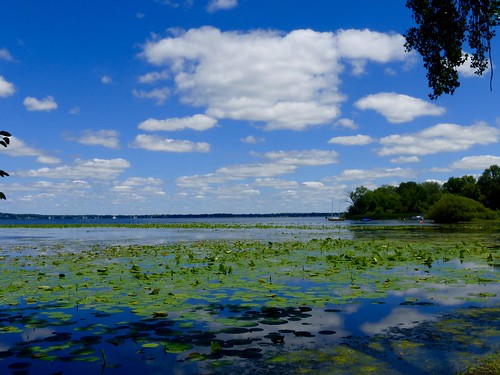
Beautiful Lake Mendota...
July 29, 2015
"I once lived in a hippie commune is Taos, New Mexico in 1972. Best time of my life. Peace, love, the sexual revolution..."
Top-rated comment at a HuffPo article titled "Haunting Nude Photos Bring 1970s Hippie Community Back To Life/From 1969 to 1977, Taylor Camp became a hippie's utopia on the island of Kauai."
October 25, 2014
Did Chris Christie react to the charge that he was using his power as chair of the Republican Governors Association to undercut Scott Walker's reelection bid?
That's from a Washington Post article noting that the Republican Governors Association has just put another $1 million into ads for Scott Walker's reelection. The headline of the article puts the emphasis on Walker's state of mind — "RGA puts additional $1 million into Wisconsin ad buys as Walker frets" — but I think Christie's is the more interesting mind about which to speculate.
Walker is trying to get reelected and the polls show a close race. That's a mundane objective reality. The subjective matter of how that feels to him — whether he "frets" — is dumb in the same way that it's dumb for reporters to ask, say, a person whose house is burning down "How do you feel?" The answer is already known: How do you think I feel? There's nothing about the subjective aspect of the story that isn't inherent in the objective aspect of the story.
But what's going on in The Mind of Chris Christie? That's where the subjective part of the story is complex and speculation-ripe.
Here's the above-referenced Weekly Standard article: "Does Chris Christie Have Scott Walker's Back?"
"The Center for Public Integrity reported Thursday that Walker and his backers spent nearly $6.1 million on ads through Monday, while Burke and her supporters ran nearly $6.6 million," the AP reported on Thursday. On Sunday, Walker told the Washington Post's Robert Costa: "We are always looking for more help. Our main help has to be the RGA." But according to the Center for Public Integrity, the Republican Governors Association has spent $5.9 million on TV ads in Michigan, where Governor Rick Snyder is up for reelection, and just $801,000 on TV ads in Wisconsin.ADDED: Writing this post made me want to look the word "fret" up in the OED. The original meaning is to eat, to devour, referring to the behavior of nonhuman animals. It still has that meaning in the sense of a small animal — like a worm or a moth — consuming or wearing away something by gnawing at it. The figurative usage is very old, the passions and various irritants consume or wear away at a person's mind. Nathaniel Hawthorne wrote: "So many curiosities drive one crazy, and fret one's heart to death." The intransitive use — "To distress oneself with constant thoughts of regret or discontent; to vex oneself, chafe, worry" — is also very old, going back to 1551, first in a translation of Thomas More's "Utopia": "He..so fret so fumed & chafed at it."
Why would the RGA spend more on Rick Snyder than Scott Walker?...
I like the verb "fret," and use it a lot, probably mostly to make a person seem fussy and overly inward. But searching this blog to find how I've used "fret," I see the first thing that comes up is a fond tribute to an old Kinks song: "Don't You Fret." And there's a reference to the famous line from "MacBeth": "Life's but a walking shadow, a poor player/That struts and frets his hour upon the stage/And then is heard no more: it is a tale/Told by an idiot, full of sound and fury/Signifying nothing." And, remember, MacBeth was already king when he said that. Chris Christie, on the other hand, is only the Thane of New Jersey.
August 9, 2014
"By now, my body resembles a corpse, thin with only skin and bones..."
From the Diary of Poch Younly, dated February 9 to July 29, 1976.
“Why is it that I have to die here like a cat or a dog ... without any reason, without any meaning?” he wrote in the spiral-bound notebook’s last pages....
[T]he diary is... one of just four known firsthand accounts penned by victims and survivors while the Khmer Rouge were in power, compared to 453 such documents written by communist cadres at the time....
The Khmer Rouge were emptying Cambodia’s cities, marching millions of people into the countryside to work as manual laborers. Their aim was to create an agrarian communist utopia, but they were turning the Southeast Asian nation into a slave state.
Younly “didn’t believe what was happening. He kept saying, ‘Don’t worry, we’ll be back soon, don’t pack much,’” his widow said. She ignored his advice, and took as much as she could — including five of her husband’s school notebooks, and several blue ink pens.