So begins "Once hailed for decriminalizing drugs, Portugal is now having doubts" (WaPo).
July 8, 2023
"Addiction haunts the recesses of this ancient port city, as people with gaunt, clumsy hands lift crack pipes to lips, syringes to veins."
So begins "Once hailed for decriminalizing drugs, Portugal is now having doubts" (WaPo).
April 18, 2022
"I was an older woman and I couldn’t get hired. I always wanted to travel the world, write and take photographs. I thought why not take 10 years and go?"
"If I run out of money and I’m not a famous writer, I’ll come back and be a Starbucks barista or a Walmart greeter."
Said Heidi Dezell, 57, quoted in "Want to Retire in Portugal? Here’s What to Know, as Americans Move There in Droves. Retirees are drawn by a low cost of living, healthcare, a sunny climate and tax incentives" (Wall Street Journal).
For some, Portugal’s newfound popularity comes with a cost. “Americans are challenging the loudness scale,” says Susan Korthase, 71, founder of the Americans & Friends in Portugal Facebook group. She moved to Portugal from Milwaukee in 2010 and says she now sees the “Californiacation” of Portugal. “You hear them in restaurants,” she adds. “Americans laugh with an open mouth and they laugh out loud. Other nationalities have a quiet chuckle.”...
We're being updated on trends by a newspaper that can't spell "Californication." They're writing about laughing while not perceiving the contents of the portmanteau. Maybe the Americans who laugh too much for Milwaukeean taste are getting more of the jokes.
I think every person in this article is female. It ends with the story of Linda Correll, 52, an Ohioan who found a small apartment in Porto where "When it rains heavily, all the water comes into my apartment."
“I don’t know if I have met any men over 50 who came here by themselves,” says Ms. Correll. “You get a lot of couples, but single women are much more common for some reason.... It’s a safe country, and the people are friendly,” she says. “The healthcare, the food, the whole vibe is the reason I’m here. I don’t have any desire to go back to the States to live.”
She says "for some reason," and then she, unwittingly, gives the reason. You're leaving your home country for some very bland comforts and no excitement. But maybe this article will prompt some older male Wall Street Journal readers to quit their job now and retire to Portugal. There are lots of health-and-safety-loving Midwestern ladies there longing — in their leaky apartments — for a man maybe something like you.
ADDED: For those who think the Red Hot Chili Peppers coined the word "Californication," here's the Wikipedia article, "Californication":
August 3, 2020
"The feelings that hurt most, the emotions that sting most, are those that are absurd - The longing for impossible things, precisely because..."
Wrote Fernando Pessoa, the Portuguese poet.
Here's a statue of him at a café in Lisbon — seated, with his own table, like another customer.

cc — Nol Aders
A fascinating character!
Pessoa was a prolific writer, and not only under his own name, for he created approximately seventy-five others, of which three stand out, Alberto Caeiro, Álvaro de Campos and Ricardo Reis. He did not call them pseudonyms because he felt that they did not capture their true independent intellectual life and instead called them heteronyms. These imaginary figures sometimes held unpopular or extreme views....
October 28, 2019
"If experiential travel signifies engaging meaningfully with the people, history, environment and culture of a destination (like a local, not a tourist), then transformational travel is..."
From "Can a ‘Transformational Journey’ Change Your Life? Our Writer Had Her Doubts/Seeing the world “through new eyes” was the aim of a rigorously planned trip to Portugal, offered by a new breed of tour operator. It almost worked." (NYT). The photograph at the top at the link looks (unintentionally) like a skull. Oh! I see it's the thing that's supposed to be like a vagina.
I'm interested in that Black Tomato "Get Lost" idea. When I was a teenager, I used to drive my car until I got lost, then try to find my way back home. But that's not really possible anymore, not if you have a phone that sees where you are and gives you directions. Does Black Tomato take away your phone? This service you pay for is strangely like getting victimized by a crime. Some will rob you with a sixgun and some with a fountain of youth promo.
April 26, 2013
"Following Portugal's April 1974 Carnation Revolution..."
Luís Cabral, Amílcar Cabral's half-brother, became President of Guinea-Bissau. Following independence local soldiers that fought along with the Portuguese Army against the PAIGC guerrillas were slaughtered by the thousands. A small number escaped to Portugal or to other African nations. The most famous massacre occurred in Bissorã. In 1980 PAIGC admitted in its newspaper "Nó Pintcha"... that many were executed and buried in unmarked collective graves in the woods of Cumerá, Portogole and Mansabá.Today's "History of" country is Guinea-Bissau.
March 25, 2013
How did this happen?
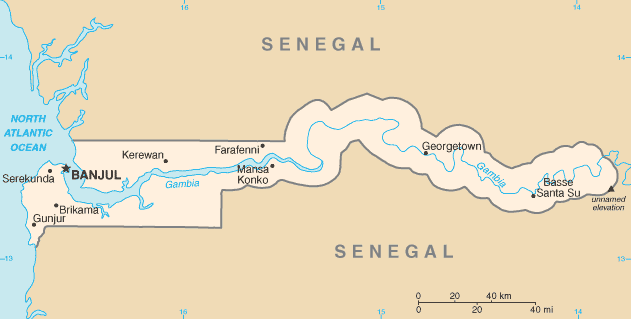
A river, a country: It's The Gambia, today's "History of" country.
In medieval times the area was dominated by the trans-Saharan trade. The reign of the Mali Empire, most renowned for the Mandinka ruler Mansa Kankan Musa, brought world wide recognition to the region due to its enormous wealth, scholarship, and civility....
As time went on the area began to suffer from continuous Moroccan and Portuguese invasion and looting. By the end of the 16th century, as the raids continued, the empire collapsed and was conquered and claimed by Portugal....
During the late 17th and throughout the 18th century, Great Britain and France constantly struggled for political and commercial supremacy in the regions of the Senegal and Gambia Rivers....
An 1889 agreement with France established the present boundaries, and the Gambia became a British Crown Colony, divided for administrative purposes into the colony (city of Banjul and the surrounding area) and the protectorate (remainder of the territory).
March 24, 2013
"Portuguese traders who arrived in the 15th century named the country after the Portuguese word gabão, a coat with sleeve and hood..."
France assumed the status of protector by signing treaties with Gabonese coastal chiefs in 1839 and 1841. In 1849, the French captured a slave ship and released the passengers at the mouth of the Komo; The slaves named their settlement Libreville, French for "free town." In 1910 Gabon became one of the four territories of French Equatorial Africa, a federation that survived until 1959.Gabon is today's "History of" country.
Union... travail... justice...
February 15, 2013
In 1491, King Nzinga a Nkuwu was baptized as the first Christian Kongolese king João I.
February 1, 2013
January 14, 2013
"The Arab navigator, Ahmad Bin Majid, visited Bahrain in 1489..."
"In Awal (Bahrain) there are 360 villages and fresh water can be found in a number of places. A most wonderful al-Qasasir, where a man can dive into the salt sea with a skin and can fill it with fresh water while he is submerged in the salt water. Around Bahrain are pearl fisheries and a number of islands all of which have pearl fisheries and connected with this trade are 1,000 ships."Today's "History of" country is Bahrain.
January 6, 2013
What's the difference between Kwanzaa and Kwanza?
But let's get back to the history of Angola, as quickly scanned via the "History of Angola" Wikipedia page, in accordance with our 206-day project. The name Angola comes from "N'gola," the Kimbundu word for king.
January 7, 2011
"We’re given menus, but they’re in Portuguese. The waiter has a handful of English words and as best as..."/"Asbestos? They had asbestos?!"
August 12, 2007
"Bullfighting in Portugal is like a play with the ending missing... Killing the bull is an art..."
The crowd had begun waving white napkins and chanting, “Kill the bull! Kill the bull!” [Pedrito] recalled in an interview. Eager to satisfy, he pulled out his sword and stabbed the raging half-ton bull in its spinal cord. He received a standing ovation, was hoisted on the crowd’s shoulders and paraded through the streets....We are lovers! We fight bulls but don't kill them. Our dictators are less authoritarian, and our conquerors refrain from pillaging. Come on, that's a concept of love, isn't it?
The case spawned a national debate here. His supporters argue that a death-free struggle is a sacrilege because the culmination of a bullfight should reflect man’s ultimate triumph or defeat against the bull, while critics contend that Portugal must retain its civility and show humanity to animals....
Sociologists here say that bullfighting in Portugal is less of a blood sport than in Spain because the Portuguese, compared with the Spanish, are “soft machos.”
Marcelo Rebelo de Sousa, a leading cultural commentator, notes in this regard that António de Oliveira Salazar, the dictator who ruled Portugal for nearly 40 years, was less authoritarian than Francisco Franco in Spain. Furthermore, he says, rather than pillaging their empire, as the Spanish did, the Portuguese married and reproduced with the inhabitants of their colonies.
“We Portuguese are lovers, not fighters,” he said. “And this is reflected in most aspects of our culture, including our approach to bullfighting.”