Full transcript here. Excerpts:
Mukasey లేబుల్తో ఉన్న పోస్ట్లను చూపుతోంది. అన్ని పోస్ట్లు చూపించు
Mukasey లేబుల్తో ఉన్న పోస్ట్లను చూపుతోంది. అన్ని పోస్ట్లు చూపించు
23 ఆగస్టు, 2015
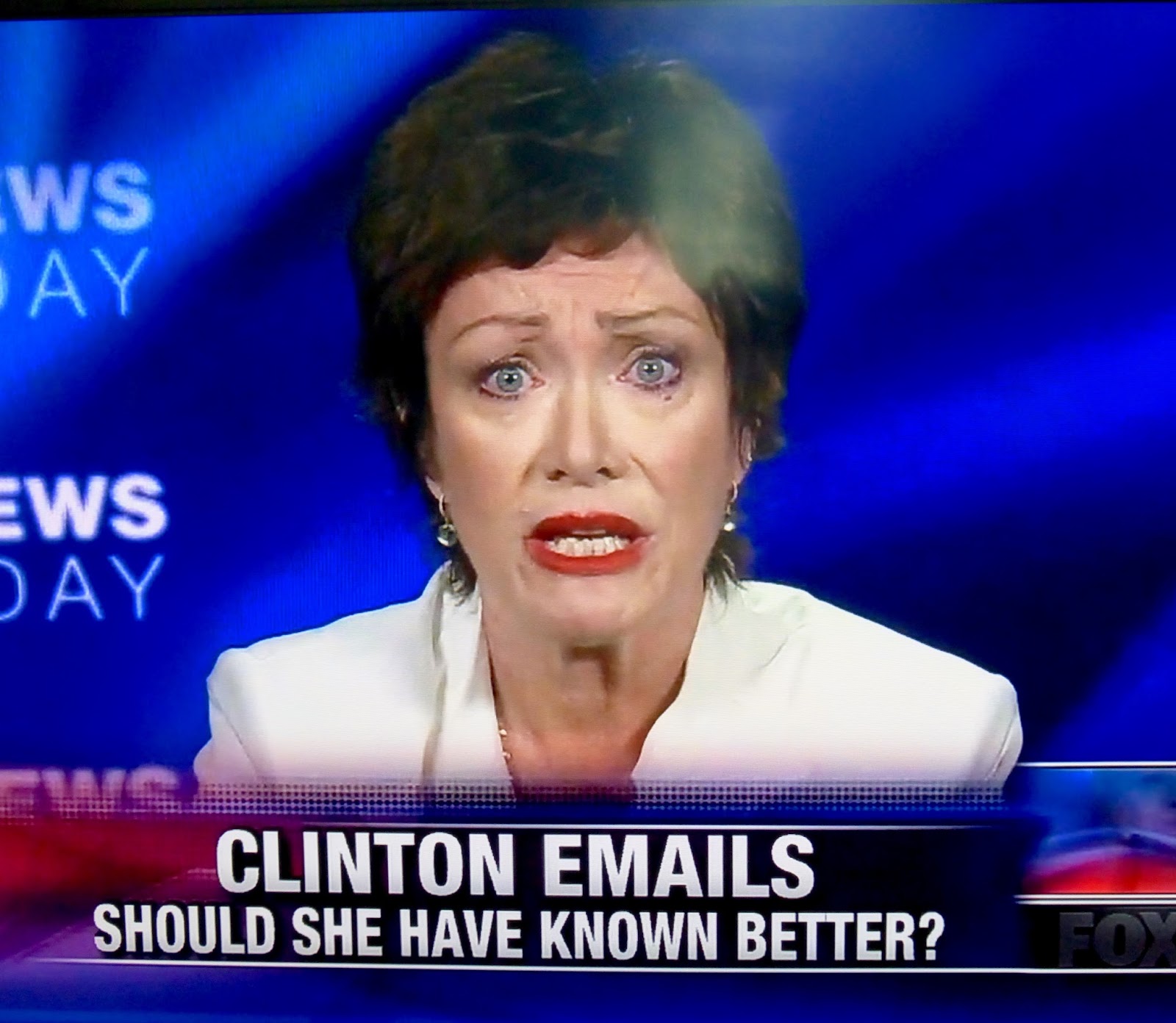
2 very different interviews about Hillary Clinton's email troubles, this morning on Fox News Sunday.
Shannon Bream was the interviewer (instead of the usual Chris Wallace) and the guests were former Attorney General Mike Mukasey —who was calm and seemingly neutral — and Ellen Tauscher — who was there to defend Hillary and looked so terrified that I took screen shots of her:



25 సెప్టెంబర్, 2012
"Will Obama Free the Blind Sheik?"
A WSJ op-ed by Michael B. Mukasey, who presided over the trial of Omar Abdel Rahman and sentenced him to life in prison.
Abdel Rahman was convicted in 1995 of participating in a seditious conspiracy that included the [Meir] Kahane murder, the 1993 WTC bombing, and a plot to blow up other landmarks in New York and to assassinate Egyptian President Hosni Mubarak when he visited the United Nations....Mukasey reviews the evidence that the Obama administration is contemplating releasing him, including the "excruciatingly lawyered" sounding statement of officials. For example, Security Secretary Janet Napolitano, who, before Congress, asked "whether there is an intention 'at any time to release the Blind Sheikh,'" said, "Well, let me just say this. I know of no such intention."
In 1997, members of Abdel Rahman's organization... murdered more than 60 tourists at Luxor, Egypt, and inserted notes in the body cavities of several victims demanding the Blind Sheik's release. Also in the mid-1990s, Abdel Rahman contrived from jail to issue the fatwa that Osama bin Laden cited as authorization to carry out the 9/11 attacks. The sheik's confinement was on bin Laden's list of grievances meant to justify that atrocity.
... Abdel Rahman has been a totemic figure to Islamists since 1981, when his pronouncements gave a group of Egyptian army officers the spiritual justification for assassinating President Anwar Sadat. The officers were hanged, but Abdel Rahman successfully defended himself at trial by arguing that he had simply been opining on issues of Islamic law and should not face censure for that in a Muslim country.
6 మే, 2011
"Consider how the intelligence that led to bin Laden came to hand."
"It began with a disclosure from Khalid Sheikh Mohammed (KSM), who broke like a dam under the pressure of harsh interrogation techniques that included waterboarding. He loosed a torrent of information—including eventually the nickname of a trusted courier of bin Laden."
Writes former U.S. Attorney General Michael Mukasey.
Writes former U.S. Attorney General Michael Mukasey.
The harsh techniques themselves were used selectively against only a small number of hard-core prisoners who successfully resisted other forms of interrogation, and then only with the explicit authorization of the director of the CIA....The Obama administration has ended these interrogations and is investigating CIA employees who conducted them.
Former CIA Director Michael Hayden has said that, as late as 2006, even with the growing success of other intelligence tools, fully half of the government's knowledge about the structure and activities of al Qaeda came from those interrogations....
3 జూన్, 2010
Do the Sestak and Romanoff revelations warrant a special prosecutor?
The NYT writes:
In any event, if it is a crime, it has kept some Presidents from doing some things they otherwise would have done. If those things are acceptable, repeal the law and remove the constraint that binds only meticulous law followers.
But the argument that others have violated a law with impunity can't be good enough. Many federal crimes are enforced against persons who don't get too far with the defense that others have violated the same law and escaped prosecution. It's a laughably childish argument: But, mom, all the other kids are doing it. Ever try to get out of a speeding ticket by informing the cop that lots of other drivers are speeding? That sort of thing doesn't work for ordinary people, and the President owes a higher duty to the law, not a lower one.
Instead of that vague expert/counter-partisan opinion, what I'd like to see in the NYT is the text of the criminal statute. Or at least the statutory section number (with a link to the text).
The Heritage Foundation has some detail on the statutes:
The White House confirmed on Thursday that it had explored the possibility of an administration job for a Democratic politician in Colorado to sidetrack his primary challenge to Senator Michael Bennet, much as it did in a Pennsylvania primary.... Mr. Romanoff... said that while no job was formally offered, three specific positions were mentioned as possibilities last September....Either it's a crime or it isn't. The phrase "political aims, such as" is odd. Have other Presidents offered political appointments to clear out competition in a primary or not? That phrase hides whether the NYT knows the answer to that question. Maybe the other Presidents have only offered political appointments to achieve other political aims.
It is not unusual for presidents of either party to offer political appointments to achieve political aims, such as clearing the nomination field for an ally, and Mr. Obama’s aides have said they did nothing wrong. But Republicans have called for a special prosecutor, citing a federal law making it illegal to offer a position to influence a primary election.
In any event, if it is a crime, it has kept some Presidents from doing some things they otherwise would have done. If those things are acceptable, repeal the law and remove the constraint that binds only meticulous law followers.
But the argument that others have violated a law with impunity can't be good enough. Many federal crimes are enforced against persons who don't get too far with the defense that others have violated the same law and escaped prosecution. It's a laughably childish argument: But, mom, all the other kids are doing it. Ever try to get out of a speeding ticket by informing the cop that lots of other drivers are speeding? That sort of thing doesn't work for ordinary people, and the President owes a higher duty to the law, not a lower one.
The Justice Department so far has rebuffed calls for an investigation and even some Republicans, including former Attorney General Michael B. Mukasey and President George W. Bush’s top ethics lawyer, have said it would be a stretch to call the White House action regarding Mr. Sestak a crime. But the focus on such tactics undercuts the image Mr. Obama has tried to cultivate as a reformer above the usual politics.So some Republicans want an independent investigation and other Republicans say — well, there's no quote — that it would be a stretch — did they say "a stretch"? — to call it a crime. Apparently, they didn't say "It's not a crime." Does anyone say "It's not a crime?" And "it" means "the White House action regarding Mr. Sestak a crime." But what exactly happened "regarding Mr. Sestak"? Without an investigation, we don't really know. And what about Mr. Romanoff? How did the NYT pose the question that procured semi-absolution from Mukasey and some — how many? who? — nameless Republicans.
Instead of that vague expert/counter-partisan opinion, what I'd like to see in the NYT is the text of the criminal statute. Or at least the statutory section number (with a link to the text).
The Heritage Foundation has some detail on the statutes:
A 1980 opinion issued by the Office of Legal Counsel (OLC) at the Justice Department outlines the key distinction between what is legal and what is illegal under federal law. What is perfectly legal and what happens all the time in Washington is individuals being offered jobs for past political activity....If the NYT would like us to accept the view of Mukasey and some unnamed Republicans that there is no crime — or it's hard to say there was a crime — I would like to see more depth of expert opinion. Why do those statutory words not apply? Eh, Mukasey? Explain that. What are people allowed to do behind the scenes to win elections? Instead of resorting to the childish argument that the other guys are doing it too, tell us exactly why we haven't been presented with enough evidence of a crime that an independent investigation is warranted.
However, what is illegal and not normal practice in Washington is to promise a federal job or appointment to an individual in exchange for future political activity. 18 U.S.C. § 600 prohibits the use of government-funded jobs or programs to advance partisan political interests. The statute makes it unlawful for anyone to “promise any employment, position, compensation, contract, appointment, or other benefit” to any person as a “consideration, favor, or reward for any political activity or for the support of or opposition to any candidate or any political party…in connection with any primary election.” As the OLC opinion says, § 600 “punishes those who promise federal employment or benefits as an enticement to or reward for future political activity, but does not prohibit rewards for past political activity.”...
Another federal statute, 18 U.S.C. § 595, prohibits any person employed in any administrative position by the United States “in connection with any activity which is financed…by the United States…us[ing] his official authority for the purpose of interfering with, or affecting, the nomination or the election of any candidate for the office of…member of the Senate.” Any administration position offered to Sestak would be financed by the United States, so Rahm Emanuel offering such an appointment through Bill Clinton to interfere with the Senate race in Pennsylvania would also constitute a possible violation of this statute.
17 ఏప్రిల్, 2009
Axelrod: Obama "thought very long and hard about" about opening up the CIA interrogation memos.
"He ... consulted widely, because there were two principles at stake. One is … the sanctity of covert operations … and keeping faith with the people who do them, and the impact on national security, on the one hand. And the other was the law and his belief in transparency."
In the struggle between 2 principles, in the mind of Obama, government transparency won.
ADDED: Former CIA Director Michal Hayden and former Attorney General Michael B. Mukasey write:
Read the whole thing.
In the struggle between 2 principles, in the mind of Obama, government transparency won.
"It was a weighty decision. As with so many issues, there are competing points of view that flow from very genuine interests and concerns that are to be respected. And then the president has to synthesize all of it and make a decision that’s in the broad national interest. He’s been thinking about this for four weeks, really."He's the decider.
ADDED: Former CIA Director Michal Hayden and former Attorney General Michael B. Mukasey write:
Although evidence shows that the Army Field Manual, which is available online, is already used by al Qaeda for training purposes, it was certainly the president's right to suspend use of any technique. However, public disclosure of the OLC opinions, and thus of the techniques themselves, assures that terrorists are now aware of the absolute limit of what the U.S. government could do to extract information from them, and can supplement their training accordingly and thus diminish the effectiveness of these techniques as they have the ones in the Army Field Manual....
The techniques themselves were used selectively against only a small number of hard-core prisoners who successfully resisted other forms of interrogation, and then only with the explicit authorization of the director of the CIA. Of the thousands of unlawful combatants captured by the U.S., fewer than 100 were detained and questioned in the CIA program. Of those, fewer than one-third were subjected to any of the techniques discussed in these opinions. As already disclosed by Director Hayden, as late as 2006, even with the growing success of other intelligence tools, fully half of the government's knowledge about the structure and activities of al Qaeda came from those interrogations.
Read the whole thing.
26 నవంబర్, 2008
Shouting "tyrant!" at Michael Muskasey, did Washington Supreme Court Justice Richard Sanders intend to cause fear of assassination?
Washington Supreme Court Justice Richard Sanders confesses that he was the one who shouted "Tyrant! You are a tyrant!" at Attorney General Michael Mukasey, during Mukasey's speech at a Federalist Society dinner:
The words immediately call to mind "sic semper tyrannis":
"Frankly, everybody in the room was applauding or sometimes laughing, and I thought, 'I've got to stand up and say something.' And I did," Sanders told The Seattle Times Tuesday. "I stood up and said, 'Tyrant,' then I sat down again, then I left."Mukasey didn't faint immediately upon hearing those words, so maybe you think it's hard to pin the fainting on Sanders. But consider how stressful it might be to hear "Tyrant! You are a tyrant!" shouted from a crowd like that.
It wasn't until the next morning — when he turned on the TV in his hotel room — that Sanders learned what happened after he departed: Mukasey, later in his speech, began slurring his words, slumped at the podium and passed out.
The words immediately call to mind "sic semper tyrannis":
The phrase is a shortened version of Sic semper evello mortem Tyrannis, which translated means "Thus always death comes to tyrants." ...An unknown person in a large crowd shouts "tyrant" at a political leader. If he knows history, it should strike fear into his heart. It would feel like the prelude to assassination. And yet, you would keep speaking. Nothing has happened yet, so of course, you go on, terror gnawing at your consciousness...
The phrase is originally attributed to Marcus Junius Brutus, the central figure in the assassination of Julius Caesar on March 15, 44 BC.... In American history, because of the association with the assassination of Caesar, John Wilkes Booth reportedly shouted the phrase after shooting United States President Abraham Lincoln on April 14, 1865. Timothy McVeigh was wearing a T-shirt with this phrase and a picture of Lincoln on it when he was arrested on April 19, 1995, the day of the Oklahoma City Bombing.
... men’s hearts failing them from fear and the expectation of those things which are coming on the earth....
21 నవంబర్, 2008
Mukasey collapse was nothing but a fainting spell.
Great news. But now let's talk about whether it's a little strange. What kind of man faints while getting overemotional and passionate in the middle of "prais[ing] the administration for 'nothing less than a fundamental reorganization of our government' after the 9/11 terrorist attacks and blast[ing] the relentless critics of the very policies that have kept us safe'"?
20 నవంబర్, 2008
"Attorney General Michael Mukasey collapsed Thursday night while giving a speech to the Federalist Society in Washington."
"Audience members said they began praying, fearing a stroke."
IN THE COMMENTS: Host with the Most said...
There are 80 comments over there now, and they are completely respectful. One commenter says: "According to local news, he was giving a 'passionate speech' when he got stuck on and kept repeating a word. Then he pitched forward and lost consciousness."
UPDATE: Josh Marshall writes:
IN THE COMMENTS: Host with the Most said...
Hope he recovers.I checked Daily Kos, where the front page post ended: "Justice Alito and former Attorney General Ashcroft were among those in attendance in this room of ~2000, and everyone there was pretty much silent, crying and praying quietly. Let us keep Mukasey in our prayers as well tonight."
This just in: Bush haters partying at the news.
There are 80 comments over there now, and they are completely respectful. One commenter says: "According to local news, he was giving a 'passionate speech' when he got stuck on and kept repeating a word. Then he pitched forward and lost consciousness."
UPDATE: Josh Marshall writes:
AG Mukasey was roughly twenty minutes into a speech defending the administration's counter-terrorism policies and particularly arguing against prosecutions of people who made decisions in the aftermath of 9/11 -- essentially arguing against what he believed amounted to the criminalization of policy differences. Mukasey appeared in earnest about it and appeared to choke up. Soon, what at first appeared to be choking up, blended into slurred words. And twenty to thirty seconds later he collapsed. His fall was broken by an FBI agent nearby.
17 అక్టోబర్, 2007
What to ask Mukasey.
4 law professors say what questions they'd like the Senate Judiciary Committee to ask Michael Mukasey. (The Attorney General nominee testifies today.)
A sampling:
Jack Goldsmith: "In 2002 the Department of Justice opined, 'Any effort by Congress to regulate the interrogations of battlefield combatants would violate the Constitution’s sole vesting of the commander-in-chief authority in the president.' Do you agree with this statement? How do you define the scope of the president’s exclusive military powers?"
Charles Fried: "Priorities in law enforcement and particular conceptions of controversial legal issues — affirmative action, severity and leniency in criminal prosecution and sentencing, antitrust policies, civil rights enforcement — have always been part of a president’s project for the nation. And yet the public expects and the rule of law demands impartiality in law enforcement. So the attorney general cannot be independent of the president who appointed him, as are judges or the chairman of the Federal Reserve Board, but neither must he be a political operative pushing the president’s advantage at every turn. How would you balance these conflicting demands?"
Jack Balkin: "When, if ever, should the government prosecute journalists or other citizens for publishing classified information leaked to them about government activities of questionable legality?"
UPDATE: Mukasey on the "torture memo": "The Bybee memo, to paraphrase a French diplomat, was worse than a sin, it was a mistake. It was unnecessary."
A sampling:
Jack Goldsmith: "In 2002 the Department of Justice opined, 'Any effort by Congress to regulate the interrogations of battlefield combatants would violate the Constitution’s sole vesting of the commander-in-chief authority in the president.' Do you agree with this statement? How do you define the scope of the president’s exclusive military powers?"
Charles Fried: "Priorities in law enforcement and particular conceptions of controversial legal issues — affirmative action, severity and leniency in criminal prosecution and sentencing, antitrust policies, civil rights enforcement — have always been part of a president’s project for the nation. And yet the public expects and the rule of law demands impartiality in law enforcement. So the attorney general cannot be independent of the president who appointed him, as are judges or the chairman of the Federal Reserve Board, but neither must he be a political operative pushing the president’s advantage at every turn. How would you balance these conflicting demands?"
Jack Balkin: "When, if ever, should the government prosecute journalists or other citizens for publishing classified information leaked to them about government activities of questionable legality?"
UPDATE: Mukasey on the "torture memo": "The Bybee memo, to paraphrase a French diplomat, was worse than a sin, it was a mistake. It was unnecessary."
దీనికి సబ్స్క్రయిబ్ చేయి:
పోస్ట్లు (Atom)


 పోస్ట్లు


