He wants to “destigmatise male sexuality”, he says, and “help men to build a healthier relationship” with the women in their lives. “I’m hoping we can be a space for men who feel caught between needing to be manosphere-adjacent and needing to be the performative liberal male,” he says.... “We should promote the idea that we can be excited about sex and we can be excited about each other and excited about touching each other,” he says with a cheeky grin.
How Catholic is he? We're told he's "a lapsed Catholic who recently completed a master’s at Harvard Divinity School in order to rediscover his faith (his thesis was titled: Is Jesus Kinda Hot?)." Is religion part of making "playful again"? You can find "an artistic and highbrow view of the female nude" in church:
This reminds me of a sequence in the movie "Blue Moon," about the songwriter Lorenz Hart, who was gay, though not openly. The character has this conversation with the bartender. From the brilliant screenplay by Robert Kaplow (commission earned):
HART: You know what the sexiest thing on the planet earth is? A half-erect penis.
EDDIE: Jesus Christ, Larry, nobody wants to hear this.
Do they let you take your old knee home with you after a replacement? I'm picturing Pete Townshend's knee in a glass case at the Rock and Roll Hall of Fame labeled with some riff on "hope I die before I get old." It would be like those relics of saints you might see in an old cathedral. I'm not Catholic, but I've wondered about the inconsistency with the visualization of Judgment Day of bodies rising up out of graves — as depicted in the "Last Judgment" mural in the Sistine Chapel.
Isn't this why some people don't want to donate their organs — they think they might need them in the afterlife? Wouldn't it be a kick in the head if failing to check the organ-donor box on your driver's license turned out to be the shortcoming that barred you from heaven?
"... which he covered with 84 murals, along with bronze panels and stained-glass windows. It took four years to build; Mr. Butcher often worked, as Michelangelo had, flat on his back, suspended on scaffolding, painting the stories of the Bible from the creation to the resurrection. But unlike Michelangelo, who was known for his muscular figures, Mr. Butcher peopled his chapel with his signature sprites. And he allowed himself some creative leeway. For his depiction of the first day of creation, from the Book of Genesis — the part where God said, 'Let there be light' — Mr. Butcher painted three angels armed with flashlights. For Day Four, when God made the heavens, Mr. Butcher painted an angelic basketball team he called the Shooting Stars...."
"The bottoms on display are male and female, nude and clothed, seen from a forensic distance or in fetishistic close-up, but rarely lascivious. All together the show is well-bred and understated...."
Paul Cadmus, whose retrograde male nudes are enjoying an unmerited revival in attention, appears here with yet more anemic drawings of standing and reclining musclemen, none more consequential than the gents on a Calvin Klein underwear box. (For what it’s worth, the gay male artists in this show all come out looking second-rate, with none of the perverse intelligence of Degas, Schiele and the other straight bros. Did Michelangelo die for this?)....
"For example, after a weekend at the beach with your family, you can probably list the irritations far more easily than the pleasant aspects, even if on balance the trip was all right.... When you get home, you’ll have a list of things you experienced, and you can easily name the ones you didn’t like and don’t want to repeat next time (for example, bringing your brother-in-law). In contrast, the things you might add (such as a different guest, who, you hope, won’t get arrested) are hypothetical. Subtractive knowledge is practically guaranteed to lead to improvement, but additive knowledge is often just a guess. "
This is consistent with my adage Better than nothing is a high standard. And the famous saying Less is more.
Brooks assures us that following the negative way does not make you a "negative person." I feel sorry for anyone who's governed by the fear of negativity. How cluttered your world must be!
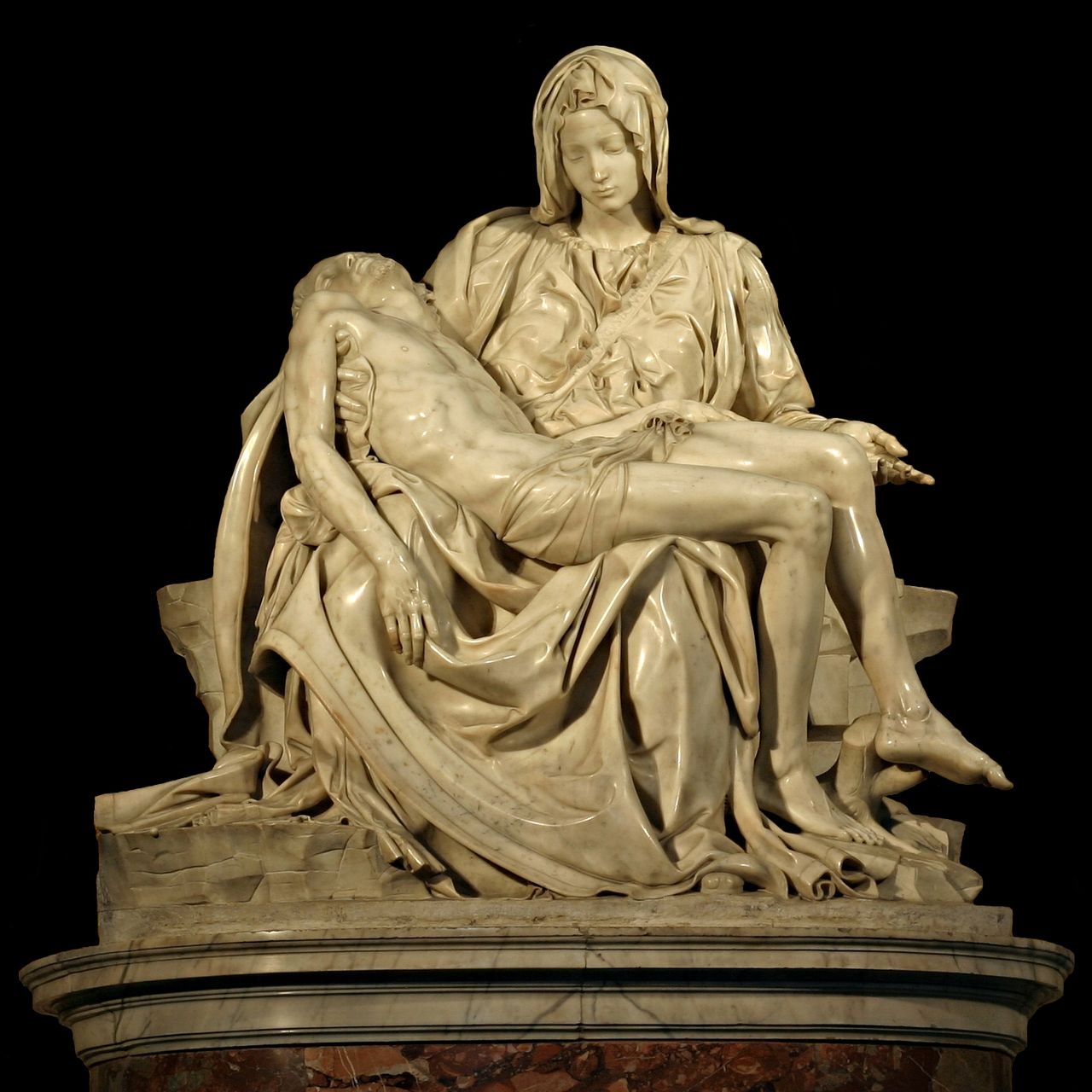
"Hundreds of Whitsunday worshipers, pilgrims and tourists watched in horror as a young man with long reddish hair and a beard pushed into the side chapel to the right of the main entrance to St. Peter's, where the Pieta is on display over, an altar. He climbed over a marble balustrade, went up the stairs to the platform on which the sculpture rests, pulled out a hammer from under a raincoat he had over his arm and started battering the marble, shouting, 'I'm Jesus Christ.'
The blows shattered the left arm of the figure of the Virgin Mary in the marble group and also chipped the nose, the left eye and the veil covering the hair... The assailant, who was identified as Laszlo Toth, 33 years old, of Sydney, Australia, was able to strike four or five hammer blows amid the gasps and shouts of the crowd before an Italian fireman ran up to him and pulled him down by his hair.... A Vatican spokesman said later that Mr. Toth had told Archbishop Benelli in English: 'If you kill me, so much the better, because I'll go straight to heaven.' The Hungarian‐born Mr. Toth had been living in Rome for some time and had acquired some notoriety for bizarre conduct. In an interview last November, II Messaggero of Rome presented him as a 'local character of sorts,' quoting Mr. Toth as saying that he was a geologist and had left Australia two years ago to return to Europe because 'I have seven mysteries to reveal.'"
In the 1970s, Novello started to write letters to famous people under the pen name of Lazlo Toth (after Laszlo Toth, a deranged man who vandalized Michelangelo's Pietà in Rome). The letters, written to suggest a serious but misinformed and obtuse correspondent, were designed to tweak the noses of politicians and corporations. Many of them received serious responses; Novello sometimes continued the charade correspondence at length, with humorous results. The letters and responses were published in the books The Lazlo Letters, Citizen Lazlo!, and From Bush to Bush: The Lazlo Toth Letters.
Here's the Wikipedia article for Lazlo Toth, the vandal:
He was not charged with a criminal offence after the incident, but was hospitalized in Italy for two years. On his release, he was immediately deported to Australia.... In June 1971 he moved to Rome, Italy, knowing no Italian, intending to become recognized as Christ.
I was interested in that — "As if some god had come down from Olympus and started to come onto me" — because isn't that the way gods from Olympus actually behave in the story? No, no, they proceed directly to rape. I'm thinking of Leda and the swan — that sort of thing.
There would need to be some new telling of a Greek myth with a god like the one Faithfull described, not lording his godliness but explaining lyrics on his new album — earnestly imagining that she would turn her favor upon him because he visualized the "diamond sky" and "haunted, frightened trees."
***
There is no comments section anymore, but you can email me here. Unless you say otherwise, I will presume you'd enjoy an update to this post with a quote from your email.
"'Everything about your past is perfect,' he says. 'Everything up to this moment about you is spectacular.' ... I found myself mindlessly nodding along, as he compares an ashtray that he remembers loving as a child, with a reclining woman holding her legs aloft, to Michelangelo’s 'Pietà.' 'How can that be any less than this masterpiece by Michelangelo?' he says. 'It’s equal.'... He asks himself, 'What have I been pulled to? What have the interests been lately?' He believes this will work for you, too.... "
I subscribed to MasterClass a while ago. I think I watched 3 courses. Really enjoyed David Sedaris and David Mamet. Both Davids taught about writing. The only other one I watched was Bobbie Brown teaching about makeup. That was sort of okay. I think the overall experience is one of encouragement: You can do it too.
But are you really encouraged? Do you go on to do the things that are supposedly being taught, or are you only feeling something called encouragement, admiring somebody whose work you like, and nothing more?
"In the end, Sachsalber was successful in locating the needle.... ... Sachsalber undertook a project called Hands, for which he and his father attempted to complete a 13,200-piece puzzle of Michelangelo’s Creation of Adam. ... Sachsalber produced 222 drawings based on Galerie Bruno Bischofberger ads that appeared on the back of Artforum. Other performances involved eating a poisonous mushroom and spending 24 hours in a room with a cow."
I don't know what kind of person you are, but some of you may wonder if he died from one of his performances — we can see that he was "involved" in eating a poisonous mushroom — and others of you may muse that life itself is an art performance if you step back and look. I believe — please do not comment to confirm this belief (I don't want to know) — that most of you simply disrespect performance art and are tempted to comment that you see no great loss to the world in the death of Sachsalber.
"Types of pointing may be subdivided according to the intention of the person, as well as by the linguistic function it serves. Pointing typically develops within the first two years of life in humans, and plays an important role in language development and reading in children..... The nature of pointing may differ for children who have autism or who are deaf, and may also vary by gender... Types of pointing are traditionally further divided by purpose, between imperative and declarative pointing. Imperative pointing is pointing to make a request for an object, while declarative pointing is pointing to declare, to comment on an object.... Types of communicative pointing may be divided by linguistic function into three main groups: Objective pointing - pointing to an object within the visual field of both the pointer and the receiver, such as pointing to a chair which is physically present; Syntactic or anaphoric pointing - pointing to linguistic entities or expressions previously identified, such as pointing to the chair which is not physically present; Imaginative pointing - pointing to things that exist in the imagination, such as pointing to a fictional or remembered chair...."
I'm reading the Wikipedia article "Pointing" a propos of Nancy Pelosi's pointing at Trump (as seen in my post "Political theater" earlier this morning).
Unfortunately, the Wikipedia article did not have what I'd hoped for, something that's often in a Wikipedia article, a history section. I had a feeling that there were famous examples of pointing, perhaps in painting. Googling didn't help. The first thing that came up was Michelangelo's painting of God creating Adam, and that's not really pointing, is it?!
I do have in my memory the final moments of Act I of Arthur Miller's "The Crucible," as performed here in Madison many years ago. The drama spiraled up until many girls were suddenly all pointing at the character accused of witchcraft and then the lights blacked out. Chills! Intermission. I don't have video of that, but from the text:
ABIGAIL: I want to open myself!... I want the light of God, I want the sweet love of Jesus! I danced for the Devil; I saw him; I wrote in his book; I go back to Jesus; I kiss His hand. I saw Sarah Good with the Devil! I saw Goody Osburn with the Devil! I saw Bridget Bishop with the Devil!...
But I see from Googling that a lot of people are talking about it. For example, at Townhall, 4 days ago, somebody wrote, "'Donald Trump's House Of Wings' Belongs In The Smithsonian" ("This video has been making the rounds on Twitter after a One America News video researcher rediscovered the gem").
"Am I saying that I'm a chicken wing expert? No. But I am telling you this, the wing is hands down the best part of the chicken. Better than the head. Better than the torso. Better than the back...."
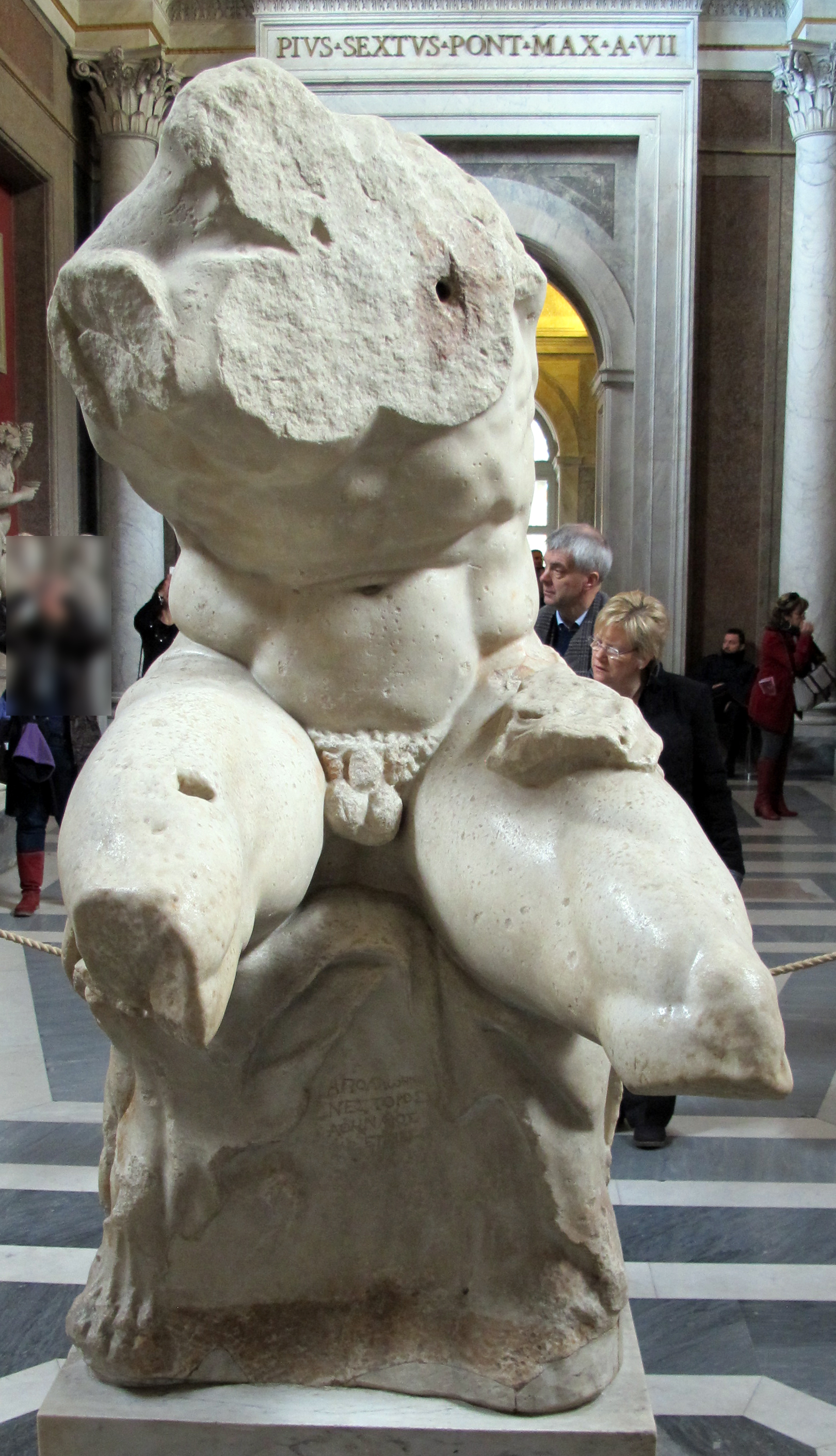
Torso... now that's funny. By the way, for decades, I've found the word "torso" funny. There's the line "and the torso, even more so" in "Lydia the Tattoed Lady," and once, when I was in Rome, visiting the Vatican Museum, there were a lot of posters showing a statue that was only a torso, with the word "torso," and, after seeing these posters all over the place, I overheard a young woman, who must have seen what I'd been seeing, and she said, "What's with the torso?" Even now, 2 decades later, I hear her inflection in my head, and I laugh out loud.
I wish I could find the old Vatican Museum poster, but I do think this is the torso in question, the most famous torso at the Vatican Museum, the "Belvedere torso":
It was once believed to be a 1st-century BC original, but is now believed to be a copy from the 1st century BC or AD of an older statue, which probably dated to the early 2nd century BC..... Legend has it that Pope Julius II requested that Michelangelo complete the statue fragment with arms, legs and a face. He respectfully declined, stating that it was too beautiful to be altered, and instead used it as the inspiration for several of the figures in the Sistine Chapel....
So that's what's with the torso!
If you don't know what that is, but you just keep seeing that, with nothing but the word "Torso," it really does make you the perfect audience for the line "What's with the torso?"
ADDED: That kind of laughing — my laughing at "What's with the torso?" — is premised on ignorance. It's like what makes "Beavis and Butt-Head" funny. They're so stupid and don't know the value of anything. They look at things and say "What's that?" Now, I don't remember what, if anything, I knew about the Belvedere torso when I went to the Vatican Museum 20 years ago, but, obviously, I knew from the museum's cues that it was an important artwork and I felt calmly assured that it was something profound and dignified. But the young women — in the manner of "Beavis and Butt-Head" — were just seeing it as a torso with the word "torso" (and, I think, a this-way-to-the-torso arrow) and reacting to it as if it was a completely random torso in no particular context. And I am still laughing out loud.
CORRECTION: The post headline originally said 2015, but it was 2004.
From the comments to the post about the dismantled "Scaffold" at the Walker Art Center. The one in the middle is Michael. The first and third comments are from me. I'm the one who loudly proclaims "Absolutely!," even as Michael says:
Where was this cliche [that art should challenge us] born? Marcel Duchamp?... This idea of art is a modern thing and a concept that has as its fruit an unlimited amount of crap produced for people paying up to be "challenged."
A few notes and pictures:
1. The Chartres Cathedral. It represents the challenge to be a Christian. What greater challenge is there? Here's a modern public art display animating the old cathedral:
"Turner... was a sharp critic of the industrial and commercial change sweeping mid-19th-century Britain. Casting a locomotive as a dark, sinister beast carving a pitiless path through the landscape in Rain, Steam and Speed – The Great Western Railway (1844), he drew attention to the threat posed to the natural beauty of the English countryside by the industrial revolution...."
Michelangelo worked at Schumacher pace. Adam's famous little penis was captured with a single brushstroke: a flick of the wrist, and the first man had his manhood. I also enjoyed his sense of humour, which, from close up, turned out to be refreshingly puerile. If you look closely at the angels who attend the scary prophetess on the Sistine ceiling known as the Cumaean Sibyl, you will see that one of them has stuck his thumb between his fingers in that mysteriously obscene gesture that visiting fans are still treated to today at Italian football matches...
In late 2014, during my second year at Harvard Law School, a student group called Students For Inclusion created a blog entitled Socratic Shortcomings. Its commitment, we are told, is to “[foster] productive and contextualized conversations on matters related to race, gender and class.” The site allows students—and anyone really—to post anonymously about events at Harvard Law School.
The site quickly picked up steam, as students gravitated toward a safe and faceless forum, where they could voice their displeasure. For a short while it appeared that the site might encourage open dialogue and actually inspire change.
However, soon thereafter, students began to complain about submissions vanishing into thin air. The moderators, we eventually learned, were selectively publishing submissions and denying others without further explanation. It seems that the Students For Inclusion only wished to include some students....
Isn't this a case for: Get your own damned blog?
The blog is moderated. It doesn't "allow" "anyone" to post there. You can see how it's operated. That's what it is. It's a blog that takes anonymous submissions and has a point of view or a set of points of view that it publishes. Here's the submission page as it looks right now. It "reserve[s] the right to maintain this blog" as "a safe space." There are moderators, and they have standards. They have a vision of the place and they mean to preserve their speech by excluding those who interfere with their idea of the place. That's not anti-free speech. Free speech didn't die.
It's not like Twitter kicking Robert Stacy McCain out of Twitter (which is discussed in the column) because Socratic Shortcomings is on Tumblr and nothing prevents the voices excluded from Socratic Shortcomings from setting up another Tumblr account and inviting submissions and putting them all up without moderation or moderating them to put up exactly whatever they think is excluded from Socratic Shortcomings — the shortcomings of Socratic Shortcomings. Start something like that of your own and you may gain some appreciation for the speech that is furthered by selectivity.
I chose this photograph — of a door in the East Village — as the next picture to blog from the trip we took to NYC over the weekend. I chose it for 2 reasons:
"I love the tension between the ornate structure of the game and its improvisatory chaos, and I love the way great players find opportunity, even a mystical kind of order, in the midst of that chaos. The problem is that I can no longer indulge these pleasures without feeling complicit...."
From a NYT Magazine essay asking the question: "Is It Immoral to Watch the Super Bowl?" The question-asker is Steve Almond. Am I supposed to know who he is? (Is it immoral not to know?) There's no note about the author on the page and the name isn't a hot link. What's his moral authority?
Perhaps he wants his ideas judged by the strength of this one text, like an anonymous pamphleteer, but I Google his name and see that he's a short-story writer and that he was an adjunct professor in creative writing at Boston College who resigned in protest when Condoleezza Rice was brought in to do the school's commencement address. Moral authority noted.
Questions asked in a NYT article illustrated by 2 photographs: an atrocious, "creative" Euro design and a beautiful, classic American radiator.
A nice example of the misguided Europe-does-it-better meme.
And that atrocious Euro-radiators — "life-size animal sculptures... draped... in skins... a red deer, a ram and an arctic fox" — cost $7,700 to $11,600. And we're told they are electric, so it seems to me they correspond to what Americans would call a space heater. (If you're wondering about all that fur, I believe NYT is generally pro-fur, so this article may be an under-the-radar service to its fur advertisers.)
Also available from European designers are...
... dozens of conversation starters, radiators that resemble a forest grove, a paper clip, a garden hose that uncoils and snakes around a room, and even a wall-hung homage to an artistic masterpiece. Hotech, an Italian radiator company, has a collection with names like Chagall and Fabergé. Its David model is a beefy male torso.
Wall-hung. That's wall-hung. Don't let the the snaking hose and the beefy male torso cause you to misread. And we've all seen David naked, so form your own opinion.
Have I started a conversation yet? Well, do you have any "conversation starters" in the interior decoration of your house? What kind of conversations do they start?
ADDED: There's also a slideshow, here, so you can see what the hose and the torso, etc. look like. I was using my imagination, and I'm sad to report that David has no discernible genitalia.
"His locks survived the months of sun and chlorine, with no colorist in sight," writes Maureen Dowd in that NYT article that we're already talking about in that first post of the day.
“No one believes me,” Mr. Redford said. “Even my kids didn’t believe me. I keep thinking of Reagan. It’s freaking me out.”
Chandor is J. C. Chandor, the director of Redford's new movie, "All Is Lost," which is a seafaring tale, hence the "sun and chlorine."
Dowd doesn't say whether she believes him, but she quotes "No one believes me" without stating her view. She has the mysterious line "Mr. Chandor can verify," but did she ask Mr. Chandor, and who can believe that Mr. Chandor watched Mr. Redford at all times? Who thinks Ronald Reagan didn't dye his hair? But it's nice of Robert Redford to keep thinking about Ronald Reagan. These slow-aging Hollywood RRs need to stick together with their age-defying secrets.
Here's the atheist Christopher Hitchens burbling about "the color and depth and majesty" of the Hubble photographs as he urges us to see the revelations of science as more awe-inspiring than the old stories told by religions:
... was never named Rosie, nor was she a riveter. All along it was Mrs. Doyle, who after graduating from high school in Ann Arbor, Mich., took a job at a metal factory, her family said.
In early 1942, the Westinghouse Corp. commissioned artist J. Howard Miller to produce several morale-boosting posters to be displayed inside its buildings. The project was funded by the government as a way to motivate workers and perhaps recruit new ones for the war effort.
Smitten with the UPI photo, Miller reportedly was said to have decided to base one of his posters on the anonymous, slender metal worker - Mrs. Doyle.
For four decades, this fact escaped Mrs. Doyle, who shortly after the photo was taken left her job at the factory. She barely lasted two weeks.
A cellist, Mrs. Doyle was horrified to learn that a previous worker at the factory had badly injured her hands working at the machines. She found safer employment at a soda fountain and bookshop in Ann Arbor, where she wooed a young dental school student and later became his wife.
Oh, the irony! She couldn't do it. But she could inspire others to do it. And she could do other things, like play the cello and rear 6 children. "We" can do it, each in our own way. You work the machines, I'll help people find the right books.
Here's the Norman Rockwell version of Rosie, who's not nearly so glamorous and is clearly not based on Mrs. Doyle:
The 52-by-40-inch oil on canvas depicts "Rosie" on lunch break, her riveting gun on her lap as she uses a dog-eared copy of Mein Kampf as a foot stool.
Great symbolism, Norman. And I don't mean the book. I mean the manly power tool.
Rockwell's Rosie is posed as an homage to Michelangelo's frescoed depiction of the prophet Isaiah from the Sistine Chapel ceiling.
I am a participant in the Amazon Services LLC Associates Program, an affiliate advertising program designed to provide a means for me to earn fees by linking to Amazon.com and affiliated sites.
Encourage Althouse by making a donation:
Make a 1-time donation or set up a monthly donation of any amount you choose:




.jpg/2560px-Michelangelo_-_Creation_of_Adam_(cropped).jpg)




 Posts
Posts


#/media/File:Michelangelo's_Pieta_5450_cut_out_black.jpg)