લેબલ Keats સાથે પોસ્ટ્સ બતાવી રહ્યું છે. બધી પોસ્ટ્સ બતાવો

8 જુલાઈ, 2023

Before blogging, there were proto-bloggers, and I have encountered another example: Rose Kennedy.

I have commemorated proto-bloggers before. For example, something John Keats did in 1816. And, in the first year of my own blogging, I told you about my grandfather, Pop. And though I can’t find where I've blogged about it, there's something I myself used to do in the 1990s. I'd read the paper NYT at the dining table in the morning and if I found something distinctly interesting, I'd tear it out and put it on the other side of the table, where my sons would see it when they eventually came into the room.

Anyway, the proto-blogger I discovered today was Rose Kennedy. As a consequence of reading that Rebecca Traister article about RFK Jr. — blogged here — I started reading his book "American Values/Lessons I Learned from My Family." 

Here's what I consider to be like blogging:

5 જૂન, 2023

"Girls aren’t fearless. Girls are terrified. And their activism isn’t naive. It’s not 'innocent.' It’s the reasoned result of the stomach-churning awareness..."

"... that girls can’t count on someone else to save them.... Of course, it’s not just girls whose fear spurs them to action. Young male activists have no less reason to feel distress over intertwined global crises. And nonbinary organizers have been on the forefront of critical social movements. But the undaunted girl — chin up, hands on hips — remains a quite literal and ill-advised avatar for progress."

Is there a myth of the "fearless girl"? There's that fearless-girl statue that stares down that Wall Street bull statue.

6 એપ્રિલ, 2023

It's just a "paid partnership" on Instagram. If it's not for you, it's not for you.

I'm yawning at the "uproar," noted by the stalwart New York Post, in "Nike faces online uproar over paid partnership with trans TikToker Dylan Mulvaney."

Overheard at Meadhouse:

"I've never called anything 'stalwart' before. I just felt for some reason that I needed to call The New York Post 'stalwart.'"

"I think you probably heard it called that before."

"So I'm being conventional?"

"It's just somewhere in the back of your memory, that you associate the word with The New York Post."

"Stalwart" means "Resolute, unbending, determined" as in " The duke made his stalwart declaration in the House of Lords against all parliamentary reform" (OED). 

And an "uproar" is a "Loud outcry or vociferation; noise of shouting or tumult" (OED). Some classy examples:

10 ફેબ્રુઆરી, 2022

"As with previous months, higher prices oozed into just about every sector of the economy, leaving households to feel the strain at the deli counter, shopping mall and just about everywhere else."

Oozed! 

It's getting nasty. WaPo is saying "oozed" in "Prices climbed 7.5% in January compared with last year, continuing inflation’s fastest pace in 40 years/High inflation is undermining a robust recovery, testing policymakers at the Federal Reserve and White House." 

The White House has been touting its actions to lower prices, including targeting corporate consolidation to help create product markets that are more competitive. But inflation has proved a blistering political handicap for Biden, and a litmus test for how many Americans judge the economy. Republicans largely blame Democrats’ $1.9 trillion American Rescue Plan for overheating the economy, and the GOP is set to hammer on inflation going into the midterm elections this fall.

ADDED: The word "ooze" — according to the OED — comes from the same line as the Old Frisian word wāse, which means mud, the Old Icelandic word veisa (wetness, mud, marshy ground), the Norwegian veis (marshy soil), and the Danish regional vejs, which means something that is more fun to say in English: oozy bottom. As a noun meaning wet mud or slime, "ooze" goes back to early Old English. The verb "ooze" is more recent, and I can see that the earliest uses had to do with bodily fluids. Example: "Ulcers that lye deep, and ouze out their Matter thro'..winding Passages" (1737). 

Some of the greatest wordsmiths have deployed the verb "ooze":

30 નવેમ્બર, 2019

"I knew that they were paper backs. They arrived on time, undamaged."

I was amused by this wan review — at Amazon — of "Complete Poems and Selected Letters of John Keats (Modern Library Classics)":
I bought two copies of this book, one for myself and one for my grandson (only 5, but he was able to recite There was a naughty boy in front of his and another class at his school in Kent) they met expectations, I knew that they were paper backs. They arrived on time, undamaged.
I was buying the book for myself, after Keats came up in that post today about the "Midwestern zest for consensus." You remember, I was researching the word "zest" and got to that fantastic Keats poem with the magnificent "zest"/"breast" rhyme ("O! let me have thee whole,—all—all—be mine!/That shape, that fairness, that sweet minor zest /Of love, your kiss,—those hands, those eyes divine/That warm, white, lucent, million-pleasured breast"). I decided I wanted to read more text at that high level.

I bought the Kindle version, so I didn't need to worry — like that man in Kent — about the thing arriving damaged. I read his review because he gave it 4 stars, and I was curious why anyone would give something like this other than 5 stars. I still don't know why he marked it down. Because it only met but did not exceed expectations? Because he doesn't really like paperbacks, but that's what it was. He knew it, but still.

One person gave the book only 1 star. The review: "Front cover torn, 25+ pages dog eared and back cover folded on itself." Did not meet expectations!

Anyway, maybe you have a 5 year old who can memorize "There was a naughty boy." That link goes not to Amazon but to Poetry by Heart, a great resource for those — including children — who want to commit poetry to memory. Kids start here.

"[Y]ou could classify Ms. Warren and Mr. Sanders as the pugilists in the field, whereas Mr. Buttigieg, he of the earnest manner and Midwestern zest for consensus, fashions himself a peacemaker."

I'm trying to read "2020 Democratic Candidates Wage Escalating Fight (on the Merits of Fighting)/For all the emphasis placed on the various divides among the candidates, the question of 'to fight or not to fight' might represent the most meaningful contrast" by Mark Leibovich (NYT).

I have a little trouble with "Midwestern zest for consensus."

I don't think these coastal elites who characterize midwesterners know much at all about them/us. (Should I say "us"? I've only lived in Madison, Wisconsin, a special island in the sea of the midwest, and I didn't begin living here until I was 33 years old, past my formative years, which were spent in Delaware and New Jersey, but I did grow up with a midwestern mother, though her midwest was that other college town, Ann Arbor, and I did go to college in my mother's midwestern hometown.)

It's partly my annoyance at the blithe stereotype of midwesterners as blandly nice. Is that even true? And what is this interest in superficial getting along really about? Would it really make you want a leader who acts like that too, or would you want a leader who's willing to take on the hard fighting that you won't do yourself?

Anyway... "zest" bothers me too. "Zest for consensus" — seems like too wacky a state of mind to be present throughout an entire region.

The original meaning of "zest" is the outer peel of a citrus fruit, the bright-colored part that you use to make a "twist" for a drink or grate into some dessert recipe. From there comes the figurative meaning: "Something which imparts excitement, energy, or interest; a stimulating or invigorating quality which adds to the enjoyment or agreeableness of something... Enthusiasm for and enjoyment of something, esp. as displayed in speech or action; gusto, relish" (OED). Here's the highest peak of usage, from John Keats:
O! let me have thee whole,—all—all—be mine!
That shape, that fairness, that sweet minor zest
Of love, your kiss,—those hands, those eyes divine,
That warm, white, lucent, million-pleasured breast,
Yourself—your soul—in pity give me all,
Withhold no atom’s atom or I die
Or living on perhaps, your wretched thrall,
Forget, in the mist of idle misery,
Life’s purposes,—the palate of my mind
Losing its gust, and my ambition blind!
Compare the zestiness of consensus to the zestiness of a warm, white, lucent, million-pleasured breast. Oh, no! This just popped up in my head:


There's your million-pleasured breast. There's your pugilist in the field.

ADDED: Can you beat the fighter with the nonfighter? There's this fantasy that what we need now is Mr. Rogers and that Pete Buttigieg is Mr. Rogers....


(That's just one of many articles you'll find if you google Buttigieg is Mr. Rogers.)

16 મે, 2019

"Thank you Joe and remember, the BRAIN is much sharper also!" tweeted Trump...

... in response to something Joe Scarborough, who'd said that Trump "looks like he’s about 20 years younger than a lot of Democratic candidates" (reported at Politico).

ADDED: Notice that Trump said "the BRAIN is much sharper," not "my BRAIN is much sharper." Remember, yesterday we were talking about "the geriatric possessive," how old people tend to say "I’m going to take my bath" and "take my walk" and "take my nap" rather than referring to baths and walks and naps and so on generally, without using a pronoun to highlight that the thing in question is theirs, which is what younger people do. Look at Trump — old but not seeming old — he doesn't even say "my brain." He says "the brain."

AND: Speaking of Trump's looks, here's something from the new Howard Stern book, from an April 2004 interview:
Caller: In a hypothetical situation—I mean, saying you’re not involved with Melania and there was no ethical backgrounds for business and whatnot—how many of those bitches [on "The Apprentice"] do you think you could’ve banged?

Howard: Good question.

Donald: Boy, I’ll tell ya. I love the thought, I’ll tell you that. ’Cause they were attractive. Do you agree with that?

Howard: I mean, some of the bodies on them while they were sitting there . . .

Donald: They were amazing.

Howard: Which is more important: talent or looking great?

Donald: Looking great.

Howard: I agree.

Donald: I’ve had both, and I’ll take looking great.
PLUS: Meade corrects my interpretation of "I’ve had both, and I’ll take looking great." He says Trump was talking about the women. I completely believed he'd switched over to talking about himself and he was looking back on the time when he was beautiful. I read the interview last night and saw it that way and went looking for it this morning because I saw it that way, and I published the quote without even seeing the ambiguity, I was so attached to that interpretation. I now believe that he meant the women — he's "had" women — and I find that so much less interesting.

SO: Now, I'm thinking about the word "had." You have your own brain, whether you call it "my brain" or not. You can use "had" to talk about the sexual partners you've had without needing to say "sex." Just say "had." To say "I've been had" means you've been tricked, and a sexual partner can be called a "trick." Of course, I look up "had" in the OED, and talk about ridiculously long entries. Try reading "have, v." It's long! I begin to laugh at myself for even trying, but then it jumps out at me:
13. transitive. a. To gain sexual possession of (esp. a woman); to have sexual intercourse with....
It goes back to Old English: "Þa het he feccan him to þa abbedessan on Leomynstre & hæfde hi þa while þe him geliste." Of course, there is Shakespeare: "Was euer woman in this humor woed, Was euer woman in this humor wonne: Ile haue her, but I will not keepe her long" ("Richard III"). Henry Fielding: "'None of your Coquet Airs, therefore, with me, Madam,’ said he, ‘for I am resolved to have you this Night.'" Keats: "I should have had her when I was in health, and I should have remained well." And — we need a woman — Judith Krantz in "Scruples" (1978): "They cherished not having had each other because it created a current of continual warmth which... was more important to them than sex." Ha, the woman is about not having.

10 ફેબ્રુઆરી, 2019

"I’ve wanted a higher power to provide that same narcotic delight one feels in the early stages of a relationship."

"In those rare white-light moments when I have felt a holy bliss, I’ve quickly purchased a candle or crystal, hoping to pocket the feeling. Unfortunately, that feeling cannot be contained in an object any more than it can be pinned down to one human being. It is so easy to confuse spiritual longing with a craving for romantic love. Beautiful people are everywhere, whereas the desire for some kind of eternal beauty or ineffable truth is more nebulous, always just out of reach. Recently, on a solo holiday trip to Paris... I saw a group of university students: three men and one woman. One of the men, the handsomest among them, kept reaching out to touch the woman’s earring. The woman would smile at him and then look down. I was reminded of the lovers frozen in time in John Keats’s poem 'Ode on a Grecian Urn.' They are eternally about to touch, forever on the precipice of kissing."

From "Life Without Longing/Who would I be if I wasn’t hustling to make some other person, real or imagined, fall in love with me?" by Melissa Broder (NYT). More text and lots of photographs at the link, including one of a Statue of Liberty street performer checking his iPhone.

What men or gods are these? What maidens loth? What mad pursuit? What struggle to escape?...

14 જાન્યુઆરી, 2019

"The president of the United States has many faults, but let’s not ignore this one: He cannot write sentences."

"If a tree falls in a forrest and no one is there to hear it … wait: Pretty much all of you noticed that mistake, right? Yet Wednesday morning, the president did not; he released a tweet referring to 'forrest fires' twice, as if these fires were set by Mr. Gump. Trump’s serial misuse of public language is one of many shortcomings that betray his lack of fitness for the presidency. Trump’s writing suggests not just inadequate manners or polish—not all of us need be dainty—but inadequate thought. Nearly every time he puts thumb to keypad, he exposes that he has never progressed beyond the mentality of the precollegiate, trash-talking teen."

Writes John McWhorter in "Trump’s Typos Reveal His Lack of Fitness for the Presidency/They suggest not just inadequate manners or polish, but inadequate thought."

I got there via "A Letter to Professor John McWhorter" by Seth Barrett Tillman, who writes:
We (Americans) have had many talented wordsmiths in the White House. I see no connection between such talents, and adopting & putting into effect substantively sound policies. Woodrow Wilson—a university academic—comes to mind. But very few can explain precisely why the U.S. entered WWI or offer any justification for Wilson's allowing the federal civil service to be (re)segregated by race. He was good with words.

Your article amounts to a non-instrumental claim that elites who share your specific skill set should have power and those who do not share that skill set should not.... It is certainly better for the President to spell "forest" with a single R rather than two Rs. But ... it is probably more important that better policies be put in place to stop similar future disasters....
That was linked by Glenn Reynolds, who writes:
Good writing, like good shooting, is a valuable skill. Neither has a moral component. The Supreme Court’s best writer was Oliver Wendell Holmes, who told us — eloquently — that it was okay to sterilize people society didn’t like.
Let me add that there's a big difference between good writing and good spelling! Some great writers have had bad spelling — notably William Faulkner:
One of Faulkner's editors at Random House, Albert Erskine, said, "I know that he did not wish to have carried through from typescript to printed book his typing mistakes, misspellings (as opposed to coinages), faulty punctuation and accidental repetition. He depended on my predecessors, and later on me, to point out such errors and correct them; and though we never achieved anything like a perfect performance, we tried."...
And Ernest Hemingway:
Whenever his newspaper editors complained about it, he'd retort, "Well, that's what you're hired to correct!"
And John Keats:
In a letter to his great love Fanny Brawne, Keats spelled the color purple, purplue. This generated a longer conversation between the two, as Keats tried to save face by suggesting he'd meant to coin a new portmanteaux [sic] - a cross between purple and blue.
And Jane Austen:
She once misspelled one of her teenage works as "Love and Freindship" and is infamously known to have spelt scissors as scissars.
And F. Scott Fitzgerald:
The original draft of The Great Gatsby contained literally hundreds of spelling mistakes, some of which are still confounding editors. These include “yatch” (instead of “yacht”) and “apon” (instead of “upon”). One of his most famous gaffes, which occurs toward the end of the novel, inspires debate to this day.
Here's that gaffe:
After Fitzgerald’s death, Edmund Wilson changed the spelling from “orgastic” to “orgiastic” in the famous closing line: “Gatsby believed in the green light, the orgastic future that year by year recedes before us.”
So many great writers were bad spellers that I've got to wonder whether bad spelling goes along with great writing. Maybe there's something about the brain of a bad speller. Have many Spelling Bee winners gone on to write great books?

John McWhorter thinks bad spelling is evidence of "inadequate thought," but — ironically — he needs to give that thought a little more thought.

ADDED: John Irving, the author of "The World According to Garp," was called "stupid" and "lazy" when he was a child and later found out he had dyslexia. I'm reading his "How to Spell." Excerpt:
You must remember that it is permissible for spelling to drive you crazy. Spelling had this effect on Andrew Jackson, who once blew his stack while trying to write a Presidential paper. “It’s a damn poor mind that can think of only one way to spell a word!” the President cried.

When you have trouble, think of poor Andrew Jackson and know that you’re not alone.

And remember what’s really important about good writing is not good spelling. If you spell badly but write well, you should hold your head up. As the poet T.S. Eliot recommended, “Write for as large and miscellaneous an audience as possible”--and don’t be overly concerned if you can’t spell “miscellaneous.” Also remember that you can spell correctly and write well and still be misunderstood. Hold your head up about that, too.

28 ઑગસ્ટ, 2015

"Why don’t you drink your wine? It’s sitting right there, for Christ’s sake. Some of us can’t drink wine, we don’t have that privilege, but you can, so why the heck don’t you do it?"

That's what Stephen King almost walked over and said to 2 old ladies who were sitting near him in a restaurant about 27 years ago, not long after he gave up drinking for good. The ladies were allowing their "half-finished glasses of white wine" to sit "forgotten in the middle of the table" while they carried on an animated conversation.

He's reminded of that when he thinks about the way Donna Tartt — a great writer — has only written 3 books and Jonathan Franzen — also great — has only written 5.
The long gaps between books from such gifted writers make me... crazy.... As a young man, my head was like a crowded movie theater where someone has just yelled “Fire!” and everyone scrambles for the exits at once. I had a thousand ideas but only 10 fingers and one typewriter. There were days — I’m not kidding about this, or exaggerating — when I thought all the clamoring voices in my mind would drive me insane. Back then, in my 20s and early 30s, I thought often of the John Keats poem that begins, “When I have fears that I may cease to be / Before my pen has glean’d my teeming brain …”

26 જૂન, 2010

Proto-blogging in 1816.

From "The Last Novel," by David Markson:
Keats stayed up all night on the occasion when he actually did look into Chapman's Homer — and then composed his sonnet so swiftly that he was able to messenger it to a friend to read before breakfast.
You read something quickly. It inspires you to write something quickly and then to get it out instantly to be read. That is blogging, and Keats got as close to that as one could in 1816. But he was reading George Chapman's translation of Homer and writing a sonnet that people will read as long as there are people who can read. That's all very grand, compared to blogging. To counterbalance, the blogger gets the instant writing out to thousands, and Keats only got his poem out instantly to one person.

But would Keats have read Homer and written a timeless sonnet if he could have blogged?

***

I read the first 82 pages of Markson's book out loud as Meade drove the TT up to Fish Creek, Wisconsin and back — via Whitefish Dunes — Thursday and Friday. I stopped reading at page 82 last night at about 9 when the last of the daylight failed. The book is composed entirely of snippets like the one quoted above, and if I'd gotten to the next snippet, it would have been:
Fish feel pain.
Ah! The fish theme! How apt!

Actually, I'm lying. Lying out of love of aptness. For your sake, dear Reader. That fish snippet is at the very bottom of page 82. It was the second to the next one. The next one was really:
If it were up to me, I would have wiped my behind with his last decree.

Said Mozart — after a demand by the Archbishop of Salzburg for more brevity in his church compositions.
There's another Mozart one that led to some laughter and conversation. On page 21:
I wish you good night, but first shit in your bed.

Reads another Mozart letter to Anna Maria.
***

Let me get the jump on the comments and say yes, I know that Kurt Cobain sang "It's okay to eat fish/'Cause they don't have any feelings." And yes, these days, on hearing "Homer," one doesn't think of the Greek poet anymore, one thinks of "The Simpsons." That's what TV and blogging and everything modern has done to us. 

25 મે, 2004

The peony conversation.

The trees in my neighborhood darken all the yards and lead good gardeners to indulge heavily in ferns and other groundcover instead of flowers and vegetables and grass. What might, without the trees, have been lawn looks like this:

Image-07F575CEAE9B11D8

Once a new homebuyer sent her gardener over to my door to ask me to let her come into my yard and cut some branches off one of my backyard trees so she could plant a "sun garden." I was understanding up to a point, but then I said "these are wooded lots" (here in this neighborhood she had chosen instead of the sunny, treeless suburbs) so maybe she should plant a garden that does well in the shade. The gardener got quite snippy and started lecturing me about the law and asserting that she had a legal right to cut back the trees in her yard. One of the benefits of being a lawyer is that when someone decides to lecture you about law, it doesn't take you any time at all to decide that person is an ass. I didn't say, "You're lecturing me about law? I'm a law professor!" I just said, "You want to assert your legal rights. Fine. So do I. You can't cut any branches off my tree." I love the way she was so wrapped up in getting what she wanted and using any argument that she reminded me to stick to my own preferences and not do her any favors. And: great way to make a good impression as a new neighbor.

But that was an anomaly. Most homeowners here in University Heights work within the beautiful shadiness. A neighbor two houses down has this neatly kept arrangment with stone rabbit:

Image-07F5D448AE9B11D8

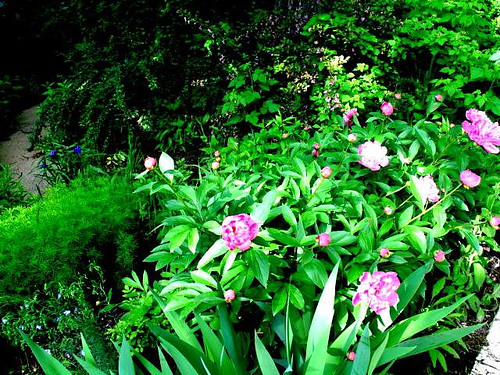
And my next-door neighbor has a yard full of shade-loving flowers, with the peonies beginning their days of glory. As I take this picture, the neighbor's mother comes out and talks to me and as we talk about peonies she almost remembers some lines about peonies by Keats and--elsewhere--Danny Kaye:

Image-07F61A6CAE9B11D8

I say I'm going to put some of these pictures on my website, and I'll find those peony quotes and put them up as well, and I give her my blog address. The Keats poem is Ode on Melancholy:
But when the melancholy fit shall fall
Sudden from heaven like a weeping cloud,
That fosters the droop-headed flowers all,
And hides the green hill in an April shroud;
Then glut thy sorrow on a morning rose,
Or on the rainbow of the salt sand-wave,
Or on the wealth of globed peonies;
Or if thy mistress some rich anger shows,
Imprison her soft hand, and let her rave,
And feed deep, deep upon her peerless eyes.

And the Danny Kaye lines? Here you see one of his songs was "The Peony Bush." But I can't find the lyrics, so you'll have to buy the album, which seems to be a nice big collection of comic songs.

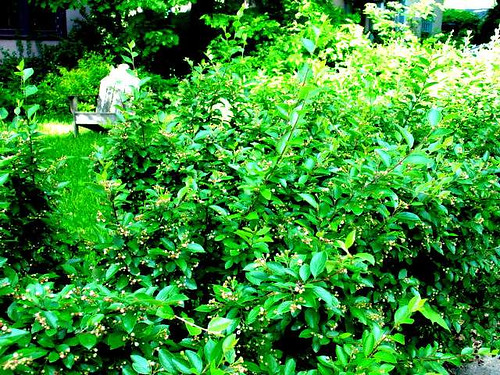
Anyway, I arrive at my own yard and see my overgrown oleaster hedge in bloom with its teeny-tiny, very un-peony-like flowers:

Image-07F63C0AAE9B11D8

UPDATE, written in 2015: Back then, I wrote "I can't find the lyrics," not even anticipating that one day I'd be able to link to an audio track of the song. Here.

7 માર્ચ, 2004

Poet or bloviator? Maureen Dowd is drooling over Kerry: he's a poet! Okay, my grandma swooned over Eugene McCarthy because he wrote poetry. (Go ahead, click on that link, you can still be the first person to review his book of selected poems, published seven years ago, which reveals "deep wisdom conveyed with a deft touch," but do hurry, because there's only one left.)

Should we swoon over John Kerry because he responded to Dowd's culture questions with long, long answers, unlike George Bush, who, asked to name his favorite "cultural experience," said "baseball"? Well, consider that, reeling off the names of 37 movies, he doesn't seem to have come up with a single offbeat or obscure title (Dowd cites "National Velvet," "The Deer Hunter," and "Men in Black"). Yet somehow Dowd manages to conclude that, when it comes to culture Kerry is (adopting Kerry's wife's adjective) "insatiable," while Bush is "incurious." She even, weirdly, says Kerry has a "vast palette of cultural preferences." A "vast palette"? Not palate? Well, then let's hope he has a really large thumb. (And, yeah, yeah, don't tell me, I know. And Heinz Kerry was referring to her husband's cultural interests with that adjective, as far as I can tell from Dowd's florid column. Florid column? Now everything sounds dirty. Focus, people!)

But what about poetry, how vast are his interests there? Why they extend to Keats, Yeats, Shelley and Kipling! And he writes it too, so Dowd's just in love. She quotes him:
"I remember flying once; I was looking out at the desert and I wrote a poem about the barren desolation of the desert," he said. "I wrote a poem once about a great encounter I had with a deer early in the morning that was very moving."


Okay, now I just feel compelled to be mean. You want me to love the guy because of this, Maureen? I'm sorry.

First, what the hell was "moving," the encounter with the deer or the poem he managed to author? Either way, Kerry's complimenting himself, and that's unsavory. Either he's saying, I'm a sensitive guy because I have moving encounters with deer in the morning, or he's saying I'm a sensitive guy because I write moving poetry about encounters with deer in the morning. "Great" encounters with deer, no less.

Second, shouldn't a poet have some sort of way with words? It's bad enough to use "moving" ambiguously and come up with nothing more precise than "great" to describe you morning deer encounter, but "the barren desolation of the desert"? I'll pause to say it doesn't take great subtlety of mind to look at a desert and come up with the insight that it's barren and desolate, but I'll assume the poem goes somewhere and compares the desert to some damn thing (life itself!). But what I've just got to rail about is "barren desolation of the desert." As opposed to what? The fertile desolation of the desert? The barren camraderie of the desert? The barren desolation of the fruited plain?

Maureen, the man isn't a poet, he's a windbag!