H. L. Mencken లేబుల్‌తో ఉన్న పోస్ట్‌లను చూపుతోంది. అన్ని పోస్ట్‌లు చూపించు

25 జులై, 2026

"Although people had been instructed to leave the animal alone, 'some members of the public continued to stop next to the power pole to film and take pictures of the bear, so the bear remained at the top of the pole'..."

"... the department said in a statement. If animals touch two wires simultaneously, they can be electrocuted, so small birds are usually unharmed, said James Dwyer, a wildlife biologist at EDM International, a consulting firm that works with electric companies. Larger animals like hawks and bears are at greater risk, he said."

From "'Heartbreaking' Video Shows Bear Before It Was Electrocuted Atop Utility Pole/The animal’s plight alarmed onlookers and highlighted the drought conditions that are forcing wild bears closer to where people live in search of food" (NYT gift link).

People need to stop rubbernecking. That link goes to Wikipedia where we learn:
H. L. Mencken said the word rubberneck is "almost a complete treatise on American psychology" and "one of the best words ever coined."

By 1909, rubbernecking was used to describe the wagons, automobiles and buses used in tours around American cities, and through their Chinatowns. The tours included a megaphone-wielding individual offering commentary on the urban landscape. Chinese Rubbernecks was the title of a 1903 film....

I looked for that old film, but didn't find it at YouTube, where I did find this: 


And, via Wikipedia, here's Čumil, a popular sculpture of a rubbernecker that you can pose with if you go to Bratislava:


What is it about us humans, stopping to stare? It's not just that one bear has died because of our rubbernecking. Many have died. And some of us have lived because others refrained from rubbernecking. I count myself in that group.

10 ఫిబ్రవరి, 2019

Talk in the Raturday Night Café and the Google search it inspired.

Click to enlarge and clarify...


Here's a link to last night's café.

"Marriage is the death of hope" brings up webpages that purport to quote Woody Allen. I'm dubious.

"Marriage is the death of romance" gets me to some boring relationship advice plus the assertion that it's the translation of a Chinese proverb:
I'm dubious. It used to be very common to hear characters on TV (often in ads) say "Ancient Chinese wisdom" (in a fake Chinese accent) followed by something in the form of a proverb (almost always a manifestly fake proverb).

"Marriage is the death of love" gets me to boring relationship advice, some more groping after a Chinese proverb, and a review of a play about Maynard Jackson, "the first African-American mayor of a major U.S. city, elected in Atlanta in 1973":
[Playwright Pearl Cleage has a] sagacious way with words, and epigrammatic pearls like "There's no greater cynic than a failed romantic" (a variation on George Carlin’s "Scratch a cynic and you will find a disappointed idealist"). Later, when Evey recalls an epiphany of self-discovery in Paris, she tells J.P., "Marriage is the death of love."
Ha ha. Scratch me, I'm a failed cynic.

Have you thought about Maynard Jackson recently? Did you know he fought Muhammad Ali?
“The only thing that really worries me is what happens if I hit him, for his sake and for mine as well,” [Mayor] Jackson said.

“[He] will not land one punch in one round, and if he dreamed it, he better wake up and apologize!” Ali responded....
But Jackson won with a technical knockout:
“Those trunks he had saved him because he had them too high.,” Ali told reporters. “I couldn’t hit him low because you’re not supposed to hit below the belt. He came with the trunks up to his breast, therefore I couldn’t hit him in the effective spots ‘cause he’s so big, he’s like a balloon, and if you hit him he’ll bust.”

4 డిసెంబర్, 2018

Who in the Sam Hill is Scott Free?

I'm reading "'Who is Scott Free?' A search for meaning after Trump’s misuse of a medieval idiom" (WaPo).

This is after Trump tweeted:
Michael Cohen asks judge for no Prison Time,'” Trump began. “You mean he can do all of the TERRIBLE, unrelated to Trump, things having to do with fraud, big loans, Taxis, etc., and not serve a long prison term? He makes up stories to get a GREAT & ALREADY reduced deal for himself, and get..... his wife and father-in-law (who has the money?) off Scott Free.
He made it look like a name — "Scott Free." He does weird capitalization, such as "Taxis," but next to "Scott," a first name, "Free" sure looks like a last name. Okay, he's got us paying attention again.

WaPo's Meagan Flynn instructs:
But, of course, what Trump meant was “scot-free,” a centuries-old phrase meaning to escape punishment, which has nothing to do with a person named Scott....
Does it have anything to do with a type of person, a Scot?
[A]ccording to the 2008 book “Common Errors in English Language” by Paul Brians... [p]eople might think the term has something to do with Scottish people (or an unfortunate “Scott”) or that it is “scotch-free,” somehow related to whisky.
I know I'm picturing Mel Gibson crying "Freedom" while getting disemboweled.
Others, Brians noted, have erroneously believed “scot-free” alludes to Dred Scott, the slave who sued for his freedom only to lose in an 1857 Supreme Court case.
Well, that would be stupid, unless you want "scot-free" to mean not free.
But really, scot-free traces its roots back to a medieval tax called a “scot” that arose in the 14th century, according to Merriam-Webster. The Vikings could also be to blame for the origin of the phrase: “Scot” is derived from the Old Norse words “skot” and also “shot” — yes, like shooting a gun or taking your shot. The Gaelic Etymology of Languages of Western Europe, an 1877 dictionary, explains that shot and scot meant the same thing at that time, as in a “contribution that ... is ‘shot’ into the general fund.” Back in those days, if you skirted around the tax, you... were scot-free....
And, now, who is Sam Hill?
Sam Hill is an American English slang phrase, a euphemism or minced oath for "the devil" or "hell" personified (as in, "What in the Sam Hill is that?"). The "Sam" coming from salmon (sal(o)mon an oath) and "Hill" from hell. Etymologist Michael Quinion and others date the expression back to the late 1830s; they and others consider the expression to have been a simple bowdlerization, with, according to the Oxford English Dictionary, an unknown origin.
But H. L. Mencken said it might be "Samiel" (one the name for the Devil, and some people point to a shopkeeper in Arizona named Sam Hill or various other characters actually named Sam Hill.

I see that term "minced oath" has a Wikipedia article:
A minced oath is a euphemistic expression formed by misspelling, mispronouncing, or replacing a part of a profane, blasphemous, or taboo term to reduce the original term's objectionable characteristics. Some examples include "gosh" (for God), "darn" (for damn), "heck" (for hell), "fudge" or "eff" (for fuck) and "shoot" (an exclamation for shit). 
And that gets me back to the problem I blogged about yesterday, a propos of Michelle Obama saying "shit." I was fine with her saying "shit." I just didn't like New York Magazine calling that "swearing." An "oath" — like "swearing" — is a solemn declaration to God, and that is something that you may think should not be debased. Talking about sex or excrement is a different matter.

Anyway, Trump got attention for a minor foible once again. I'm interested to hear what Scott Adams has to say about this. He's got to do this one in his podcast today, no? It's got the name "Scott."

10 జులై, 2017

"There’s really no negative publicity, so I felt we’re good to go."

Said the founder of the company that makes Coco Loko — snortable powdered cocoa infused with ginkgo biloba, taurine, and guarana — which Chuck Schumer just went on a rampage against.

You can buy Coko Loko at Amazon. It's only $24.99 for 1.25 ounces, where the comments are already infused with Schumerosity.

What Schumer said is: "I can’t think of a single parent who thinks it is a good idea for their children to be snorting over-the-counter stimulants up their noses. This suspect product has no clear health value." He wants the FDA to get involved because it's marketed as a drug. But it's just cocoa powder with caffeine (guarana), amino acid (taurine), and the extract of ginkgo leaves that has never been shown to do anything.

But I guess it's the fact that they're telling you to take it in through the nose that stimulates the anti-drug sensibilities. If finely ground coffee were sold as snortable, I guess it would be the same problem. It brings out the prudes, anything that suggests that a drug-related mentality will accompany the use of the product. It's really a desire to regulate thoughts. Don't even think of getting high.

This relates to the way marijuana is wedging its way to legality. The medical/"medical" use was forefronted to numb the prudes' censoriousness. God FDA forbid anyone should actually have fun.

By the way, you can still buy candy cigarettes. How we enjoyed all the nicotine we only imagined... back in the old days, before the Baby Boomers matured beyond the 1960s "If it feels good, do it" to the sick fun of restricting the pleasure of others.

Do people even remember the 60s slogan "If it feels good, do it"? It's talked about in this 1996 NYT review of the book "The Pleasure Police/How Bluenose Busybodies and Lily-Livered Alarmists Are Taking All the Fun Out of Life."
"If it feels good, do it!" was the moral imperative at Woodstock, but since the advent of Jimmy Carter, the nation has been swept by a counterrevolution. Now the rule is: "If it feels good, it must be risky and bad, immoral and dangerous to your health."...

A new complicity has grown up between the religious Ayatollahs on the right and the sanctimonious alarmists on the left, united in their common determination to make everything we touch or ingest illegal, immoral or fattening. In chapters devoted to eating and drinking, smoking and making love, Mr. Shaw documents the excessive prudery and exaggerated warnings that have come to surround our every indulgence. In American culture, all universal sources of pleasure are eventually medicalized, then politicized and finally policed (if not prohibited): witness alcohol, tobacco, cannabis, fat, pornography, masturbation, perfume. Mr. Shaw aptly quotes H. L. Mencken's eternal definition of puritanism as "the haunting fear that someone, somewhere, may be happy." All our most intimate spheres of solace and release are exposed to the prurient curiosity of those who cannot themselves enjoy, because of the envy they feel. We Americans, with our Puritan ancestors, are different from, say, the French, who are too busy passionately pursuing their own pleasure to worry much about other people's....
Speaking of puritanism and the special problem of snorting, I'm thinking of this Prince lyric, from "Pop Life":
What you putting in your nose?
Is that where all your money goes (is that where your money goes)
The river of addiction flows
You think it's hot, but there won't be no water
When the fire blows
I don't know where Prince is now, but he's starting at long last to put his videos on YouTube. I wish "Pop Life" were one of the first few to go up but it's not. This might do in a pinch.

Hey, that reminds me: Can you still get Pop Rocks candy? Yes! But — stand down, Schumer — the FDA did get involved:
Rumors persisted that eating Pop Rocks and drinking soda would cause a person's stomach to boil and explode.... One of these myths involved a character named Mikey from the Life cereal commercials.... The Food and Drug Administration set up a hotline [in Seattle] to assure anxious parents that the fizzing candy would not cause their children to choke.... On the very first episode of MythBusters, Adam Savage and Jamie Hyneman put the Mikey rumor to the test...
By the way, Mikey (John Gilchrist) is still alive as is the myth that he died from Pop Rocks:
In Shrek The Musical (2008–2010), one of the main characters, Donkey, sings a song "Don't Let Me Go". In the song, he is begging Shrek not to leave him and starts naming things that go together. He sings, "like Cupid and Psyche, like Pop Rocks and Mikey!"

10 జులై, 2015

90 years ago today, the Scopes trial begins in Tennessee.

The Nation reprints a contemporaneous article by H.L. Mencken:
Behind every school ever heard of there is a definite concept of its purpose—of the sort of equipment it is to give to its pupils. It cannot conceivably teach everything; it must confine itself by sheer necessity to teaching what will be of the greatest utility, cultural or practical; to the youth actually in hand. Well, what could be of greater utility to the son of a Tennessee mountaineer than an education making him a good Tennesseean, content with his father, at peace with his neighbors, dutiful to the local religion, and docile under the local mores? That is all the Tennessee anti-evolution law seeks to accomplish. It differs from other regulations of the same sort only to the extent that Tennessee differs from the rest of the world. The State, to a degree that should be gratifying, has escaped the national standardization. Its people show a character that is immensely different from the character of, say, New Yorkers or Californians. They retain, among other things, the anthropomorphic religion of an elder day. They do not profess it; they actually believe in it. The Old Testament, to them, is not a mere sacerdotal whizz-bang, to be read for its pornography; it is an authoritative history.... So crediting the sacred narrative, they desire that it be taught to their children, and any doctrine that makes game of it is immensely offensive to them. When such a doctrine, despite their protests, is actually taught, they proceed to put it down by force.
They do not profess it; they actually believe in it. Great stuff! Read the whole thing:

12 మే, 2015

Those terrible mountebanks.

I questioned whether I'd ever seen the word "mountebank" in the newspaper, so I searched the NYT archive — all the way back to 1852 — and got 782 hits, beginning with "Really, this Louis NAPOLEON is a very provoking fellow" ("the appearance of the mountebank in the character of a king").

Quite a few of the hits were repetitions of H.L. Mencken's 1926 description of William Jennings Bryan: "a charlatan, a mountebank, a zany without sense or dignity . . . deluded by a childish theology, full of an almost pathological hatred of all learning, . . . all beauty, all fine and noble things. . . . Imagine a gentleman, and you have imagined everything that he was not."

One often encounters "mountebank" in a string of contradictions about a person, for example, Theodore Roosevelt: "He transformed the 20th century; no, he overextended the 19th. He was a progressive trust buster; no, an imperialist demagogue. He was a defender of liberty; no, a power-hungry mountebank — a pioneer environmentalist, a bloodthirsty hunter; a farseeing visionary, an energetic clerk."

I see that future President Woodrow Wilson — upon hearing of the death of President McKinley in 1901 — said: "What will happen to the country with that mountebank as President?"

13 ఏప్రిల్, 2015

"Think of it this way: if none of us wore any clothes, then it would be the male genitalia sticking out visibly..."

"... while women’s would remain largely hidden. Maybe the entire point of formal attire to invert this possibility, to say, 'Yes, in nature, it is women who have mysterious hidden powers of creation, but once we get all dressed and civilized, it’s precisely the other way around.'"

The last paragraph of "Dickheads/The paradox of the necktie resolved," a Baffler article by David Graeber (with an excellent illustration).

Via Metafilter, where there are many comments, including:
Couldn’t we say that a tie is really a symbolic displacementof the penis, only an intellectualized penis, dangling not from one’s crotch but from one’s head?

Is this a comp lit undergrad class in 1986?
I see I have a neckties tag. I'll have to publish this post so I can click on it to see what the hell I've said about neckties over the past decade. Beyond this past decade, for the past half century, the most common insight into the necktie has been that it's a phallic symbol. But what I liked about Graeber's take was the seen-and-unseen angle — and seen and unseen is one of my all-time favorite tags.

ADDED: From the necktie-tagged archive. This is from a 2004 post about shopping for a suit at Brooks Brothers:

24 జనవరి, 2015

"The two earliest statements as to [the origin of the term 'Yankee'] were published in 1789..."

"... Thomas Anburey, a British officer who served under Burgoyne in the War of Independence, in his Travels II. 50 derives Yankee from Cherokee eankke slave, coward, which he says was applied to the inhabitants of New England by the Virginians for not assisting them in a war with the Cherokees; William Gordon in Hist. Amer. War states that it was a favourite word with farmer Jonathan Hastings of Cambridge, Mass., c1713, who used it in the sense of 'excellent.' Appearing next in order of date (1822) is the statement which has been most widely accepted, viz. that the word has been evolved from North American Indian corruptions of the word English through Yengees to Yankees (Heckewelder, Indian Nations iii. ed. 1876, p. 77); compare Yengees n.

Says the (unlinkable) Oxford English Dictionary, in its entry for "Yankee," which sends us to "Yengee," where we see this quote from an 1819  history of the Indians: "When the Yengeese arrived at Machtitschwanne, they looked about everywhere for good spots of land." If it's Yengeese — with an "e" on the end — one might imagine the singular as "Yengoose," that is, if you're amused by invented false notions about words. In that form of play, the etymology of Yankee could be: that which has been yanked — a prick. As for the delightful word "Machtitschwanne," that's just another way to spell Massachusetts.

But to stick with the uprightly historical, Yankee is a word of uncertain origin, perhaps meaning slave or coward, perhaps excellent, and perhaps English. That's the OED. Wikipedia's entry for Yankee claims that "linguists" reject all the theories that the word comes from any Native American language.

Here's Wikipedia's article "Names for United States citizens," dealing with the pesky old problem of the inaccuracy of the term "Americans," which, taken literally, could refer to everyone on the continents of North and South America. That's nothing that could confuse anyone grounded in the real world, but the question of alternative terms remains amusing (or even important to someone looking to take offense at microagressions).
Several single-word English alternatives for "American" have been suggested over time, including "Usonian", popularized by Frank Lloyd Wright, and the nonce term "United-Statesian". The writer H. L. Mencken collected a number of proposals from between 1789 and 1939, finding terms including "Columbian", "Columbard", "Fredonian", "Frede", "Unisian", "United Statesian", "Colonican", "Appalacian", "USian", "Washingtonian", "Usonian", "Uessian", "U-S-ian", "Uesican", and "United Stater".
"Yankee" is one more alternative, but only non-Americans see it as referring to all Americans, rather than only to non-Southerners. (I was going to say "only to non-Northerners," but it was only yesterday that were were talking about the notion that, in the U.S., "the North" consists of little more than Minnesota.)

Why am I writing about this today? It's a complete sidetrack from the subject you'll see in the next post.

20 మార్చి, 2013

"Spouses Probably Shouldn't Try to Split Household Tasks Exactly Evenly."

Instapundit links to this piece by Noah Berlatsky in The Atlantic, which seems to state a comically obvious point. The "exactly" kind of gives it all away, doesn't it? You can't quantify tasks — different individuals take different amounts of time doing the same thing, different tasks have different degrees of arduousness (and the arduousness is different to different individuals both objectively and subjectively) — so the split couldn't be done exactly, even if that's what you wanted to do. Doing the calculations would add to the work, and different individuals would react differently to the arduousness — and symbolism — of that new dose of work. The idea is to get along better, not worse.

But there's some great stuff here: If you quantify and keep track, you are thinking in terms of debt. Berlatsky refers to David Graeber's book "Debt: The First 5,000 Years":
[M]any egalitarian societies make an enormous effort to keep clear of the logic of debt. Graeber tells a story about an Inuit man who offered a hungry anthropologist named Peter Freuchen a huge mound of seal meat. Freuchen thanked the man profusely. Freuchen recorded the man's response.
"Up in our country we are human!" said the hunter. "And since we are human we help each other. We don't like to hear anybody say thanks for that. What I get today you may get tomorrow. Up here we say that by gifts one makes slaves and by whips one makes dogs."
The logic of debt? Isn't that the logic of gifts? Keeping track of debts is a way of avoiding too much, doing only your fair share. Gifts complicate a relationship, adding joy to serving and transforming the experience of being served. Debts make a cooler transaction. But Berlatsky conflates debt and gift in the pursuit of the idea that human beings do things for one another in recognition of mutual humanity. He also — scarily — conflates marriage and egalitarian societies:
Societies like the Inuit put enormous social effort and pressure into making sure that excellent hunters don't end up putting everyone in their debt. Marriages, too, can slide towards hierarchy if you're not careful. There's a lot of years of inequity and a lot of learned gender roles telling men and women that women owe housework to their families—an obligation that (as the hunter suggests) can pretty easily end up feeling like, and even functioning as, slavery. That's why housework is a feminist issue—and why both men and women need to work to stop it from becoming the whip that makes one spouse the master and the other the dog.
Okay, I've done my fair share of the work of untangling the mixed up ideas in this article. But that paragraph is a mess. Why don't you clean it up?

I'm going to comment on the illustration The Atlantic paired with Berlatsky's idea salad. That looks like a more amusing task. It's Grant Wood's "American Gothic." Quick! I need a picture that represents a marriage... a bad marriage.


But the article critiques a modern-day version of a bad marriage, and "American Gothic" depicts a comical, cliché, old-fashioned marriage.

Anyway, I found a nice 2005 Slate article about "American Gothic." I hope you know the models for that painting were not a married couple that Wood found living in that house you see in the background. Wood found the house in Iowa, painted it, then got the idea to pose a couple characters in front of it. The woman is his own sister. The man was his dentist.
The critics who admired the painting in the early '30s — including Gertrude Stein and Christopher Morley — ... assumed it was a satire about the rigidity of American rural or small-town life, lampooning the people H. L. Mencken called the "booboisie" of the "Bible Belt." As [Steven] Biel [author of "American Gothic"] explains, "American Gothic appeared to its first viewers as the visual equivalent of the revolt-against-the-provinces genre in 1910s and 1920s American literature"—a critique of provincialism akin to Sherwood Anderson's Winesburg, Ohio, Sinclair Lewis' Main Street, and Carl Van Vechten's The Tattooed Countess.

But a few years later, as the nation sank into the Great Depression, people started to see Wood's painting in a different light. American Gothic was no longer understood as satirical, but as a celebratory expression of populist nationalism. Critics extolled the farmer and his wife as steadfast embodiments of American virtue and the pioneer spirit. "American democracy was built upon the labors of men and women of stout hearts and firm jaws, such people as those above," read one caption in 1935.
The political propagandists are everywhere, mining whatever material they can get their hands on. It's arduous work, but somebody's got to do it.

6 ఆగస్టు, 2012

"If my rule-breaking is ethical and safe (and Idaho-legal), why does it annoy anyone?"

Asks Randy Cohen, the original NYT "ethicist," who admits to treating stop signals as yield signals when he's on his bicycle.
I choose my riding style mindful of my own safety and that of my neighbors, but also in pursuit of happiness. Uninterrupted motion, gliding silently and swiftly, is a joy. 
And you ask why it annoys anyone! There will always be some people who are annoyed by somebody else having fun — you know, the people H.L. Mencken was knocking when he defined Puritanism as "The haunting fear that someone, somewhere, may be happy." But there's something else about rule-following that matters. If there's a system of rules, individuals can always subjectively, flexibly, pragmatically spin out all sorts of applicable exceptions that let them do what they want. Randy Cohen has used his big brain to determine that he's right about the unnecessary severity of the rule in this case, but he's promoting a style of thinking, an approach to ethics, that others will use in all sorts of self-serving ways. If we're not going to follow the rules anymore... then what?

Interestingly, Cohen ends his little essay with a quote from Supreme Court Justice Stephen Breyer, who, we're told sometimes bikes to work:
“The advantages? Exercise, no parking problems, gas prices, it’s fun. An automobile is expensive. You have to find a place to park and it’s not fun. So why not ride a bicycle? I recommend it.” 
Now, Breyer isn't saying anything about whether or not he follows the rules, and Cohen seems to be injecting relevance by quipping: "I don’t know if he runs red lights. I hope so." But if you know a few things about Supreme Court Justices and their theories of interpretation, you shouldn't think Cohen dragged in Breyer because he's some random celebrity who, like Cohen, bikes for fun.

Breyer is not a rules guy:

3 మార్చి, 2012

"Puritanism: The haunting fear that someone, somewhere, may be happy."

An H.L. Mencken quote from 1916.

Now, here's something Rush Limbaugh said yesterday. He was talking about Sandra Fluke, "a student at Georgetown Law, who admits to having so much sex that she can't afford it anymore." Fluke is a woman who testified last week at an unofficial hearing (set up by Nancy Pelosi) in support of requiring health insurance coverage for birth control, even for those who get their health insurance from institutions affiliated with religions that see birth control as sinful. Opponents of that requirement had crafted their argument around respect for religious belief, and before Rush's loud voice took over, they seemed to want us to think about the exalted religious feeling underlying the objection to birth control. But Rush dragged our attention to the spectacle of a woman having sex, over and over — 3 times a day! — and she wants us "to pay for it." Heh heh. Wants us to pay for it?!! So she's a slut! A prostitute!
When [President Obama telephoned Fluke and] asked her if she's okay, she said that Obama told her that she should tell her parents they should be proud. (pause) Okay, I'm button [sic] my lip on that one.  The president tells Sandra Fluke (chuckling), 30-year-old Sandra Fluke, that her parents should be proud.  Okay.  Let me ask you a question.  I might be surprised at the answer I would get to this question.  Your daughter appears before a congressional committee and says she's having so much sex, she can't pay for it and wants a new welfare program to pay for it. Would you be proud?  I don't know about you, but I'd be embarrassed.  I'd disconnect the phone. I'd go into hiding and hope the media didn't find me.  See, everybody forgets what starts this, or what started this whole thing. Or maybe they don't! Maybe that's normal behavior on the left now, for all I know.
If that were your daughter, you should be ashamed. Shame! She's having so much sex. Shame. 3 times a day. Wants to get paid. Shame. That's Rush's theme. He can't let it go. That's where he found the resonance with the audience he imagines as he speaks. Who are those listeners? They're not those people on the left. (Who knows what "normal behavior" for them is now?) But his audience, he knows how to talk to them, and he's sounding the theme of shame — shame for the woman who openly enjoys her sexuality. Rush is plying the audience, playing on their haunting fear that someone, somewhere, may be happy. So much sex!

Now, I know he's also got the small government theme in there. "We" shouldn't have to pay for it. There shouldn't be "a new welfare program" for it. That's distorted. It's not a welfare program funded by taxpayers. It's an insurance regulation that will have some effect on insurance premiums. That's a conservative theme that resonates with listeners who don't worry about how much sex other people are having. But he doesn't bother to get the conservative argument straight. He has to distort it so it works with his joking about prostitution, and he's only talking about it in connection to sex — that very, very frequent sex that somebody else is having.

And whatever happened to religion? I mean religion as the exalted aspiration toward God, the theme that other Republicans had worked so hard to refine and articulate before Rush's big voice drowned them out. Now, the connection to religion seems to be about the old sexual Puritanism. This is a theme that makes many modern American women suspect that what people like Rush are really about is preserving the body's uncontrolled sexual function for the purpose of subordinating women. How dare women seize the power to disconnect sexuality from the consequences God built in!

But it is fundamental to women's freedom that we have the ability to decide for ourselves when our bodies will go through pregnancy and bear children. At some point, society ought to intervene to protect a developing child, and we will argue until doomsday about exactly where that point is, but it is nevertheless crucial to the equality of women that we control our bodies' reproductive function. There are in this world societies that appropriate the reproductive function and use it as a means of intimidating and punishing women who might act upon sexual desire, but that is not the United States, not since quite a long time ago. Now, we could become a society like that, and I suspect some of Rush's listeners, if not Rush himself, love that idea.

Yes, yes, no one is currently proposing taking away birth control. The debate is about who pays for it. Of course. But the political effort to channel public opinion reaches more deeply into the human mind. Politicians make choices about what emotions to stimulate. The Republican Party and the Republican candidates seem to have decided that their emotional theme would be freedom of religion. That might elegantly balance the Democratic Party's theme of reproductive freedom. And then Rush lumbered into the spotlight and spouted about sex. Sex! The women are having too much sex! Sex, sex, sex, all the time, 3 times a day! Sex!

In the long comments thread on yesterday's post about Limbaugh and Fluke, Mark O said:
This is part of a wonderfully orchestrated maneuver to distract the voters from Obama's economic failures to something nearly irrelevant.
And I said:
Nice of Rush to sit in on Obama's orchestra.

27 మార్చి, 2011

Why didn't Scott Walker realize he was talking to a prankster who was only pretending to be David Koch?

Because Walker had never spoken to David Koch in his life.

That fact begins a Weekly Standard article called "The Paranoid Style in Liberal Politics." Toward the end:
As the assaults piled up Charles [Koch] couldn’t help thinking of Schopenhauer’s “Art of Controversy.” The German philosopher had noted that people who can’t win an argument through reason attack their opponent’s motivation. “I thought I was cynical enough,” Charles said. “But that was pretty shocking, to see what we’re up against, or what the country’s up against: to have an element like this.”...

To Charles, the call for bigger government was egalitarianism run amok. Liberals, he thought, fetishized equality of condition at the expense of personal liberty. “They cannot stand that some people are better off than others,” Charles said. “I think part of it fits Mencken’s definition of a Puritan: someone that’s miserable because he knows that someone, somewhere, is enjoying himself. He cannot stand that. And I think they all slept through Economics 101.”

26 ఆగస్టు, 2010

Fake outrage over Alan Simpson's twist on the phrase "sucking on the government tit."

It's a standard expression. Simpson came up with a brilliantly memorable variation to describe social security: "a milk cow with 310 million tits." Then he let himself get pushed back by people who spewed faux outrage to keep anyone from using the powerful phrase ever again.

And by the way, shouldn't the word Simpson used be spelled "teat"? The "tit" pronunciation of "teat" is seared in my memory, because once, years ago, I read the phrase "colder than a witch's teat" and pronounced it "teet." Apparently, at least in some sectors — possibly including Wyoming — you sound like a fool if you say "teet." It's "tit." "Tit" for "teat."

Discuss!

IN THE COMMENTS: Charlie Martin said:
You're correct about the pronunciation. /tit/ is the common pronunciation for most country folks and is listed as the preferred pronunciation in some dictionaries, and is the technical term in dairy farming for the place where the milk comes outta.

/teet/ is the preferred pronunciation for the sort of little old ladies that say the table has "limbs" and city folks who think what the milk comes outta is a cardboard box.
Anne B. said:
I'm pretty sure Mencken used it first, or at least used it earlier. "A milch cow with 125,000,000 teats" was his description of the second FDR administration.

Still fits, of course.
She's right!

Why did Simpson retreat? He could have made his critics look dumb and elitist by pointing out a literary reference they didn't get and a country-style pronunciation they weren't in touch with.

CORRECTIONS: I made 2 little corrections: adding a "d" to "pronounce" is paragraph 2 and deleting the stray word "embarrassed" after "look" in the last paragraph. I don't always note superficial tidying up like that, but I'm doing it this time because I just have the feeling that Althouse-haters are quoting the "embarrassed" mistake and saying I should be "embarrassed." I'm not trying to hide that I'm capable of typing and editing mishaps, only trying to make things as readable as possible.

ADDED: Simpson's comment was made by email, so he chose the spelling "tit."

3 ఫిబ్రవరి, 2007

When one word is funnier than another.

So, we've established that "naked" is funnier than "nude," and now I feel like this is a subject comics have riffed on hundreds of times. I'm trying to find some good examples of this. Oh! Wikipedia has it -- don't you love Wikipedia? -- under the heading: "Inherently funny words" (a somewhat broader topic).
In Neil Simon's play The Sunshine Boys, a character says: "Words with a k in it are funny. Alka-Seltzer is funny. Chicken is funny. Pickle is funny. All with a k. Ls are not funny. Ms are not funny."
Hence the pickle jar in the "Seinfeld" episode.
In an article in the New Yorker published in 1948, H. L. Mencken argues that "k words" are funny: "K, for some occult reason, has always appealed to the oafish risibles of the American plain people, and its presence in the names of many ... places has helped to make them joke towns ... for example, Kankakee, Kalamazoo, Hoboken, Hohokus, Yonkers, Squeedunk, and Brooklyn."...

In the ["Simpsons"] episode "Homie the Clown", Krusty the Clown tells Homer during a lesson at his clown college: "Memorize these funny place names: Walla Walla, Keokuk, Cucamonga, Seattle." Upon hearing the word "Seattle", Homer bursts into laughter.

In another episode, Krusty the Clown paralyzes his vocal cords when he tries to cram in too many "Comedy K's".
And "naked," unlike "nude," has a k. Presumably, it's even funnier when spelled "nekkid."
Dave Barry's 1991 book Dave Barry Talks Back reprints a column on linguistic humor. He contrasts the phrases "Richard Nixon wearing a necktie" with "Richard Nixon wearing a neck weasel", and "Scientists have discovered a 23rd moon orbiting Jupiter" with "Scientists have discovered a giant weasel orbiting Jupiter." He concludes that weasel is a very funny word - "You can improve the humor value of almost any situation by injecting a weasel into it."
I don't remember reading that, but once, on throwing out the trash, I felt moved to say -- and got a big laugh -- "I don't want the weasels to get it." The normal thing to say was "raccoons," which does have a k. And that either goes to show you just how the word "weasels" is, or it's not about the word at all, but the fact that there are no weasels trying to break into the trash cans, and there are raccoons.


By the way, what's funnier: "trash," "garbage," or "rubbish"?
An old Internet phenomenon involved taking lines from the Star Wars movies and replacing one word from the line with the word "pants", with comedic effect. This suggests that "pants" may be an inherently funny word....

In his DVD commentaries, Simpsons creator Matt Groening has proclaimed the word underpants to be at least 15% funnier than the word underwear. This idea is based on a theory by Futurama writer Ken Keeler. In the show Futurama, underpants is almost always used in lieu of "underwear."

David Letterman has frequently used pants as a subject of humor, from screaming out "I am not wearing pants!" over a megahorn during the Today Show to naming his production company Worldwide Pants Incorporated.
I used "pants" for comic effect in the naked gym post.

Consider this dialogue in the dramatic movie "Anatomy of a Murder." The judge has called the lawyers to the bench after the word "panties" -- at a murder trial -- has caused laughter in the courtroom. There are times when the funny-sounding word is a problem. The defense lawyer -- Paul Biegler, played by Jimmy Stewart -- has been trying to bring in evidence that his client killed the man who raped his wife:
Judge Weaver: Mr. Biegler, you finally got your rape into the case, and I think all the details should now be made clear to the jury. What exactly was the undergarment just referred to?

Paul Biegler: Panties, Your Honor.

Judge Weaver: Do you expect this subject to come up again?

Paul Biegler: Yes, Sir.

Judge Weaver: There's a certain light connotation attached to the word "panties." Can we find another name for them?

Mitch Lodwick: I never heard my wife call 'em anything else.

Judge Weaver: Mr. Biegler?

Paul Biegler: I'm a bachelor, Your Honor.

Judge Weaver: That's a great help. Mr. Dancer?

Claude Dancer: When I was overseas during the war, Your Honor, I learned a French word. I'm afraid that might be slightly suggestive.

Judge Weaver: Most French words are.
And that's a whole other subject: words that sound dirty.

24 ఫిబ్రవరి, 2006

Religion, free speech, books, quotes.

Andrew Sullivan has some nice photos from a rally in D.C. in support of Denmark and free speech. I like the H.L. Mencken quote on one of the placards: "The most curious social convention is that religious opinions should be respected." Checking that quote on the web, I found this website. Ooh, Mencken said a lot of crusty things about religion.

That reminds me. I spent some time hanging around at Half Price Books today while they counted up the value of the 15 or so shopping bags full of books and CDs and tapes that I lugged in. ($209!) Mostly, I just read the NYT and did the crossword, but then I finished all that and took to wandering about picking up books almost at random and reading a sentence or two, forming opinions about the quality of writers as quickly as possible. (One sentence from Jay McInerney's "Model Behavior" made me decide he was excruciatingly awful.)

One of the books I picked up was the Bhagavad Gita. I opened it at random -- this would be a good opportunity for God to communicate with me if He were so inclined -- and I get diet advice:
Foods dear to those in the mode of goodness increase the duration of life, purify one's existence and give strength, health, happiness and satisfaction. Such foods are juicy, fatty, wholesome, and pleasing to the heart.
Wow! Just like Dr. Atkins.

Sorry, no profundities here. Just go about your business. Have a cheeseburger or a porkburger or whatever juicy, fatty thing pleases your heart.

23 డిసెంబర్, 2004

Cabbage-blogging.

An emailer, having read my last post, declares: Forget tire-blogging! The new thing is cabbage-blogging! I look into it the new trend. Hey! Just yesterday a head of cabbage was revealed as Fafblog's Man of the Year!

Well, maybe you are in the midst of making your Red Cabbage Christmas Salad. Maybe you are Croatian, celebrating a traditional Croatian Christmas, with some fine stuffed cabbage. Here's some Spanish Christmas cabbage. How many nationalities have a Christmas cabbage dish? Feel free to cabbage-blog!

Or maybe you have a Christmasy cabbage miracle to tell about.

Did you know broccoli is a type of cabbage?

Did you know "cole slaw" is just Dutch for sliced cabbage: koolsla?

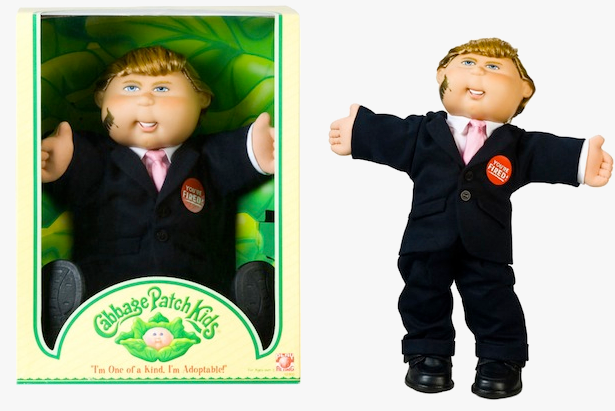
Did you know Cabbage Patch Dolls are back this year? Maybe you've got one wrapped under the tree right now. Did you know there was an urban legend that the CIA or President Reagan had Cabbage Patch Dolls designed to get people used to loving ugly babies so humanity could carry on after a nuclear war?

Speaking of ugly, did you know you can get a Donald Trump Cabbage Patch Doll?

And then there is the cabbage of fable:
It is said that no sort of food causes so much thirst as cabbage, especially that called colewort. Pausanias tells us it first sprang from the sweat of Jupiter, some drops of which fell on the earth. Cœlius, Rhodiginus, Ovid, Suidas, and others repeat the same fable.

Rabelais: Pantagruel, book iv. (Prologue). “Some drops of sweat happening to light on the earth produced what mortals call cabbage.”—
The poets have lavished their attention on the lowly cabbage. Yeats:
All his happier dreams came true
A small old house, wife, daughter, son,
Grounds where plum and cabbage grew,
Poets and Wits about him drew;
“What then?”sang Plato’s ghost, “what then?”
Lewis Carrol:
"The time has come," the Walrus said,
"To talk of many things:
Of shoes--and ships--and sealing-wax--
Of cabbages--and kings--
And why the sea is boiling hot--
And whether pigs have wings."
There is also the cabbage of politics. H.L. Mencken has good political wisdom framed in cabbage terms: "An idealist is one who, on noticing that a rose smells better than a cabbage, concludes that it will also make better soup."

And George Orwell begins his "1984" with the reek of cabbage:
The ideal set up by the Party was something huge, terrible, and glittering—a world of steel and concrete, of monstrous machines and terrifying weapons—a nation of warriors and fanatics, marching forward in perfect unity, all thinking the same thoughts and shouting the same slogans, perpetually working, fighting, triumphing, persecuting—three hundred million people all with the same face. The reality was decaying, dingy cities, where underfed people shuffled to and fro in leaky shoes, in patched-up nineteenth-century houses that smelt always of cabbage and bad lavatories.
Well, that reminds me what I don't like about cabbage. So maybe I won't get too carried away with the new cabbage-blogging craze. So don't hesitate to pick up the slack and cabbage-blog yourself.