Fearless Girl/Charging Bull লেবেলটি সহ পোস্টগুলি দেখানো হচ্ছে৷ সকল পোস্ট দেখান

২১ এপ্রিল, ২০১৭

"Every sculpture needs space. That is the nature of sculpture. If you put something else there, it changes it."

"Fearless Girl" is “cute,” but “you don’t stand up for women’s rights at the expense of the artist’s rights. Each right is equally important. I am saying this as a woman.”

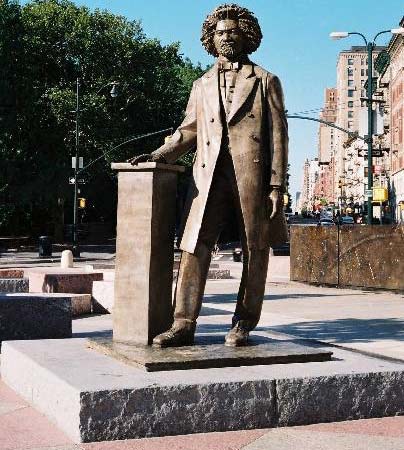
Said Gabriel Koren, an artist who made a statue of Frederick Douglass that is situated in Central Park, looking into Harlem. What if a second statute — a figure reacting to Frederick Douglass — were put close to it? Should Koren have final say about whether the second statue can be there? I'd say no, but I think she has moral power to influence the decision, and I think that would be enough to preserve the space around Frederick Douglas.

But that's in part because it's Frederick Douglass...


.... not a charging bull. There's a debate to be had about whether things should be put near other things, but the first thing to go up shouldn't become a tyrant. Sometimes putting things together makes a dialogue that benefits the people, who, after all, have our space cluttered by all sorts of art and art-like junk. And sometimes the first thing that goes up is kind of bad or an incomplete statement, and continuing the "conversation" with something else is an improvement.

Considering the urge to take down statues that don't say what the public wants said, we ought to keep open the option of putting up another sculpture nearby and changing the meaning. For example, in New Orleans:
Statues of Confederate leaders Robert E. Lee and Jefferson Davis are targeted for removal in New Orleans, after a federal appeals court approved the city's plan to change how it treats symbols of its history. Opponents of the move vow to keep fighting it in court....

In addition to the statue of Lee, [Mayor Mitch] Landrieu and other city officials want to take down a statue honoring Gen. P.G.T. Beauregard and a monument to the paramilitary White League, which launched a Reconstruction-era rebellion against the integrated Metropolitan New Orleans Police Force....

"White House officials said Mr. Trump took a personal interest in her case.... 'He just said, "Let’s bring her home."'"

From the NYT report, "American Aid Worker, Release Secured by Trump Officials, Leaves Egypt."

This article, new today, appears in the print edition not on the front page, but on page 10. On the home page of the web edition, it's hard to find. I did a search for the woman's name and found nothing, then for "Egypt," and found the headline tucked away... do you see it?


It's not under "World" or "U.S." but "Politics" — politics? — sandwiched between "Right and Left: Partisan Writing You Shouldn’t Miss" and "Jeff Sessions Dismisses Hawaii as ‘an Island in the Pacific.’"

By contrast, the Washington Post home page has the story at the top of the home page, with the woman's name, Aya Hijazi, in clear print:


The visual effect is a triad of bold females challenging the powers that be: 1. There's "Aya Hijazi, a charity worker... incarcerated without trial on charges that were widely derided." 2. There's that "Fearless Girl" sculpture we've been talking about. (It's not a new story, so it seems especially conscious to put the story front and center today. (The article has an interesting feminist angle: The male artist expresses pain that his bull — against his original intent — has become a symbol of male chauvinism.)) 3. There's Marie Le Pen, boosted by the latest Paris terrorist attack.

It's hard — isn't it? — for the liberal media to give President Trump credit for anything, but they should gracefully give him the credit he genuinely deserves. Imagine what the NYT would look like if President Obama had brought Aya Hijazi home! Trump was portrayed in a negative light for cozying up to Egyptian President Abdel Fatah al-Sissi, but the Obama administration tried and failed to bring Hijazi home. From WaPo:
It was not until Trump moved to reset U.S. relations with Egypt by embracing Sissi at the White House on April 3 — he publicly hailed the autocrat’s leadership as “fantastic” and offered the U.S. government’s “strong backing” — that Egypt’s posture changed. Last Sunday, a court in Cairo dropped all charges against Hijazi and the others.
Let's talk about which is better, Obama's words or Trump's words? Do Trump's words seem ridiculous and clownish — calling Sissi "fantastic" — when we see that Trump got results?

WaPo prods us to think of the Trump administration in terms of "confusion" (it's the old "chaos" template, that alternates with "evil" in the elite media's coverage of Trump):
What the White House plans to celebrate as vindication of its early diplomacy comes at the end of a week in which the administration has combated charges of foreign policy confusion. Although the president received wide praise for his decision to punish Syria for its presumed chemical weapons attack with a barrage of cruise missiles, the administration has been criticized for contradictions over policy toward Syria and Turkey, and misstatements on the U.S. response to North Korea’s weapons activity.
Successful action is camouflaged in verbiage about things that have been said. Some of his words may sound like confusion, but that doesn't mean Trump is confused about what he is saying. Maybe he knows how to use words. There's an awful lot of evidence that he does. You can look down on him and call him confused, but when the results come in, you ought to question your analysis of what he is doing with words.

Toward the end of the WaPo article:
The senior Trump administration official said the agreement for Hijazi’s release was the product of Trump’s “discreet diplomacy” — meaning the president’s efforts to cultivate warm relations with strongmen such as Sissi and Chinese President Xi Jinping, in part by avoiding public pronouncements on human rights that might alienate the foreign governments.
Discreet. Consider the notion that Trump is discreet

১৫ এপ্রিল, ২০১৭

"As an artist, I love Fearless Girl. But as an intellectual property lawyer, I will say that Mr. Da Modica has a valid legal argument."

"Fearless Girl is a work of art that incorporates Charging Bull without permission of the copyright owner. Unauthorized use of a copyrighted work — unless it falls within some narrow exceptions — is straight up copyright infringement. In my opinion, Mr. Da Modica is absolutely correct that Fearless Girl completely changes his sculpture’s meaning. You can’t control how people view your copyrighted work necessarily, but you can certainly prohibit them from using it without authorization. The relevant factual question would be, does Fearless Girl use the bull sculpture?"

One of 2 comments at the NYT about the Fearless Girl/Charging Bull controversy, selected by the NYT for publication in a column (the NYT equivalent of what I call, on the blog, "frontpaging"). The other comment loves "Fearless Girl" and credits it with making "Charging Bull" "relevant."

Note that the "Fearless Girl" statue is not attached to "Charging Bull." She's not riding it or grabbing it by the horns or even right up in its face.

She... I think it's sentimental to call the sculpture, an inanimate object, she. A child calls her girl-doll she. An adult, speaking about politics and art, should say it, unless you want to look as though you don't respect any of this as art but are all inside the emotionalism and the propaganda. Say "she" if you mean this is kitsch.

I'll eschew "she," because I don't want to sound childish or snobby. My point is: There's some distance between the 2 sculptures. It is possible to look at them independently and see them one at a time without the other necessarily intruding into your field of vision. You, the viewer, can also choose to position yourself so as to see them together and think of them together. The "Charging Bull" sculptor wants to own the space in the vicinity of his work. If he's right, it would seem that artists could push around museum curators for grouping pieces together.

For example, here's a picture I took at the Museum of Modern Art, where a sculpture was placed in front a painting, creating an excellent relationship between the 2, perhaps something the painter and the sculptor would object to:

Futurism

These 2 works of art are simply positioned near each other so that viewers will often see them together and have perceptions and ideas based on the relationship, but the viewer can also choose to see them separately. The works are unchanged. The painting isn't touching or even that close to the sculpture. The museum and the museum-goer are affecting the proximity. We might criticize the placement and say it's wrong in some way. Or we might think the combination is great. I think the combo effect in my photograph is fantastic, expressive of Futurism, but for all I know one or both of the artists would think putting the 2 together creates a misunderstanding of Futurism. 

The "Fearless Girl" most reminds me of the "Three Soldiers" sculpture at the Vietnam Memorial in Washington, D.C., which was designed in reaction to the minimalist Maya Lin sculpture. The very simple and dramatic Maya Lin's wall must exist in proximity to the realistic depiction of three men, painstakingly detailed in particular uniforms, with identifiable weaponry, and with faces sculpted to beat us over the head with the fact that one is white, one is black, and one is Hispanic. It's as though "Three Soldiers" and Maya Lin's wall are having a debate about what bad taste is.

The wall had been controversial, and Lin didn't like the intrusion of the second sculpture:
Lin was furious at the adulteration of her design and called the decision to add Hart's piece "a coup," which "had nothing to do with how many veterans liked or disliked my piece." In response to veteran Tom Carhart's comments that her design was a "black gash of shame and sorrow, hacked into the national visage that is the Mall," Lin asserted that she had not received a single negative letter from a veteran, adding that "most of them are not as conservative as Carhart." Hart's addition was placed a distance away from the memorial wall in order to minimize the effect on her design. Still, Lin refused to attend the dedication of the sculpture.
But as far as I know, Lin didn't sue anybody, and "Three Soldiers" is still there in proximity to the wall, so what's the difference between that and the "Fearless Girl"/"Charging Bull" problem?