8 જૂન, 2019

At the Lake Shore Café...

fullsizeoutput_2fba

... you can talk all night.
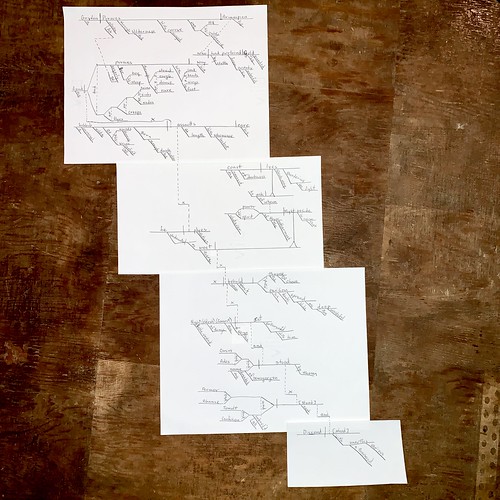
On April 10th, I challenged you to diagram a 153-word sentence from "Paradise Lost."

It all started with a weather report that used the word "haboob," which got me thinking about whether "haboob" is related to "hubbub." It's not. "Hubbub" comes (probably) from the ancient Irish war-cry "ub! ub! ubub!" Looking "hubbub" up in the OED, I came across a snippet from "Paradise Lost": "A universal hubbub wilde Of stunning sounds and voices all confus'd." I wanted the complete sentence and found what I thought was the whole thing, a passage 153 words long.

Today, I get an email from Clark who says, "I have been noodling your sentence from Paradise Lost. Here is my attempt." He informs me that the 153-word text in my post is not the full sentence. There's an opening clause, and it seems to have been harder to diagram the sentence without these additional 30 words. Here's the diagram Clark sent me (click and click again to enlarge and clarify):

fullsizeoutput_2fb9

Here's the full 183 word passage from John Milton's magnificent poem.

"You have to go all the way back to President Harry Truman to find a president who even participated in the formal Washington celebration."

"(In 1951, Mr. Truman spoke from the Washington Monument about the progress of the Korean War.) In 1970, during the fractious era of Vietnam, President Richard Nixon videotaped remarks to be shown on the Mall. Other leaders have largely remained out of the picture, visiting troops or attending naturalization ceremonies or hosting bipartisan picnics on the South Lawn of the White House.... Mr. Trump, by contrast, cares not at all about public unity...."

Writes Michelle Cottle in "Trump Hijacks the 4th of July/The president decided that the one thing missing from the capital’s celebration was himself" (NYT), and I wonder how much she cares about public unity. Because I'm not feeling it. I mean, what's so bad about being like Harry Truman? It might be bad to "hijack" the occasion to propagandize about a war, and yet the 4th of July is kind of about enthusiasm about fighting wars. Those fireworks represent bombs bursting in air, don't they? Anyway, I think it's a good gesture to show up, if you do it the right way. It could be overly self-centered, but it doesn't have to be. I can be done in an appropriate scale and tone. We don't say Presidents "hijack" Easter when they do those egg roll events. Could everyone just calm down?

"Jeopardy!" genius James Holzhaeur — amusingly modest on Twitter — adopts a Weird Al "I Lost on Jeopardy" avatar.

I just noticed this:


I went to his feed to look for this (also amusingly modest):

And here's the great Weird Al parody of a song no one would remember without the parody (but is actually cheesily enjoyable):


The Weird Al song predates the Alex Trebek version of the ancient game show. And:
The song has been referenced several times on the game show itself, including once as a category on the current Alex Trebek-hosted version, and later when Yankovic appeared on Rock & Roll Jeopardy!....

The video takes place on a re-creation of the original set from the 1964-75 version of the quiz show Jeopardy! (for some reason, the exclamation point used in the show's original logo was missing). The video also depicted a "behind-the-scenes" look at the show, and featured cameo appearances by original Jeopardy! host Art Fleming and announcer Don Pardo, Yankovic's mentor, Dr. Demento, members of Yankovic's band, his real-life parents and a brief cameo by Greg Kihn [writer of the original song, "(Our Love's in) Jeopardy"] at the end....

Yankovic lands in the back seat of an Alfa Romeo Spyder convertible driven by Kihn himself, with the license plate reading "LOSER". In the original ["(Our Love's in) Jeopardy" video, Kihn drives away with a female bride in an MG MGB convertible, with the license plate reading "LIPS"...

"With Venezuela in collapse, towns slip into primitive isolation."

A Reuters headline.
At the once-busy beach resort of Patanemo, tourism has evaporated.... These days, its Caribbean shoreline flanked by forested hills receives a different type of visitor: people who walk 10 minutes from a nearby town carrying rice, plantains or bananas in hopes of exchanging them for the fishermen’s latest catch....

“The fish that we catch is to exchange or give away,” said Yofran Arias, one of 15 fishermen who have grown accustomed to a rustic existence even though they live a 15-minute drive from Venezuela’s main port of Puerto Cabello. “Money doesn’t buy anything so it’s better for people to bring food so we can give them fish,” he said, while cleaning bonefish, known for abundant bones and limited commercial value....

“I haven’t been to the city center in almost two years. What would I do there? I don’t have enough (money) to buy a shirt or a pair of shorts,” said a fisherman in Patanemo who identified himself only as Luis. “I’m better off here swapping things to survive.”...

In the mountains of the central state of Lara, residents of the town of Guarico this year found a different way of paying bills - coffee beans. Residents of the coffee-growing region now exchange roasted beans for anything from haircuts to spare parts for agricultural machinery....
Inflation is more than a million percent. The "primitive isolation" is a barter economy. They have absolutely no money.

Here's an article from 2016 in The Atlantic, "The Myth of the Barter Economy/Adam Smith said that quid-pro-quo exchange systems preceded economies based on currency, but there’s no evidence that he was right."
The man who arguably founded modern economic theory, the 18th-century Scottish philosopher Adam Smith, popularized the idea that barter was a precursor to money.
In Venezuela, barter is a successor to money, which is some evidence that barter was a precursor to money, but this Atlantic writer, Ilana Strauss, questions whether human beings really ever lived without currency:
[V]arious anthropologists have pointed out that this barter economy has never been witnessed as researchers have traveled to undeveloped parts of the globe.
That was back in 2016.
“No example of a barter economy, pure and simple, has ever been described, let alone the emergence from it of money,” wrote the Cambridge anthropology professor Caroline Humphrey in a 1985 paper. “All available ethnography suggests that there never has been such a thing.”...

When barter has appeared, it wasn’t as part of a purely barter economy, and money didn’t emerge from it—rather, it emerged from money. After Rome fell, for instance, Europeans used barter as a substitute for the Roman currency people had gotten used to.
So barter as a successor to money doesn't tend to show that barter was ever a precursor to money....

Own... rent... it's all a state of mind, isn't it?

I'm reading "They See It. They Like It. They Want It. They Rent It. Owning nothing is now a luxury, thanks to a number of subscription start-ups" (NYT):
Many young American urbanites have resigned themselves to a life of non-ownership, abandoning the dream of their parents and grandparents and great-grandparents before them, often out of financial necessity. But renting isn’t just a matter of necessity these days. It’s become almost posh....

“We were raised to save and invest and buy a home and do all of these things,” said Miki Reynolds, 38, who pays a monthly fee for much of what she uses in her day-to-day life in Los Angeles. “But my mentality to currently rent — it’s not YOLO. It’s more living in the present as much as planning for the future because I feel like nothing is guaranteed.”...

“I want nice things, but I’m also not going to drop thousands of dollars all at once on a bunch of things when I don’t know in a year if I’m going to be in the same place,” [said Lili Morton, 36, who recently moved to Seattle from New York].... “I’m going to get a facial or a massage or get my hair blown out,” she said, “things that make me feel good and happy, rather than some impulse purchase that makes you feel good for a bit but maybe you get tired of it.”
The NYT presents this as a youthful change, but the big change is all these services that make it easy to rent different kinds of things. And it's not just for the young, is it?

This is also something us Baby Boomers might want. Get rid of all the accumulated stuff — Marie Kondo the hell out of your life — unload the real estate and move somewhere with no idea if in a year you're going to be in the same place.

Permanence is an illusion, and if you like that illusion, you can bolster it with an ownership relationship to your things, but you can embrace and highlight impermanence through rental.

And these rental services are there to help (and to employ both Miki Reynolds and Lili Morton, you'll see if you look closely).

This subject calls to mind the old joke: "You don't buy beer, you rent it." It's funny (or was funny, when it was funny) because of the graphic depiction of impermanence. You have paid and you think you own what you bought, but it is only flowing through you. You can't hold onto that beer or, in the long run, anything else. If that troubles you, raise your spirits with a certificate of ownership.

What is it time to start worrying about?

Click to enlarge and clarify:


The headlines on the front page of the Washington Post are: "U.S. and Mexico reach deal, averting tariffs, Trump says," "U.S. hiring slows sharply as trade war starts to bite," and "Perspective: It’s time to start worrying about the economy." Maybe later this morning the "perspective" will change. Or perhaps I should worry that Trump is lying about a deal with Mexico. Is he just manipulating the perspective?

From the "U.S. and Mexico reach deal" piece:
The agreement, which came just two days before Trump had vowed to impose a 5 percent, across-the-board tariff on one of the United States’ top trading partners, called for the Mexican government to widely dispatch its national guard forces to help with immigration enforcement, with priority in the south, on its border with Guatemala, according to a joint statement.

In addition, the two countries would expand a program known as the Migrant Protection Protocols (MPP), created this year, that allows the United States to return Central American migrants to Mexico while they await the adjudication of their asylum hearings in U.S. immigration court, a process that can take months....

On Friday, Mexican finance officials said they had frozen the bank accounts of 26 people because of their alleged involvement in human trafficking, another sign of escalating enforcement efforts....
I see that Mexican President Andrés Manuel López Obrador has tweeted about the agreement as well,  but Chuck Schumer, WaPo tells us, "reacted sarcastically":
“This is an historic night! @realDonaldTrump has announced that he has cut a deal to ‘greatly reduce, or eliminate, Illegal Immigration coming from Mexico, and into the United States,’ ” Schumer wrote on Twitter. “Now that that problem is solved, I’m sure we won’t be hearing any more about it in the future.”
So he's telling us to worry that it's a phony claim of a deal — fake news. Or does he sound like a sarcastic jerk, hearing about progress dealing with a problem and snarking about how it's not actually completely solved? But what's the poor man to do? His party suffers if there is an immigration problem and if Trump has any success solving it. Oh, I don't know, he could be gracious and hopeful.

Here's the top-rated comment at WaPo, which went up 20 hours ago on a version of the article that did not include Trump's announcement of the deal: "My opinion: There are not going to be any tariffs on Mexico. There never were going to be any tariffs on Mexico. Mexico will change something, Trump will proclaim victory and the charade will be over."

That's prescient, except to the extent that the charade will never be over.

7 જૂન, 2019

At the Friday Night Cafe...

... you can talk all night.

Nice things.

The quasi-religion of New York Magazine clickbait is making me uneasy and a little sad.

Just 2 things I'm seeing on the front page of New York Magazine right now...


I'm not recommending reading these. I haven't clicked through. I'm just contemplating the meaning and the emptiness.

"I’ve never owned a crop top before and I was nervous at first about wearing it but my husband loved the way it looked on me and encouraged me to wear it since I liked it so much."

"I really felt cute in it and now I never wanna wear that shirt again even though it was the first time I ever wore it and I felt good about my self in it."

Says a woman who wore a crop top, quoted in a Daily News article that's mainly about men in crop tops, "Just in time for summer, crop tops for men are coming into style." Of course, it's a bad idea. I'm just quoting her a propos of the "wife guy" phenomenon, noted yesterday.

Photos at the link.

Biden bullied into supporting federal money for abortions.

I'm reading "In reversal, Biden opposes ban on federal money for abortion" (AP).

I thought the whole point of Biden was that he was the one that other people would vote for. If he squares up his positions with the other Democratic candidates, the Biden's reason for being a candidate collapses.

I was going to say the Democrats are screwing up their "other people" reasoning, but I see that it's pretty clever of all the non-Biden candidates to lure him into surrendering his big advantage. Well played!

NPR people are way too jazzed up about a "transcranial direct current stimulation" device.

This is a very cutesy video that sort of acts like these characters are doing a scientific test, while also admitting — twice — that it's "unscientific":


What is NPR for? This seems like a 10 minute ad for a dicey product. The NPR reporter, Elise Hu, purports to want to know how an actual athlete would respond to the product, and then we get to hear from an athlete who is sponsored by the manufacturer! The athlete says, "To me, like, all of a sudden, it was just like everything was a lot easier for me." Later, Hu interviews the co-founder of the company, who, we're told, thinks his product could "actually increase our life span." She invites us to worry about the inequities that might emerge if humans get "upgraded too much."

I watched this so you don't have to. It's 9 minutes, so I'm not recommending it. Maybe scroll to the part I think is most ridiculous, the interview with the co-founder, which begins at 5:50.

This style of ultra-perky video is just atrocious, but it must work on someone. And I'm sending hits their way, so I'm probably encouraging it.

"Despite all of these alluring architectural features, folks in Madison still moan, 'oh, the Humanities (Building)!' or call it a 'munitions plant from some bleak dystopian fiction.'"

"Brutalism often gets dismissed as the most hated or ugliest architectural style... To people coming of age during the height of the style's popularity, Brutalist buildings were ready symbol of the establishment that spawned protests and punk songs. Folks of that generation perhaps started the 'Brutalism is ugly' myth, taking Brutalist buildings as symbols of the cold bureaucracy, ignoring the human-scale articulation and thoughtful formal elements that are characteristic of the style. But the progressive, utopian, often socialist ideals that Brutalism also represents are back in vogue for today's young people. The resurgence of the left, in combination with the fact that Brutalist buildings' bare concrete exteriors look great on Instagram, could be fueling a renaissance of the style. Brutalism is back, baby!"

From "Towards an appreciation of Brutalism: Or, the Humanities Building is very good/Madison's most-maligned structure embodies a misunderstood, utopian school of architecture" by Mary Dahlman Begley (Tone).

Here's the "look great on Instagram" link, so judge for yourself if Brutalism looks great in Instagram's glossy little squares. I've experienced walking-around life with that Humanities Building for more than 30 years, and it's pretty horrible, but maybe I'm just a creature of the age group that hates it. I've walked by and through it many times, and I've done figure drawing sessions in the gloomy top floor where (I seem to remember) the windows are at ankle level. It will be very disruptive to tear it down, and maybe it is wrong to tear down a monument, even if you believe it's a monument to ugliness.

Thanks to our regular commenter David Begley for sending me that link. I don't know if I'd ever noticed Tone before. Here's another article there: "Madison dodged a monorail grift and barely even noticed" by Scott Gordon. We talked about that crazy thing a few days ago — here. Gordon writes:
In most of Transit X's renderings, and a hilariously bad video the company produced, the pods seem to be about 15 feet above ground and improbably tiny, looking more like weird oblong suitcases than passenger cars holding multiple people. The sense of scale here is severely off. City staff, perhaps fearing decapitation by massive black jellybeans, have wisely advised that we stick to the plan to bring bus rapid transit to Madison.
The video, at the link, is indeed hilarious.

"It was around this time that I started separating the alphabet into good letters, V as well as M, and bad letters, S, F and T, plus the terrible vowel sounds..."

"... open and mysterious and nearly impossible to wrangle. Each letter had a degree of difficulty that changed depending upon its position in the sentence. Much later when I read that Nabokov as a child assigned colors to letters, it made sense to me that the hard G looked like 'vulcanized rubber' and the R, 'a sooty rag being ripped.' My beloved V, in the Nabokovian system, was a jewel-like 'rose quartz.'"

From "My Stutter Made Me a Better Writer/At times it caused suffering, but it also gave me a passion for words and language" by Darcey Steinke (NYT).

"While singing along to a rap song in Kloey’s car, Grace, who is white, used a hateful racial slur for what she said was the very first time."

"Kloey, also white, posted the photo on Snapchat to commemorate the occasion, spelling out the slur in the caption.... Kloey’s post helped set off a violent clash the following Monday that involved students, teachers and police officers. The scuffle ended with a black 16-year-old girl being tackled and arrested. That prompted the school’s handful of black students to demand that the school take on its culture of racism. Their efforts led to messy, uncomfortable conversations that would have seemed impossible not long ago. Sitting in a Mexican cafe three months after the unrest, Kloey struggled to explain why she had felt so comfortable using the racial slur. Maybe it was because she had a relative who would sometimes use the word when talking about black people and then laugh, she said, so it did not seem meanspirited. Perhaps it was ignorance or selfishness, she said. 'I think it comes from a place of racism,' said Abang, the girl who was tackled and arrested, recalling that she had told Kloey back in middle school not to say the word, but that she had continued to say it anyway.... To make matters worse, after Kloey’s post had gone viral, two more Snapchat posts by other white students, both using the same offensive racial slur, began to circulate that day. One was from a white student who posted a selfie flashing his middle finger, with a caption that accused Owatonna’s black students of 'playing the black card.'"

From "Few Talked About Race at This School. Then a Student Posted a Racist Slur./When white students at a Minnesota school posted a slur to Snapchat, black classmates demanded action. Their efforts led to uncomfortable conversations about race" (NYT).