From "Hooters Says Bring the Kids/The chain known for skimpy uniforms and 'bikini nights' is trying to change its image. Hooters onesie, anyone?" (NYT).
Showing posts with label women in shorts. Show all posts
Showing posts with label women in shorts. Show all posts
May 21, 2026
"In recent months, the original owners have moved to reclaim much of the business, acquiring roughly 140 locations with a plan to 're-Hooterize' the brand."
"The effort is led by Neil Kiefer, who was once the founders’ lawyer and is now the chief executive. He aims to return Hooters to what he described as its core identity — a casual place with a family-friendly vibe. 'There’s a lot to clean up,' Kiefer, 74, said in an interview. Under private equity control, Kiefer argued, the franchise operators leaned into more overtly sexual marketing, notably a 2021 decision to introduce uniforms that resembled underwear. 'We’re getting back to what makes us a beach-themed restaurant as opposed to a girlie bar,' Kiefer said."
From "Hooters Says Bring the Kids/The chain known for skimpy uniforms and 'bikini nights' is trying to change its image. Hooters onesie, anyone?" (NYT).
From "Hooters Says Bring the Kids/The chain known for skimpy uniforms and 'bikini nights' is trying to change its image. Hooters onesie, anyone?" (NYT).


January 12, 2026
Bob Weir's "Bobby shorts" were NOT hot pants.
All respect to Bob Weir. My blog tribute to him is here. But now I need to talk about a NYT article that talks about his pants, his shorts. Here: "Bob Weir, a Virtuoso of Hot Pants/The Grateful Dead guitarist wore short shorts like no other" (NYT).

I am not taking one more step 'til I know where I'm going.
Okay, I am an expert on this subject... and not because I've been talking about the issue of men in shorts for 20 years. I was there, at ground zero, in the summer of 1971, when the "hot pants" fashion trend peaked. It was the summer after my sophomore year of college, I was 20 years old, and I worked — for what was probably less than $2 an hour — in the juniors department of Lit Brothers department store in Camden county, New Jersey. New hot pants outfits came in every week and we positioned them on the racks near the store entryway so they'd, presumably, mesmerize the passersby. I saw and handled this merchandise in real time. It was not made of denim. It was polyester. It was certainly not cut off and frayed. It had neatly finished edges. And most important, it had a 2-INCH INSEAM.
Now let's look at what that NYT is calling hot pants:
The article leans heavily into the idea that these shorts are really really shorty short. Key language: "chopped-to-the-heavens jean shorts," "Mr. Weir’s shorts were short," "snipped high enough that fans quite a distance from the stage could make out Mr. Weir’s upper thighs," "not Daisy Dukes, they were 'Bobby Shorts,'" "The Bob Weir Inseam... five inches max."
5 inches! 5 inches, you say?! Hot pants had a 2-INCH INSEAM! A woman in shorts with a 5-inch inseam would — in the era of hot pants — have been seen as frumpy and ultra-modest.
Don't fight with me. I am a 1970s hot-pants purist. I was there. I didn't measure the inseam at the time, but I handled the merchandise, and I've researched the measurement, and the number is 2 inches. You may marvel — I'm marveling now — at how these pants could adequately enclose a woman's crotch, let alone a man's.
September 5, 2025
"... 'soft-clubbing'... 'what happens when a generation raised on overstimulation and burnout wants the fun without the fatigue.' Think lo-fi coffee shop D.J. sets at 2 p.m...."
"... with everyone behaving a little too respectfully. Perhaps that explains the natural — or 'natty,' if you’ve been here a while — wine craze that has taken over New York’s restaurant and bar scene in the last couple of years, attracting 20-somethings looking to drink a little more 'intentionally.' And perhaps that’s how you get something called a wine rave at Public Records, a vast multilevel bar in Brooklyn, hosted by the D.J. collective Beverages on a Saturday afternoon. Here, finance bros in light blue linen button-ups and weathered Stan Smiths milled about clutching wine glasses, sediment occasionally pooling at the bottom."
From "Is Partying Dead, or Are You Just Old? Gen Z was alive during a week of supper clubs, daytime raves and rooftop ragers in New York City" (NYT).

From "Is Partying Dead, or Are You Just Old? Gen Z was alive during a week of supper clubs, daytime raves and rooftop ragers in New York City" (NYT).
Lots of photographs at the link, including the one I captured a segment of, because I've been keeping track of men (and women) in shorts:
I'll translate my feelings into a survey:
June 29, 2025
"Morgan Wallen, baby!"/"From tailgates to patio parties the streets around Camp Randall were buzzing. Downtown Madison transformed into a party well before the gates opened."
"Bars were shoulder-to-shoulder, lines snaked outside of Jimmy John's, and parking spots went for as high as $100...."
Yes, the Morgan Wallen people were out in abundance yesterday, and there's a second concert tonight. This is my neighborhood, where I remember, long ago, listening to Pink Floyd wafting over from Camp Randall.
I hadn't realized it's been 28 years since there's been a concert in the football stadium. Nice. The crowd seems to have included lots of people from out of town. So many women in short shorts and cowboy boots. We talked to a couple who'd come in from Iowa for the big concert. Me, I'd never heard of Morgan Wallen, but what do I know? I found out he's the biggest star. I hope he and everyone else enjoy Madison.
If you watch the video, keep an eye out for the children selling lemonade. The reporter asks each of them what they'll do with the money, and you may be surprised at what they say.
October 5, 2023
"While the runways featured many palettes, there were far fewer body types. Aside from at the Nina Ricci show in Paris, where people of different sizes walked the runway..."
"... models were as skinny as I’ve seen them in the more than 10 years I’ve been documenting fashion weeks."
Writes Simbarashe Cha, in "Shades of Gray, and Then Some/During Paris Fashion Week, almost every color could be spotted on the streets and the runways" (NYT).
Writes Simbarashe Cha, in "Shades of Gray, and Then Some/During Paris Fashion Week, almost every color could be spotted on the streets and the runways" (NYT).
Look at these models. They all look famished and 5 out of 6 seem deeply depressed about it:

That's just part of the photo. I wanted to stress the evident starvation.
The whole photo — at the link — is something that deserves its caption: "Miu Miu’s latest collection included Speedo-style briefs in several colors. Only time will tell if they become as ubiquitous as its miniskirt."
The captions, by the way, are excellent. For example: "Feathers also appeared on the runway at Nina Ricci, where they protruded from this gown like acupuncture needle." And: "Walking with purpose can make a good outfit look even better." And: "Her crouched posture made the tiny bag seem that much bigger"... which I like to think of as small bag the size of a large bag.
Or... minuscule bag the size of a ludicrously capacious bag.
September 9, 2023
"There was definitely a thumb on the scale to get boys. We were just a little more forgiving and lenient when they were boys than when they were girls. You’d be like, 'I’m kind of on the fence about this one, but — we need boys.'"
Said Sourav Guha, assistant dean of admissions at Wesleyan University from 2001 to 2004, quoted in "‘There Was Definitely a Thumb on the Scale to Get Boys’/Declining male enrollment has led many colleges to adopt an unofficial policy: affirmative action for men" (NYT).
This article is illustrated with many photographs of large groups of beautiful young women in shorts. The idea seems to be to cause the reader to agonize over the wasted pulchritude. No boyfriends!
August 16, 2023
"With this summer’s heat waves in Europe, Americans wearing shorts and ordering ice water may butt up against etiquette and norms in some areas."
A caption under a photograph of so many tourists at the Parthenon that it makes me think it's absolutely pointless (aesthetically) to visit the Parthenon. That's my cultural norm. I don't want the sight I'm seeing to be other tourists.
But the article is about the cultural norms of the people in the place the tourists are visiting: "Iced Coffee and Flip-Flops as Europe Broils? Not So Fast, Americans. As large numbers of U.S. tourists visit Europe during a record hot summer, their efforts to stay cool are running up against cultural norms" (NYT).
The article still takes the point of view of the American tourists, because the reason for paying attention to the cultural norms of the place you are visiting is that you aspire to "blend in with the locals."
August 8, 2023
"At Wimbledon earlier this summer, Elena Rybakina of Kazakhstan and Shelby Rogers of the United States were among the first competitors to wear dark shorts under their tennis whites..."
"... as the All England Club finally relaxed its all-white rules in recognition of female menstrual reality. At the EuroHockey Championship later this month, shorts will be an option for every participant as well as the traditional skorts, and the decision about what to wear will be left up to each individual player. And some track and field competitors have swapped their bikini-like 'buns' for shorts and leggings in competition."
From "From the Women’s World Cup to Wimbledon, a Victory Everyone Can Share/Across sports, female athletes are fighting a battle over what they put on their bodies and how much of those bodies they display" (NYT).
From "From the Women’s World Cup to Wimbledon, a Victory Everyone Can Share/Across sports, female athletes are fighting a battle over what they put on their bodies and how much of those bodies they display" (NYT).
We're prompted to ask: Wait, why are we doing things this way:
May 16, 2023
Let's look at the complaint in Noelle Dunphy v. Rudolph W. Giuliani.
Filed in yesterday in state court in Manhattan. I'm just going to extract some things that stood out to me, so I encourage you to do your own independent reading. My selections are entirely biased, as is this entire blog, toward what catches my attention:
Giuliani worked aggressively to hire Ms. Dunphy, offering her what seemed like a once-in-a-lifetime opportunity to work as his Director of Business Development with a salary of $1 million per year.... He made clear that satisfying his sexual demands—which came virtually anytime, anywhere—was an absolute requirement of her employment and of his legal representation. Giuliani began requiring Ms. Dunphy to work at his home and out of hotel room, so that she would be at his beck and call. He drank morning, noon, and night, and was frequently intoxicated, and therefore his behavior was always unpredictable. Giuliani also took Viagra constantly.
October 5, 2022
Half Human.

I love that poster. It's for a 1955 Japanese film about the Abominable Snowman.
I ran across that just now researching the phrase "half human" as I was writing the previous post.
Interesting things about the poster: woman in shorts in a snowy mountain environment, man more suitably dressed in a Tyrolean hat, vaguely indicated male genitalia on the Snowman.
ADDED: Joe Dante explains "Half Human":
What the whole thing if you dare: here.
January 20, 2022
"When Polka Dots Signal Both Optimism and Disquiet/The motif has long been associated with a certain brand of American cheeriness but, as its recent ubiquity attests, is most visible during times of turbulence."
A headline in T, the NYT Style Magazine, for an article by Nick Haramis.
The history of polka dots. This is the article I want to read. I feel some pressure to write about Biden's 2-hour news conference yesterday, which I watched, but I'm loath to blog it without a complete transcript. I have seen the "5 takeaways" pieces and the "utter disaster!!!" stuff, and it's propaganda on top of propaganda. Until I find a transcript, I'm holding off, I'm in the ellipsis... and therefore: polka dots!
Haramis writes delightfully:
May 13, 2021
"The guest was initially stopped because her shorts exposed a significant portion of her buttocks. She was given multiple opportunities to change or cover up..."
"... but refused. Instead, she responded with profanity and offensive conduct, including further exposing her buttocks."
Six Flags responds to the woman who Facebooked her outrage at being asked to leave the amusement park because her shorts were extremely short.
From the Facebook post: "Then [the park police officer] proceeded to follow me and grabbed my shoulder to turn me around and proceeded to tell me my shorts were 'too short.' I committed no crime and proceeded to walk to my boyfriend as I am autistic and have a hard time talking to officers. She followed me yelling and calling for backup... [W]e were about to leave and were blocked by your female officer from leaving and she pulled out her cuffs and demanded my ID. When we asked for probable cause their answer was 'because they are the police.'"
Video clip at the link, showing part of the interaction with the cop. Without the full context, I'm not going to opine on what the cop did. I'm wary of these videos that begin after conflict has escalated. But I support the park's requirement that guests keep their buttocks in their pants! By the way, the woman with the shorts is a petite and pretty white woman. The cop is a large black woman. Whatever the buttock exposure policy is at Six Flags, it has to be the same for whites and blacks, for the slim and the fat. Enforcing the policy on this woman is, I think, evidence that Six Flags is treating all its guests the same. Rules are rules. No exceptions.
October 17, 2020
"[I]n an attempt to defend [Billie] Eilish — a sincere attempt, often from other young women — a new narrative is being formed around her body."
"Now, it’s about Eilish’s 'bravery' in having a body atypical for celebrities because she’s seemingly not a size 0. It’s a common refrain anytime a woman in the public eye is seen eating in public, having hips in public, or having rolls in public.... The goal of this kind of noxious positivity is to make clear that not being thin — either intentionally or not — is just as worthy of celebration as thinness has been since basically forever. But this is a false equivalence; we praise thinness because we think it tells us something about someone’s worth, their inherent beauty, their value as a person. The issue isn’t so much celebrating one type of body over another, but rather celebrating a body for its bravery, as if there’s something impressive about existing in the world even though your body doesn’t conform to narrow standards of beauty. Refusing beauty norms, or merely falling outside of them, isn’t that brave; it’s just an inevitability since those standards are increasingly harder to attain. Arguably, every woman in the world is brave in that regard because none of us are meeting every characteristic of perfection, whether we want to or not.
Eilish has been vocal in the past about why she wears clothes '800 sizes bigger' than she actually is. 'It kind of gives nobody the opportunity to judge what your body looks like. I don’t want to give anyone the excuse of judging,' she told Vogue Australia in 2019. 'Anything you look at, you judge.'... Calling someone brave for merely existing in the body they have doesn’t take power away from thinness, and it doesn’t create any kind of equilibrium in culture.... The truth about Eilish’s body in those paparazzi photos — the truth about most women and their bodies — is really boring: It’s just a body, and you get the one you get."
From "That Photo Of Billie Eilish Isn’t Brave. It’s Just Typical.
In the pursuit of body positivity, we’ve tipped over into an absurd place — where merely existing in a body larger than a size 0 is considered courageous" Scaachi Koul (Buzzfeed).
First, I'd just like to say, the idea that there are beautiful celebrities who wear size zero is absurd. The chest measurement for size zero is 30 inches! Please point me to any adult with a 30 inch chest. This is not any sort of beauty ideal. But people say "size 0" the way people used to say "thin as a reed." Nobody is thin as a reed, and if they were, it would freak you out.
Second, I'll say that women's bodies are not boring.
June 19, 2020
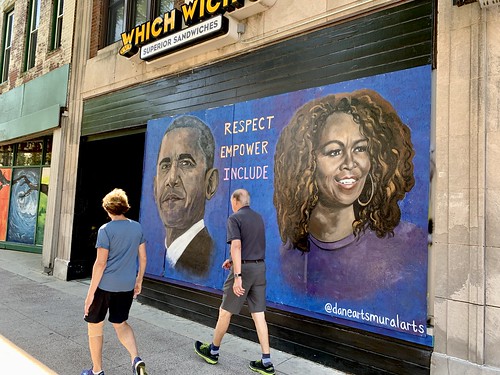
"Respect/Empower/Include."
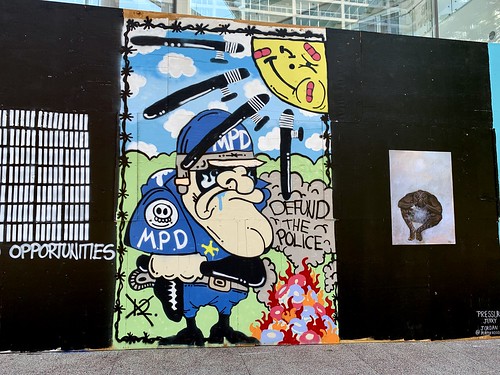
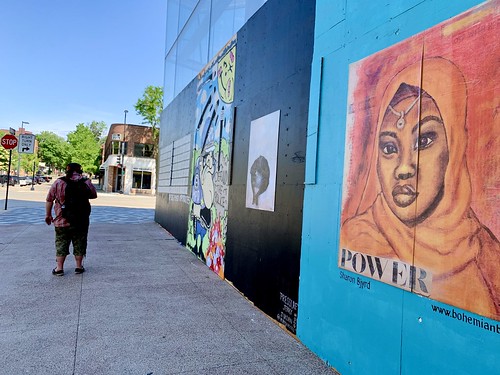
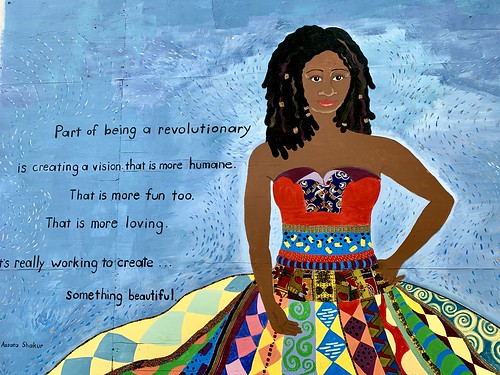
Murals on the boarded up windows of State Street, photographed today, in Madison, Wisconsin.
Madisonians in shorts trudge past a mural of Barack and Michelle Obama that is painted on the boarded-up window of Which Wich Superior Sandwiches:
On the boarded-up window of the Madison Museum of Contemporary Art, a drooling troglodyte cop observes what might be a pile of burning doughnuts that give off smoke that reads — like a thought balloon — "Defund the Police":
A longer view of the side of the museum featuring an ironic "Right turn only" sign:
There's the notion that "being a revolutionary" has an element of being fun, loving, and beautiful:
There's the grievance that you can't play your music really loud without people calling the cops:

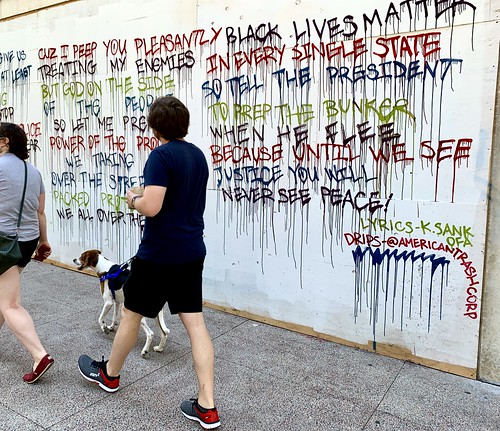
More Madisonians trudging along, this time past dripping letters that few will read, but I'm seeing "Tell the President/To prepare the bunker/When he flee/Because until we see/Justice you will/Never see peace!"
"Yes, we can!" the old President says, as a waiter sets up an outdoor café table.
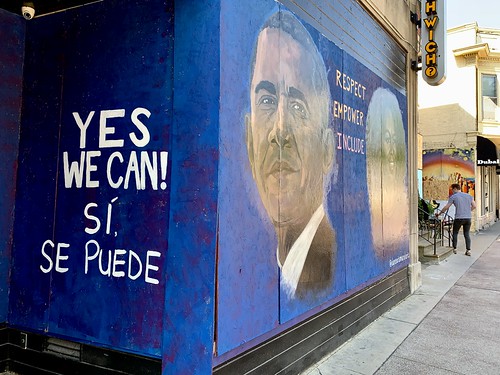
Madisonians in shorts trudge past a mural of Barack and Michelle Obama that is painted on the boarded-up window of Which Wich Superior Sandwiches:
On the boarded-up window of the Madison Museum of Contemporary Art, a drooling troglodyte cop observes what might be a pile of burning doughnuts that give off smoke that reads — like a thought balloon — "Defund the Police":
A longer view of the side of the museum featuring an ironic "Right turn only" sign:
There's the notion that "being a revolutionary" has an element of being fun, loving, and beautiful:
There's the grievance that you can't play your music really loud without people calling the cops:
More Madisonians trudging along, this time past dripping letters that few will read, but I'm seeing "Tell the President/To prepare the bunker/When he flee/Because until we see/Justice you will/Never see peace!"
"Yes, we can!" the old President says, as a waiter sets up an outdoor café table.
July 10, 2019
"Had they seen that same issue in a woman who was not a woman of color, they would not have felt empowered to take me off the plane."
"In pop culture, especially black women with a body like mine, they’re often portrayed as video vixens. So I’ve had to deal with those stereotypes my whole life"/"We are policed for being black... I’ve seen white women with much shorter shorts board a plane without a blink of an eye. I guess if it’s a ‘nice ass’ vs. a Serena Booty it’s O.K."
Wrote Tisha Rowe — on Twitter and Facebook — quoted in "Woman Required to Cover Up on American Airlines Flight Says Race Was a Factor/Dr. Tisha Rowe was about to fly from Jamaica to Miami when a flight attendant briefly removed her from the plane because of her romper, she said" (NYT).
That's the trouble with the "offensiveness" standard! It doesn't address the clothing, but the way other people react to YOU in the clothing. But the airline doesn't want to get specific and say no bared shoulders or clothing must cover your legs at least to mid-thigh — even though your seatmates have an obvious interest in not having to be in contact with your bare flesh.
With that subjective standard, any enforcement is going to feel personal, and inevitably that will mean that people will feel that race and gender and age and level of attractiveness are going to be part of the judgment — whether they are or not. I doubt if the employees enforcing the rule can even know whether they're using inappropriate factors in applying their standard of appropriateness. It's a paradox of propriety.
Wrote Tisha Rowe — on Twitter and Facebook — quoted in "Woman Required to Cover Up on American Airlines Flight Says Race Was a Factor/Dr. Tisha Rowe was about to fly from Jamaica to Miami when a flight attendant briefly removed her from the plane because of her romper, she said" (NYT).
Dr. Rowe said she was walking to her seat when a male flight attendant, whom she described as black, asked her to return to the front of the plane. Another flight attendant, who was also black, then spoke to her about her appearance while she stood on the jet bridge, Dr. Rowe said.So... the airline has a dress code with improper grammar. How's a person to know what's "appropriate" in this world? The airline is specific about one thing: bare feet. I take that to mean it's okay to wear flip flops. Or does it depend on whether the feet you expose are hairy and gnarly?
“She poses the question to me, ‘Do you have a jacket?’” Dr. Rowe said. “I said, ‘No, I do not.’ I’ve been given no explanation as to why I was taken off the plane. So finally she says, ‘You’re not boarding the plane dressed like that.’ Then they started to give me a lecture about how when I got on the plane, I better not make a scene or be loud.”
The airline’s conditions of carriage, which are posted on its website, make a brief reference to a dress code: “Dress appropriately; bare feet or offensive clothing aren’t allowed.”
That's the trouble with the "offensiveness" standard! It doesn't address the clothing, but the way other people react to YOU in the clothing. But the airline doesn't want to get specific and say no bared shoulders or clothing must cover your legs at least to mid-thigh — even though your seatmates have an obvious interest in not having to be in contact with your bare flesh.
With that subjective standard, any enforcement is going to feel personal, and inevitably that will mean that people will feel that race and gender and age and level of attractiveness are going to be part of the judgment — whether they are or not. I doubt if the employees enforcing the rule can even know whether they're using inappropriate factors in applying their standard of appropriateness. It's a paradox of propriety.
September 27, 2018
"What exactly is Saint Laurent saying about female sexuality and empowerment here?"

I'm reading Robin Givhan in the Washington Post. The post title is the headline. There are lots of photographs of glamorous clothes with an edge of trashiness. I clipped out part of one photograph. Not randomly selected. It's what caught my eye as I scanned the page with the idea of "female empowerment" foremost in my mind. I've left out what Givhan calls the "teeny-tiny shorts" (which are what we used to call "hot pants").
Let's see how Givhan answers the question posed in the headline:
Yes, the female form is beautiful, but is it made more beautiful by borrowing clothes from the boys, by wrapping it in a cloud of debauchery, by having parts exposed in a way that makes a woman “all legs” instead of full human?I guess I'm not going to get an answer to the question, only more questions. Questions good. Why not a column full of questions? Maybe we women writers should be all questions, just like the runway models are "all legs."
This is not to say that the collection was bad or offensive or improper, only that it raised questions. And raising questions is good, particularly in this moment when the culture, both here and in the United States, is considering its male and feminine norms....
[Male designers at Saint Laurent] have told women that it is empowering and satisfying to wear teeny-tiny snakeskin shorts with towering heels, to splash through shallow waters with breasts bared on a night chilly enough that guests were swaddled under blankets. They have told them that the ideal female form has the spindly legs of a filly — so immature and scrawny that one half expects the model to collapse in a heap from the sheer exhaustion of having to walk upright....So, yeah, we do end with more questions. I was going to say it's the same old questions I've always seen about fashion designers, but really the questions have evolved. What I used to see (half a century ago) was the question whether the designers hated women. This idea was typically tied to the observation that they didn't sexually desire women at all: The designers are gay and that's why the clothes are hostile to women. What we see in this new column is the idea that male sexual desire for women is driving the designs. Are the designers not gay anymore? Why would expensive clothes be designed to "satisfy" men? The women are the clients. What's the logic here?
Yes, the female form is beautiful. It’s inspirational. But what has it inspired? And has that been empowering to women or simply satisfying to men?
Oh, I see I'm doing questions, even as I want Givhan not to proceed in the form of question-asking. All right. I'll posit some answers to her questions. Why shouldn't I take the power to say what's what? I will! The clothing is designed to call out to women. It looks the way it does because that has been working to sell clothes. The women who buy those clothes think those clothes will benefit them, and the perception that this is what heterosexual men desire in a woman is a perception that needs to take place in the mind of the woman, and that is the perception the designer is trying to stimulate. If the woman buys clothes that she perceives as satisfying male desire, she is seeking sexual power over men.
And I suspect that one reason Robin Givhan doesn't say that is because it criticizes the woman. The question "has that been empowering to women or simply satisfying to men?" leaves women in the down position, where we can muse MeTooishly. That's a politically advantageous place to stop. And how much of the advertising in The Washington Post comes from the fashion industry? That's another reason to end with musing questions and not rough critique — economic interest.
Raising questions is good, particularly in this moment....
August 19, 2018
"I understand why my school has a dresscode, but what about the boys who wear shorts..."
Today my school was shown this video. So sad how ONLY girls are shown as the violators. I understand why my school has a dresscode, but what about the boys who wear shorts, or show their shoulders? It’s 2018...Why are we still over-sexualizing teen girls? pic.twitter.com/fCXymYAIEG— cat (@catmoring) August 16, 2018
Via "Texas high school causes outrage with dress code video targeting female students in athletic shorts."
1. Were any boys in the school wearing "athletic shorts" (that is, tight, very short shorts)? I'm picturing boys wearing exactly the opposite type of shorts — long and baggy.
2. The school probably thought it was being lighthearted and cool about it — what with the music, the teacher playing a parody of an old school marm, and the emphasis on just not wearing this sort of thing in school.
3. Was the video shown in an all-girls environment? If not, then there is a problem of deploying girls' bodies for the entertainment of boys. If it was just for girls, it might be construed as an attempt at saying something like: You're just fine, you're as cute as you think you are, but please understand that we can't have that in school. And yet, that's still a problem. It's saying: We have a dress code because you're so sexy, please see yourself as sexy so that you will agree with us about the importance of this dress code.
4. Back in 1965, I got sent to the vice-principal for wearing miniskirts. Eventually, they got tough and sent me to the principal, who, unlike the vice-principal, made an argument about the boys: It wasn't fair to the boys. It made school difficult for the boys. I took great offense at this, because he was raising the topic of sex as if I had implicitly made it the subject simply by wearing an article of clothing that was precisely the fashion. In an embarrassing display of how his thinking was grounded in sex, he posed the hypothetical: What if I had come to school in a bikini?
5. But I didn't have Twitter. In the actual Texas case, after the Twitter exposure, the school apologized.
6. The Twitter exposure...
July 10, 2018
At the Tread Lightly Café...
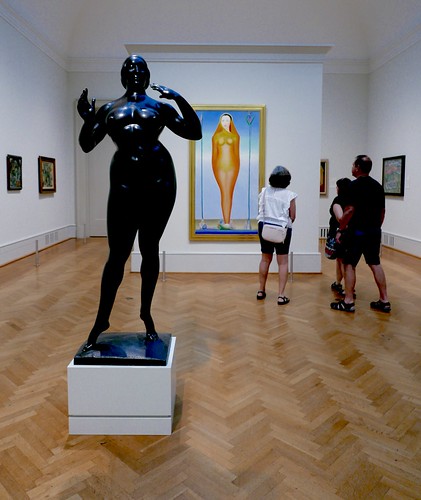
... you can keep your feet firmly planted on the ground.
The photo is from the Art Institute of Chicago.
Here's an idea: Buy something for yourself at Amazon using the Althouse Portal. For example, I just bought this transistor radio (is that still the right term — transistor?).
June 30, 2018
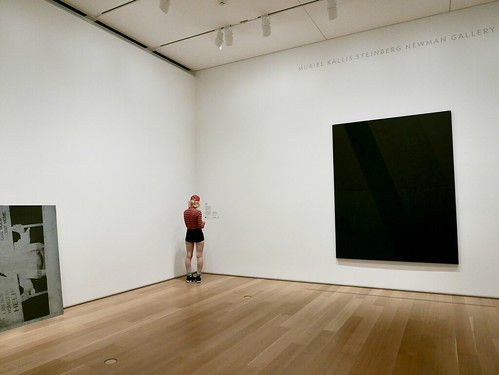
How to dress for the museum....
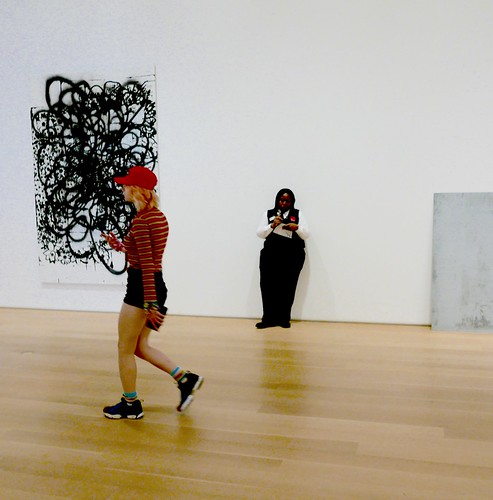
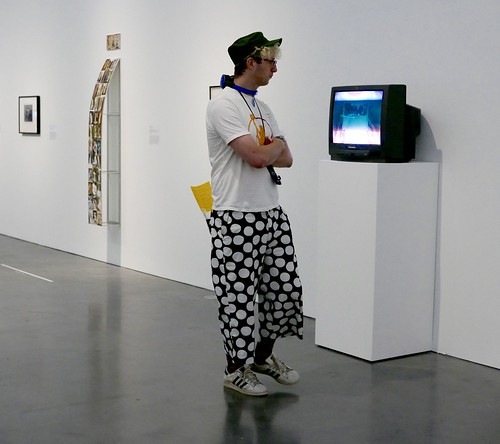
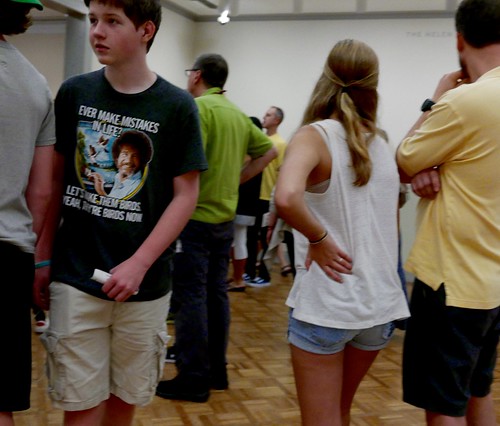
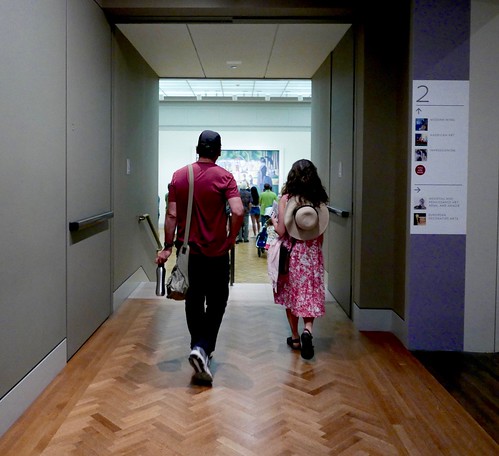
I like all these get-ups (but only the figure on the left in the third picture).
You're at the museum. People are in visual mode, paying attention. It's a good time to wear something to be looked at — something to charm and amuse.
Feel free to use this post as an open thread.
Subscribe to:
Posts (Atom)


 Posts
Posts


