Showing posts with label subliminality. Show all posts

March 20, 2026

I like how the blurred pink petal in the foreground reads subliminally as her naked ass.

 I say when Meade texts me this.

ADDED: It's video at the link, making it more subliminal. A freeze frame:

May 2, 2025

Humor prompt.

I found that on Facebook, where it has thousands of comments, and they are all what you think.

October 19, 2018

Advertising ineptitude.

A screenshot of something displayed in my Facebook timeline this morning. Glance, then look away, and tell me what you saw:


I saw, "DON'T VOTE."

I had to look a lot more closely to see what that other word was. (Admittedly, I'm going blind.) It felt like, "DON'T VOTE, BRO."

And the bro is looking at me hypnotically. Don't vote.

April 5, 2018

You've all been scraped.


Great headline and photo choice by Drudge.


He's linking to "Zuckerberg says most Facebook users should assume they have had their public info scraped/Facebook CEO Mark Zuckerberg said in a call to reporters that users who had a specific search functionality turned on should 'assume' that their public profile has been scraped" (CNBC):
"We've seen some scraping," CEO Mark Zuckerberg said on a call with reporters. "I would assume if you had that setting turned on that someone at some point has access to your public information in some way," he said.
I'll bet Zuckerberg felt he was saying something mellow, not Orwellian at all. There's just "some scraping" and only "if you had that setting turned on" and — just for thought purposes — you should "assume" — because it's possible.
The setting Zuckerberg referred to is one where users let other users search for them by e-mail address or phone number instead of by name.
Do you know if you had that turned on?

ADDED: I just went to Facebook and tried to figure out if I had that setting turned on, and I couldn't find it. I can see that I put my phone number in there, and I suspect they required me to give a phone number to get an account. I don't remember. But, you know, in the old days, we all had landlines and the phone company was the phone company. You had to use The Phone Company, and it delivered a phone book that had everyone's name and number in it (unless you paid them extra to be "unlisted").

IN THE COMMENTS: Bob Boyd sees the word within the word: "Not just scraped, gang-scraped."

November 4, 2017

"Newsweek is like Mad Magazine now apparently"/"Looks like something from Mad Magazine."

The first comment is what I wrote at Facebook when somebody put up this image of the cover of this week's Newsweek:


The second comment is what Meade said when I showed him the image (and he had not seen my Facebook comment (he's not on Facebook)).

ADDED: Most people will just see this cover and not even consider reading the article, so the question is: What is the subliminal effect of the cover? If it's not anti-Trump, then Newsweek has failed, and I would say Newsweek has failed. Reason:

1. Trump has a huge penis.

2. Trump is joyously throwing money at us. He seems to be Santa Claus, flying through the air, bringing wealth.

3. If you look closely you can see the plane says "Government Air," but what the hell is "Government Air"? I see the plane and think of Trump's own planes, and Trump is personally wealthy, so the money seems to flow from him, not the government. If there's supposed to be some idea that Trump is throwing away government money on bad things, I don't get it. Maybe I would if I read the article, but I'm not going to do that.

4. "SNAKES" spelled backward is SEXans. I'm seeing "SEX" with Trump's head right in the K turning it into an X (from a strikeout to a strike, to mix baseball with bowling). That's "SEX" on top and right under him "PLAN." In the arch of light right under the plane, the word is "PLAN." Once you see "PLAN," it seems to pop and glow.

5. The man falling out of the plane is funny. Who is he? Just some guy. Subliminally, who is he to you? He's near the words "the most corrupt," so he's corruption. That's how my head reads it. Corrupt Washington, the Democratic Party and the the GOP establishment.

6. There's Trump, some money guy helping him, and 2 beautiful women, riding that giant cock sidesaddle.

7. Speaking of phallic symbols: SNAKES!

October 5, 2017

Michelle Obama tells us what to like.

The former First Lady said this to a crowd in Boston last week:
As far as I'm concerned, any woman who voted against Hillary Clinton voted against their own voice in a way. To me, it doesn’t say as much about Hillary ― and everybody’s trying to wonder. Well, what does it mean for Hillary? No, no, no. What does it mean for us as women? That we look at those two candidates, as women, and many of us said, ‘That guy. He’s better for me. His voice is more true to me.’ Well, to me that just says you don’t like your voice. You like the thing we’re told to like.
I'm using the transcription from "Millions of American women disagree with Michelle Obama: Donald Trump is their voice," by Eugene Scott, who "writes about identity politics" for The Washington Post. He says, "But what Obama and other critics may not understand is that Trump's voice actually IS the voice of many of his female supporters — the traditionalist voice that speaks out against a liberal culture that many conservative women feel has left them behind."

I first read the quote here at The Federalist, in a piece by Inez Feltscher, who rejects the idea that conservative women fail to think for themselves and says: "[I]magining that women on the Right are mere sock puppets for their husbands, sons, and fathers is a crucial illusion for an ideology that has constructed a political paradigm entirely upon identity."

I just want to note the irony: Michelle Obama is herself telling women what to like.

What I'd like to tell women (and other people) to like is endlessly asking: What do I like?

It's not easy to know, especially since part of the propaganda that surrounds us is about our "own voice." But those who tell us to be in touch with our own desires are often merely trying to make us believe that what we want is the thing that they are selling. We see that in endless TV commercials for food and cars: You know you want it. Like your insides are crying out for this sandwich. This car expresses what you, deep in your heart, have been trying to say. This shirt is you.

We're used to that kind of persuasion, for political candidates as well as commercial products.

It's harder to play this game out in the open, the way Michelle Obama is doing. Once you call attention to the way the other side drew people in by making them feel that their candidate expressed what they really felt inside, you're waking us up to the fact that you were doing that too, and you seem rather pathetic complaining that your depiction of the customer's internal desires didn't work on many people.

Complaining about your ineffective sales pitch won't make it more effective: We said true women vote for women, and those women who did not feel what we meant to make them feel are inauthentic women. Our "voice" was their "voice." If they rejected us, they rejected themselves.

Said openly, it sounds absurd.

I think I've seen ads for commercial products that play with this idea of misunderstanding your own true desires. You see a guy happily eating a sandwich, and his inner voice prompts him about some other sandwich, superior to this sandwich in so many ways, until he stops mid-bite, looks at the sandwich, and drops it and goes running off and is suddenly seen getting a sandwich at the advertiser's store.

That might be funny and persuasive, but now try to imagine a Democratic Party commercial that depicts a pro-Trump woman, enjoying what she thinks are her true desires, then realizing how Democrats really are better, and running off to join the liberal crowd and finding happiness at last. Hard to picture that being handled well. From what I've seen, it's better to keep it subliminal:

November 20, 2016

Is the NYT slanted? Literally, yes.

Look at the photo of Romney and Trump on the front page of today's paper edition:


Here, I've straightened it up in iPhoto, using the vertical and horizontal lines of the building, which took about 3 seconds:


Why would the NYT publish a picture that's so demonstrably off (and in such a conspicuous place)? Are they trying to heighten disquietude? Is it a way of ascribing more weight to Romney? Perhaps there's a journalistic ethics rule against doing anything to change a news photograph, but then why wasn't the photographer the NYT relied on to position herself to get this shot able to keep her camera straight?

The photographer is Hilary Swift. Here is her website. There are some nice photographs there, and indeed, her picture of Trump and Romney is excellent. I like the way Trump is in the background but in focus (unlike Romney) and Trump's head is framed by the corner of the door. I like the centrality of Trump's upraised hand. The distance between the 2 men is exquisite negative space. Romney's right shoulder is aligned with the American flag. Pillars are strong but almost invisible staking out the edges. Romney's face is a complex mixture of pride and sheepishness.

I like it all. Great picture. I just don't understand why it isn't straightened out. Is it possible to argue that the slant gives a dynamism to the image, a feeling that gravity assists the push of Trump's hand as Romney slips away? It doesn't work for me, because all those visible lines of the door, the steps, and the pillars makes me conscious of the tilt. If you want to do things subliminally, I'm not supposed to notice.

November 6, 2016

Al Franken sees anti-Semitism in Trump's new 2-minute ad: "This was something of a German shepherd whistle, a dog whistle...."

On "State of the Union" this morning, the host Jake Tapper asked Franken about Trump's ad (which we were talking about yesterday, here). Here's the ad:


Did you see the anti-Semitism? Tapper froze a frame that showed billionaire George Soros, Federal Reserve Chair Janet Yellen and Goldman Sachs CEO Lloyd Blankfein — all of whom, Tapper said, are Jewish. Franken said:
Franken, a Democrat and Hillary Clinton supporter, said his reaction to the ad was: “This was something of a German shepherd whistle, a dog whistle, to sort of the, a certain group in the United States” and said it speaks to “a certain part” of Trump’s base in the alt-right.

“I’m Jewish, so maybe I’m sensitive to it, but it clearly had sort of [an] ‘Elders of Zion’ kind of feel to it,” Franken said. “International banking plot or conspiracy, rather, and then a number of Jews.”

“I think that it’s an appeal to some of the worst elements in our country as his closing argument,” he added. “And I think that people who aren’t sensitive to that or don’t know that history may not see that in that, but that’s what I immediately saw.”
If an anti-Semitic message was intended, Franken gave it air, but Franken had to think that accusing the other side of anti-Semitism would help his candidate. Maybe the message from Trump works, but only if it's kept at a subconscious level — or maybe that's just what Franken thinks. What if anti-Semitism works and it was not intended by the ad, but Franken originated the charge and unintentionally helped Trump?

This is an awful subject to bring up now, but maybe the Democratic cause is desperate. Franken certainly looked very depressed. He could barely get his words out. It was painful to watch.

Now, I do want to add that I'm sympathetic to the argument that political material can sneak in an anti-Semitic message. That's what I thought I saw in Michael Moore's movie "Capitalism: A Love Story," blogged here in October 2009:
The most striking thing in the movie was the religion. I think Moore is seriously motivated by Christianity. He says he is (and has been since he was a boy). And he presented various priests, Biblical quotations, and movie footage from "Jesus of Nazareth" to make the argument that Christianity requires socialism. With this theme, I found it unsettling that in attacking the banking system, Moore presented quite a parade of Jewish names and faces. He never says the word "Jewish," but I think the anti-Semitic theme is there. We receive long lectures about how capitalism is inconsistent with Christianity, followed a heavy-handed array of — it's up to you to see that they are — Jewish villains.

Am I wrong to see Moore as an anti-Semite? I don't know, but the movie worked as anti-Semitic propaganda. I had to struggle to fight off the idea the movie seemed to want to plant in my head.

September 29, 2016

The "Party in the U.S.A." ad is "a little weird, a little off" and "agressively American," but does that work to make millennials anti-Trump?

Here's "an advertisement intended to convince young voters not to vote for Donald Trump, conceived and produced by the Democratic Coalition Against Trump, 'the nation’s largest grassroots anti-Trump organization'..."


"We wanted it to be a little weird, a little off — why am I seeing ISIS and neo-Nazis celebrating over ‘Party in the U.S.A.’? I guess we worried it was a little too poppy at one point, but it’s just so perfect — aggressively American, and a young song that you literally party to."

Yeah, well, you never know when these things will backfire on you. What you mean to be anti-Trump could just as well work pro-Trump. You're showing the enemy, and that could make people feel that they want the strongest opposition to the enemy. Also, "Party in the U.S.A." could mostly stimulate an amorphous pro-U.S.A. feeling, and I think Trump has pretty successfully merged his brand with the general idea of America. Hillary Clinton seems to have more of the Obama-style modesty about America, more reaching out to globalism. Yesterday, I was watching TV, just casually seeing some promotional ad for tonight's Dolphins/Bengals game that had an American flag mixed in with the football images and I felt that, subliminally, this was working pro-Trump. There's no reason why images of the flag and men in football costumes running about makes any kind of an argument for Trump, but I think he's managed to make pro-America feel pro-Trump.

So you can try to influence millennials (or other groups) with flashing images and sounds, but how are you predicting what will go on in their limbic system? You can just take a chance and stimulate and see what happens. Ironically, I think that's what Trump has been doing. And it's out of control. Why not jump in?

It's the political equivalent of treating kidney stones with roller coaster rides.

September 21, 2016

"Did she get scared? Was she choking? What happened? People that do that — maybe they can't be doing what they're doing."

Said Trump, commenting on the shooting, in Tulsa, of a black man by a white female police officer.

And I can't help suspecting that he's trying to deliver a subliminal message about Hillary: Maybe the woman is not up to the extreme stress of the job.

July 17, 2016

Trump-Pence post-coital...

... logo.

That's the first time I've seen fit to use the word "post-coital" on this blog, though it did appear — once — in a quote:
"I realised one day, as I gazed out on the treetops outside the bedroom of our little cottage, that the usual post-coital rush of a sense of vitality infusing the world, of delight with myself and with all around me, and of creative energy rushing through everything alive, was no longer following the physical pleasure.... I felt I was losing somehow, what made me a woman, and that I could not face living in this condition for the rest of my life."
Recognize the distinctive authorial voice? It's Naomi Wolf.

That post ends — aptly! — with this:


"Yes, a profound sense of fatigue, a feeling of emptiness followed [the physical act of love]. Luckily, I was able to interpret these feelings correctly."

Here's the Wikipedia article, "Post-coital tristesse":
Post-coital tristesse (PCT) or post-coital dysphoria (PCD) is the feeling in humans of melancholy, anxiety, agitation or aggression after sexual intercourse (coitus). Its name comes from New Latin postcoitalis and French tristesse, literally "sadness". Many people with PCT may exhibit strong feelings of anxiety lasting from five minutes to two hours after coitus.

The phenomenon is traced to the [ancient] Greek doctor Galen, who wrote, "Every animal is sad after coitus except the human female and the rooster." The philosopher Baruch Spinoza in his Tractatus de Intellectus Emendatione writes "For as far as sensual pleasure is concerned, the mind is so caught up in it, as if at peace in a [true] good, that it is quite prevented from thinking of anything else. But after the enjoyment of sensual pleasure is past, the greatest sadness follows. If this does not completely engross, still it thoroughly confuses and dulls the mind."...
We'll see how Trump and Pence do. 

July 15, 2016

Is it just a bad logo or a logo that makes you think bad thoughts?

July 3, 2016

Did Trump mean to tweet a Star of David?


Criticized, he replaced that tweet with the "Most Corrupt Candidate Ever!" in a circle instead of a star.

Could it have been a mere failure to perceive a Star of David? It is missing the internal lines showing intersecting triangles. It is stupid to fail to perceive even the unintentional image, and a candidate's operation should not be that stupid. And I'm the one who held Hillary Clinton responsible — back in the '08 campaign — for the letters "NIG" on the pajamas of a black/possibly black child in her 3-a.m.-in-the-White-House ad:
Is the campaign responsible for sending out a subliminal message to stimulate racist thoughts in the unsuspecting viewer? It is either deliberate or terribly incompetent. There is no other writing on screen until the very end of the commercial, and if letters appear in any place in a commercial, they should be carefully selected letters. Certainly, each image is artfully composed and shot and intended to deliver an emotional impact. Could this be a mere lapse?...

The intense scrutiny of [GWB's] "RATS" ad heightens the assumption that presidential candidates these days pay close attention to any incidental lettering that appears in their ads. "RATS" as part of the word "bureaucrats" in an ad criticizing Gore's prescription plan is nothing compared to "NIG" isolated on a sleeping child's shoulder in an ad intended to create doubts about a black man's ability to take an urgent phone call at 3 a.m., an ad authorized by a candidate who has already heard accusations that her campaign is slipping racial material into its attacks on her opponent.

This is either a revolting outrage or shocking incompetence.

December 13, 2014

The Fruit Formerly Known As Apple.

P1130617


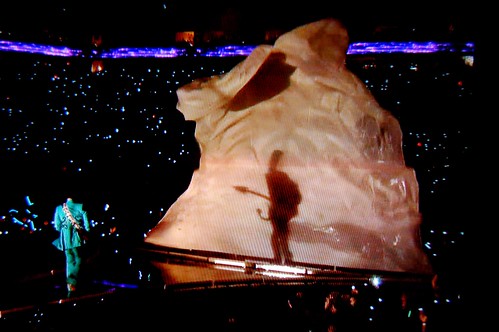
AND: As Meade points out in the comments, the image from the Super Bowl is more apt:

Prince

Something about the directionality of the phallic extension.

November 3, 2014

A civility matchup: Christie's "Sit down and shut up" versus Rand Paul's "The Republican brand sucks."

I greatly enjoyed Rand Paul's performance yesterday on "Face the Nation." At one point, I was moved to exclaim "He's very articulate," and Meade quipped, "And clean." Anyone other than Paul who's hoping to run for president better observe Paul carefully. He's setting a high standard in speaking skill. Now, Chris Christie also has his verbal ability, but it's different from Paul's, and Paul was invited to criticize the way Christie speaks, with that viral clip of Christie forcibly deflating a heckler:
GOV. CHRIS CHRISTIE (R), NEW JERSEY: There's been 23 months since then when all you have been doing is flapping your mouth and not doing anything. So, listen, you want to have the conversation later, I'm happy to have it, buddy. But until that time, sit down and shut up.
Now, when I hear that, I laugh and say something like "I love it!" But here's how Paul reacted, prompted by Bob Shieffer's question: "What do you think? Is that the right demeanor for somebody getting ready to run for president?" I'll boldface some notable word choices:
PAUL: I think this sort of bully demeanor may go over well in certain places. But I can't imagine that -- I grew up in the South. And we're, yes, ma'am, and, no, sir, and a little bit more polite. So, I don't think that -- I think people want someone to be bold. And there was a time when I thought, you know what? When he stands up and he says things boldly, that's kind of good. He's not taking any flak. But there can be [too] much of that too. We live in a world where we have so much cacophony of voices on TV sometimes of yelling back and forth. And I think there's a resurgence of people who want a little more civility and discourse.
Notice how subtle the critique is. We only need "a little" more politeness. He's not slamming Christie. He said the word "bully," but he didn't call Christie a bully. He referred to the "demeanor" as "sort of bully," and noted that in some regions of the country, it might not "go over well." He swapped out "bully" for "bold" as he continued, and he said that it was even "kind of good," but in the right dose, perhaps dispensed by someone with a better understanding of what the right dose is, which would, of course, be Dr. Paul. Paul deftly offers himself as the man with the good balance of boldness and politesse. He doesn't directly say that, but he's from the South, and the people in the South have more of a culture of polite speech.

And I love the form of his call for "civility," which is also indirect. He tells us that there are "people who want a little more civility." It's not that there's no civility now or that we need much more civility. We just need a little more civility. And, note, Paul doesn't even say that he likes or wants civility, only that he understands those people who want more civility. Best of all, he links "civility" with "discourse." It's not mere blandness that people want. They want the "cacophony" and "yelling" to give way to back-and-forth substantive conversation to make us more informed, thoughtful, and able to interact with those who have differing beliefs and preferences.

I'm carefully parsing this and am impressed with the detail and the balance to these remarks that just rolled out of the man. But when I listened to the interview the first time, I'd thought I'd heard a contradiction. I wrote down 2 words to find in the transcript for this blog post. The words are "hell" and "sucks." "Hell" actually doesn't appear in the transcript. Seconds after hearing Christie's "sit down and shut up," I'd remembered it as "sit the hell down and shut up" or "sit down and shut the hell up." But "sucks" is in there, and it's Rand Paul who said it. This was an earlier part of the interview which became relevant to me after I heard what he said about polite speech:
SCHIEFFER: You know, you had a somewhat surprising comment the other day. You said -- and this is your quote -- "The Republican brand sucks." That's a pretty unusual rallying cry in an election year. What do you mean by that?

PAUL: Well, you know, what I meant by that is that, if I were to go into a college campus today and I were to talk to a young person and say, hey, you want to be part of the Republican Party, or let's say I go and talk to a young African-American male or woman, do you want to be part of the Republican Party, the initial perception of our brand is, hmm. Like, for example, I had a meeting with some conservative African-Americans recently. And I said, let's try to get something moving nationally. And they said, well, yes, but we may not want to put the word Republican in it. So, that means essentially our brand is broken. I don't think what we stand for is bad. I believe in what the Republican Party values. But we have a wall or a barrier between us and African-American voters. So, I have spent last year trying to break down some of that wall and say, look, maybe what the Democrats have been doing for you or maybe you're being taken for granted. Maybe it's not working. Maybe we could look at some of these Republican proposals for poverty, for long-term unemployment.
That was a great answer on what was the real substance of the question: Why is "Republican" considered a bad brand? But he did say "sucks." If Christie shouldn't say "sit down and shut up," why is Paul saying "sucks"? One answer is that Paul wasn't in the South. He was in Detroit, speaking in what the newspaper called "a predominantly middle-class African-American neighborhood." He said:
"Remember Domino's Pizza? They admitted, 'Hey, our pizza crust sucks.' The Republican Party brand sucks, and so people don't want to be a Republican, and for 80 years, African-Americans have had nothing to do with Republicans."
It's smart to talk about Domino's in southern Michigan, where the big brand got its start. And it's entertaining to remind us of the old campaign that featured Domino's haters insulting the brand: "Worst excuse for pizza I ever had," etc. I don't think the word "sucks" ever appeared in those ads, but "sucks" sums it up quickly and sharply, and those ads are the classic example of a "mea culpa ad campaign":
Domino's very public admission of its own awfulness might represent the most elaborate mea culpa ad in history. But it's hardly the first. Companies sometimes admit their flaws and faults in a bid for public empathy. The strategy usually has two parts. Part one: Fess up. Part two: Vow to do better. While Domino's never quite expresses remorse, the crusty comments in its commercial do set up the company's promise to improve, with better ingredients and a new pizza recipe.

Airlines such as United and JetBlue have prostrated themselves in public to mollify travelers enraged by scheduling snafus. Fast-food outfits have done it, too; Hardee's trashed the poor quality of its hamburgers in an ad campaign a few years ago. Domestic car manufacturers have practically made an art of acknowledging their shortcomings; General Motors went on an apology tour starting in late 2008 when it began lobbying for billions of dollars in federal bailout funds. Last summer, as it went through Chapter 11 bankruptcy proceedings, it flooded the airwaves with a commercial that acknowledged, "General Motors needs to start over in order to get stronger."
So Rand Paul seems to be doing some deep thinking about restoring the GOP brand. He's openly talking about it, inviting discourse on the subject. "Sucks" may be a bit strong. Even if it's not too strong for northerners — as Mitt Romney learned — whatever you say anywhere will be heard everywhere.

It's possible — and don't freak out, stay calm! — that Rand Paul is using the word "sucks" to create anxiety about the likely Democratic Party nominee, Hillary Clinton. Do people want Bill Clinton back in the White House? I hasten to note that the "sucks" in phrases like "that sucks" does not have its etymology in blow jobs. That creates nice deniability if anyone ever corners Rand Paul about saying "sucks," but etymology isn't enough to keep people from thinking about blow jobs.

November 1, 2014

Mary Burke's use of the swastika in her ad does the very thing defenders of the ad will say she's accusing her antagonist of doing.

"Mary Burke hits Scott Walker in ad with swastika imagery," says the headline at the Washington Post.
Democrat Mary Burke released a new ad Friday accusing Wisconsin Gov. Scott Walker (R) of using a Republican county chairman's "lies to attack" her. The ad includes images of swastikas, it says, the county chair posted to his Facebook page.

Burke's ad seeks to tie Walker to Gary Ellerman, the Jefferson County Republican Party chairman and a former human resources director at Trek Bicycle, the Burke family company where the Democrat used to work.

Ellerman was quoted in a report on the conservative Web site Wisconsin Reporter that cited sources saying Burke was fired from the company. In the report, Ellerman said, “She was not performing. She was (in) so far over her head. She didn’t understand the bike business." Burke denies being fired.
You can watch the whole ad at the link, but here's a screen shot of the part where swastikas float across the screen and have whatever subliminal effect they're supposed to have:


There's writing on the screen, but are we supposed to read it or just have feelings that something awful is going on? If you're watching it on line, you can freeze it and read it, and if you do, you'll find swastikas used against Obama in exactly the same way swastikas were used against Scott Walker back in the 2011 protests, to say that a politician you oppose is like the Nazis.

Burke seems to be saying that Ellerman is bad because he used the swastika, and since Ellerman asserted something about Burke that could help Walker, Walker is connected to Ellerman, and Ellerman's form of expression should be attributed to Walker, making Walker bad.

If we had the time to read the words on the screen, it would be clear that Ellerman's use of the swastika is not pro- but anti-Nazi, but the ad doesn't give us that time, and in fact, the words on the graphic on the left never fully appear appear on screen. The most you ever see — and I had to freeze the frame to read this — is "cordance with the/Order, all Christian/-ches must hand over/-rmons regarding/-sexuality and gender/state so that we may/or and "correct" any/-rsive speech that/-dicts our Manifesto," a quote attributed to "-ton's Democrat Mayor, Annise Parker." The words "-sexuality and gender" line up with the eyes of the unfamiliar woman who is smirking and has her hands in what could be called the I-have-an-evil-plan position.


What subliminal effect does that have? One might, in so little time, subliminally read the "evil" woman as Mary Burke. And it is Mary Burke who is wafting swastikas in front of our eyes. I've seen anti-Walker protesters holding signs that put a swastika on Walker, so a casual viewer might think that's what Burke is doing here, even though she wants to say that's the kind of thing that Ellerman does. But most of us don't know or care about Ellerman any more than we know or care about Parker, so I think the subliminal effect — probably intended — was to make us think of Walker as a Nazi. That's something that Burke herself cannot say as a mainstream candidate, but it is something Walker-haters have been expressing for years.

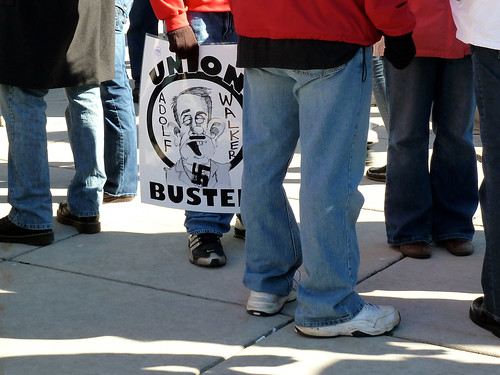
At the 2011 protests, we saw many, many signs comparing Walker to Hitler. Meade and I frequently approached people who were holding these signs. Asked to explain, they always defended the comparison. Here's of photo of mine from February 2011:

P1060646

I asked that woman behind the sign if she thought Scott Walker was like Hitler, and she said "Yes." So I followed up with: "Are you saying that you think fascism could come to America?" And she said, "It's what's happening." 

And then there was this woman, also from February 2011:


The expression on her face and the tone of her voice when she said "like Hitler" is something Meade and I have never forgotten. (Watch how quickly she otherizes Meade.)

Here's an "Adolf Walker" sign with a swastika.

P1060655

Here's a young woman with a sign that says "Walker is a dictator" and has an image of Walker with a Hitler mustache. She says she "definitely" thinks Walker is like Hitler. Why? "He doesn't do nice things. He's not a nice person."


Meade follows up: "So, anyone who's not nice is like Hitler?" She tries again: "Well, no. He doesn't do what he should, doesn't do the right thing, and he's doing something that might ruin a lot of things for people. He's pretty much ruining, like, our future."

Meade offers: "You don't think that's over the top, that you're comparing him to Adolf Hitler?" She responds: "It might be a little over the top." Meade: "Just a little?" She makes the concession that might be perhaps what Gary Ellerman would say about Obama: "Just a little, but we kind of need to be dramatic in something like this."

An older woman cuts in and says: "It brings the point across." Meade: "And the point is?" Woman: "The point is this is a democracy, not a dictatorship." Meade asks whether there was something undemocratic about the election back in November, and she says: "Nothing. But what he's doing now is undemocratic." The woman continues, admitting that she didn't vote for Walker, but it's undemocratic because he's not "willing to compromise and negotiate... and that's what democracy is." That's what a lot of people thought about about Obama — quite aptly — when he said "I won" and foisted Obamacare on us when clearly there wasn't majoritarian support for it.

Now, you can see that the young and the older woman are nice people, not extremists, but aggrieved by the policies of the candidate who won the last election, and that they are appropriating a vivid graphic symbol for dramatic effect. Personally, I would not display a swastika as a way to make an exaggerated point about an American politician, but others do — on the right and on the left.

Obviously, I don't refrain from showing you that others are using a swastika in their form of expression, and you might say, that's exactly what Mary Burke is doing in her new ad.

But I am showing you things carefully, so you can study them, and to slow things down so there is no subliminal effect, no irrational roiling of the emotions. And that's exactly what Mary Burke is not doing. Her ad begins with a picture of Walker standing with "a Walker campaign worker and donor who puts pictures like this on his Facebook page." The image — my screen shot, above — slips by in 3 seconds, obliterating any hope of figuring out that Ellerman is not a Nazi fan and that he's just another Wisconsinite using dramatic imagery to get his point across.

Ironically, Burke's use of the swastika works exactly like Ellerman's, and she's doing the very thing defenders of the ad will say she's trying to criticize Ellerman for doing. Arguably, it's worse, because it's not a still image that you can gaze at until you understand. It means to creep in by the backdoor to your mind.

AND: From February 20, 2011: "Do you think Scott Walker deserves to be compared to the Nazis?"/"Yes, I do":


ALSO: I'd written "Annie Parker," but it's Annise Parker. Here's the story the swastika graphic was about:
The city of Houston has issued subpoenas demanding a group of pastors turn over any sermons dealing with homosexuality, gender identity or Annise Parker, the city’s first openly lesbian mayor. And those ministers who fail to comply could be held in contempt of court.

October 17, 2014

How racist is Newsweek's "Smuggled Bushmeat Is Ebola's Back Door to America"?


That Newsweek cover story is from last August, and so is this criticism of it, "The long and ugly tradition of treating Africa as a dirty, diseased place," which I saw this morning (I think) on the "Most Read" list in the sidebar at The Washington Post.

I see that the Newsweek cover also has the words "Post-Post Racial America" (referring to a different article) and the choice of a chimpanzee rather than a fruit bat (the creature most closely associated with the current outbreak), so Newsweek does seem to be trying to insinuate itself into the magazine-buyer's subconscious. Also: "back door." What's your first association? I asked Meade, and his was the same as mine, and I asked Google too, and it agreed, putting this as the top hit. The ape threatens rape... anal rape... fatal anal rape.

Now, let's read The Washington Post article. It's written by 2 assistant professors Laura Seay and Kim Yi Dionne, who study, respectively, "African politics, conflict, and development" and "identity, public opinion, political behavior, and policy aimed at improving the human condition, with a focus on African countries." They review the history of depicting "Africans as hyper-sexualized savages" and they define and deploy the term "othering":
Newsweek’s use of a chimpanzee to represent a scientifically invalid story about an African disease is a classic case of othering. It suggests that African immigrants are to be feared, and that apes — and African immigrants who eat them — could bring a deadly disease to the pristine shores of the United States of America....

Newsweek’s piece is in the worst tradition of what journalist Howard French calls “Ooga-Booga” journalism, the practice of writing in exoticizing and dehumanizing ways about Africa....

The long history of associating immigrants and disease in America and the problematic impact that has on attitudes toward immigrants should make us sensitive to the impact of “othering” African immigrants to the United States in the midst of the current Ebola outbreak in West Africa. Scare-mongering about infinitesimally small risks in one context serves no purpose to the greater good of trying to curb disease transmission and relieve people’s suffering in another context.

September 23, 2014

"Scott Walker hits Mary Burke again..."

A reader emails, noting the domestic violence imagery in the headline at the Milwaukee Journal Sentinel.

Intentional? Make your best guess.
 
pollcode.com free polls

September 4, 2014

The violent imagery deployed against Scott Walker by Debbie Wasserman Shultz is gendered — it's domestic violence.

When Wasserman Shultz says "Scott Walker has given women the back of his hand" and "What Republican tea party extremists like Scott Walker are doing is they are grabbing us by the hair and pulling us back," she evokes domestic violence. Grabbing a woman by the hair and pulling is the classic image of a caveman capturing his sex partner by force. Sociology professor Lisa Wade wrote a piece on the subject (cross-posted at Ms. Magazine):
[T]he caveman-club-’er-over-the-head-and-drag-her-by-the-hair narrative is pure mythology. The mythology, nonetheless, affirms the idea that men are naturally coercive and violent by suggesting that our most natural and socially-uncorrupted male selves will engage in this sort of behavior.  Rape, that is.
If we think of it that way — the feminist way — Wasserman Schultz can be accused of subtly purveying a rape metaphor.

Here's a vivid drawing by R. Crumb showing grabbing and pulling a woman's hair to control and subordinate her during sex: "Big healthy girl enjoys deep penetration from the rear."

Some of the most lurid stories of violence against women extract the dragged-by-the-hair detail for the headline: "Brutal attacker forced woman's head down Burger King toilet before dragging her outside by her hair with the threat: 'You're going to die today'" and "Man dragged ex by hair, tried to run her over, police say." From the Occupy Wall Street blogging at FireDogLake: "Cop Dragging A Woman By Her Hair?" ("Cops especially like the opportunity offered by long-haired females (view above video) to drag such females by the hair across the pavement to be zip-cuffed.") 

Attacking and controlling a woman by using her long hair — the shining emblem of her femininity repurposed as a hand grip — strikes a deep chord. It is a chord I believe Wasserman Shultz meant to strike. She wanted to reach through our conscious, critical mind and stir that most powerful emotion, fear.

To give the back of his hand is a more puzzling expression. I'm seeing it internet-defined as merely an insult, connected to the phrase "back-handed compliment." I think that's confusing "back-handed" with "left-handed." According to the (unlinkable) OED, the figurative meaning of "back-handed" is "indirect, like a back-handed sword-cut." Dickens wrote "Having given her this back-handed reminder" (in "Our Mutual Friend"). But what's a back-handed sword-cut? I think you can picture that easily. And the first meaning of "back-handed" is "With the back of the hand" as in "A back-handed slap across the face." And, indeed, "back-hand" is a verb, and it means "To hit... with the back of the hand." So I think to give the back of one's hand is the way you'd punch if you began with your fist across your chest.