Here's today's cartoon, obviously chosen — I hope! — back when the top news was the dreary deja vu of Congress needing to fund the government again and Biden and Trump tripping and stumbling their way toward another major-party nomination:
That seems so out of it, even as it's intended to make fun of New Yorker readers who are out of it. Or was it trying to make New Yorker readers feel sophisticated for feeling bored by all the hopeless shenanigans out there in the world? Whichever, it's painfully crass today.
Is this America — men shuffling in slippers, barely alive?
Said a commenter, at WaPo, on an "Ask Amy" column about a letter from a woman who wanted another woman's husband to stop talking so much and so obnoxiously on Facebook.
The larger issue is the way people expect the wife to control her husband and think it's a wife's job to be an intermediary on their behalf. It's always the woman's job to tend to social harmony. A secondary issue is that people who are unhappy with interactions occurring on Facebook don't seem to realize you can just click a button — "snooze" or "unfollow" — and you don't have to see that person anymore.
But the line "Instead of trying to carpet the world, put on slippers" was so good, I figured it's unlikely to be original with that commenter. Google gives over 9 million hits, rephrases it — "It's easier to put on slippers than to carpet the whole world" — and attributes it to...
The Redditor also quotes what purports to be the writing of some unknown person in the year 1100... though it sounds like something somebody wrote yesterday... and therefore I'm not going to quote it here. It's not good enough. It's like something somebody I'd like to snooze would put on Facebook.
Also at that link is a quote that's quite similar to the wisdom attributed to Franken: "To walk the Earth without cutting your feet, it is easier to cover your soles in leather than to cover the world."
Is that authentic ancient wisdom or recent old-time-i-ness? It gets over 30 million hits on Google, but that just means it's been repeated more often. And the Franken quote is better, because you can visualize carpeting the world, not that you could actually do it. It's a good, vivid image and the point is made, but it's awkward to picture covering the world in leather. On the other hand, you can go walking out in the world in leather shoes, but if you're only wearing slippers, you kind of need to stay home.
I say kind of, because there are a few people who've gone out and about in slippers, notably Vincent Gigante. And I once saw a lady try a case in federal court in slippers. Pro se.
Simonson also tweets: "This woman is alone, living in squalor and drinking." Prescription drugs too. (Click on the image to see the full cover. There's lots of stuff on the floor.)
Simonson adds: "People say it’s meant to be dark but this interview with the artist doesn’t make that clear." And he links to this piece in The New Yorker, an interview with the artist Adrian Tomine.
And I must say that before I read the interview, I went to Amazon and bought a hardcover book of his, "The Loneliness of the Long-Distance Cartoonist." That's how much I love that beautifully drawn cover.
I think the cover is about the built-up effects of the lockdown on a young person in a small apartment and how it remains nonetheless possible to present a pulled-together image within the frame of a video call. The woman is struggling with the long ordeal of isolation but still looking out into the world for social interaction. She has a pretty cocktail in her hand, so it must be a social, not a business call. She's got her polished looks — lipstick, ruffled blouse, earrings. She's ready to move forward, optimistic. Outside of the frame of the call, the place is a mess, but it's a homey mess, with kitty cats and snack containers. She's comfortable, in shorts and fluffy slippers. And now that I'm looking closely, unshaved legs. The expression on her face is a serene smile.
Now, I'm reading the interview. The book on the floor — lower right — is the book I just bought. Nice. The artist was influenced by Edward Hopper. Here's the closest thing to a statement about the darkness/nondarkness of the cover:
"... that, in spite of that power, young women are more likely than not to be careless and foolish, and to bring trouble and disgrace on themselves—[the 17-year-old character] China has to be an empty vessel, an absolute airhead with no sense of self and no mind of her own. Her attraction to [the old movie director] Leslie wouldn’t be remotely plausible otherwise; she would see him for what he is—ridiculous—and laugh him out of the room. In the end, it is China who makes herself absurd. She is the one who throws herself at Leslie, not the other way around, and so it is she who ends up rejected and humiliated. Leslie glides away in his Moroccan slippers with his integrity intact. He is St. Anthony warding off the devil; the young temptress is discarded, and the important artist can at last get back to his work.... As for China, her redemption comes in the form of a job at the perfume counter of Bloomingdale’s and a shared apartment in Harlem: she has decided to take Daddy’s counsel and go get her independence. There is something depressingly subdued about her, in the film’s last scene, a deadened quality that is supposed to pass for maturity. Such is the film’s final point where women are concerned: stop flirting and mooching and get to work, because, if you don’t have to depend on men for money, they can’t control you, or harm you, or fuck you over."
The decision to cancel the release of the film is welcome; ”I Love You Daddy”—which Louis C.K. directed, edited, wrote, and stars in—is a disgusting movie that should never have been acquired for distribution in the first place....
The [movie] is, in effect, an act of cinematic gaslighting, an attempt to spin the tenets of modern liberal feminism into shiny objects of hypnotic paralysis. The movie declares that depredation is liberation, morality is tyranny, judgment is narrow-mindedness, shamelessness is creativity, lechery is admiration, and public complaint is private vanity. And it does so with a jocular self-deprecation that frames its screed as a personal journey through loss to self-awareness by way of a newfound respect for women’s virtues and desires—and a newfound skepticism about moral verities....
IN THE COMMENTS: Rabel said...
I think you are missing the point of this movie. It's not about Electra or Woody Allen or feminism or Fatherhood.
It's about putting 20 year-old Chloë Grace Moretz on screen as an underage sex object.
Period.
I'm sure many of you will say you've never heard of her but she's been playing underage sex objects since she was, well, an underage sex object.
Whether it was also about putting Louis in close proximity and a commanding position as regards Moretz is open to speculation.
And note that the New Yorker gets in on the game with the oversized bikini shot at the top of the article.
They're selling sex and trying their best to find "artistic" ways to sell it.
I note that The New Yorker chose to put the bikini photo of Moretz on the article with the female author.
The Daily Beast is going for a distinctive graphic style. Here's how the top of the front page looks right now:
Red and yellow predominate, but notice the streaks of magenta in the red background and the intense blue of Melania's shoulder (and also dotted around around her jacket).
Like the colors, gender is heightened and highly contrasted. 2 of the 4 rectangles are feminine, 2 are masculine. The males are: 1. In shadows, 2. Brutally violent, 3. Not individuals. The females are: 1. Specific individuals, 2. Distinguished from each other through color and style, 3. Distinguished morally: One is depicted as a saint, the other as complicated, mysterious, and dangerous.
Today, [Melania's] family has a modern two-floor white house in the center of the modern part of Sevnica. It has a built-in garage, a mansard floor, a balcony, and a small satellite dish on the roof. While not grandiose, it is still far from the modest apartment where Melania and her sister Ines grew up.
What's a mansard floor? That's a mistake, no?
The house is not far from a statue of an enormous boot, a monument installed at the entrance to the city in honor of local Kopitarna shoe factory. (Last year Kopitarna sent Ms. Trump “White House” slippers as a present.)...
That's comically dull. Meanwhile, we hear of Bojan Pozar, who's writing (or has written) a book about Melania and who "interviewed several local men who claimed that they had once been Melania’s boyfriends" and said she was "cold" — which either means Melania was (and maybe is) cold or that these guys never really attained the elevated status that we in the United States call "boyfriend."
Also in the article, the way some Slovenians would like to hear Melania speak Slovenian and would like her to wear Slovenian clothes. So... basically, this is a completely inconsequential puff piece about Melania, and it contains absolutely nothing that's religion-like or cultish about anybody's interest in her. Nor is there anything to justify the subtitle, nothing about Melania's fear of anything back home.
But it's a fascinating graphic. It made me think of another article about an American First Lady, one that really did work on the idea religion — "Saint Hillary," a cover story by Michael Kelly in the NYT Magazine in 1993 (previously blogged here). Sample text:
Driven by the increasingly common view that something is terribly awry with modern life, Mrs. Clinton is searching for not merely programmatic answers but for The Answer. Something in the Meaning of It All line, something that would inform everything from her imminent and all-encompassing health care proposal to ways in which the state might encourage parents not to let their children wander all hours of the night in shopping malls.
When it is suggested that she sounds as though she's trying to come up with a sort of unified-field theory of life, she says, excitedly, "That's right, that's exactly right!"
The 1993 cover image of Hillary makes a nice contrast to the graphics that sear the Daily Beast today. The color idea here was white white white:
Click through to see "Flooded," a dinner spread of "burdock and dandelion root hummus with sunchoke chips; jellyfish salad; roasted hen of the woods mushroom; fried potatoes with chipotle vegan mayo; salted anchovies; and oysters with slippers."
The link goes to NPR, an American website, but I don't think Americans say "oysters with slippers." It might just be a way to say oysters on the half shell. I Googled "oysters with slippers" and got this Tori Amos song "Oysters" — which doesn't put oysters in slippers. She, the woman, has "ruby slippers," and she's "gonna turn oysters in the sand." On my own, I think of Lewis Carroll ("The Walrus and the Carpenter"):
But four young Oysters hurried up,
All eager for the treat:
Their coats were brushed, their faces washed,
Their shoes were clean and neat —
And this was odd, because, you know,
They hadn't any feet.
Leaving aside the well-shod, footless oysters, remember the Walrus and the Carpenter were — before they invited the oysters to take a walk — crying over the way the beach was covered in sand — "If this were only cleared away/They said, it would be grand!"
Stop your crying. The problem is solved, and not by the Walrus's proposed solution — "seven maids with seven mops," sweeping "for half a year." Global warming is coming to relocate the beach sand underwater, where it will be unseen seabed. And apparently you can still eat your oysters — along with your jellyfish salad and assorted horrible grungy little roots like burdock.
And here's something Leo Tolstoy wrote in his journal about a shoot of burdock he saw in a plowed field:
"Black from dust but still alive and red in the center... It makes me want to write. It asserts life to the end, and alone in the midst of the whole field, somehow or other had asserted it."
That was written in 1896, when, perhaps, artists still felt some urge to uplift and encourage us. Rather than wake us up for the purpose of telling us bad news.
"They cuddled into big furry jackets and toted handbags that looked like pillows. They were somnambulating beauties. A concrete jungle had been transformed into a fanciful forest. And the message for the curious consumer is that fashion is getting ever easier and more comfortable. So you might as well relent and buy a pair of fuzzy house shoes and wear them to the market...."
Writes Robin Givhan — sorry it's WaPo again, and I know you don't have a subscription — about some pretty amazing clothes. Example:
And now, I've gone and done it. Seen a movie. Because I love the book. Because I, like millions before me, imagined that I would, through the magic of movies, really get to see what heretofore I'd only half seen — in the mind's eye. In my mind's eye, before I went to the movie, I saw the movie and it looked more vivid and real and panoramic than what the book made me see in my mind's eye. But now, I have seen that movie, and I know that what I saw on the screen was so far less than what the book made me see in my mind that I feel like a fool for not already knowing well, of course!
There are so many shots I could take at this movie. Robert Redford is too old — 79, when Bryson, in the book, is 44. The script departs from the story in the book in ways that are stupid and in ways that would might have been delightful if the movie, as originally planned, had reunited Redford with Paul Newman. There was intentional resonance with things like this:
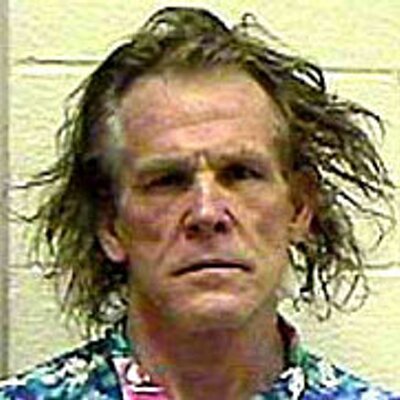
But Newman died, and Nick Nolte took his place, and while I was amused by the I-think-intentional resonance with this...
... I was annoyed by all the forced buddy-pic humor that replaced the relationship that Bill Bryson described in the book. I expected the film to have the 2 men talking a lot, though in the book, it's quite clear that the men barely ever talk. But the banter was either boringly stupid — not the people in the theater didn't laugh on every cue — or stupidly profound — such as looking at the stars and deciding that we are very small. If only you could look at the protons, you could decide that you are quite huge. Or just read Bill Bryson's "A Short History of Nearly Everything:" and he'll make you see it in your mind's eye:
No matter how hard you try you will never be able to grasp just how tiny, how spatially unassuming, is a proton. It is just way too small. A proton is an infinitesimal part of an atom, which is itself of course an insubstantial thing. Protons are so small that a little dib of ink like the dot on this “i” can hold something in the region of 500,000,000,000 of them, or rather more than the number of seconds it takes to make half a million years. So protons are exceedingly microscopic, to say the very least.
"In my mind's eye" comes from Shakespeare. Here's a block of text from another Bill Bryson book, "Shakespeare":
Just a small sampling of phrases originally found in Shakespeare’s works include flesh and blood, bated breath, tower of strength, foul play, foregone conclusion, good riddance, dead as a doornail, fool’s paradise, heart of gold, Greek to me, fancy-free, devil incarnate, one fell swoop, for goodness’ sake, vanish into thin air, play fast and loose, eaten me out of house and home, elbow room, go down the primrose path, in a pickle, budge an inch, cold comfort, household word, full circle, salad days, in my heart of hearts, in my mind’s eye, laughing stock, love is blind, lie low, naked truth, neither rhyme nor reason, star-crossed lovers, pitched battle, pound of flesh, sea change, make short shrift, spotless reputation, set my teeth on edge, there’s the rub, too much of a good thing, what the dickens, and wild goose chase.
Must I get back to my list of many shots I can take at the movie "A Walk in the Woods"? They added sexual things (even though the movie is generally overly, stupidly "family friendly"). There was a sequence — completely made up — with Mary Steenburgen as the owner of a crappy motel, and she tries to put the move on Redford after he comes out of his room to the motel office to ask for towels. He's wearing a nice bathrobe and leather slippers. Who, going out on a months-long hike, would put a bathrobe and slippers in his backpack?! In the book-world of Bill Bryson, there is absolutely no chance that he would be unfaithful to his beloved wife or even that he would amuse us with the slightest thought of being unfaithful to her. The sexual temptation scene was just squicky.
The movie complicates the relationship with the wife — perhaps to give the actress Emma Thompson something to do. It has her opposing the trip and trying to scare him with gruesome information about things that could go wrong in the woods. But Bill Bryson, the author, absolutely loves to find out about terrible things that can happen and to amuse use with the details. It's almost the main thing he does, but the movie transplants that aspect of his character into his wife, making her seem like a female stereotype — fussy, fretting — and making him seem alienated from her — and like more of a male stereotype.
The movie is full of shallow references to a fear of death and even begins with a funeral — as if Bryson's reason for walking is that he's freaked out about dying and needs to act — act! — before it's too late. And Redford must act. He must act because he's an actor. We must see his face on the big screen, which is not as it appears in my mind's eye, but dominated by those awful Chicklet veneers that have replaced normal teeth among the pretty people and topped with something I want to call a "wig hat." I did not enjoy spending 2 hours surveying the landscape of his face.
I thought I was going to get to see the landscape of the Appalachian Trail — all those fine and varied views from mountaintops and within forests. Where was the detail? Where was the cinematography? What is the big screen for? As I said, there are so many shots I could take at this movie. But this is the deal breaker. Show me the Appalachian Trail!
At one point in the movie, early on, somebody disparages the idea of walking the Appalachian Trail by saying you could see the whole thing in a 4-minute video on YouTube. That's quite a taunt to us movie goers! We're stuck here for 2 hours and had to pay $10, and I bet that 4-minute video on YouTube gives us a better vision of the trail. What the hell am I doing here?
Good move (presumably by her stylist). Keep people guessing. Keep people looking. Keep people off balance wondering/worrying whether they are feeling sexual toward a child.
Some people wear paper slippers. I wear dog slippers. But you can't be shuffling around in your slippers indoors all day, even when it seems that there is always one more blog post to be blogged. I remember yesterday:
What are the legitimate powers of the president? Of Congress? Some people’s answers to these enduring questions seem to shift dramatically depending on a single (and seemingly irrelevant) fact: whether the current president is a Democrat or a Republican. These shifts amount to “institutional flip-flops,” a defining feature of modern political life.
In recent weeks, the filibuster has been the most prominent example...
Meade says:
I'm picturing the characters in "One Flew Over the Cuckoo's Nest," shuffling about in paper slippers...
He demonstrates the drugged mental-patient walk.
Sunstein recommends the "veil of ignorance" as a solution to "institutional flip-flops." He's actually saying something smart, so smart it feels obvious and mundane at the point when you understand. You're all: Everybody already knows that. I'm distracted by the accidental metaphor "institutional flip-flops" — I know he didn't mean to make us think about footwear — which is intensified by the old intentional metaphor "veil of ignorance."
The veil goes over your face and puts a barrier between your eyes and the world you'd otherwise see, and the flip-flops go up between your toes and put a barrier between the soles of your feet and the ground they would otherwise come into contact with, not that the filth of wherever it is your walking doesn't rage up and contaminate the insole.
The Abby and the Zeus. Abby is a 17-week-old St. Bernard, and Zeus is a 6-year-old Labrador Retriever. They come from different neighbors, and in our house, we try to apply the Principles of Dog, which — I'm told — do not include equality.
AND: This seems to be the post where I should remind you to use my Amazon portal, and let me just recommend: "Betsey Johnson Women's Flirty Faux Fur Slipper Boot." What's up with calling everything "flirty"? This is a strange fashion-writing tic. There's no way that slipper boot is flirting with anyone. It's quite the opposite. I mean, it's like those "In the mood/Not in the mood" pillows, with those slippers being the "not in the mood." [These can be your "in the mood" slippers.]
But... I know... the craze for "flirty" started with skirts, because of the rhyme "flirty skirts." And "flirty" is an alternative to "sexy," when you've already written "sexy" somewhere else on the page and "slutty," "sultry," "seductive," etc. etc. — all those other words on your women's magazine editor list — are not quite right.
Something I said in the comments to an October 2008 post titled "So, I've been thinking of getting a dog...." Note that I met Meade in January 2009 and married him later that year. Here's the context of the highlighted quote. I'd said I was thinking of getting a poodle and somebody said "Ann, women with poodles are like men in shorts." My response was:
Eh, if I was just trying to get men to like me, I would have kept my mouth shut about not liking them in shorts. But it's an interesting issue: What dog should a woman get if what she wants is to make herself as attractive as possible to men?
Somebody else, recommending boxers, said "they sleep a lot, and especially love to sleep with you," and I said:
Is that considered a plus? There is no way on earth I want to sleep with a dog (unless it's some sort of emergency freezing survival situation).
Photo #1: "At least they let the people on the glacier wear slippers."
Photo #3: "He put the prettiest people in front."
Photo #6: "I like the painted people."
Photo #10: "Mmmm. Part of the pattern, with the aqua seats."
Photo #24: "It's kind of cool to see huge groups of naked people where they don't belong."
Photo #26: "This looks like the chicken display at the meat store."
Photo #29: "It's really funny the way some of them really look like naked people standing around and some of them look like a pattern and not really naked people at all."
"By being happy, we sow anonymous benefits upon the world, which remain unknown even to ourselves, or when they are disclosed, surprise nobody so much as the benefactor. The other day, a ragged, barefoot boy ran down the street after a marble, with so jolly an air that he set every one he passed into a good humour; one of these persons, who had been delivered from more than usually black thoughts, stopped the little fellow and gave him some money with this remark: 'You see what sometimes comes of looking pleased.' If he had looked pleased before, he had now to look both pleased and mystified. For my part, I justify this encouragement of smiling rather than tearful children; I do not wish to pay for tears anywhere but upon the stage; but I am prepared to deal largely in the opposite commodity. A happy man or woman is a better thing to find than a five-pound note. He or she is a radiating focus of goodwill; and their entrance into a room is as though another candle had been lighted. We need not care whether they could prove the forty-seventh proposition; they do a better thing than that, they practically demonstrate the great Theorem of the Liveableness of Life. Consequently, if a person cannot be happy without remaining idle, idle he should remain. It is a revolutionary precept; but thanks to hunger and the workhouse, one not easily to be abused; and within practical limits, it is one of the most incontestable truths in the whole Body of Morality. Look at one of your industrious fellows for a moment, I beseech you. He sows hurry and reaps indigestion; he puts a vast deal of activity out to interest, and receives a large measure of nervous derangement in return. Either he absents himself entirely from all fellowship, and lives a recluse in a garret, with carpet slippers and a leaden inkpot; or he comes among people swiftly and bitterly, in a contraction of his whole nervous system, to discharge some temper before he returns to work. I do not care how much or how well he works, this fellow is an evil feature in other people’s lives. They would be happier if he were dead. They could easier do without his services in the Circumlocution Office, than they can tolerate his fractious spirits. He poisons life at the well-head. It is better to be beggared out of hand by a scapegrace nephew, than daily hag-ridden by a peevish uncle."
Robert Louis Stevenson, An Apology for Idlers (pp. 10-12). Penguin UK. Kindle Edition.
A couple days ago, speaking to the Congressional Black Caucus, President Obama said: "Take off your bedroom slippers, put on your marching shoes. Shake it off. Stop complaining. Stop grumbling. Stop crying. We are gonna press on. We've got work to do."
This shoe metaphor resonated for me. I know that that in 2007, candidate Obama told union workers that as President he would "put on a comfortable pair of shoes myself" and walk the picket line with them:
The reason I'm familiar with Obama's shoe rhetoric is that I saw references to it again and again during the Wisconsin protests. There were "Where's Obama?" signs with reference to shoes and even an effort to get people to mail shoes to Obama:
Let's think about the shoe as a political symbol. Where else have we seen that?
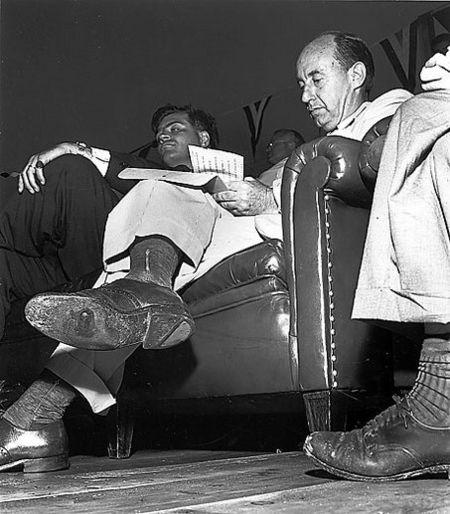
I ask that question out loud, and Meade says: Adlai Stevenson! Ah, yes. An iconic photograph:
[T]he oft-repeated story that the modern meaning derives from strikers' supposed tactic of throwing old shoes into machinery is not supported by the etymology. Likely it was not meant as a literal image; the word was used in French in a variety of "bungling" senses, such as "to play a piece of music badly."
I am a participant in the Amazon Services LLC Associates Program, an affiliate advertising program designed to provide a means for me to earn fees by linking to Amazon.com and affiliated sites.
Encourage Althouse by making a donation:
Make a 1-time donation or set up a monthly donation of any amount you choose:






 Posts
Posts


