102 years old, and still gone much too soon. RIP to one of my all-time heroes, the great Al Jaffee. pic.twitter.com/hJ4XhcoCGl
— Al Yankovic (@alyankovic) April 10, 2023
Ipinapakita ang mga post na may etiketa na skull. Ipakita ang lahat ng mga post
Ipinapakita ang mga post na may etiketa na skull. Ipakita ang lahat ng mga post
Abril 12, 2023
"But he's also responsible for my single most-favorite one-panel cartoon ever."


Hunyo 23, 2020
"Silence Is Made In America" (a found slogan).

You may have to click twice to enlarge and see the plywood stamp "Made in America." Oh, let me help:
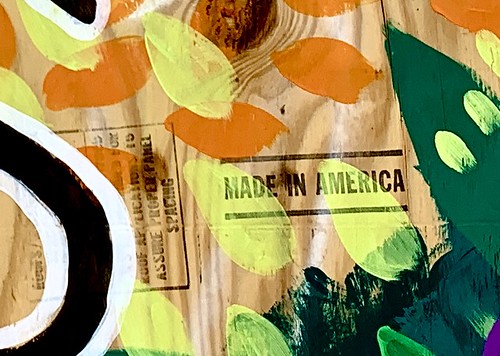
Here's the full image, with the intended slogan ("Silence Is Violence"):

Here's the Wikipedia article "Found Poetry" (which I'm choosing over "Found object" because we're talking about words):
Found poetry is a type of poetry created by taking words, phrases, and sometimes whole passages from other sources and reframing them (a literary equivalent of a collage) by making changes in spacing and lines, or by adding or deleting text, thus imparting new meaning. The resulting poem can be defined as either treated: changed in a profound and systematic manner; or untreated: virtually unchanged from the order, syntax and meaning of the poem.I invite you to reflect on the meaning of the phrase no human mind intended to say, but that I saw and regarded as worth reflecting upon: "Silence Is Made In America." It's not something I am happy about, this American product, Silence. It is not one of the world's most beloved brands.
Here's a statement about silence that was made with intention: "Silence is death, and you, if you talk, you die, and if you remain silent, you die. So, speak out and die." That was said by the Algerian journalist and writer Tahar Djaout (who was assassinated).
ADDED: Is "silence"/"violence" a good rhyme? Dylan used it:
My love she speaks like silence
Without ideals or violence
Enero 15, 2019
"The Extraction of the Stone of Madness."

That's a painting by Hieronymus Bosch (c.1488–1516). I'm seeing it this morning because I'm hearing about a friend's surgery and thinking about how (and when) human beings got the idea that cutting (or drilling) into the interior of the human body might improve person's medical condition. You'd think the idea "first, do no harm" is so strong and obvious that no one would dare intrude into a living human body.
The title of Bosch's painting suggests that the daring arises out of the belief that something alien has already broken in and is causing damage and needs extracting. I found the painting at the Wikipedia page "Trepanning." I knew that drilling into the human cranium is a very old practice, seen in prehistoric skulls, and I knew the distinctive term:
Trepanning... or making a burr hole... is a surgical intervention in which a hole is drilled or scraped into the human skull... At one burial site in France dated to 6500 BCE, 40 out of 120 prehistoric skulls found had trepanation holes... Hippocrates gave specific directions on the procedure.... During the Middle Ages and the Renaissance, trepanation was practiced as a cure for various ailments...Not just slurp... schlurp.
The practice of trepanning also continues today.... One of the most prominent advocates of trepanning was Dutch librarian Bart Huges. In 1965, Huges drilled a hole in his own head with a dentist drill.... Huges contend[ed] that children have a higher state of consciousness and since children's skulls are not fully closed, one can return to an earlier, childlike state of consciousness by self-trepanation....
[In] a book called Bore Hole... Joey Mellen.... describes his third attempt at self-trepanation:
After some time there was an ominous sounding schlurp and the sound of bubbling. I drew the trepan out and the gurgling continued. It sounded like air bubbles running under the skull as they were pressed out. I looked at the trepan and there was a bit of bone in it. At last!
Nobyembre 18, 2018
Celine Dion is a super-hero who bestows gender privacy on babies... with her new fashion line.
This weird commercial is worth watching — if only for the expression of philosophy:
Gender privacy for babies... and older kids... with stuff like this:


ADDED: At the shopping site, called CELINUNUNU, the brand explains itself in the kind of prose I've seen too often on wall cards at art museums:
Gender privacy for babies... and older kids... with stuff like this:


ADDED: At the shopping site, called CELINUNUNU, the brand explains itself in the kind of prose I've seen too often on wall cards at art museums:
Disyembre 12, 2016
Apparently, the term "alt-right" has become unusable unless you actually mean to say "neo-Nazi."
So they were making this Cadillac ad:
But quite aside from whether advertisers use the word "alt-right" in their casting calls, I think they are going for this look. I was watching the Packers game with Meade last night, and as the various car and beer and fast-food restaurant ads came on, I found myself quipping "Does this haircut make me look like a Nazi?"
And it's only looks that matter in these ads. No one will be expressing any political opinions in a Cadillac ad. And if they were, the opinions would be scripted, not the actual opinions of the actors. What does it mean to do a casting call asking for "REAL Alt-Right believers/thinkers"? It can only mean that you look like that sort of real person, not that you really are one.
No one cares what's actually in the actor's head.

And the casting notice said they were looking for:

Social media pounced. There were tweets like:

Super horrified that @Cadillac is planning on including neo-nazis in a "feel good" campaign featuring "all walks of life." Unacceptable.Cadillac reacted quickly:
“The notice was drafted by an employee, who was immediately terminated for her actions,” the statement said. “Additionally an outside third party further altered the breakdown without our knowledge and posted it on social media. Cadillac unequivocally did not authorize this notice or anything like it, and we apologize to Cadillac for the ex-employee’s actions.”If you're operating in the mainstream commercial world, take a lesson. You can't use "alt-right" as shorthand for guys with does-this-haircut-make-me-look-like-a-Nazi hair.
But quite aside from whether advertisers use the word "alt-right" in their casting calls, I think they are going for this look. I was watching the Packers game with Meade last night, and as the various car and beer and fast-food restaurant ads came on, I found myself quipping "Does this haircut make me look like a Nazi?"
And it's only looks that matter in these ads. No one will be expressing any political opinions in a Cadillac ad. And if they were, the opinions would be scripted, not the actual opinions of the actors. What does it mean to do a casting call asking for "REAL Alt-Right believers/thinkers"? It can only mean that you look like that sort of real person, not that you really are one.
No one cares what's actually in the actor's head.
Oktubre 13, 2016
"Bob Dylan Wins Nobel Prize in Literature."
Whoa!
I am stunned. It's taking some moments for the news to sink in.
My first reaction was: I'd heard this idea floated for a long time, but I didn't take it too seriously. And I'm the kind of deep devotee of Dylan that when I write "take it too seriously," I hear a Dylan song and stop to think what it is. Isn't that a Dylan line? No, I'm thinking "You shouldn’t take it so personal...." — which is "One Of Us Must Know (Sooner Or Later)." "Seriously" only appears in one Dylan song — if I can trust the search function on his website — and that's here....
Oh! I am simply delighted. No one I don't actually know has made such an impression on me in my life, and it was done with words... words and music... but it's the literature prize, so I'm going to stick to the words here, even though the last thing I read before I went to sleep last night was David Remnick's New Yorker article "Leonard Cohen Makes It Darker/At eighty-two, the troubadour has another album coming. Like him, it is obsessed with mortality, God-infused, and funny." And that contains some long quotes from Bob Dylan, who had a lot to say about Cohen. But it wasn't mostly about the words, but the music:
Unlike many of the recordings of the day, Bob Dylan enunciated his words clearly. He was saying unusual things, but you knew what the words were — nothing garbled Louie-Louiesquely — so you got those words lodged in your head, where they would come to mind often, and swirl into your self-generated thoughts, even when you didn't know exactly what he was talking about, there was meaning, meaning to contemplate for the rest of your life.
You could read and try to memorize poems or hear a poet recite his verses — Dylan Thomas, Allen Ginsberg — but because this was music, those words got very deeply rooted. All my life, ever since I was 14, Bob Dylan lyrics have been interlaced with my own thoughts. I can't imagine who I would be without Bob Dylan. I can't begin to unravel my mind back to the point when it didn't contain threads of Bob Dylan. I can't pull out any particular idea of mine that I got from Bob Dylan. I'm not the get-out-of-the-doorway-if-you-can't-lend-a-hand type of Bob Dylan fan, stuck on the political propaganda era, his younger, older days.
I am stunned. It's taking some moments for the news to sink in.
My first reaction was: I'd heard this idea floated for a long time, but I didn't take it too seriously. And I'm the kind of deep devotee of Dylan that when I write "take it too seriously," I hear a Dylan song and stop to think what it is. Isn't that a Dylan line? No, I'm thinking "You shouldn’t take it so personal...." — which is "One Of Us Must Know (Sooner Or Later)." "Seriously" only appears in one Dylan song — if I can trust the search function on his website — and that's here....
Now, little boy lost, he takes himself so seriously"Visions of Johanna." Sorry if I'm muttering small talk at the... web... while I'm just out of bed...
He brags of his misery, he likes to live dangerously
And when bringing her name up
He speaks of a farewell kiss to me
He’s sure got a lotta gall to be so useless and all
Muttering small talk at the wall while I’m in the hall
How can I explain?
Oh, it’s so hard to get on
And these visions of Johanna, they kept me up past the dawn
Oh! I am simply delighted. No one I don't actually know has made such an impression on me in my life, and it was done with words... words and music... but it's the literature prize, so I'm going to stick to the words here, even though the last thing I read before I went to sleep last night was David Remnick's New Yorker article "Leonard Cohen Makes It Darker/At eighty-two, the troubadour has another album coming. Like him, it is obsessed with mortality, God-infused, and funny." And that contains some long quotes from Bob Dylan, who had a lot to say about Cohen. But it wasn't mostly about the words, but the music:
“His gift or genius is in his connection to the music of the spheres,” Dylan went on. “In the song ‘Sisters of Mercy,’ for instance, the verses are four elemental lines which change and move at predictable intervals . . . but the tune is anything but predictable. The song just comes in and states a fact. And after that anything can happen and it does, and Leonard allows it to happen. His tone is far from condescending or mocking. He is a tough-minded lover who doesn’t recognize the brush-off. Leonard’s always above it all. ‘Sisters of Mercy’ is verse after verse of four distinctive lines, in perfect meter, with no chorus, quivering with drama. The first line begins in a minor key. The second line goes from minor to major and steps up, and changes melody and variation. The third line steps up even higher than that to a different degree, and then the fourth line comes back to the beginning. This is a deceptively unusual musical theme, with or without lyrics. But it’s so subtle a listener doesn’t realize he’s been taken on a musical journey and dropped off somewhere, with or without lyrics.”But let's talk about lyrics, Bob Dylan's lyrics — a singer's lyrics have won the Nobel Prize. I don't think that's happened before. We expect poetry — to be taken so seriously — to stand disengaged from music. But wasn't early poetry sung? Dylan's words, because they were sung, became imprinted on minds. I cannot exaggerate the impression these words made on me when I began listening to the songs half a century ago. Utterly entranced by The Byrds' "Mr. Tambourine Man," I took a chance and bought an album from the "folk" section of the record store: "Bringing It All Back Home." That was Bob's current album at the time The Byrds' single came out, and "Mr. Tambourine Man" was on that album. It was also just before the release of "Highway 61 Revisited," so a summer of bonding to "Bringing It All Back Home" ended with access to the new album. I played those 2 albums continually in 1965, when I was 14. I went back into the old albums, "Another Side Of Bob Dylan" and "The Freewheelin Bob Dylan."
Unlike many of the recordings of the day, Bob Dylan enunciated his words clearly. He was saying unusual things, but you knew what the words were — nothing garbled Louie-Louiesquely — so you got those words lodged in your head, where they would come to mind often, and swirl into your self-generated thoughts, even when you didn't know exactly what he was talking about, there was meaning, meaning to contemplate for the rest of your life.
You could read and try to memorize poems or hear a poet recite his verses — Dylan Thomas, Allen Ginsberg — but because this was music, those words got very deeply rooted. All my life, ever since I was 14, Bob Dylan lyrics have been interlaced with my own thoughts. I can't imagine who I would be without Bob Dylan. I can't begin to unravel my mind back to the point when it didn't contain threads of Bob Dylan. I can't pull out any particular idea of mine that I got from Bob Dylan. I'm not the get-out-of-the-doorway-if-you-can't-lend-a-hand type of Bob Dylan fan, stuck on the political propaganda era, his younger, older days.
Half-wracked prejudice leaped forth
“Rip down all hate,” I screamed
Lies that life is black and white
Spoke from my skull. I dreamed
Romantic facts of musketeers
Foundationed deep, somehow
Ah, but I was so much older then
I’m younger than that now....
Hunyo 7, 2016
"A 4-year-old boy who was 'clinically decapitated' in a recent car accident in Idaho survived after a rescuer resisted the urge to pick up and cradle the screaming child..."
"... and instead held his head in place for a half-hour, most likely saving his life, his mother and the rescuer said...."
Killian’s skull was separated from his spine....The article quotes a spinal surgeon, Nicholas Theodore, who has reattached 60 skulls to spines. The injury tends to happen to children, because their "head is like a bowling ball on a stick... Their head sort of bobbles."
Leah Woodward and her husband, Joel Woodward, an officer with the Nampa, Idaho, Police Department, were driving home from a camping trip when they saw the accident and stopped to help....
Officer Woodward broke into Ms. Gonzalez’s vehicle using a hitch. Ms. Woodward sat the boy upright and held his head in place, Ms. Gonzalez said.
“Inside, I am panicking, and I am thinking, ‘I don’t know what I am doing,’” Ms. Woodward told the television station. She held the boy still until emergency medics arrived, it said.... “Thank God Joel knew what was needed because it definitely saved his life on that day,” she wrote, referring to her husband....
Abril 23, 2016
I'd like to hear Ben Carson talk about Harriet Tubman's brain surgery.
I see that the brain surgeon was asked about whether Harriet Tubman belongs on the $20 bill and he said something that got him criticized about how Andrew Jackson was "a tremendous present" so maybe Tubman — whom he loves — could go on the $2 bill. (Thomas Jefferson would have to be ousted for that, but whatever.)
I'd like to hear him talk about Harriet Tubman's brain surgery:

I wonder how sophisticated the surgery could have been in the late 1890s. Here we have this wonderful brain surgeon, Ben Carson, on a show to talk about Harriet Tubman, and there was a fascinating subject squarely within his expertise. I would have loved to hear what he might have said about the history of brain surgery!
I'd like to hear him talk about Harriet Tubman's brain surgery:
Early in life, she suffered a traumatic head wound when an irate slave owner threw a heavy metal weight intending to hit another slave and hit her instead. [She later explained her belief that her hair – which "had never been combed and ... stood out like a bushel basket" – might have saved her life.] The injury caused dizziness, pain, and spells of hypersomnia, which occurred throughout her life. She was a devout Christian and experienced strange visions and vivid dreams, which she ascribed to premonitions from God....What could brain surgery have been like at that time? I see that Harvey Williams Cushing (April 8, 1869 – October 7, 1939), the "father of modern neurosurgery," did his internship at Massachusetts General Hospital after graduating from Harvard Medical School in 1895.
As Tubman aged, the seizures, headaches, and suffering from her childhood head trauma continued to plague her. At some point in the late 1890s, she underwent brain surgery at Boston's Massachusetts General Hospital. Unable to sleep because of pains and "buzzing" in her head, she asked a doctor if he could operate. He agreed and, in her words, "sawed open my skull, and raised it up, and now it feels more comfortable." She had received no anesthesia for the procedure and reportedly chose instead to bite down on a bullet, as she had seen Civil War soldiers do when their limbs were amputated.
I wonder how sophisticated the surgery could have been in the late 1890s. Here we have this wonderful brain surgeon, Ben Carson, on a show to talk about Harriet Tubman, and there was a fascinating subject squarely within his expertise. I would have loved to hear what he might have said about the history of brain surgery!
Pebrero 1, 2016
"The diagnosis [of microcephaly] usually comes halfway through pregnancy, if at all...."
"Families have very little time to have the necessary studies, get the results, process their thoughts and make a decision before they reach the legal limits of termination...."
Melissa and Peter Therrien, of Brewster, Mass., faced that choice when they learned that their daughter had a very small skull, after an ultrasound during Mrs. Therrien’s 24th week of pregnancy.Here is a diagnosis that comes right around the point of "viability," the point where the constitutional right to have an abortion changes from free choice to an option available only where there is danger to the woman's own life or health. If the statutory law is as restrictive of abortion as the constitution permits, the parents are given virtually no time to absorb the terrible news before they must decide whether to reject a child they had wanted. I would think some parents would rush to have an abortion before the time window closes and then, perhaps, suffer horrible guilt for what they did so rashly. Other parents will feel called to step up to the moral challenge of continuing to love the child despite its imperfection and then, perhaps, later, too late, wish they had ended this ordeal and begun again, and in a life of what Peter Therrien called "walking on eggshells," they may long for that other child that never came into being.
“I felt heartbroken,” Mrs. Therrien, 21, said. “The doctor gave me the option to terminate the pregnancy.” But, she said, “I couldn’t do that.”
Their daughter, Alainah, is now 15 months old, but her development is uncertain. She can walk, although doctors said she might not, and she is given to peals of laughter, Mrs. Therrien said. Yet Alainah speaks just three words: Mama, Papa and “aba,” which she uses to describe various objects. ... Doctors at Boston Children’s Hospital will not know the extent of damage to her brain for nine months or so. She may still have seizures and profound disability.
“It’s just tough,” said Peter Therrien, 26. “There’s nothing we can do to fix it. We’ll pretty much be walking on eggshells for the rest of our lives.”
Disyembre 22, 2015
Nicolas Cage outbid Leonardo DiCaprio for a 32-inch-long, 67-million-year-old Tyrannosaurus bataar skull.
He paid $276,000, but turns out it was stolen, and now Cage must send the skull back where it belongs: Mongolia.
“Cultural artifacts such as this Bataar Skull represent a part of Mongolian national cultural heritage,” Glenn Sorge, a special agent with [the United States attorney in Manhattan], said in a statement. “It belongs to the people of Mongolia. These priceless antiquities are not souvenirs to be sold to private collectors or hobbyists.”ADDED: How is the skull of an animal that died tens of millions of years before there was a Mongolia part of the "Mongolian national cultural heritage"? Mongolia may have a superior claim to the valuable object, and the claim may be based on lofty values of some sort, but it's not a claim based on Mongolian national cultural heritage. Talk about cultural appropriation!
Disyembre 17, 2015
Nobyembre 30, 2015
"But before he replaced the 'bone flap'—the section of skull that is removed to allow access to the brain—he soaked it for an hour in a solution teeming with Enterobacter aerogenes, a common fecal bacterium."
"Then he reattached it to Egan’s skull, using tiny metal plates and screws. Muizelaar hoped that inside Egan’s brain an infection was brewing.... The surgeons had no data to suggest what might constitute a therapeutic dose of Enterobacter, or a safe delivery method. The procedure was heretical in principle: deliberately exposing a patient to bacteria in the operating room violated a basic tenet of modern surgery.... For four weeks, Egan lay in intensive care, most of the time in a coma. Then, on the afternoon of November 10th, Muizelaar learned that a scan of Egan’s brain had failed to pick up the distinctive signature of glioblastoma. The pattern on the scan suggested that the tumor had been replaced by an abscess—an infection—precisely as the surgeons had intended...."
From "Bacteria on the Brain/A brilliant surgeon offered an untested treatment to dying patients. Was it innovation or overreach?"
From "Bacteria on the Brain/A brilliant surgeon offered an untested treatment to dying patients. Was it innovation or overreach?"
Setyembre 10, 2015
Hulyo 2, 2013
Disyembre 18, 2012
Drudge features huge, horrible Pelosi laughing skull-face.
This is expressive:

You have to click over to Drudge to get the real effect. The picture is huge. The link goes here.)

You have to click over to Drudge to get the real effect. The picture is huge. The link goes here.)
Setyembre 28, 2012
Hunyo 14, 2011
Ideology and irony: Stephen Jay Gould mismeasured "The Mismeasure of Man."
A new study shows that Gould — who purported to show that ideology influenced the 19th-century physical anthropologist Samuel George Morton — was himself the one who got the data wrong.
Ah, but what does John Hawks — our local (UW) blogging paleoanthropologist — have to say?
In a 1981 book, “The Mismeasure of Man,” the paleontologist Stephen Jay Gould asserted that Morton, believing that brain size was a measure of intelligence, had subconsciously manipulated the brain volumes of European, Asian and African skulls to favor his bias that Europeans had larger brains and Africans smaller ones.Does that mean Gould was the ideologue? Did Gould consciously or unconsciously slime Morton? Gould isn't around anymore to explain. He died in 2002, presumably a rich man, having sold many books that said many things readers enjoyed hearing, including the defamation of a man who'd died a century before he was born. But all the skulls remain, to be measured and evaluated by the living.
But now physical anthropologists at the University of Pennsylvania, which owns Morton’s collection, have remeasured the skulls... “demonstrating that Morton did not manipulate his data to support his preconceptions”...
Dr. Gould, who died in 2002, based his attack on the premise that Morton believed that brain size was correlated with intelligence. But there is no evidence that Morton believed this or was trying to prove it.... Rather, Morton was measuring his skulls to study human variation, as part of his inquiry into whether God had created the human races separately....
But the Penn team... identified and remeasured half of the skulls used in his reports, finding that in only 2 percent of cases did Morton’s measurements differ significantly from their own. These errors either were random or gave a larger than accurate volume to African skulls, the reverse of the bias that Dr. Gould imputed to Morton.
“These results falsify the claim that Morton physically mismeasured crania based on his a priori biases”....
Ah, but what does John Hawks — our local (UW) blogging paleoanthropologist — have to say?
Some of Gould's mistakes are outrageous, with others it is hard for me to believe that the misstatements were not deliberate misrepresentations.Truly shocking.
For example, let's take the story about pushing seed into the skulls. Here is a paragraph from Lewis and colleagues, with direct quotes from Gould:
Gould famously suggested that Morton's measurements may have been subject to bias: “Plausible scenarios are easy to construct. Morton, measuring by seed, picks up a threateningly large black skull, fills it lightly and gives it a few desultory shakes. Next, he takes a distressingly small Caucasian skull, shakes hard, and pushes mightily at the foramen magnum with his thumb. It is easily done, without conscious motivation; expectation is a powerful guide to action”... While Gould offers this as only a “plausible scenario,” and did not remeasure any crania, subsequent authors have generally (and incorrectly) cited Gould as demonstrating that Morton physically mismeasured crania...In other words, Gould made up the whole thing. It was an utter fabulation. It is disgraceful that later authors have cited this idea as fact.
Mayo 19, 2011
Mayo 20, 2009
Marso 18, 2009

Mag-subscribe sa:
Mga Post (Atom)


 Mga Post


