Ipinapakita ang mga post na may etiketa na nostrils. Ipakita ang lahat ng mga post
Ipinapakita ang mga post na may etiketa na nostrils. Ipakita ang lahat ng mga post
Oktubre 30, 2023
"Nasal congestion, I’ve learned in all this, is far weirder than I ever thought."
"For starters, the nose is actually two noses, which work in an alternating cycle that is somehow connected to our armpits.... Each nostril opens into its own nasal cavity, which does not connect with the other directly. They are two separate organs, as separate as your two eyes or your two ears.... [T]he nose’s hidden inner anatomy is... lined with venous erectile tissue that has a 'similar structure to the erectile tissue in the penis'... Infection or allergies amplify the swelling, so much so that the nasal passages become completely blocked. This swelling, not mucus, is the primary cause of a stuffy nose, which is why expelling snot never quite fixes congestion entirely.... In healthy noses, the swelling and unswelling of nasal tissue usually follows a predictable pattern called the nasal cycle. Every few hours, one side of the nose becomes partially congested while the other opens.... Once you’re aware of the nasal cycle, you can control it—to some extent.... [T]urning from side to side [in bed]... activat[es] receptors under [you] arm, which open the opposite side of the nose.... And an online hack for stuffy noses suggests squeezing a bottle under the opposite arm...."


Pebrero 7, 2023
"Over the years, Rushdie’s friends have marvelled at his ability to write amid the fury unleashed on him."
"Martin Amis has said that, if he were in his shoes, 'I would, by now, be a tearful and tranquilized three-hundred-pounder, with no eyelashes or nostril hairs.' And yet 'Victory City' is Rushdie’s sixteenth book since the fatwa.... During the pandemic, Rushdie... was already toying with an idea for another novel. He’d reread Thomas Mann’s 'The Magic Mountain' and Franz Kafka’s 'The Castle,' novels that deploy a naturalistic language to evoke strange, hermetic worlds—an alpine sanatorium, a remote provincial bureaucracy. Rushdie thought about using a similar approach to create a peculiar imaginary college as his setting. He started keeping notes...."
From "The Defiance of Salman Rushdie/After a near-fatal stabbing—and decades of threats—the novelist speaks about writing as a death-defying act" by David Remnick (in The New Yorker).
Setyembre 30, 2017
"I pity you with your inefficient nostrils."

#4 on Scott Adams's list of top 10 favorite "Dilbert" strips.
Maybe I like this the best because I myself have lost nearly all my own sense of smell. And I happen to know that Scott Adams has lost his sense of smell. I've heard him say (on a Periscope) that he's completely happy to have no sense of smell because most smells are bad. Might as well love whatever it is that's your predicament if you can't change it. If I were deaf, I'd enjoy the quiet. If I were blind, I wouldn't have to bother with turning lights on and off.
Here's a 2009 blog post by Adams, "Addition by Subtraction":
Recently I lost my sense of smell thanks to, I assume, some allergy meds I’ve been snorting.... Over time I have come to realize that the ratio of stinky smells to delicious smells is very high. If the price for not smelling a flatulent cat five times a night is that I also don’t get to smell pumpkin pie once a year, I’ll take that deal.What about the problem of not realizing your house reeks? Solution: Never let anyone else in your house. Communicate only by Periscope and blog. But that's not what he says. He says he keeps nonanosmic people around to keep track of stinks for him.
Adams also likes the lost sense of taste that accompanies the loss of smell, and he adopts the bright-side perspective there too. It keeps his weight low, because food seems merely utilitarian. He theorizes that fatness/skinniness in human beings correlates to the intensity of the smell sense.
That is, he pities you with your efficient nostrils.
BONUS:
Setyembre 14, 2017
"Clinton’s memoir radiates with fury at the forces and the figures ranged against her, but it is also salted with self-searching..."
"... grief, bitterness, and fitful attempts to channel and contain that fury. At one point, she writes, 'Breathe out. Scream later,'" writes David Remnick at The New Yorker, with just enough alliteration to make me think it's unintentional. Clinton did an interview with him, and there's even more about breathing:
How did she get from day to day? “Chardonnay helped,” she told me.... She also practiced a form of yoga that involves “alternate-nostril breathing.” That someone might leap on her prescription of white wine and yoga as a parody of blue-state self-care is, in her post-candidate life, irrelevant.I'm amused both by alternate-nostril breathing and the way Remnick makes a joke about it (as if he's not the one making the joke).
In Clinton’s view, she could never win with people who had been trained to regard her as a high-minded phony.... Clinton has come to believe that there is an overriding reason that she has aroused such resentment: her gender.... Clinton said that she has learned... that “the more successful a man becomes, the more likable he becomes; the more professionally successful a woman becomes, the less likable she becomes.” Her situation, she said, “was Clinton-specific, plus sexism and misogyny.”...
She castigates Trump for inflaming and giving “permission” to misogynists and racists. “Those attitudes have never gone away,” she told me. “But we had successfully—and this is part of the role of civilization—we had rendered them unacceptable: being an overt racist, being an overt misogynist, saying the terrible things that Trump said about immigrants or Muslims. All of that was not political correctness. It was respect. It was tolerance. It was acceptance. But there was a growing resentment, anger, that came to full flower in this election. . . . The Internet has given voice to, and a home for, so many more people. And so with Trump to light the match, from the first day of his campaign to the last, there was a sense of acceptance, liberation, empowerment for these forces.”
Disyembre 16, 2011
Oktubre 24, 2008
Oktubre 17, 2008
Obama says: "The more I'm in public, I don't even want to pick my nose."
LOL. He's answering Katie Couric's question why politicians risk everything by committing adultery. McCain is asked the question too in this clip, and it's interesting to see the similarities and differences between the 2 candidates:
The most fascinating thing to me in this clip is -- can you guess? -- the way Obama moves his mouth in silent words at 0:46. I've never seen him do that. That's a completely new mannerism for him as he answers a question that is far from any question I've seen him try to answer before. In context, it seems to show him trying to get to the right answer, as if it needs a little rehearsal, which is striking since the answer he arrives at through this lip-fumbling is that he wants to be, truly, the person he seems to be: "that there's no gap between who I am and the face that I'm presenting in the world."
To compare the 2 candidates: Both refrain from explaining why other politicians do what they do, and both reflect on their own behavior. Obviously, the 2 men are differently situated, since we know that McCain committed adultery. (Long ago, but still.) McCain stresses the Biblical admonition: "Judge not." (The full text is:"Judge not, that ye be not judged. For with what judgment ye judge, ye shall be judged: and with what measure ye mete, it shall be measured to you again.")
Obama stresses his personal effort to achieve integrity. Obama's answer is more articulate, more deeply touching. I like the way we can see him thinking, formulating values. McCain by contrast, takes refuge in the teachings of traditional morality. This is evidence -- take note! -- that in some very fundamental way Obama is a liberal and McCain is a conservative.
Oh, now look how serious I've gotten! My post title is now completely off. This happens a lot. I should change it. But for some reason, I do not.
The most fascinating thing to me in this clip is -- can you guess? -- the way Obama moves his mouth in silent words at 0:46. I've never seen him do that. That's a completely new mannerism for him as he answers a question that is far from any question I've seen him try to answer before. In context, it seems to show him trying to get to the right answer, as if it needs a little rehearsal, which is striking since the answer he arrives at through this lip-fumbling is that he wants to be, truly, the person he seems to be: "that there's no gap between who I am and the face that I'm presenting in the world."
To compare the 2 candidates: Both refrain from explaining why other politicians do what they do, and both reflect on their own behavior. Obviously, the 2 men are differently situated, since we know that McCain committed adultery. (Long ago, but still.) McCain stresses the Biblical admonition: "Judge not." (The full text is:"Judge not, that ye be not judged. For with what judgment ye judge, ye shall be judged: and with what measure ye mete, it shall be measured to you again.")
Obama stresses his personal effort to achieve integrity. Obama's answer is more articulate, more deeply touching. I like the way we can see him thinking, formulating values. McCain by contrast, takes refuge in the teachings of traditional morality. This is evidence -- take note! -- that in some very fundamental way Obama is a liberal and McCain is a conservative.
Oh, now look how serious I've gotten! My post title is now completely off. This happens a lot. I should change it. But for some reason, I do not.
Oktubre 10, 2008
Harry Shearer likes "making these guys walk around." ("These guys" = Obama and McCain.)
You will know them by their walk. Of course, Bush had the better walk in 2000 and 2004.
ADDED: Want to see some debate walking? Watch the last 30 seconds of this clip from a Bush-Gore debate. Gore does the stupidest debate walking I have ever seen, and Bush's reaction to it never fails to make me laugh out loud.
And check out the clueless look on Gore's face at the end. So pleased with himself. He thinks he's doing so well that he triumphantly re-intones the magic phrase "Dingell-Norwood."
Hulyo 2, 2008
"The inhalation brought the damp cloths tight against my nostrils, as if a huge, wet paw had been suddenly and annihilatingly clamped over my face."
Christopher Hitchens has himself waterboarded.
Hitchens doesn't deprive us of the pro-waterboarding argument:
ADDED: Video of the Hitchens waterboarding.
Unable to determine whether I was breathing in or out, and flooded more with sheer panic than with mere water, I triggered the pre-arranged signal and felt the unbelievable relief of being pulled upright and having the soaking and stifling layers pulled off me. I find I don’t want to tell you how little time I lasted.He has a second go at it:
Steeling myself to remember what it had been like last time, and to learn from the previous panic attack, I fought down the first, and some of the second, wave of nausea and terror but soon found that I was an abject prisoner of my gag reflex. The interrogators would hardly have had time to ask me any questions, and I knew that I would quite readily have agreed to supply any answer. I still feel ashamed when I think about it....Hitchens concludes: "[I]f waterboarding does not constitute torture, then there is no such thing as torture." But if Hitchens is willing to submit to it as an experiment, it can't be the worst torture. We can easily think of many tortures that he would not have accepted for journalistic purposes and that no one friendly to him would have perpetrated.
Hitchens doesn't deprive us of the pro-waterboarding argument:
[A] man who has been waterboarded may well emerge from the experience a bit shaky, but he is in a mood to surrender the relevant information and is unmarked and undamaged and indeed ready for another bout in quite a short time. When contrasted to actual torture, waterboarding is more like foreplay. No thumbscrew, no pincers, no electrodes, no rack. Can one say this of those who have been captured by the tormentors and murderers of (say) Daniel Pearl? On this analysis, any call to indict the United States for torture is therefore a lame and diseased attempt to arrive at a moral equivalence between those who defend civilization and those who exploit its freedoms to hollow it out, and ultimately to bring it down. I myself do not trust anybody who does not clearly understand this viewpoint.But Hitchens nevertheless concludes that it is torture and that Americans should not torture, and his argument is chiefly a practical one premised on American interests.
ADDED: Video of the Hitchens waterboarding.
Setyembre 8, 2007
"I want to see you game boys..."
Let's talk about this quote from Theodore Roosevelt...
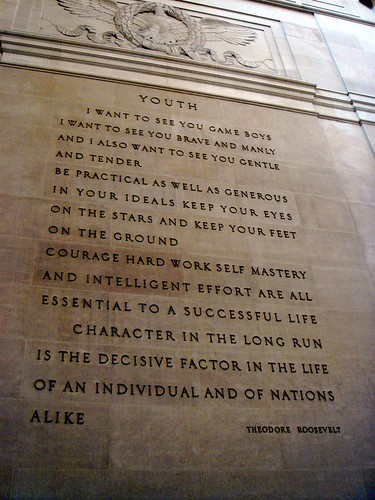
... which is inscribed on a wall at the American Museum of Natural History. And even though I went there today, it is not one of the answers to the question posed in the previous post. I've been to this museum many times. And I did way too much today, but if a 7-year-old boy can do it, I will do it.
But here's another thing to occupy your mind. Here are the white rhinos (diorama style):

Now, look at those nostrils and think of them as mouths. What freaky alien creatures!
... which is inscribed on a wall at the American Museum of Natural History. And even though I went there today, it is not one of the answers to the question posed in the previous post. I've been to this museum many times. And I did way too much today, but if a 7-year-old boy can do it, I will do it.
But here's another thing to occupy your mind. Here are the white rhinos (diorama style):
Now, look at those nostrils and think of them as mouths. What freaky alien creatures!
Enero 3, 2006
Blog style tips for the new year.
Evan Shaeffer comes up with ten New Year's Resolutions for bloggers, especially law bloggers. He mentions me a couple times, in the context of recommending blogging on a variety of topics. I'd just say there are two kinds of blogs, the kind that pick one topic and stay on it and the kind that range over whatever topics the blogger feels moved to write about. One person might write both types of blogs. For example, lawprof Stephen Bainbridge has his wide-ranging blog and then a single-topic blog. And his single-topic blog, nicely, isn't about law. It's about wine. Do I have a specialized interest of the sort that I'd want to break out into a separate blog? I certainly wouldn't segregate the law material.
I actually had a separate blog for a while, and I used it for very lightweight, chatty material. I stopped because the software trial license I was experimenting with expired, and I was happy enough mixing up this blog with serious and very easygoing material -- you know, the kind of stuff that makes certain bloggers rail against me. Ann Althouse, who's supposed to be a constitutional law professor, wrote this, about nostrils, nostrils! Hey, I pick my topics, and, if I want, I can pick nostrils.
I actually had a separate blog for a while, and I used it for very lightweight, chatty material. I stopped because the software trial license I was experimenting with expired, and I was happy enough mixing up this blog with serious and very easygoing material -- you know, the kind of stuff that makes certain bloggers rail against me. Ann Althouse, who's supposed to be a constitutional law professor, wrote this, about nostrils, nostrils! Hey, I pick my topics, and, if I want, I can pick nostrils.
Disyembre 18, 2005
Audible Althouse, #26.
Here's the new podcast. Questions raised: Why do I -- a conlawprof! -- withhold the answer to whatever the conlaw question of the day is? Why do I -- a lawprof! -- dare to talk about movies that I haven't even seen? Does King Kong belong to the nostril-flaring school of acting? Is "Brokeback Mountain" political? Why pay any attention to "The Apprentice"? If Althouse doesn't stick to the subject of law, is she nuts? If Althouse riffs about nostrils, is she high? (38 minutes.)
Disyembre 17, 2005
Thinking about going to the movies.
Look at how this silly man is outraged that I talk about movies when I haven't seen them. It would be a nice advantage for the folks who make movies if they could get people to believe that it was inappropriate to talk until you'd paid up and wasted your time. I think a key skill in modern life is figuring out which movies to avoid. Well, why don't I just keep my thoughts to myself? I'm a blogger: we display our thought patterns in real time. If you aren't interested, don't read. Really, why is that silly man upset? Does he have a financial interest in the movie? Or is he some fanboy who really, really wants Peter Jackson to succeed?
Occasionally, I actually put three hours of my precious life into movie-viewing. Usually, it's not worth it, even though I rarely do it and am highly selective. Having something bloggable does create a little additional value, but trotting out an actual movie review, MSM-style, doesn't interest me much. If I were paid to do it, I'd put in the effort needed to find new ways to say "X gave a great performance" and "the plot was confusing" and so forth.
All that said, I am giving a tiny bit of thought to seeing a movie today and blogging about it. Here's what's playing in Madison. Actually reading that list reduced my interest in going to the movies about 80%. The only one I really want to see is "Capote," but I don't know that I want to see it in the theater, especially the crap theater where it's playing. Then there are some that I think I've heard are -- in the inevitable cliché -- "supposed to be good"? "The Squid and the Whale"? Well, what the hell is it? I'd have to do some research to have any idea. What a drag! "The Family Stone"? The clip looked good when Sarah Jessica Parker was on "The Daily Show" the other day. But have I heard that it's "supposed to be bad"? I can't remember. Again, research is required! "King Kong"? You know how I feel about that. I'm just not that into nostril-gazing.
I spend much of the day staring at a screen already. For diversion, why look at another screen? There is that famous real world that I've heard so much about. I could go out there.
BONUS QUESTIONS, thought up on rereading this post: What actress has the most beautiful nostrils? How much harder is that question to answer than what actress has the most beautiful eyes or the most beautiful lips? There's a reason it's harder: you don't really want to look at nostrils, even on a beautiful face. Sometimes you get an actress who does too much nostril acting. You know, that flaring and re-flaring. Once you start noticing it, the performance becomes comic. Can you think of any actresses or actors who belong to the nostril-flaring school of drama? Any examples of an actor or actress that does nostril-flaring spoofily, for deliberate comic effect? And can someone clue me in on how much Peter Jackson's Kong goes in for nostril-flaring. Nostrils, nostrils, nostrils. There, I've said it! I'm obsessed with nostrils. Nostrils are the body part of the week, here on the Althouse blog.
UPDATE: Can you believe it? The very next day I write an elaborate post about another movie I haven't seen. I'm starting to think that this actually is a specialty of mine -- check out my old posts on "Alexander" -- and I'm going to pursue it actively and intentionally now. I note too that some of my critics are perplexed about the nostril-focused material in this post. They really aren't understanding the unique mix of topics that is Althouse. The most flat-footedly pedestrian of these critics feel compelled to point out time and again that I am a law professor: in their regimented world, everyone is supposed to stay neatly on track, doggedly pursuing the matters of their occupational specialization. The dentist must blog about teeth, and the conlawprof about conlaw. How terribly dull! What grim little minds!
Occasionally, I actually put three hours of my precious life into movie-viewing. Usually, it's not worth it, even though I rarely do it and am highly selective. Having something bloggable does create a little additional value, but trotting out an actual movie review, MSM-style, doesn't interest me much. If I were paid to do it, I'd put in the effort needed to find new ways to say "X gave a great performance" and "the plot was confusing" and so forth.
All that said, I am giving a tiny bit of thought to seeing a movie today and blogging about it. Here's what's playing in Madison. Actually reading that list reduced my interest in going to the movies about 80%. The only one I really want to see is "Capote," but I don't know that I want to see it in the theater, especially the crap theater where it's playing. Then there are some that I think I've heard are -- in the inevitable cliché -- "supposed to be good"? "The Squid and the Whale"? Well, what the hell is it? I'd have to do some research to have any idea. What a drag! "The Family Stone"? The clip looked good when Sarah Jessica Parker was on "The Daily Show" the other day. But have I heard that it's "supposed to be bad"? I can't remember. Again, research is required! "King Kong"? You know how I feel about that. I'm just not that into nostril-gazing.
I spend much of the day staring at a screen already. For diversion, why look at another screen? There is that famous real world that I've heard so much about. I could go out there.
BONUS QUESTIONS, thought up on rereading this post: What actress has the most beautiful nostrils? How much harder is that question to answer than what actress has the most beautiful eyes or the most beautiful lips? There's a reason it's harder: you don't really want to look at nostrils, even on a beautiful face. Sometimes you get an actress who does too much nostril acting. You know, that flaring and re-flaring. Once you start noticing it, the performance becomes comic. Can you think of any actresses or actors who belong to the nostril-flaring school of drama? Any examples of an actor or actress that does nostril-flaring spoofily, for deliberate comic effect? And can someone clue me in on how much Peter Jackson's Kong goes in for nostril-flaring. Nostrils, nostrils, nostrils. There, I've said it! I'm obsessed with nostrils. Nostrils are the body part of the week, here on the Althouse blog.
UPDATE: Can you believe it? The very next day I write an elaborate post about another movie I haven't seen. I'm starting to think that this actually is a specialty of mine -- check out my old posts on "Alexander" -- and I'm going to pursue it actively and intentionally now. I note too that some of my critics are perplexed about the nostril-focused material in this post. They really aren't understanding the unique mix of topics that is Althouse. The most flat-footedly pedestrian of these critics feel compelled to point out time and again that I am a law professor: in their regimented world, everyone is supposed to stay neatly on track, doggedly pursuing the matters of their occupational specialization. The dentist must blog about teeth, and the conlawprof about conlaw. How terribly dull! What grim little minds!
Disyembre 15, 2005
"King Kong."
Have you seen it yet? I'm too busy even to have considered going to see it yesterday, but I was resistant to the idea anyway for several reasons. It's 3 hours long, and the prospect of getting bored is way too real. I don't like CGI, and the clips I've seen have especially bad CGI. I especially disliked shots of Kong jumping about weightlessly and of a herd of dinosaurs running straight at the camera. That the human beings can stand unharmed amid the stampede is not surprising: these things are insubstantial.
But Chris saw the movie yesterday and gave it a mixed review. It was too long. It takes an hour just to get to the island, with nothing much happening. Was Adrian Brody good? He had little to do. Was the CGI bad? The close up shots of Kong were great, but the long shots were not. Yeah, that's what I thought from the clips. Everything close up with Kong and Naomi Watts was really good. Naomi Watts was great. And the whole last hour was great.
Maybe I'll stop by and just see the last hour. It's not like I won't understand the story without the two hours of build-up, and that way I won't be stuck dying to leave and looking at my watch during the only part of the movie I have much chance of liking. But I'm not so sure I'll enjoy all those close ups as much as Chris did. I dislike big close ups, especially in CGI, and I already dislike the Kong face I've seen too many times in the magazines. It's so dominated by nose, that crinkly, creased, complicated nose. What's the point of staring into those nostrilly depths for an hour?
And why are his nostrils always so sparkling clean? Does being good somehow serve the same purpose as Kleenex? In movies where a monster is bad -- think "Aliens" -- it's festooned with strings of mucus. I'll bet there's never a trace of snot in those big gaping Kong nose holes.
UPDATE: And then there's the racism question. Does Kong represent a black man? Is there something about the way we live now that absolves the new Kong of that reading?
IN THE COMMENTS: A reader thinks it's "silly" for me to attack a movie I haven't seen. My disagreement includes the assertion that the guys who make movies don't deserve fairness.
MORE: For my response to a blogger who criticizes me for writing about a movie I haven't seen, go here.
But Chris saw the movie yesterday and gave it a mixed review. It was too long. It takes an hour just to get to the island, with nothing much happening. Was Adrian Brody good? He had little to do. Was the CGI bad? The close up shots of Kong were great, but the long shots were not. Yeah, that's what I thought from the clips. Everything close up with Kong and Naomi Watts was really good. Naomi Watts was great. And the whole last hour was great.
Maybe I'll stop by and just see the last hour. It's not like I won't understand the story without the two hours of build-up, and that way I won't be stuck dying to leave and looking at my watch during the only part of the movie I have much chance of liking. But I'm not so sure I'll enjoy all those close ups as much as Chris did. I dislike big close ups, especially in CGI, and I already dislike the Kong face I've seen too many times in the magazines. It's so dominated by nose, that crinkly, creased, complicated nose. What's the point of staring into those nostrilly depths for an hour?
And why are his nostrils always so sparkling clean? Does being good somehow serve the same purpose as Kleenex? In movies where a monster is bad -- think "Aliens" -- it's festooned with strings of mucus. I'll bet there's never a trace of snot in those big gaping Kong nose holes.
UPDATE: And then there's the racism question. Does Kong represent a black man? Is there something about the way we live now that absolves the new Kong of that reading?
IN THE COMMENTS: A reader thinks it's "silly" for me to attack a movie I haven't seen. My disagreement includes the assertion that the guys who make movies don't deserve fairness.
MORE: For my response to a blogger who criticizes me for writing about a movie I haven't seen, go here.
Enero 1, 2005
"I roared. And I rampaged. And I got bloody satisfaction."
"I've killed a hell of a lot of people to get to this point, but I have only one more. The last one. The one I'm driving to right now. The only one left. And when I arrive at my destination...."
UPDATE: The comments over there -- after an Instalanche -- are cracking me up. Especially: "the nostrils they are obviously different." Because, really, the difference between Uma and me ... it's mainly in the nostrils!
UPDATE: The comments over there -- after an Instalanche -- are cracking me up. Especially: "the nostrils they are obviously different." Because, really, the difference between Uma and me ... it's mainly in the nostrils!
Abril 29, 2004
Omarosa and ... the ordeal of the bier! According to Jeannette Walls at MSNBC News:
A sidenote: that case appeared in an early edition of the Green and Nesson problem method Evidence book. I harshly critiqued that edition of Green and Nesson in "The Lying Woman, The Devious Prostitute, and Other Stories from the Evidence Casebook," 88 Northwestern Law Review 914 (1994). That's not available on line, but it makes excellent reading. Having written an article with that title, I now have the rare distinction of having a resumé with the word "prostitute" on it! File that under: Things I Didn't Think About At The Time. And I have no quarrel with later editions of Green and Nesson's book, at least some of which included passages from my article.
ADDED: "The Lying Woman..." is now available to read on line: here.
The much-loathed reject from “The Apprentice” was scheduled to appear on “Jimmy Kimmel Live” last week, but refused to go on air when she saw a lie detector test backstage.That reminds me of a lesson about relevant evidence I used back in the days when I taught Evidence. We read a 1894 Missouri State Supreme Court case, State v. Wisdom (sorry for the long block quote, but this is not otherwise available on line and it's really cool):
“The lie-detector test wasn’t even for her,” a spokeswoman for the show told the Scoop. “It was intended for Jimmy’s Uncle Frank [a regular character on the show], but when Omarosa saw it, she just freaked.” Some fellow contestants have accused Omarosa Manigault-Stallworth of lying when she said one of them used the N-word. “We tried and tried to calm her down, but she just kept saying ‘I’m not going on stage with that lie detector test’ then she just walked out.”
In the course of the examination of the witness Hill, he was asked to tell what happened down at the morgue by the dead body of Mr. Drexler, when the witness Willard and defendant were there, prior to the inquest. This was objected to as immaterial; the objection was overruled. The witness answered that "they told us to put our hands on Mr. Drexler," and that he "and Willard did so, but defendant wouldn't do it." Officer McGrath corroborated this statement. Defendant objected to McGrath's statement, but assigned no reason. The action of the court in this regard is now assigned as error. Who it was that told them to put their hands on Mr. Drexler's dead body does not appear.So, getting back to Omarosa: even if the lie detector was not to be used on her, and, indeed, even if lie detector tests are not reliable, if she believed it was to be used on her and believed it was reliable, her running off at the sight of it is some evidence that she had lied in her accusation about the other contestant. On the other hand, it isn't very strong evidence. She may have believed lie detector tests are not reliable, especially for someone under stress (as she would be if given the test on camera), and so she could be telling the truth but rejecting the test to avoid producing evidence that would be used against her. And it is also completely sensible to flee the lie detector because it gave her the strong impression that she was going to be subjected to intrusive, disrespectful intrusions other than the interview she agreed to. Oh, and I'd like to see a lie detector test given to the spokeswoman for the show, with questions about whether they were planning to ask Omarosa once she was on stage whether she wouldn't like to take the test.
The request to touch the body was evidently prompted by the old superstition of the ordeal of the bier in Europe in the Middle Ages, which taught that the body of a murdered man would bleed freshly when touched by his murderer, and hence it was resorted to as a means of ascertaining the guilt or innocence of a person suspected of a murder.
This superstition has not been confined to one nation or people. It obtained among the Germans, prior to the twelfth century, and is recorded in the Nibelungenlied, the great epic poem of that country, in the incident in which the murdered Seigfried is laid on his bier and Hagen is called on to prove his innocence by going to the corpse, but at his approach the dead chief's wounds bleed afresh. That it dominated the English mind is attested by the passage of Matthew Paris, that when Henry II. died at Chinon in 1189, his son and successor came to view his body, and as he drew near, immediately the blood flowed from the nostrils of the dead king as if his spirit was so indignant at the approach of the one who caused his death, that his blood thus protested to God. And Shakespeare voices the same superstition in Richard III., in act 1, scene 2, thus:
"O! gentlemen, see, see! dear Henry's wounds Open their congealed mouths and bleed afresh."
And so does Dr. Warren, in "Diary of a Late Physician," 3 vol., p. 327. That it was a prevalent belief in Africa and Australia, in another form, see 17 Encyclopedia Britannica, pp. 818, 819.
This superstition has come to this country with the emigration from other lands, and, although a creature of the imagination, it does to a considerable degree affect the opinions of a large class of our people.
It is true it was not shown that defendant believed that touching this body would cause any evidence of guilt to appear, or that he entertained any fear of possible consequences, but it was simply a test proposed by some bystander, and it was offered as showing the manner in which the three suspects conducted themselves when it was proposed. Clarke v. State, 78 Ala. 474; Chamberlayne's Best on Ev., page 488.
While defendant had a perfect right to decline, either because of his instinctive repugnance to the unpleasant task or because no one had a right to subject him to the test, and his refusal might not prejudice him in the minds of a rational jury, on the other hand, a consciousness of guilt might have influenced him to refuse to undergo the proposed test, however unreasonable it was and it is one of the circumstances of the case, that the jury could weigh. The jury could consider that, while it was a superstitious test, still defendant might have been more or less affected by it, as many intelligent people are by equally baseless notions as shown by their conduct and movements. It often happens that a case must be established by a number of facts, any one of which, by itself, would be of little weight, but all of which taken together would prove the issue.
A sidenote: that case appeared in an early edition of the Green and Nesson problem method Evidence book. I harshly critiqued that edition of Green and Nesson in "The Lying Woman, The Devious Prostitute, and Other Stories from the Evidence Casebook," 88 Northwestern Law Review 914 (1994). That's not available on line, but it makes excellent reading. Having written an article with that title, I now have the rare distinction of having a resumé with the word "prostitute" on it! File that under: Things I Didn't Think About At The Time. And I have no quarrel with later editions of Green and Nesson's book, at least some of which included passages from my article.
ADDED: "The Lying Woman..." is now available to read on line: here.
Mag-subscribe sa:
Mga Post (Atom)


 Mga Post


