Writes Supriya Ganesh, "My Strange Dysphoria/Growing up in India, I never questioned my gender. When I moved to the U.S. at 18, I began to feel disconnected from my body" (New York Magazine).
curly hair लेबलों वाले संदेश दिखाए जा रहे हैं. सभी संदेश दिखाएं
curly hair लेबलों वाले संदेश दिखाए जा रहे हैं. सभी संदेश दिखाएं
27 अप्रैल 2026
"I’d never questioned my gender before I came to America; growing up in India, I’d always identified as a girl."
"Of course, India has a gender hegemony of its own — one I arguably benefitted from in many ways and suffered from in others. I am upper-caste, upper-class, Hindu, and also a Tamil woman who didn’t look like the models in the Fair & Lovely commercials. I was the only Tamilian in most rooms I was in, a fact my North Indian classmates consistently reminded me of. Still, the popular conception of what a woman or a man was felt more fluid. I grew up among Sikh women who didn’t tame their body hair, men who would hold hands platonically with their male friends, and children who cross-dressed for play (almost every boy had a photo of himself dressed up as a girl by his mother for fun).... [And there] is our third-gender community, or hijras, as they are commonly known...."


28 जनवरी 2026
Moving to Australia (from the UK) "makes you more attractive. At least that’s what young expats who moved down under claim as 'the Australia effect.'"
I'm reading "Moving to Australia made my fiancé more attractive/Young adults find travelling down under does wonders for their self-esteem and sex appeal. It’s what happens when you live life without stress, one says" (London Times).
Among the scores of travellers showing off their “glow-ups” is Abigail Phillips, 29, who posted on Instagram her fiancé’s transformation from pale and formal to a surfer boy with a golden tan, mullet and trendy moustache. “I really do like the ’tache and the curly hair,” said Phillips
19 अगस्त 2025
"At first, my hair came back as you’d expect, as the softest stubble. At about half an inch, though, there started to be a distinct ripple. The ripple evolved..."
"... into ’90s Billy Crystal (I clearly was not specific enough when I wished for the hair in 'When Harry Met Sally…'). There was a Nancy Reagan moment. And since then, it has gotten darker — and more and more (and more) poodle. I call this the haircut nobody asks for, or Baby’s First ’Do. It has changed the shape of my face. Old friends don’t recognize me. They seem to share some of the discomfort I feel standing in front of the mirror: Who is this? It’s like I uncanny-valleyed myself."
Writes Rachel Manteuffel, quite charmingly, in "Cancer changes you, but I never saw my new hair comingIt’s not clear why chemotherapy gave me curls, but when life gives you Garfunkel..." (WaPo).
Writes Rachel Manteuffel, quite charmingly, in "Cancer changes you, but I never saw my new hair comingIt’s not clear why chemotherapy gave me curls, but when life gives you Garfunkel..." (WaPo).
11 अप्रैल 2025
"[H]is sartorial inspirations included people he described as 'accidentally well dressed' or, as he put it, those who 'have no intention of being fashionable.'"
"'They have just found a style that works for them and developed it throughout their life, which often leads to their clothes telling interesting stories,' he said. As for his hair, he explained that he started growing it out seven years ago when he was looking for ways to style his thick, fuzzy curls. 'It just stuck ever since,' Mr. Willis said, 'and I think the style unintentionally guided how my way of dressing has developed. And it keeps my ears warm in winter!''"
From "Look of the Week/Dreamy Hair With Clothes to Match" (NYT)(free-access link so you can see what Billy Willis wore).
From "Look of the Week/Dreamy Hair With Clothes to Match" (NYT)(free-access link so you can see what Billy Willis wore).
Note: I love it — the clothes and the hair. Reminds me of Marc Bolan in his Tyrannosaurus Rex days.
1 मई 2023
"The modern men’s perm is loud for a hairstyle so soft. On TikTok, the hashtag #menperm... has garnered more than 20.7 million views."
"Those videos often begin with a man in a salon chair, pictured from the shoulder up. The camera orbits around his head just before a final shot of his crown: silky, voluminous waves lacquered with the aplomb of K-pop boy bands...."
I'm reading "Why Are More Men Getting Perms? The modern male perm is softer, more natural and has taken off, thanks to K-pop and TikTok" (NYT).
I'm reading "Why Are More Men Getting Perms? The modern male perm is softer, more natural and has taken off, thanks to K-pop and TikTok" (NYT).
TikTok is very powerful. Videos don't just get views. They garner them.
26 अक्टूबर 2022
"I was never told a woman’s hair should look beautiful. But, definitely, my hair was the most hated — in my culture, in my village..."
"... because in Iran, when I was growing up, oh, my God, curly hair was a disaster. People mocked me, called people with big hair a specific name — it meant 'big-head woman' — to shame us. When I was taking an English course [to prepare to attend university in the United Kingdom], a woman asked me, 'You straighten your hair?' And then she took off my headscarf and said, 'My God, look at your head. What are you doing? You just straighten this part because when it’s out of your scarf, you want to show you have straight hair?' I said, 'Yeah, because I don’t have time. I straighten my hair just a bit.' And she told me, 'Don’t.' I went back to my mirror and she said, 'Just look at yourself.' At first I didn’t know why. She said: 'Just look at yourself and don’t make your hair straight. Just look deeply at your hair. You are going to love it.'"
From "Here’s what it’s like to be persecuted for your hair" (WaPo).
8 मई 2019
"People, generally white ones, always think the answer to things like racism is to do away with race — to, as the saying goes, never see color."
People, generally white ones, always think you're never supposed to split infinitives, especially with a really long phrase like "as the saying goes."
But I'm just trying to get my straight-haired head around "The Royal Baby and Blackness as a Badge of Honor/Whether he 'looks' black or not, I’ll be glad to claim him" by Lizzie Skurnick, who — being black — can wonder out loud in the NYT, "Will he have kinky hair?" That sounds like an awful question to me, a white person.
I remember when I had my first baby — with a Jewish father — somebody asked me, "Does he have a big nose?" I'm still taking offense, and it's nearly 40 years later.
From the top-rated comment at the NYT:
But I'm just trying to get my straight-haired head around "The Royal Baby and Blackness as a Badge of Honor/Whether he 'looks' black or not, I’ll be glad to claim him" by Lizzie Skurnick, who — being black — can wonder out loud in the NYT, "Will he have kinky hair?" That sounds like an awful question to me, a white person.
I remember when I had my first baby — with a Jewish father — somebody asked me, "Does he have a big nose?" I'm still taking offense, and it's nearly 40 years later.
From the top-rated comment at the NYT:
I’m a black man and I’m rather annoyed that people are already trying to draw life’s lines and boundaries around the boy, who at this moment, is nameless. I don’t care what he looks like. His parents love him to pieces. Shouldn’t that be enough?
30 अगस्त 2016
"He got this bright idea that he could save money on haircuts. So he let his hair grow, he got a perm, and decided he would never need a haircut again."
"Before he could change it back, though, the perm became his company's logo — Ross hated it. 'He could never, ever, ever change his hair, and he was so mad about that... He got tired of that curly hair.'"
The truth about Bob Ross.
The truth about Bob Ross.
"Bob used to lay in bed at night, he told me, he rehearsed every word," Kowalski says. "He knew exactly what he was going to say on every one of those programs."
Like this famous phrase: "You know without question that we don't make mistakes here. We just have happy accidents."
4 अक्टूबर 2015
16 अप्रैल 2015
Why is Hillary Clinton misstating checkable facts about her life?
Buzzfeed reports: "Speaking in Iowa Wednesday, former Secretary of State Hillary Clinton said that all her grandparents had immigrated to the United States, a story that conflicts with public census and other records related to her maternal and paternal grandparents."
Meanwhile, Chelsea Clinton expects people to believe that her very curly hair on its own changed into glossily sleek, slightly curved straight hair:
Meanwhile, Chelsea Clinton expects people to believe that her very curly hair on its own changed into glossily sleek, slightly curved straight hair:
"My curls, in my early twenties, just fell into waves. I don't know if they got tired of me, but the curls slowly subsided, and so now it's naturally a little bit wavy but... I miss my curls."Why lie about things you don't even need to lie about, things that can be checked? Why lie so badly?
10 अक्टूबर 2014
Do you notice what's extraordinary...
... about this, from 1968?
I was just poking around in the Christmas Eve 1976 edition of The New York Times, looking for something else, and I ran across:
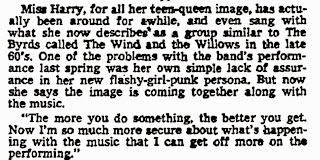
And this pair of ads on the facing page caught my eye:

Two competing images of sexiness from late 1976. Who knew then that the Rocky image would be the much more enduring one. The man, alone with his armpits. Not the man and the woman, with hands thoroughly entangled in curly hair. Rocky even has the more enduring font. And they tried so hard with all those futuristic serifs stabbing their way through the adjoining letters in "A Star Is Born."
Anyway, after finding what I'd actually been looking for — news of the concerts Lou Reed played in NYC in the 70s — I went in search of The Wind in the Willows. I hope you enjoyed that hippie, trippy sojourn into the land of the gentle people, that canyon of if-not-your-then-my mind that was the 1960s, before the mean old 70s came along and made everything so harsh and cruel.
I was just poking around in the Christmas Eve 1976 edition of The New York Times, looking for something else, and I ran across:

And this pair of ads on the facing page caught my eye:

Two competing images of sexiness from late 1976. Who knew then that the Rocky image would be the much more enduring one. The man, alone with his armpits. Not the man and the woman, with hands thoroughly entangled in curly hair. Rocky even has the more enduring font. And they tried so hard with all those futuristic serifs stabbing their way through the adjoining letters in "A Star Is Born."
Anyway, after finding what I'd actually been looking for — news of the concerts Lou Reed played in NYC in the 70s — I went in search of The Wind in the Willows. I hope you enjoyed that hippie, trippy sojourn into the land of the gentle people, that canyon of if-not-your-then-my mind that was the 1960s, before the mean old 70s came along and made everything so harsh and cruel.
11 फ़रवरी 2014
Goodbye to Shirley Temple.
Here's the NYT obituary, with some of the details of the life of the greatest child star of all time and perhaps the most loved actress of all time. My mother taught me to love her in the 1950s when I was a child — my mother, who had loved going to the movies when she was a child during The Depression, when Shirley Temple movies were coming out and making people happy.
I watched so many Shirley Temple movies on our big black-and-white TV. They were on all the time — "Captain January," "The Littlest Rebel," "Curly Top," "The Little Princess." So many of the movies I saw as a child were Shirley Temple movies on TV. I was never taken to a movie theater with my parents, so I didn't see a movie in a theater until I was old enough to go without an adult. Movies were part of television, and there was Shirley in her childhood prime. She had a TV show — "Shirley Temple's Storybook" — where we saw her as a lovely adult woman, introducing a filmed fairy tale each week.
I've written many blog posts about Shirley Temple over the years, and I'm going to extend this post with some links to them.
January 29, 2014, blogging about the State of the Union:
August 27, 2012, the topic was the desire for a movie that "helps me be a nicer person, not a sharper arguer":
April 29, 2009, a controversy over a photographic presentation of teenaged Miley Cyrus looking overly sexualized led me to show you this clip of Shirley Temple as a toddler playing a seductress. It's simply astounding by today's standards:
April 9, 2007, I have "A profound movie experience... watching one of the first movies I ever saw... Perhaps the second movie I ever saw in my life -- the first was 'The Little Fugitive" -- was the Shirley Temple movie 'Captain January.'"

Read the whole story at the link. I'll just tell you that Ronald Reagan rescues the suicidal Shirley from drowning — complete with pictures of Reagan diving into the raging river and Shirley looking "modern and fabulous" while wet — and in the end he tells her — so Reaganesquely — "It's what you are, and where you're going that really matters."

April 24, 2004, the day after that big Shirley-and-Reagan post, I posited a question for which you'll see no answers at the link, because I didn't have the comments on back then. You might find this a particularly interesting question today, what with all the recent talk of Woody Allen's depredations and travails:
I watched so many Shirley Temple movies on our big black-and-white TV. They were on all the time — "Captain January," "The Littlest Rebel," "Curly Top," "The Little Princess." So many of the movies I saw as a child were Shirley Temple movies on TV. I was never taken to a movie theater with my parents, so I didn't see a movie in a theater until I was old enough to go without an adult. Movies were part of television, and there was Shirley in her childhood prime. She had a TV show — "Shirley Temple's Storybook" — where we saw her as a lovely adult woman, introducing a filmed fairy tale each week.
I've written many blog posts about Shirley Temple over the years, and I'm going to extend this post with some links to them.
January 29, 2014, blogging about the State of the Union:
"Shirley Temple is there," I said, spotting Debbie Wasserman Schultz, and being unfair to Shirley Temple, whose ringlets — as I do an image search this morning — look artlessly subtle and not at all like Debbie's headful of boing-y springs. Incredible what women can do to themselves and still be taken seriously.June 20, 2013, blogging about Paula Deen's getting into trouble for the notion of a slave-themed wedding with "a bunch of little n-----s..." like "in the Shirley Temple days," where "they used to tap dance around":
[O]bviously, there were all sorts of problems with the way black people were depicted in old Hollywood movies, let's at least get it clear in our minds what the movie reference is. There was a 1935 Shirley Temple movie called "The Littlest Rebel," and here's what it looked like when Bill Bojangles Robinson (playing the slave "Uncle Billy") danced. He's not tap dancing "around" — as if slaves dance around while working — he's giving a performance at an elegant affair — as a soloist, not in "a bunch." And he's not in shorts and shirt-sleeves. He's wearing long pants and a vest and a jacket. So Deen's mental image of what went on in the bad old days of Hollywood is itself an embarrassing distortion.February 6, 2013, "My duck does a wonderful trick. My duck can lay an egg!" A sweet clip of Shirley, presented a propos of the "'Signs that people are tired of thinking about politics,' which highlighted the Washington Post article about the amazing fact that a bird laid an egg. And who better than Shirley Temple to epitomize the desire for distraction from politics?"
August 27, 2012, the topic was the desire for a movie that "helps me be a nicer person, not a sharper arguer":
I'm wracking my brain trying to come up with a movie that oriented me toward greater niceness. I can think of movies that might help you become a better person, but it's usually in the sense of becoming bolder, more independent, more resolutely opposed to evil and oppression. But nicer? Can you think of a movie in which the central character, someone you identify with, is especially polite and the politeness isn't basically something he must overcome in order to succeed.April 28, 2012, somehow the top of Obama's gaffe about "clinging to guns and religion" led to Shirley, after some lady reminded somebody of Jane Withers, as Withers' appeared as an adult in the 1960s in ads for Comet scouring powder, and I said:
A-ha! The answer: Every Shirley Temple movie.
When my mother saw those Comet ads, she's always exclaim about how mean Jane Withers was to Shirley Temple. She was the child actress who was most emphatically not Shirley Temple....Withers played the role of a girl who was mean to the most lovable child who ever lived, and therefore she became — in my mothers mind — the mean girl, indelibly, no matter how many sinks she scrubbed clean.
April 29, 2009, a controversy over a photographic presentation of teenaged Miley Cyrus looking overly sexualized led me to show you this clip of Shirley Temple as a toddler playing a seductress. It's simply astounding by today's standards:
April 9, 2007, I have "A profound movie experience... watching one of the first movies I ever saw... Perhaps the second movie I ever saw in my life -- the first was 'The Little Fugitive" -- was the Shirley Temple movie 'Captain January.'"
And speaking of influences, I can see how much this influenced me. Shirley is angrily defiant as she stands up to the prissy female truant officer who doesn't like the feisty attitude she's learning from the men. The truant officer wants to put her in an institution, away from Captain January, the kindly lighthouse keeper who found her after a shipwreck.April 23, 2004, I write my first (and best) Shirley Temple post, telling the story of "The Hagen Girl" — the movie she made with Ronald Reagan — complete with shot-from-the-TV-screen stills:
You should be taken home and spanked! What kind of man is this Captain January to allow you to run around?This is some heavy dialogue for a young child to hear. (Shirley has just been looking at a picture she thinks is her dead mother and has tried to sing the song "Asleep in the Deep.")
Helen: How can anyone sleep in the deep?Yes, Shirley reminds you of death, then tries to cheer you back up with Christmas and short term hopes.
Capt. January: That's the long last sleep, Star.
Helen: Does everyone have to die?
Capt. January: Yes, everyone does.
Helen: Even you and me?
Capt. January: Yes, when the time comes.
Helen: Do you think we'll make it till Christmas?
Capt. January: Yes, I wouldn't be surprised if we did.
It's bad, but awesome. Ronald Reagan comes to town, hears people gossiping about him, and doesn't like it..... The gossip is all about how Mary Hagen, played by Shirley Temple, is an illegitimate child and the father is Reagan. Shirley was the most adorable child ever, but here she is as a gorgeous teenager:

Read the whole story at the link. I'll just tell you that Ronald Reagan rescues the suicidal Shirley from drowning — complete with pictures of Reagan diving into the raging river and Shirley looking "modern and fabulous" while wet — and in the end he tells her — so Reaganesquely — "It's what you are, and where you're going that really matters."

April 24, 2004, the day after that big Shirley-and-Reagan post, I posited a question for which you'll see no answers at the link, because I didn't have the comments on back then. You might find this a particularly interesting question today, what with all the recent talk of Woody Allen's depredations and travails:
So if a teenage girl goes for a year believing an older man is her biological father, but then finds out it was just rumor, is it okay to marry him? I mean in a conventional family-oriented movie. That's what happened in "That Hagen Girl" (discussed... with pictures, yesterday). Ronald Reagan was none too happy with the role of the father figure and begged for a rewrite in which he doesn't end up marrying Shirley Temple.
Reagan's misgivings about the script were borne out when the film had its first preview screening. After he rescues Temple from her suicide attempt, he admits that he loves her. But when he said the words on screen, the preview audience screamed "Oh no!" almost in unison.So they recut it, so people wouldn't scream in horror! But that only made it an inexplicably sexless marriage.
30 जनवरी 2014
"The female power brokers of Washington wear color like virtually no other group of working women."
Observes Robin Givhan, describing the absurdly bright colors worn by the female members of Congress at the State of the Union spectacle.
Both Givhan and I talk about the difference between the way men and women dress. She is saying that the women seem beset by discomfort with the authority they in fact possess, and the arc of progress bends toward a day when, finally relaxed, they wear something more like what the men wear. I'm saying the men are more constrained, by strict fashion convention, by the judgment that would befall them if they deviated — we'd think them nuts if they dressed like Tom Wolfe — controlled for the expectation that they confine themselves to convention, and by the demand that they never let it show that they think the women look ridiculous.

That's Connecticut Congresswoman, Rosa DeLaurio. Respect the woman! You may not laugh! Behind her is Debbie Wasserman Schultz. In my "10 things" post, I wrote:

Those few curls on a man make us think he's pretty wild. Too nutty to take seriously? What if he let it go a little farther into something more like this:

Mental?! Do you recognize who that is? He's not in politics. Here he is in a younger condition:

What if Rand Paul wore blond, brilliantined, biblical hair, like Jesus wore it (Hallelujah I adore it)? What would you think? You couldn't imagine that you could defend him by saying he wasn't putting much effort into the achievement of that look!
When will the gentlewomen of Congress stop feeling as though they must announce themselves for the cameras, their constituents and their colleagues? How many more women will it take in the upper echelons of Washington before they can all relax, suit up with authority — see Sen. Kelly Ayotte (R-N.H.) — and stop dressing like gumdrops?...Here's how I observed the same scene (in yesterday's post "10 things I might have live-blogged, if I'd blogged the State of the Union Address"):
Congresswomen, there’s no need to peacock for the cameras.
Is every woman wearing bright red? As Obama squeezes in down the aisle, the backdrop of red looks like an array of military personnel from some European country, but it's just the congresswomen, bulging into the aisles. Of course, military personnel would clear a path, not make it more difficult for The Commander to walk by. The congressmen are less showily dressed. What choice do they have? If a male member wore anything other than a dark, neutral color, you'd think he's lost his mind, but the women seem to think they can't look crazy.... Incredible what women can do to themselves and still be taken seriously. Respect the women! You'd better. Or else!Here's how Givhan describes what Michelle Obama wore:
And, of course, the first lady was the most subdued of all: She chose monochromatic, almost-black pine green, with a full skirt and cropped jacket... by Azzedine Alaia.... The signature cut, with its fitted waist and exuberant skirt, speaks of grace rather than power. Personal preference rather than politics.Here's how I described the same outfit:
Michelle Obama... is wearing something that seems halfway between a 1950s little girl's party dress and an enlarged insect's carapace.The First Lady knew the cameras would focus on her, so she was free to wear any color she chose, and she chose what Robin Givhan called almost-black pine green and what had me doing a Google image search for a bottle fly. The Congresswomen knew they would be dots in a crowd, and both Givhan and I spoke in terms of mental problems. You might think she sounds a lot nicer than I do, but she's the one who perceives the women as having a psychological deficiency that makes them overdo the demand for attention. I was talking about how the viewer accepts women displaying themselves so outlandishly without regarding them as insane.
Both Givhan and I talk about the difference between the way men and women dress. She is saying that the women seem beset by discomfort with the authority they in fact possess, and the arc of progress bends toward a day when, finally relaxed, they wear something more like what the men wear. I'm saying the men are more constrained, by strict fashion convention, by the judgment that would befall them if they deviated — we'd think them nuts if they dressed like Tom Wolfe — controlled for the expectation that they confine themselves to convention, and by the demand that they never let it show that they think the women look ridiculous.

That's Connecticut Congresswoman, Rosa DeLaurio. Respect the woman! You may not laugh! Behind her is Debbie Wasserman Schultz. In my "10 things" post, I wrote:
"Shirley Temple is there," I said, spotting Debbie Wasserman Schultz, and being unfair to Shirley Temple, whose ringlets — as I do an image search this morning — look artlessly subtle and not at all like Debbie's headful of boing-y springs.My laughing at the woman, there, produced this long column from Neo-Neocon. Purporting to defend Wasserman Schultz, Neo-Neocon relies heavily on the belief that she probably didn't do much to her hair to cause it to look like that:
She’s probably desperate for an “artlessly subtle” look, but that’s probably beyond her powers, or would take so much “doing” for her as to be all-consuming. She’s lucky if her hair doesn’t frizz up into a big puffball or frizz down into a limp and wan collection of wires.Why is it a defense to say that little work was put into the achievement of the look? Is that a special defense for women or can men get similar support? Seems to me the male members are poofing and puffing whatever they've got and adding fake hair too. In them, we look at the result, and pronounce it ridiculous when it seems ridiculous. We feel perfectly free to point and laugh at this:

Those few curls on a man make us think he's pretty wild. Too nutty to take seriously? What if he let it go a little farther into something more like this:

Mental?! Do you recognize who that is? He's not in politics. Here he is in a younger condition:

What if Rand Paul wore blond, brilliantined, biblical hair, like Jesus wore it (Hallelujah I adore it)? What would you think? You couldn't imagine that you could defend him by saying he wasn't putting much effort into the achievement of that look!
5 मई 2013
Purchase of the day.
From the May 4, 2013 Amazon Associates Report:
The Althouse Amazon portal: emitting the maximum number of approved negative ions allowed by law.
BaBylissPRO Nano Titanium Straightening IronBy using the Althouse portal, you can buy things you want, pay nothing extra, and make a contribution to this blog. We notice. We appreciate it. And only if you sign your name will we know it's you.
The Althouse Amazon portal: emitting the maximum number of approved negative ions allowed by law.
18 मार्च 2013
21 जुलाई 2011

20 जुलाई 2011
Robin Givhan chides Rebekah Brooks for her big, curly hairdo: "That was look-at-me hair — stare at me, remember me. Me, me, me."
"It’s always risky to attach politics, social status or cultural affinity to a hairstyle — to endow it with too much meaning," says the writer whose stock-in-trade is finding meaning in fashion and style.
Surely the many debates and lawsuits stemming from disagreements over cornrows, Afros, and dreadlocks have driven home this lesson.But Brooks is not black, so let's put that worry on the backburner.
Still, in such a serious situation as an interrogation by Parliament, why risk being misread, mischaracterized or misunderstood?Would you say that to a black person with a trademark extravagant hairstyle?
... One could argue that it’s to Brooks’ credit that she refrained from dramatically altering her signature look. She is who she is. She didn’t pull her hair into a trim bun or clip it into a ponytail. Either choice would have made her hair less of a distraction, but it also might have made it less of a personal comfort.It would have been distracting to change it, and I bet Givhan would have written her column about that.
[Brooks's hair is] a spray of self-conscious indifference.... [P]erhaps... Brooks was attempting to defy presumptions.... But that’s a pretty brazen thing to do when Parliament is on your case for defying laws, ethics and common decency.Do you, like Givhan, attribute that to brazen ego, or do you think that a powerful person, called to account by government, should maintain the basic aspects of her image and individuality? And how much of a self-defense is it, really, to become someone other than who you've been, by taking away your tangled, spangled, and spaghettied hair?
Brooks’ hair was a distraction because it was a ballsy rebuke of our expectations governing how people on the defensive are supposed to tread.
24 दिसंबर 2010
"Washington's currency is power, and fashion helps to bring order to the power structure."
"Clothes provide the first hint of how we relate to one another and how seriously we should be taken. (Remember that, dear interns in your flip-flops and miniskirts.) Gentlemen may pull on a bespoke suit or rebel against that brand of traditionalism with rumpled jeans and T-shirts. Power is now a woman in a sleek sheath, not one in a frumpy suit and a pair of commuter sneakers."
Robin Givhan opines on fashion and Washington as she steps away from her fashion beat at the Washington Post (and into the more stylish Daily Beast). She thanks the Post and pleads for the importance of fashion writing — "fashion [can] provide a window on who we are... amid the frippery and parties, fashion is also business, politics, religion, sociology and ultimately, life." And she links to a few choice old items, going back as far as 1998 — I wish I were blogging then! — to a thing about Paula Jones:
Robin Givhan opines on fashion and Washington as she steps away from her fashion beat at the Washington Post (and into the more stylish Daily Beast). She thanks the Post and pleads for the importance of fashion writing — "fashion [can] provide a window on who we are... amid the frippery and parties, fashion is also business, politics, religion, sociology and ultimately, life." And she links to a few choice old items, going back as far as 1998 — I wish I were blogging then! — to a thing about Paula Jones:
She has smoothed the frizzy mane of curls that once reached to such dazzling heights. Her makeup is now subtle and based on natural, not neon, hues. Her clothing is inspired by the boardroom instead of the secretarial pool. She has embraced the markers of dignity, refinement and power.So... the frumpy suit and not the sleek sheath? Funny how these "markers" get switched around, isn't it?
"I had been very aware of the horrible things the White House was saying about her. The main thing we looked at was what could we do to do away with all those things," says her California-based spokeswoman, Susan Carpenter-McMillan.Whatever the woman is, she needs to be the opposite. Do you have big hair and they're calling you a white-trash floozy? Get small hair! Wouldn't it be funny if men under attack made their big hair small or their small hair big and changed from — what would it be? — a conservative suit to a less conservative suit or a less conservative suit to a more conservative suit? Bill Clinton didn't alter his appearance when he got into trouble. (But see Al Gore.)
"She is not white trash," she says. "She is not a big-haired floozy."
22 सितंबर 2009
"Captain Bezu Fache carried himself like an angry ox, with his wide shoulders thrown back and his chin tucked hard into his chest."
"His dark hair was slicked back with oil, accentuating an arrow-like widow's peak that divided his jutting brow and preceded him like the prow of a battleship. As he advanced, his dark eyes seemed to scorch the earth before him, radiating a fiery clarity that forecast his reputation for unblinking severity in all matters."
From a list of 20 putrid sentences written by Dan Brown.
From a list of 20 putrid sentences written by Dan Brown.
सदस्यता लें
संदेश (Atom)


 संदेश
संदेश