"He couldn’t stand math. 'I was supposed to fulfill his desire and to be a successful capitalist,' he snorted. He was a 'hotheaded' teenager attracted to the religious fervor of the 1970s — like the Jesus movement, a youthful West Coast evangelicalism — and its intersections with social-justice movements. The way that the Shakers put their commitment to faith, pacifism and equality at the center of everything they did appealed to him. He soon began visiting Sabbathday Lake, the only active Shaker community accepting new members, after high school.... The self-abnegation required of this level of communal Christianity necessitated some internal rearranging.... Subordinating your own dreams, preferences and even personality to the interests of the group and the pursuit of Christlike virtue. Over and over, for the rest of your life. Brother Arnold nearly quit in his first year over an argument with an older sister who wrongly accused him of some minor, long-forgotten transgression. 'I’m just 21, living with people in their 40s, 50s, 60s, 70s. You can’t talk back to them. I had no redress, so I just had to take it. Helpless.' He smiled. 'I didn’t really think that that was right.' He appealed to Brother Ted, who told him that it didn’t matter if Arnold was right; he needed to get ahold of his wounded ego. Brother Arnold fumed while he worked, debating whether to leave. Eventually, he calmed down. Brother Ted was right. 'If you’re here, you’re supposed to be here as a vessel of love,' he told me. 'You’re not supposed to be here to be yourself. You’re supposed to be here to be better than yourself.'"
From "There Are Only Two Shakers Left. They’ve Still Got Utopia in Their Sights. Their numbers have dwindled, but the remaining members are imagining what comes next" (free-access link).
Showing posts with label communes. Show all posts
Showing posts with label communes. Show all posts
September 9, 2024


May 12, 2023
"‘Mommunes’: Mothers Are Living Single Together/Women are joining forces under one roof, using the age-old power of sisterhood to split the household bills and raise their children."
A NYT article.
All over the world, women are joining forces under one roof, sharing the load of child care and household bills through the age-old power of sisterhood....
January 22, 2020
"Milk drips onto a dairy cow's hoof"/"Don Rust, 69, assembles a rope sandal..."/"Austin, 24, blends in with the Ozarks’ autumn leaves"/"Channel Salmons, 30, with her Alembic Hydro cell"/"Maddie sits on top of a woodpile."
Captions under photographs at "The New Generation of Self-Created Utopias/As so-called intentional communities proliferate across the country, a subset of Americans is discovering the value of opting out of contemporary society" (NYT).
Excerpts from the text:
Excerpts from the text:
It wasn’t until the decades after World War II, when large numbers of Americans began questioning their nation’s sociopolitical and environmental policies, that the desire to create alternative societies was renewed, leading to the “hippie communes” that would become indelible features of the 20th-century cultural landscape.... Many of these communes... eventually faltered, but they had already achieved a kind of dubious cultural immortality, ultimately becoming the nation’s measure for the alternative living arrangements and utopian enterprises that followed....
Though many residents of intentional communities are undoubtedly frustrated by climate inaction and mounting economic inequality, others are joining primarily to form stronger social bonds..... As Boone Wheeler, a 33-year-old member of East Wind, told me, “There are literal health consequences to loneliness: Your quality of life goes down due to lack of community — you will die sooner.”
August 25, 2019
"The five members of HOWL's board... have begun weighing the possibility that their perfect place may not be long for this world."
"There are no clear inheritors of [The Huntington Open Women’s Land], which was designated a place for women and women only by a private donor in 1986.... Such stories of pending obsolescence are common among the living leaders of the womyn’s land movement, who began founding rural lesbian utopias in the 1960s. At the peak, in the late ’70s and early ’80s, there were an estimated 150 such intentional communities in the United States. The lands are now at risk of dying out, partly because of their virtues: They exist in remote, off-the-grid areas.... In the absence of the men, women often comfortably lounged around the premises in various states of undress. HOWL in particular was envisioned 'as a place where young women have role models of strong old women....'... More recently, HOWL joined Hipcamp, an online camping booking platform, which has led to an uptick in visitors.... 'This is a business,' said Barbara Lieu, 74, who manages the properties. 'Some might say it’s not, but it is.... I don’t have a fantasy that young lesbians will want to come here. They have enough freedoms in the world that we never had. And they’re transitioning in all kinds of ways.'... Starting about a decade ago, HOWL began to welcome anyone who identifies as a woman. The move caused some longstanding members to bristle.... There have been rumors of new separatist communities springing up elsewhere. [There is word] of one run entirely by trans women in the South. The rumors place it on an alpaca farm...."
From "Why Doesn’t Anyone Want to Live in This Perfect Place?" (NYT).
From "Why Doesn’t Anyone Want to Live in This Perfect Place?" (NYT).
March 14, 2017
A square look at signs.
Here's yesterday's discussion of the square format in photography. I'm shuffling through the mass of photographs from our trip. I posted a few along the way as we traveled across the country and back over the last 2 weeks, but I've got many left to pick through. I'm doing a bit of that now and experimenting with cropping to a square composition.
Here are 3 that Meade stopped the car for me to take. I love roadside signs and have missed so many over the years as I've thought of stopping but barreled past anyway. But I've gotten better at seeing how important these opportunities are — much more important than big landmarks like the Delicate Arch, which are pointed out for you and photographed so often. These roadside sights are something you find for yourself. The idea that this can be a photograph is your idea. And Meade has been a great companion, who not only does nearly all the driving and drives with professional care but who turns my idea that this could be a photograph into an actual stop and who also often has the idea that this is a photograph.
Here's something we stopped for in Orderville, Utah:
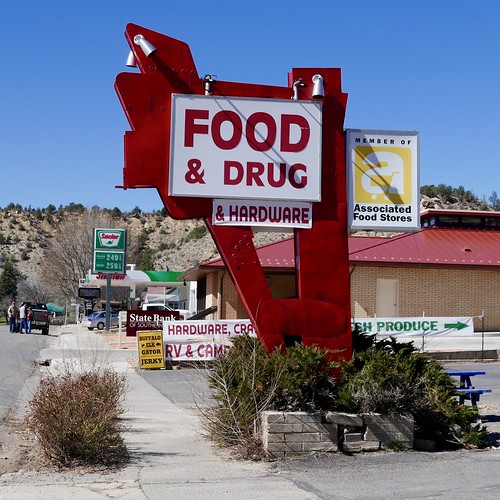
I love how generic and inclusive that big sign is. And I'm fascinated by the wacky jumble of points on the red shape. Is it Googie? Anyway, I love the contrast between the complicated, exciting red structure and the simple, bland words. But it wasn't that sign that caused the stop. It was that little yellow sign. "Buffalo Elk Gator Jerky":
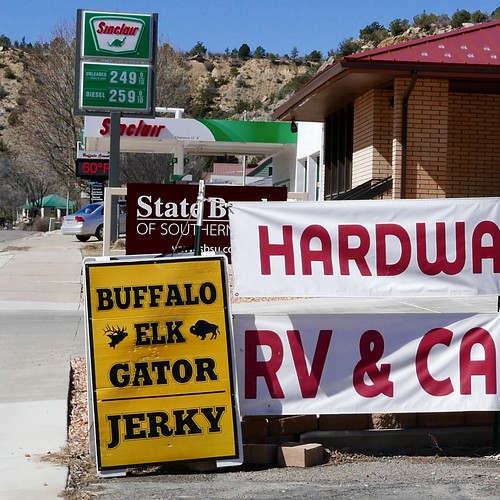
It was Meade who spotted that sign and insisted that we stop and I take a picture of it. It's only as I process the photo now that I see that the requisite potshots have been taken at it. I pause to Google why do people shoot at signs? and find "The Dangers and Costs of Sign Shooting" at Outdoorhub. I'm shooting the sign myself, of course, but I don't leave my impression in Orderville. I put it here on the blog.
Now, I wasn't even sure this picture was from Utah, and I don't know if I ever knew we passed through a place named Orderville. I know it's Orderville because I swiveled around and took a shot at "Food & Drug" and saw that it did have a less than completely generic name: Terry's.
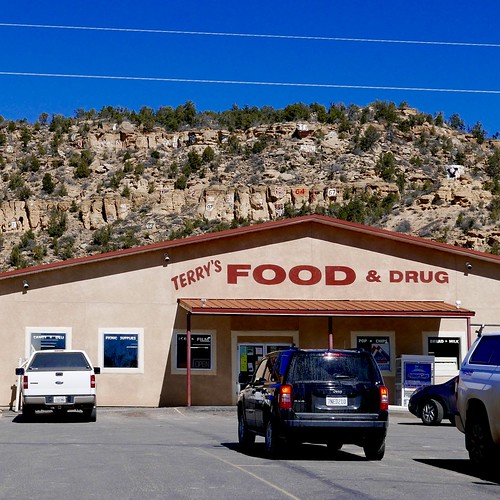
I found a Yelp review — one review, 5 stars — for Terry's Food & Drug — "Small town service for a small town" — and that's where I see this is Orderville.
Orderville. We didn't explore. We only stopped for some signs that charmed us, transitorily. I muse about the motives to name a town Orderville. I think of law and order. But that's the kind of thinking of a person who blows through town and takes in the surfaces. Gator jerky! A Sinclair sign! Numbers painted on the rocks! But Orderville is something else:
Here are 3 that Meade stopped the car for me to take. I love roadside signs and have missed so many over the years as I've thought of stopping but barreled past anyway. But I've gotten better at seeing how important these opportunities are — much more important than big landmarks like the Delicate Arch, which are pointed out for you and photographed so often. These roadside sights are something you find for yourself. The idea that this can be a photograph is your idea. And Meade has been a great companion, who not only does nearly all the driving and drives with professional care but who turns my idea that this could be a photograph into an actual stop and who also often has the idea that this is a photograph.
Here's something we stopped for in Orderville, Utah:
I love how generic and inclusive that big sign is. And I'm fascinated by the wacky jumble of points on the red shape. Is it Googie? Anyway, I love the contrast between the complicated, exciting red structure and the simple, bland words. But it wasn't that sign that caused the stop. It was that little yellow sign. "Buffalo Elk Gator Jerky":
It was Meade who spotted that sign and insisted that we stop and I take a picture of it. It's only as I process the photo now that I see that the requisite potshots have been taken at it. I pause to Google why do people shoot at signs? and find "The Dangers and Costs of Sign Shooting" at Outdoorhub. I'm shooting the sign myself, of course, but I don't leave my impression in Orderville. I put it here on the blog.
Now, I wasn't even sure this picture was from Utah, and I don't know if I ever knew we passed through a place named Orderville. I know it's Orderville because I swiveled around and took a shot at "Food & Drug" and saw that it did have a less than completely generic name: Terry's.
I found a Yelp review — one review, 5 stars — for Terry's Food & Drug — "Small town service for a small town" — and that's where I see this is Orderville.
Orderville. We didn't explore. We only stopped for some signs that charmed us, transitorily. I muse about the motives to name a town Orderville. I think of law and order. But that's the kind of thinking of a person who blows through town and takes in the surfaces. Gator jerky! A Sinclair sign! Numbers painted on the rocks! But Orderville is something else:
October 19, 2014
Whatever happened to Primo Communist Flitworth?
I'm reading Simon Winchester's "The Men Who United the States: America's Explorers, Inventors, Eccentrics and Mavericks, and the Creation of One Nation, Indivisible," the part about Robert Owen, born in Wales in 1771, who came to America with ideas of utopian socialism he'd developed in Scotland. He met "with President Monroe, took tea with Thomas Jefferson and James Madison, and gave two public lectures in the Capitol. John Quincy Adams, the president-elect, came to both talks, and was so taken that he had Owen build a scale model of his proposed New Harmony building and display it at the White House." New Harmony failed:
As is so often the way with utopias, factions developed — no fewer than ten had formed within just two years of Owen’s arrival, and all began bickering, squabbling, and arguing for various rewritings of the commune rules, each splinter group jostling for ideological supremacy. In the end, a demoralized and disillusioned Owen, shocked at a brand of waywardness he had never experienced back home among the Scots, returned to Britain. His confidence was sorely shaken: his ideas for the universal betterment of the working classes began slowly to evaporate, and he became steadily ever more marginalized and ridiculed a figure.That paragraph ends with a footnote, and it is in that footnote where we encounter the most perfectly silly name I have ever seen:
Robert Owen’s final grand gesture was the creation of an immense and ruinously expensive cooperative community in Hampshire called Queenswood, in which seven hundred people lived, their inner quadrangle illuminated by “koniophostic light,” with conveyor belts bringing food from central kitchens to their dining halls. Couples moved in. A first baby born at Queenswood was formally named Primo Communist Flitworth. But the community never really prospered and closed after only a short while. Owen then changed gear once again and provided valuable help in settling the rival US-Canadian claims to Oregon territory, then tried in vain once more to sell his socialist ideas in Paris, where he died in 1858 and was buried in the grounds of a deconsecrated church.What happened to Primo Communist Flitworth? Was he not worth a flit? Did he have some informal name that he used and blended into the general populace. He's the 19th century's Zezozose Zadfrack Glutz. Who did he become when he disaggregated himself from the commune that gave him his stigmatizing name? A nobody?
May 7, 2014
Put in charge of shoveling the hill of manure.
"[T]he campaign biography is an American tradition dating as far back as 1852, when Nathaniel Hawthorne put aside his nobler duties to produce a piece of unfortunate hackwork dedicated to spreading the gospel of Franklin Pierce."
(Hawthorne had known the candidate since their days together at Bowdoin College in the 1820's and was thus able to look beyond Pierce's spectacular weaknesses -- his unwillingness to oppose slavery, notably -- and produce a work of gaseous flattery.)"Today" was March 2000. I'm quoting a NYT review of some damned book about Al Gore (which the reviewer informs us is "evenhanded"). Who cares about a 2000 book about Al Gore? I'm interested in
We've come a long way, baby. No self-respecting writer would deliver such a polemic today....
September 23, 2013
Cheesecake, an experiment in communal living, ongoing after 20 years.
"Of the original 11 members, seven are still here... The community has taken on new members, so there are now 13 altogether. No one seems lonely..."
In matters involving the environment, Ms. Otis said, the community is divided into two camps: “Some are Druids, those who don’t want to change anything, and some are foresters, who can cut the brush back. Jill and Gaile are the Druids.”
Gaile Wakeman, a retired pediatric physical therapist who is 76, concurred. “I don’t want a single tree to be cut.... I don’t give on this. You cannot replace a tree that’s been here 300 years.”...
The other thing residents tend to disagree about is money. And as is true elsewhere in the country, Ms. Otis said, “conservatives are those who do not want to spend money, and liberals do.”
But while these distinctions may resemble those between Republicans and Democrats, Ms. Wakeman noted, Cheesecake members lean to the left politically. “We’re all pretty liberal,” she said. “A Tea Party person would never live here.”
April 20, 2013
What's "fake" about 2 gay couples — where gay marriage is illegal — colluding to create 2 opposite-sex couples?
Here's this Daily Beast article titled "China’s Fake Gay Marriages":
In China, where homosexuality was classified as a mental illness until 2001 and a crime until 1997, gays and lesbians still face serious discrimination, [and] where the pressure to get married is strong and starts early, it has long been common for gays to marry straight spouses. Now, some are finding what they consider a better alternative. Known as “cooperative marriages,” or hunzuo hunyin, gay men and lesbian women are increasingly marrying each other — often aided by the Internet. (Such marriages are also known as “fake marriage” [jia jiehun] or “ritual marriage” [xingshi hunyin].)This could be a structure for producing children — children who could then live with both biological parents. Obviously, a male and female can produce a child together, without ever having sex and without medical intervention. In China, this is being done in a way that deceives their family, and sometimes they're doing nothing together but having a wedding. So, depending on what the couple does, it could be fake. But what if, say, a female gay couple and a male gay couple were compatible friends, who pooled their resources to buy a big house and they really wanted to raise their children together responsibly and with both parents in the house. Would it be wrong for the males to marry the females?
October 17, 2010
Maureen Dowd on the Sharron Angle/Harry Reid debate.
I smell a whiff of anti-feminism in this focus on laundry and food:
But, so... Dowd's point is that Sharron Angle is a high-school "mean girl." Hey, I wonder if she read my October 8th piece answering Slate's question "Who gets to be a feminist?" I wrote:
And how is it "hurling cafeteria insults" to question Reid about how he got so rich when he's spent nearly his whole career in politics? It certainly wasn't saying my neighborhood is better than yours — which might be mean-girlish. He lives in the Ritz-Carlton in Washington!
Dowd is hot to flip everything around. If you want to talk about mean girls, she's the mean girl! But look at how she portrays herself:
The senator began the debate with a gentle reminiscence about his mother, who took in wash from the brothels in scruffy Searchlight, Nev.I thought "Prairie Fire" was William Ayers's "forgotten communist manifesto." Lefties are poetic — "A single spark can start a prairie fire" — but apparently Sharron Angle wrote a book about an actual prairie fire. Literal. Righties are so concrete. Dumb as a block.
Angle could have told the poignant story of her German immigrant great-grandmother who died trying to save laundry hanging on the clothesline in a South Dakota prairie fire, which Angle wrote about in her self-published book, “Prairie Fire.” But instead the former teacher and assemblywoman began hurling cafeteria insults. “I live in a middle-class neighborhood in Reno, Nevada,” she said. “Senator Reid lives in the Ritz-Carlton in Washington, D.C.”
But, so... Dowd's point is that Sharron Angle is a high-school "mean girl." Hey, I wonder if she read my October 8th piece answering Slate's question "Who gets to be a feminist?" I wrote:
So what am I supposed to care about here? You don't get any special rights or privileges for being a feminist, so what difference does it make? "Who gets to be a feminist?" Is it some high-school clique with mean girls deciding who gets in? Are there guardians at the entrance? The entrance of what? Nothing hinges on it. One woman says, "I am a feminist" and another says, "No, you're not." This is political polemic of a very dull sort.I see the liberal women as having the exclusionary "mean girl" attitude, but Dowd is trying to pin that stereotype on Angle. How does Angle's failure — in a political debate — to rhapsodize about an ancestor exclude anyone? I can see that Reid might wish things had stayed sweet and gentle, but how is a political debate a time for hugs? If women are to be in politics, we need to rise above the socialization toward niceness and not hurting anyone's feelings.
And how is it "hurling cafeteria insults" to question Reid about how he got so rich when he's spent nearly his whole career in politics? It certainly wasn't saying my neighborhood is better than yours — which might be mean-girlish. He lives in the Ritz-Carlton in Washington!
Dowd is hot to flip everything around. If you want to talk about mean girls, she's the mean girl! But look at how she portrays herself:
... I was getting jittery....Dowd is my age — nearly 60. Isn't there something really awful about presenting your emotional life in adolescent terms when you are that old? Especially when you're cozily situated on the op-ed page of the New York Times. Here's Dowd's description of Sharron Angle:
As the politicians droned on and my Irish skin turned toasty brown, I worried that Governor Brewer might make a citizen’s arrest and I would have to run for my life across the desert. She has, after all, declared open season on anyone with a suspicious skin tone in her state....
After the debate was over, Angle scurried away and so did I — in a different direction. I was feeling jittery again. If she saw me, she might take away my health insurance and spray-paint my locker.
Even sober and smiling beneath her girlish bangs, the 61-year-old Angle had the slightly threatening air of the inebriated lady in a country club bar...Now, click over to Dowd's column and see how she looks: sober and smiling beneath her girlish side-swept bangs, the 58-year-old Dowd has a slightly threatening air. Which is just fine! Don't get me wrong. A columnist should feel threatening. But she's not a timorous girl. Or maybe she is when she gets out in the world, out of her comfort zone. If so, that's not fine. And it's not Sharron Angle's flaw.
March 16, 2009
"In our culture, women have been conditioned to have closed sexuality and open feelings, and men to have open sexuality and closed feelings."
From a ridiculous article about a commune dedicated to the female orgasm.
AND: I'm concerned about the dedication of communes to female orgasms.
AND: I'm concerned about the dedication of communes to female orgasms.
Subscribe to:
Posts (Atom)


 Posts
Posts


