I'm reading "Sugar raining down from space may have helped create life on Earth/Cluster of sweet molecules in Milky Way gas cloud offers clue to possible origins of DNA, astronomers claim" (London Times).
Ipinapakita ang mga post na may etiketa na astronomy. Ipakita ang lahat ng mga post
Ipinapakita ang mga post na may etiketa na astronomy. Ipakita ang lahat ng mga post
Hulyo 13, 2026
"Up to 50 million tonnes of sugar may have rained down from space on to Earth about four billion years ago, potentially delivering the building blocks of life..."
"... a study has found. Scientists have discovered sugar molecules in clouds of interstellar gas, suggesting a key ingredient for DNA and RNA could have come to our planet from deep space...."
I'm reading "Sugar raining down from space may have helped create life on Earth/Cluster of sweet molecules in Milky Way gas cloud offers clue to possible origins of DNA, astronomers claim" (London Times).
I'm reading "Sugar raining down from space may have helped create life on Earth/Cluster of sweet molecules in Milky Way gas cloud offers clue to possible origins of DNA, astronomers claim" (London Times).


Marso 5, 2026
The Pillars of Creation.
(Sorry I had the wrong video up. Fixed)These pictures of the Pillars of Creation were taken 19 years apart by different telescopes, with each image capturing a unique perspective.
— NASA (@NASA) March 5, 2026
On the left, @NASAHubble shows more thick dust. On the right, @NASAWebb peers through the dust to show more stars. Which is your favorite? pic.twitter.com/2QLApmSE1X
Disyembre 5, 2025
"A New Jersey-bound airplane that suddenly plunged thousands of feet in the air... was likely struck by cosmic rays from a star that exploded in another galaxy, according to space experts."
"The JetBlue Airbus A320 flight was hit by a stream of high-energy particles from a distant supernova blast that traveled millions of years, according to Clive Dyer, a space and radiation expert.... 'They can cause a simple bit flip, like a zero to one or one to zero. They can mess up information and make things go wrong. But they can cause hardware failures too, when they induce a current in an electronic device and burn it out.'"
From "NJ-bound plane that suddenly plunged thousands of feet likely hit by ‘cosmic rays’ from a whole other galaxy" (NY Post).
From "NJ-bound plane that suddenly plunged thousands of feet likely hit by ‘cosmic rays’ from a whole other galaxy" (NY Post).
Marso 14, 2025
Did you go outside at 1 a.m. to watch the lunar eclipse?
 We did, but not with a tripod and telephoto lens. That's just my iPhone pic. We had binoculars, so we saw a bit more than what you're seeing there. We talked about the moon — its history, its phases, whether it looked red — the "blood moon" — or fashionably brown.
For the annals of Things I Asked Grok (after thinking of the question while watching the worm moon): "How exactly did the moon come into existence and what would Earth be like now if that had not happened?" In the total eclipse, we could not arrive at a total answer, but then neither could Grok, queried just now. But it did sketch out 6 things that would be different about Earth if the event that produced the moon never happened. I could only think of No Tides. And no moonlight.
Abril 7, 2024
"The Double Asteroid Redirection Test (Dart) slammed a spacecraft into Dimorphos, an asteroid 160 metres wide, at 14,000mph to validate techniques and technologies..."
"... that might one day be needed to stop potential 'city killer' space rocks by modifying their orbital path. The mission exceeded expectations, demonstrating the extent to which kinetic energy can be harnessed to deflect asteroids. But it also provided important lessons about the potential for unexpected consequences, according to a study that reveals 37 boulders blasted off Dimorphos by the shockwave could be go on to create meteor storms on Mars — though not for at least 6,000 years...."
From "Nasa mission to blast asteroid off course has unintended consequences/Debris from the Dart mission on Dimorphos, a test for a future ‘Deep Impact’ scenario, is set to slam into the surface of Mars" (London Times).
Setyembre 3, 2023
"According to the standard model, which is the basis for essentially all research in the field, there is a fixed and precise sequence of events that followed the Big Bang."
"First, the force of gravity pulled together denser regions in the cooling cosmic gas, which grew to become stars and black holes; then, the force of gravity pulled together the stars into galaxies.
The Webb data, though, revealed that some very large galaxies formed really fast, in too short a time, at least according to the standard model. This was no minor discrepancy. The finding is akin to parents and their children appearing in a story when the grandparents are still children themselves.... Physicists and astronomers are starting to get the sense that something may be really wrong. It’s not just that some of us believe we might have to rethink the standard model of cosmology; we might also have to change the way we think about some of the most basic features of our universe — a conceptual revolution that would have implications far beyond the world of science.... [W]e may need not just a new story of the universe but also a new way to tell stories about it."
Hunyo 29, 2023
"What we measure is the Earth kind of moving in this sea. It’s bobbing around — and it’s not just bobbing up and down, its bobbing in all directions."
Said astrophysicist Michael Lam, quoted in "In a major discovery, scientists say space-time churns like a choppy sea/The mind-bending finding suggests that everything around us is constantly being roiled by low-frequency gravitational waves" by Joel Achenbach and Victoria Jaggard (WaPo).
The simultaneous release of papers from far-flung and competitive teams using similar methodology came only after some scientific diplomacy that ensured no group tried to scoop the rest of the astrophysical community.
“We’ve been on a mission for the last 15 years to find a low-pitch hum of gravitational waves resounding throughout the universe and washing through our galaxy to warp space-time in a measurable way,” NANOGrav chair Stephen Taylor of Vanderbilt University said at a news briefing Tuesday. “We’re very happy to announce that our hard work has paid off.”...
[T]he newly announced waves are not one-shot wonders, and theorists are noodling the many potential explanations for why the cosmic sea ripples in such a fashion....
Disyembre 8, 2022
I've got 9 TikToks for you tonight — all things I liked. I invite you to appreciate them too.
1. The crochet genius.
2. A Kardashian Christmas.
3. The joy of Neptune.
4. The importance of routine during the long polar night.
5. The importance of layers when dressing for winter.
6. Let a girl show you how to approach a girl.
7. Celine Dion explains her rare disease — stiff person syndrome.
8. He gets AI to write a folk song about his dog dying.
9. AI envisions the cast of "The Office" as babies.
Setyembre 26, 2022
"On Monday, NASA’s Double Asteroid Redirection Test spacecraft, or DART, is set to collide with Dimorphos, a small asteroid..."
"... that is the moon of a larger space rock, Didymos. While these two near-Earth objects pose no immediate threat to our world, NASA launched DART last year to test a technique that could one day be used for planetary defense.... While the agency is searching the heavens for deadly space rocks, it also is developing methods for responding to a threat, should one emerge.
The DART mission isn’t like the movie 'Armageddon.' Blowing up an asteroid generally would not be a good thing to do. Rather, the mission is a proof-of-principle demonstration that hitting an oncoming asteroid with a projectile can nudge it into a different orbit....."
Agosto 23, 2022
Jupiter.
From the NASA Webb Telescope:

ADDED: From the WaPo article "‘Incredible’ Jupiter images revealed by NASA’s James Webb telescope":
Jupiter, where a day is about 10 hours long, has at least 50 moons. The four largest are named: Io, Europa, Ganymede, and Callisto were first observed by Italian physicist Galileo Galilei in 1610. The images also capture Jupiter’s iconic Great Red Spot, which appears white in the photographs as it’s reflecting sunlight, says NASA. The Great Red Spot is in fact a giant storm bigger than the size of Earth, which has been raging for centuries.
Agosto 7, 2022
"We Earthlings lug around a very long and daunting list of Things We Don’t Know. The new telescope can chip away at them..."
"The fact that there are so many unknowns should not be confused with the silly notion that we don’t know anything at all. [That] is not an intellectual argument so much as a moral one, a kind of chastisement for arrogating to ourselves the belief that we can understand our physical reality.
Hogwash. If you lived a few centuries ago and asked an astronomer how many light-years distant is the Andromeda Galaxy, the answer might be 'What’s a light-year?' (and also 'What’s a galaxy?')... Maybe one reason it is so hard to understand some of the fundamental features of the universe is that it’s outrageous on its face. It is packed with untold trillions of stars and galaxies and planets and moons.... If the universe were much simpler — just a lot of hydrogen and helium floating around — it wouldn’t be as inscrutable. It would be just a big, boring gasbag.... Maybe someday we’ll figure out gravity, cosmic destiny and life on other worlds, but for now let’s just remember that we’re making progress on the great unknowns...."
Agosto 6, 2022
"In any case, many of us feel suspicious of the color-and-shape manipulations of these images. They're nudging us too much..."
"... insisting that we feel awe. It's a little like the January 6th Committee's over-produced show that insists that we feel anger and outrage. And some people don't think hardcore pornography is sexy. What X thinks is so sexy is exactly what makes it not sexy at all to Y. Maybe something subtler, something more real. Something human."
I blogged on July 14, as I resisted the hoopla, and noticed a column in WaPo by Alexandra Petri titled "James Webb Space Telescope images ranked by how good they look to eat."
Now, I see this in the news: "A prominent scientist posted an image of a distant star he said was taken by the Webb telescope. It was actually a slice of chorizo" (CBS).
The scientist, Etienne Klein, put up his silly post on July 31st, 17 days after Petri's jovial scribblings.
Hulyo 14, 2022
"During the Apollo era... NASA flooded the public domain with views of both the astronauts themselves and photographs taken by the astronauts."
"One goal was bottling wonder.... In the decades after Apollo funding evaporated, a new visual culture emerged from NASA missions connected to the Jet Propulsion Lab in California and a cohort of Hollywood-adjacent scientists like Carl Sagan. They promoted a new rationale for wandering into the expanse for the sake of intellectual curiosity, not just to beat the Russians."
Yet President Biden remained grounded in the old rationale. He said: "These images are going to remind the world that America can do big things."
I'm reading "The Lonely Work of Picking the Universe’s Best Astronomy Pictures/In June, specialists gathered in Baltimore to select images from the James Webb Space Telescope to share with the public. Keeping the results to themselves hasn’t been easy" by Joshua Sokol in the NYT.
I'm reading "The Lonely Work of Picking the Universe’s Best Astronomy Pictures/In June, specialists gathered in Baltimore to select images from the James Webb Space Telescope to share with the public. Keeping the results to themselves hasn’t been easy" by Joshua Sokol in the NYT.
In the new rationale, we don't get a flood of photographs. We get a slow succession of carefully chosen, heavily processed images.
The news media and politicians were invited to galas to see eagerly anticipated first glimpses of other planets, beamed back like postcards from sightseeing drives through the solar system. In this era, at the inception of digital imagery, engineers on missions like Voyager often experimented with combining multi-wavelength data into pictures with ultra-vivid hues, said Elizabeth Kessler, a historian of visual culture at Stanford. "They just look like throbbing, shifting, morphing, psychedelic colors," she said....
In 2016, a committee of representatives from the Space Telescope Science Institute, NASA and the European and Canadian space agencies convened to start choosing Webb’s very first demo targets. They checked off boxes that vibed with the telescope’s scientific goals: a deeper-than-ever deep field, galaxies pulsing in the void like jellyfish, a star with an attendant exoplanet, star-forming regions like the Carina Nebula and more....
Stars in Webb images have six points, unlike the four spikes common in most space photography, a quirk that emerges from the quantum mumbo-jumbo of how incoming photons lap against this telescope’s structure and are then gathered up by its hexagonal mirrors. In particular wavelengths.... clouds that would otherwise look diffuse seem to have hard soap-bubble surfaces, skins of interstellar gas that are absorbing ultraviolet light from nearby stars and shining it back into space as infrared radiation. And in the mid-infrared, when space itself looks afire because of glowing molecules called polycyclic aromatic hydrocarbons that are produced by aging stars, colors again get wonky. 'We end up having psychedelic purple clouds'....
Will anything land as hard as the Apollo shots?
Part of the science is the science of our emotions and how to manipulate them with images. We are expected to gape and gasp "wow." Color is big. The word psychedelic keeps coming up. Composition matters. They choose to put solid-looking "vaguely geologic structures" at the bottom to mentally orient us in something that feels like a landscape:
Think 19th-century paintings from surveys of the Western frontier, the photography of Ansel Adams, background scenery in countless Westerns — or El Capitan, from Yosemite National Park, looming in the desktop background of a Mac computer.
They are hoping this will "land as hard as the Apollo shots." I remember how Apollo interfaced with the public. I was a skeptic at the time. I'm quick to feel the manipulation and resist. I'm not saying the science isn't worthy, only that what we are getting is a show about science.
Hulyo 13, 2022
Here are 8 TikToks for your delectation tonight. Let me know what you like best.
1. You know what it means when you kick the Italian husband under the table.
2. That feeling, halfway through a hike.
3. What kind of reader are you?
4. Sometimes there really is a rescue possum.
5. Sometimes the cat is satanic.
6. Meet Andrea, the on-line influencer.
7. "Yeah, space is sexy. It's also none of my business...."
Hulyo 12, 2022
"Light travels at 186,000 miles per second. And that light that you are seeing on one of those little specks has been travelling for over 13 billion years."
"And by the way, we're going back further, because this is just the first image. They're going back about 13 and a half billion years. And since we know the Universe is 13.8 billion years old, you're going back almost to the beginning."
Said NASA administrator Bill Nelson, quoted in "James Webb telescope takes super sharp view of early cosmos" (BBC).
President Biden dragged the profound down to earth, to rah-rah-America-is-great politics: "These images are going to remind the world that America can do big things, and remind the American people — especially our children — that there's nothing beyond our capacity. We can see possibilities no-one has ever seen before. We can go places no-one has ever gone before."
You're looking at an image that shows a tiny part of the universe, including what is 13 billion years old, and that's what you want to say? That is so far beyond the existence of Earth, let alone the existence of human beings. It makes me think of how infinitesimal America is, not how big. We can look back 13.5 billion years, where no one has gone before, but we are not going there, and it is something — something huge — that is beyond our capacity.
Marso 17, 2022
"The prediction of bald, featureless black holes has been nicknamed the 'no-hair theorem' since the 1970s."
"[Xavier] Calmet and his collaborators think the black hole is more complex – or hairy. As matter collapses into a black hole, they suggest, it leaves a faint imprint in its gravitational field. This imprint is referred to as 'quantum hair' and, the authors say, would provide the mechanism by which information is preserved during the collapse of a black hole.... There is no obvious way to test the theory through astronomical observations – the gravitational fluctuations would be too tiny to be measurable.... 'It’s going to take some time for people to fully accept this. The paradox has been around for a long time and you’ve got very famous people all over the world who’ve been working on this for years.'"
From "'Quantum hair' could resolve Hawking’s black hole paradox, say scientists/New mathematical formulation means huge paradigm shift in physics would not be necessary" (The Guardian).
Setyembre 15, 2020
"A black hole as massive as Earth would be about the size of a Ping-Pong ball and would be exceptionally hard to see."
"No such primordial black holes have been detected yet. But neither has their existence been ruled out. Dr. Scholtz and Dr. Unwin pointed out that an experiment called OGLE, for Optical Gravitational Lensing Experiment, based at the University of Warsaw in Poland, had detected the presence of a half-dozen dark objects in the direction of the center of our Milky Way galaxy. Their gravitational fields had acted as lenses, briefly amplifying the light from distant stars that they drifted in front of. Those objects could be free-floating planets, the authors said, with masses ranging from half to about 20 times that of Earth. But they could as easily be primordial black holes floating around the galaxy, the astronomers proposed. If that were the case, the putative Planet Nine could well be a black hole, too, in a distant orbit around the sun.... The prospect of finding a black hole in our own solar system 'is as startling as finding evidence that someone might be living in the shed in your backyard,' [wrote Avi Loeb, chair of the astronomy department at Harvard]. 'If so, who is it, and how did it get there?'"
From "Is There a Black Hole in Our Backyard?/Astrophysicists have recently begun hatching plans to find out just how weird Planet Nine might be" (NYT).
From "Is There a Black Hole in Our Backyard?/Astrophysicists have recently begun hatching plans to find out just how weird Planet Nine might be" (NYT).
Setyembre 3, 2020
"This crash happened about 7 bn years ago, when the universe was half its current age, but is only being detected now because it happened so far away."
From "'It just sounds like a thud': astronomers hear biggest cosmic event since big bang/Researchers believe noise was two black holes colliding around 7 billion years ago, creating a previously unseen class of stellar object" (BBC).
Lost in the collision was an enormous amount of energy in the form of a gravitational wave, a ripple in space that travels at the speed of light.... Because the detectors allow scientists to pick up the gravitational waves as audio signals, scientists actually heard the collision. For all the violence and drama, the signal lasted only a tenth of a second. “It just sounds like a thud,” Weinstein said. “It really doesn’t sound like much on a speaker.”So... it was heard as a tenth-of-a-second thud after traveling at the speed of light — light, not sound — for 7 billion years. I don't think they really heard the crash, but they picked it up, one way or another, after 7 billion years. It's mind-blowing to think of how far away that was.
Hulyo 17, 2020
3 occasions — this morning at sunrise — for thinking — if only momentarily — is that the comet?
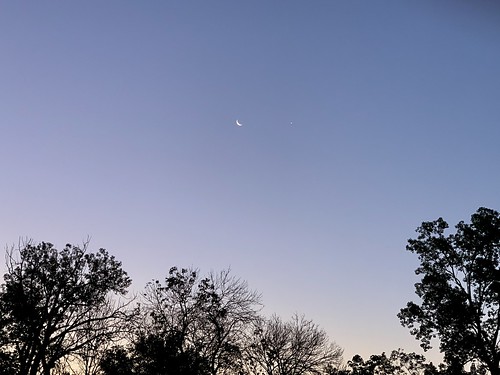


(Click images to enlarge if you can't see what I was seeing.)
NASA wants you to know it did not change the Zodiac.
👀 We see your comments about a zodiac story that re-emerges every few years. No, we did not change the zodiac.
— NASA (@NASA) July 17, 2020
When the Babylonians invented the constellations 3,000 years ago, they chose to leave out a 13th sign. So, we did the math: https://t.co/DQOs5VSjT7 pic.twitter.com/WlblguobGT
Mag-subscribe sa:
Mga Post (Atom)


 Mga Post


