Wrote Wendell Berry, quoted by Etienne in last night's
"Winter Road Café," after Bunk said "Hey, this photo..."
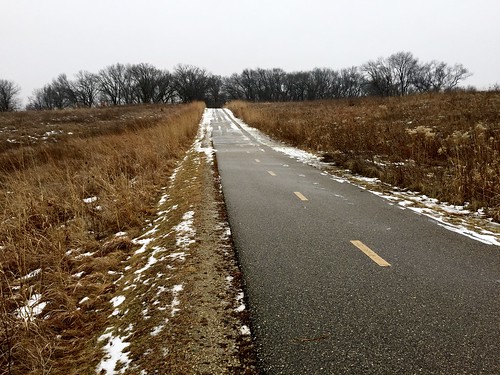
"... appears to be a bike path, not a road."
I love the Berry quote, and thanks to Etienne for bringing it to us. It perfectly explains why I, using that photograph and needing a title for the "café," could not bring myself to use the word "path," even though I knew for sure — what you were left guessing* — that it is the thing most people call a "bike path."**
___________________
* Danno observed that if it's not a bike path, it's got "a very wide stripe!"
** Actually, around here, the official term for a thing like that is
"bike trail." So you may want to discuss the path/trail distinction or bring out evocative poetic quotes with "trail." There must be many, "trail" being an even more powerful word in the legend of America. The Chisholm Trail, the Appalachian Trail, etc. And yet "trail" refers to dragging something along behind you. The oldest meaning is the trail of a long robe. On the landscape, then, the "trail" is what those who've gone before have left behind. And "trail" has only meant "path" since the early 1800s. "Path" has referred to "A way or track formed by the continued treading of pedestrians or animals" for as long as we can find a language called English — the period the OED calls "early OE" (600-950). That's profound. And — here's where I change my mind and decide that "path" is more powerful than "trail" — the word "pathfinder" has special resonance (from the OED):
1840 J. F. Cooper (title) The pathfinder.
1860 W. Whitman Leaves of Grass (new ed.) 425 The path-finder, penetrating inland, weary and long....
1847 R. W. Emerson Poems 169 Sharpest-sighted god.., Path-finder, road-builder, Mediator, royal giver.
1898 W. James Coll. Ess. & Rev. (1920) 408 Philosophers are after all like poets. They are path-finders. What every one can feel, what every one can know in the bone and marrow of him, they sometimes can find words for and express.
4 great American names, clustered in the great English Dictionary.
There is no word "trailfinder," though there is — we must give "trail" its due — "trail-blazer." But "trail-blazer" only arrives on the scene in the 20th century, and its earilest recorded usage cannot compare to the quadrumvirate of James Fennimore Cooper, Walt Whitman, Ralph Waldo Emerson and William James:
1908 Daily Chron. 19 May 3/2 Mrs. Hubbard's journey..with a small party of ‘trail blazers’ native to the ways of Labrador....
1957 V. Packard Hidden Persuaders xxi. 233 Tide, the merchandisers' journal, admonished America's merchandisers to pay attention to this trail-blazing development as it might be ‘tomorrow's marketing target.’
The "trail-blazing development" was
a planned suburban community in Miramar, Florida:
What does it mean to buy a "packaged" home in a "packaged" community? For many (but apparently not all) of the Miramar families it means they simply had to bring their suitcases, nothing more. No fuss with moving vans, or shopping for food, or waiting for your new neighbors to make friendly overtures. The homes are completely furnished, even down to linens, china, silver, and a refrigerator full of food. And you pay for it all, even the refrigerator full of food, on the installment plan.


 संदेश
संदेश


