લેબલ W.C. Fields સાથે પોસ્ટ્સ બતાવી રહ્યું છે. બધી પોસ્ટ્સ બતાવો

8 સપ્ટેમ્બર, 2025

Vegetarian is not enough.

IMG_2370

Photo by Meade, which he describes as "City bus 3 blocks from Ag school dairy building."

It's an impressive and persuasive slogan, but one might also say: Because you consume vegetables, rodents, birds, snakes, and amphibians die.

But the calf is a lovable being, one could respond, speciesistly. Look at its sweet face!

26 ઑક્ટોબર, 2018

Jerry Seinfeld said, "I was watching some W.C. Fields with a friend the other day. We could not believe the timing, the material, the performances. Perfect."

"We wouldn’t change a thing. That’s how eternal comedy is. What political material from 15, 20 years ago do you want to hear? None of it, really. The content of it isn’t, largely, comedic. It’s rhetoric."

From "Jerry Seinfeld on Louis C.K., Roseanne and Tense Times in Comedy" (NYT).

As for Louis C.K.:
We know the routine: the person does something wrong. The person’s humiliated. They’re exiled. They suffer, we want them to suffer. We love the tumble, we love the crash and bang of the fall. And then we love the crawl-back. The grovel. Are you going to grovel? How long are you going to grovel? Are you going to cry? Are you going to Jimmy Swaggart? And people, I think, figured they had that coming with Louie — he owes us that. We, the court of public opinion, decided if he’s going to come back, he’d better show a lot of pain. 
We love the crawl-back. That's very Jerry. He goes on to observe that Louis C.K., by just going to comedy clubs again and doing his act, denied people the satisfaction of the crawl back.

About Roseanne:
I would say about Roseanne, I never saw anything that bad happen from a finger-tap on a screen. A whole career: gone. That’s an aspect of this unease we feel, that you just wake up — “Oh, by the way, the Lincoln Memorial’s gone.” “What?” “Yeah, they took it down. They found out Lincoln was fooling around and they took it down.” “Oh, my God. All right, I guess I have to adjust to that. I really liked the Lincoln Memorial.”
More generally:
[H]umans — we have an abusive relationship with each other. We hate other people. We despise them. And then we see somebody play a beautiful piano concerto and we go, “Oh, people are the best.” They get us right back for more abuse...

21 ઑક્ટોબર, 2017

What I did a year ago.

Facebook reminds me of what it calls my "memories," even though they aren't my memories, because I'd forgotten all this:
1. Wrote a lot. 2. Walked 2 miles to Hilldale and bought 2 pairs of glasses with Theo frames. 3. Met Chris and drank a pomegranate martini. 4. Walked 2 miles back home. 5. Watched the 1934 movie "Bright Eyes" on TV and Meade watched it just because it's what I was watching. That was sweet of him. And Shirley was sweet. We laughed at Jane Withers and I was delighted that the actor who played Uncle Ned was the same actor who played Mr. Muckle in "It's a Gift," one of my all time favorite movies. Also the dog that played Rags was the same dog who played Toto 5 years later in "The Wizard of Oz."
The actor is Charles Sellon:


17 જૂન, 2016

"What a gorgeous day! What effulgent sunshine!"

19 સપ્ટેમ્બર, 2015

20 years ago today: The Washington Post published the 35,000-word "Unabomber Manifesto."

The Washington Post has the story, with a photograph, at the top center of the home page: "How publishing a 35,000-word manifesto led to the Unabomber."
In more than 35,000 words spread over eight pages of a special section, an anonymous author laid out his complaint against the “industrial-technological system” and his desire to destroy it by sparking a revolution. The essay bumped and blundered through a forest of dark themes and discontent, from a lengthy lament about environmental destruction to a brief critique of golf and bowling.
The publication led to the identification and arrest of Kaczynski (because his sister-in-law and brother recognized his distinctive style of expression), but the reason for publishing the whole damned thing was to comply with Kaczynski's ultimatum: If it's published, he'll stop bombing, and if not, he'll "start building our [sic] next bomb."

WaPo puts the old story in the context of present-day concerns about terrorism:
[T]he episode also stands out as an early milestone in the current age of anxiety. The Unabomber’s manifesto appeared just as Washington was beginning its long preoccupation with terrorism and national security. As the news media and the public fixated on the Unabomber drama, a much bigger story was quietly dawning. That same year, in a classified National Intelligence Estimate, the CIA warned that Islamic extremists were intent on striking targets inside the United States.
The NYT — which coordinated with WaPo in responding to the ultimatum — ignores the anniversary. There's a mention on the day's "Today in History" feature, which comes from The Associated Press. It's in there along with other historical anniversaries like: "In 1970, the situation comedy 'The Mary Tyler Moore Show' debuted on CBS-TV." And: "In 1915, vaudeville performer W.C. Fields made his movie debut as 'Pool Sharks,' a one-reel silent comedy, was released." And in 1959, Nikita Khrushchev got mad when he found out they weren't going to let him into Disneyland. In 1960, Fidel Castro came to New York City, didn't like his hotel, and "angrily checked out" and went to a different hotel.  Communists and comedians. Communists and comedians and Ted Kaczynski.

Ted had a lot to say about leftists in his manifesto. Let's look. It's worth reading if only to see how surprisingly similar it is to things you may be seeing every day on the internet:

4 ઑગસ્ટ, 2015

"What I’ve come to realize is that when it comes to The Bluebook, small changes are made for the sake of making small changes."

Writes Bryan Garner, commenting on the new edition — the 20th edition — of the "Uniform System of Citation" law students are supposed to obsess over.
New law students want their predecessors’ work to look obsolete. It’s the theory first elaborated by the social philosopher Thorstein Veblen: planned obsolescence. Veblen postulated that companies deliberately produce consumer goods that will become outdated after limited use so that consumers will have to buy new items more often.

You see the principle at work with smartphone chargers (your old ones won’t work on your new gear), iPod connections (ditto), lightbulbs and even coursebooks. Legal publishers like frequent editions so as to avoid the forgone profits represented by a secondhand market.

And so it is with The Bluebook. Things shift from edition to edition—every five years or so—in response to nothing but the itch of a new crop of law students to leave their mark on their venerated citation guide.
I'm not convinced that law students feel a desire to "leave their mark" with changes in citation form. Anyone who is meticulous about citation form ought to feel bad about changes that make older volumes of the journal different from the new. The most important thing about form is consistency. Pick a form and then stick to it. I have various things like that on this blog, certain punctuation, capitalization, and grammatical preferences that have been established. The interest in formal consistency now vastly outweighs all the various factors that went into the original decision. For example, I capitalize "Justice" but not "judge." And in a sentence like "The five men blew their nose," I am never going to change that "nose" to "noses," no matter how many times Meade says "Shouldn't that be 'noses'?" I just say, "That's that thing again," meaning that's that point of grammar I resolved long ago.

I wish Death Cab For Cutie had followed my grammatical preference in the lovely song "I Will Follow You Into The Dark," which has the great, but flawed, line: "If Heaven and Hell decide/That they both are satisfied/Illuminate the no's on their vacancy signs." If it were "Illuminate the no on their vacancy sign," listeners would be spared the no's/nose homophone. Each afterlife domain has only one sign, and each sign has only one no that can be illuminated when there is no vacancy, so the singular makes sense and avoids confusion. I learned that long ago from a teacher who knew it was better to say to us students "Use your head," not "Use your heads."


But back to "The Bluebook." I think Garner got closer to the truth when he said "Legal publishers like frequent editions so as to avoid the forgone profits represented by a secondhand market." When you're an editor, you have to resist stepping on the writer's stylistic choices. But I'd just like to say, I'd never have written the sentence like that. Garner is using that verbose, 19th century style of rhetoric that W.C. Fields made fun of in the early 20th century. And in doing so, he's making it easier to overlook the truth — what I think is the truth — that is lost in the musings about the psychology of cite-checking law students. I'd have written: The new editions of The Bluebook are a scheme to extract money from students, and students not only pay for new books, they pay in the time and effort it takes to learn the piddling new rules.

12 મે, 2015

Those terrible mountebanks.

I questioned whether I'd ever seen the word "mountebank" in the newspaper, so I searched the NYT archive — all the way back to 1852 — and got 782 hits, beginning with "Really, this Louis NAPOLEON is a very provoking fellow" ("the appearance of the mountebank in the character of a king").

Quite a few of the hits were repetitions of H.L. Mencken's 1926 description of William Jennings Bryan: "a charlatan, a mountebank, a zany without sense or dignity . . . deluded by a childish theology, full of an almost pathological hatred of all learning, . . . all beauty, all fine and noble things. . . . Imagine a gentleman, and you have imagined everything that he was not."

One often encounters "mountebank" in a string of contradictions about a person, for example, Theodore Roosevelt: "He transformed the 20th century; no, he overextended the 19th. He was a progressive trust buster; no, an imperialist demagogue. He was a defender of liberty; no, a power-hungry mountebank — a pioneer environmentalist, a bloodthirsty hunter; a farseeing visionary, an energetic clerk."

I see that future President Woodrow Wilson — upon hearing of the death of President McKinley in 1901 — said: "What will happen to the country with that mountebank as President?"

10 મે, 2015

"There should be more reflection about the source of our sense of the 'ratedness' of a movie."

"'The Big Lebowski' was mentioned [as overrated] by someone who is probably thinking of the cult status it achieved long after it came out. It wasn't considered very good originally. I remember seeing it in the theater when it came out, in spite of the not-so-good reviews, and seeing good and bad in it. Later, people found the good in a movie that hadn't gotten enough credit when it first came out. It became a cult favorite. If you then come along after all that, you may think you're going to see something wonderful, and when you see the bad that led to the original mixed reviews, you'll say the film is 'overrated.' So: what is your reference point? Where did you come in on the time line?"

That's something I wrote at the end of a long conversation over at Facebook (started by my son John with the question "What do you think is the most overrated movie?").

AND: Here's the picnic scene from "It's a Gift":


"Ah! Crackers! Good old crackers!"

ALSO: A good Mother's Day quote: "Those were my mother's feathers!"/"Never knew your mother had feathers."

24 ફેબ્રુઆરી, 2012

Why did Rick Santorum deliver a yank-your-arm-out-of-its-shoulder-socket handshake to Ron Paul?

At the end of the debate on Wednesday. Video at the link, where the headline reads "Ron Paul Fans Outraged At Hearty Post-Debate Handshake." I watched the video, and you don't have to be a Ron Paul fan to be outraged. I had to wonder about Santorum's sanity. That wasn't just a hearty handshake. That was... evil. There is evil in the world. Could it be... Satan?

Hey, Rick. Take a lesson from a master:


IN THE COMMENTS: Chip Ahoy said:
Ron Paul was ready for Santorum at the fifty-seventh debate and wore a prop rubber arm. At the end of the debate when Santorum vigorously shook Ron Paul's prop arm it warbled and stretched right out of the jacket sleeve. Ron Paul yelled "Ow! WTF, you freak?!" The rubber arm snapped back and 2% of Santorum's vote flowed over to Ron Paul in repulsion to the aggression but in a twist 1% of Ron Paul's votes and 3% of Gingrich's votes, and 2% of Romney's votes flowed to Santorum because those voters thought the sight of pulling out Ron Paul's arm was awesome.

By the time the fifty-eighth debate rolled around Ron Paul's supporters had fashioned an electrified arm to use on Santorum at the end of the debate but that was detected at the debate entrance and viewers were denied the chance of seeing Santorum electrified by his own aggressive handshake.
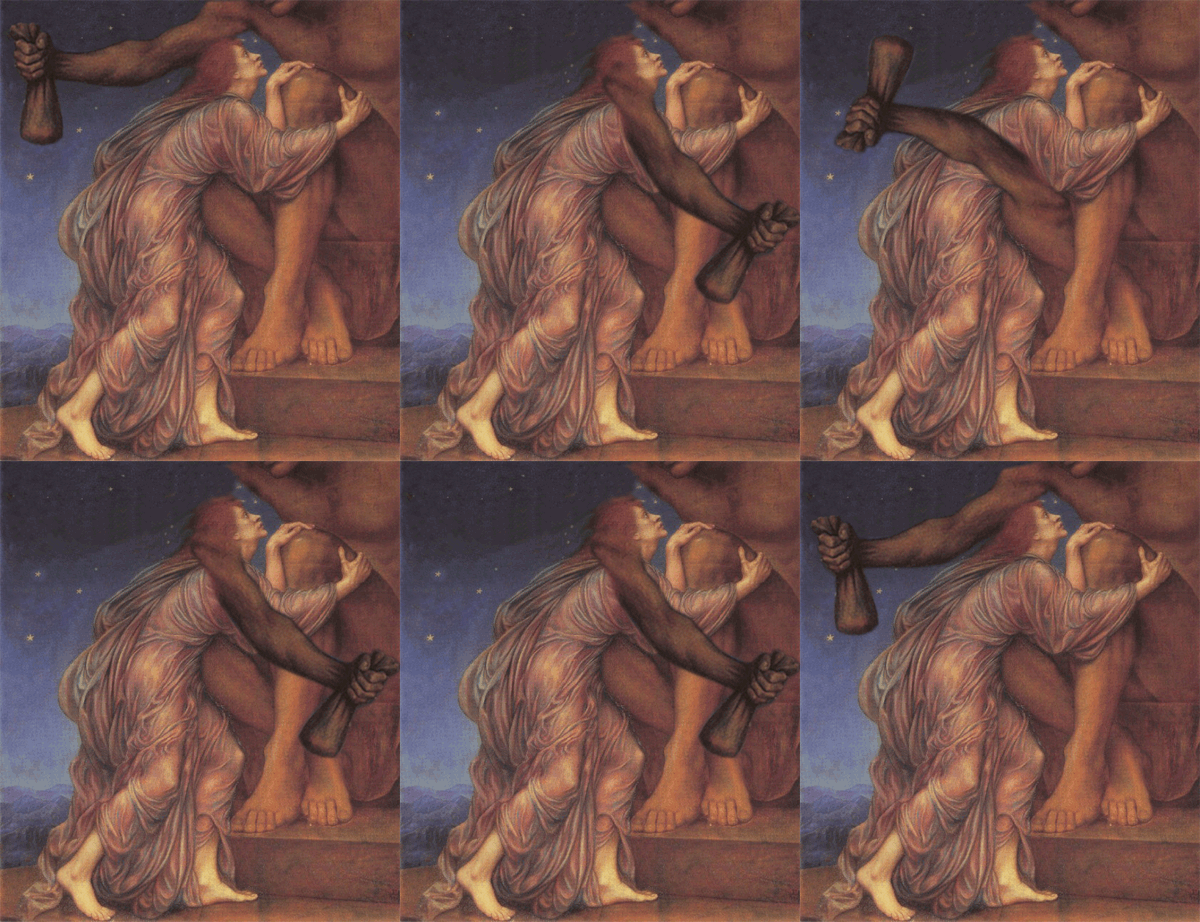
And perhaps for the 59th debate, the prop arm might pull out altogether, creating an image something like the animation Chip made for us yesterday, when we were trying to understand not Satan, but Mammon (one of the 7 princes of Hell), and a painting by Evelyn De Morgan called "The Worship of Mammon" had a strangely meaningful extended arm. The illuminating animation:


And the lesson we learn, at long last? The man who gives an extremely vigorous, super-macho handshake — what is it, really, that he is afraid of?

12 માર્ચ, 2011

"Their arrogance and condescension... just amazing."

It is their own self-love that makes them so vulnerable.

W.C. Fields said "You can't cheat an honest man," and I say "You can't punk a self-deprecating man."

28 ડિસેમ્બર, 2010

"Everything you like to do is wrong."

25 more films enter the National Film Registry — "culturally, historically or aesthetically significant."

Which ones have you seen?
1. AIRPLANE! (1980)
2. ALL THE PRESIDENT'S MEN (1976)
3. THE BARGAIN (1914)
4. CRY OF JAZZ (1959)
5. ELECTRONIC LABYRINTH: THX 1138 4EB (1967)
6. THE EMPIRE STRIKES BACK (1980)
7. THE EXORCIST (1973)
8. THE FRONT PAGE (1931)
9. GREY GARDENS (1976)
10. I AM JOAQUIN (1969)
11. IT'S A GIFT (1934)
12. LET THERE BE LIGHT (1946)
13. LONESOME (1928)
14. MAKE WAY FOR TOMORROW (1937)
15. MALCOLM X (1992)
16. MCCABE AND MRS. MILLER (1971)
17. NEWARK ATHLETE (1891)
18. OUR LADY OF THE SPHERE (1969)
19. THE PINK PANTHER (1964)
20. PRESERVATION OF THE SIGN LANGUAGE (1913)
21. SATURDAY NIGHT FEVER (1977)
22. STUDY OF A RIVER (1996)
23. TARANTELLA (1940)
24. A TREE GROWS IN BROOKLYN (1945)
25. A TRIP DOWN MARKET STREET (1906)
List the ones you've seen in the order of their what you think is their cultural/historical/aesthetic significance. Here's mine:
1. It's a Gift
2. Grey Gardens
3. McCabe and Mrs. Miller
4. Saturday Night Fever
5. THX 1138
6. All the President's Men
The first 2 on my list have long been high on my personal list of favorite moves. The 3d one is also on my list of favorite movies, but not so high.

5 સપ્ટેમ્બર, 2010

"Will you quit annoying me?"

That line appears at 1:58 in this clip from the great Marx Brothers movie "Duck Soup":


It's a funny scene with all sorts of things in it, such as Harpo surreptitiously cutting off the man's pocket and using it as a bag for his peanuts. (Yeah, count the phallic symbols.) But that line — "Will you quit annoying me?" — has stuck with me for many years as a particular type of funniness. I was IM-ing my son John about it this morning.

Me:
do you remember the line "stop annoying me" --- finding that really funny? what movie and how would you explain why we thought it was so funny?
John:
"would you quit annoying me!!!"

Duck Soup [+ link to the above clip]

similar to W.C. Fields in It's a Gift saying, "I hate you"*
In a comedy you expect wit, wisecracks, innuendo .... So it's funny if someone blatantly says the obvious thing you've been watching for several minutes.
Me:
thanks!!!

it's the element of surprise, but the surprising thing is its flatfootedness
it's surprisingly ordinary
John:
Also, it's funny for someone to openly say what they think of someone as if there are no social inhibitions

Reminds me of a scene in The Office (last episode of season 2) where Michael Scott is talking to everyone in the office about they're going to have a gambling night in the warehouse....

Michael Scott: Oh, and another fun thing. We, at the end of the night, are going to give the check to an actual group of Boy Scouts. Right, Toby? We're gonna...

Toby: Actually, I didn't think it was appropriate to invite children since it's, uh, you know, there's gambling and alcohol. And it's in our dangerous warehouse. And it's a school night. And, you know, Hooters is catering. Is that enou-is that enough? Should I keep going?

Michael Scott: Why are you the way that you are? Honestly, every time I try to do something fun or exciting, you make it not... that way. I hate... so much about the things that you choose to be.
Ha ha.

Speaking of analyzing exactly why something is funny, I put a lot of thought into the title of that blog post last night with the praying mantis. Originally, I had "Non Compos Mentis Campus Mantis," then, thinking it might be off-putting to start in Latin, I made it "Campus Mantis: Non Compos Mentis." Then, this morning, I was sorry I switched it. "Non Compos Mentis Campus Mantis" seemed much better — kind of like a 3 Stooges title. Looking at all the 3 Stooges titles, I'm not really sure why.

_________

* The key segment is at 4:40:


CORRECTION: "Praying" changed to "campus" 3 times.

28 એપ્રિલ, 2010

"Imagine if Obama's gaffe about 'clinging to guns and religion' had been uttered by John McCain, about his own base."

It would look like this...

But, actually, to be fair, that is worse than the hypothetical McCain scenario. British Prime Minister Gordon Brown was caught on tape insulting a particular individual — Gillian Duffy — calling her a "bigot" right after talking to her, and her reaction to hearing about it (and then listening to it) is caught on video.

More of Gillian Duffy's amazing real-time response here. (I like when she gets a cell phone call and the reporters can't believe she'd take a phone call while she's on live TV.) Brown has now given Duffy an in-personal apology, but as you can see in that video she says she doesn't want that. She wants to know why her comments were counted as bigotry.

IN THE COMMENTS: Class factotum said:
Josephine the Plumber has been born.
Hey! Wait a minute! Josephine the Plumber? Jane Withers!


When my mother saw those Comet ads, she's always exclaim about how mean Jane Withers was to Shirley Temple. She was the child actress who was most emphatically not Shirley Temple:


And the actor in the wheelchair is Charles Sellon — or as I insist on calling him, Mr. Muckle. Now, open the door for Mr. Muckle:

15 ડિસેમ્બર, 2008

"Paterson in a Blind Rage over "SNL' Skit."

That's the headline to the NY Post article that begins "Gov. Paterson didn't see the humor in a 'Saturday Night Live' bit that mocked his blindness." Yeah, he shouldn't criticize it if he didn't see it.

Video of the 2 Paterson sketches at the link. Chris Danielsen, spokesman for the National Federation of the Blind, is quoted saying:
"We have 70 percent unemployment - and it's not because we can't work. Obviously, the governor of New York is blind, and he's doing the job. Whenever you have a portrayal that calls the basic capacity of [blind people] into question, that's a potential problem."

Danielsen claims "SNL" has a long history of mocking the blind - going back to Eddie Murphy's Stevie Wonder impression and, more recently, a "Weekend Update" one-liner that hybrid cars are dangerous to blind people because they can't hear the engine.
Now, wait, there really were news stories, plenty of them, that reported that hybrid cars were dangerous to blind people. Like this one. Notice anything? It quotes Christopher S. Danielsen, a spokesman for the National Federation of the Blind. It looks as though "SNL" may have read his organization's press release... and it got a laugh.

Maybe Danielsen needs to get a sense of humor...

... like Stevie Wonder, seen here standing right next to Eddie Murphy as Eddie imitates him.

And open the door for Mr. Muckle!

23 નવેમ્બર, 2008

"At five years old, she loves pink so much that she wants to wear only pink clothes and use only pink toys or objects."

That would be the daughter of photographer Jeongmee Yoon:
To make "The Pink and Blue Project" images, I visit the child's room, where I display and rearrange his/her colored accessories. I ask my models to pose for me with their pink or blue objects, in an effort to show the viewer the extent to which children and their parents, knowingly or unknowingly, are influenced by advertising and popular culture. I first lay out the larger items, blankets or coats, and then spread smaller articles on top of the clothes. This method references objects that are displayed in a museum collection. In some pictures, the children even look like dolls.
Via Andrew Sullivan, who calls the kids "children who would only wear and buy gender specific clothes and toys." Do the kids deserve that? I see a pink shovel and a blue vacuum cleaner. To have a favorite color -- the color the culture assigns to your sex -- is not necessarily to want only sex-typed toys and clothes. Are these children stereotypes or are we adults stereotypers?

Consider the possibility that children have powerful aesthetic principles, that they love color as color, and that they perceive order in monochrome.

Of course, there is nothing inherently masculine about blue or feminine about pink:
[F]or centuries, all European children were dressed in blue because the color was associated with the Virgin Mary. The use of pink and blue emerged at the turn of the century, the rule being pink for boys, blue for girls. Since pink was a stronger color it was best suited for boys; blue was more delicate and dainty and best for girls. And in 1921, the Women's Institute for Domestic Science in Pennsylvania endorsed pink for boys, blue for girls.
There's a W.C. Fields movie -- maybe "The Bank Dick" -- where a woman annoys him -- women annoy him in every movie -- by fretting over whether pink is for boys and blue for girls or the other way around. That would have been around 1940.

Surely, there are children who latch onto colors other than blue or pink. I remember my mother deciding that orange was the right color for me, and I believed that for a while.

3 એપ્રિલ, 2008

Pick a movie to design a meal around.

That was the challenge last night on "Top Chef," which this post won't spoil, but there are spoilers at here, where I read about it. (I haven't watched this season of "Top Chef." Maybe I'll catch up with it later. Is it good this time around?) Anyway, Jim Hu, at the link, thinks the contestants made pretty lame movie choices. They should have been less literal, more creative, and more cleverly knowing about the content of a good movie. His choices:
Wizard of Oz: Rainbow trout with artichoke hearts and a poppy seed crackers.
Spartacus. Escargot... and oysters.
Duck Soup. Perhaps an exception to the obviousness rule, but how can you not do this?
The Godfather: Fish baked in parchment.
The main entree could be Dances with Wolves Buffalo steaks. Or you could do Silence of the Lambs, but only if you serve the lamb with fava beans
Citizen Kane Rose sorbet
Commenters, surely you have some ideas! Me? Well, my favorite movie already is about dinner: "My Dinner With Andre." To be creative and knowing, we'd have to get past the potato soup and squab and come up with something from inside the stories Andre tells. Maybe something covered in coarse salt to represent sand — Andre eats sand in the Sahara Desert (and laughs). [ADDED: Actually, he doesn't laugh: "We weren't trying to be funny. I started, and then he started, and we just ate sand, and threw up. That was — that was how desperate we were."]

Let me go on to the rest of the favorite movies I list in my Blogger profile:

"Aguirre the Wrath of God." This should not be an opportunity to serve Spanish or Brazilian food. I'd be all about the seaweed. (When they're really hungry they pull algae out from between the logs of the raft.)

"Crumb." The first thing I think of here is a drawing of a can labeled "[unwritable word] Hearts." Next, I think of Maxon Crumb ingesting a long strip of cloth dipped in water (to clean out his innards). Let's skip this movie.

"Grey Gardens." Paté on crackers! [ADDED December 20, 2014, after watching this movie again: ice cream right out of the container, Wonder Bread, cat chow, and corn on the cob.]

"32 Short Films About Glenn Gould." Pills!

"Limelight." Hmmm. Limes? No, the lime in limelight is not the fruit.

"It's a Gift." Kumquats!


"Dr. Strangelove." To drink: nothing but distilled water. [AND: Pure grain alcohol!] Food: a big buffet table. And every night: a food fight. That's our restaurant gimmick: We encourage the patrons to throw food. "The Grave of the Fireflies." In this movie, a Japanese animation, children starve. Must skip. "The Nights of Cabiria." Too easy of an excuse to make Italian food. Nothing specific comes to mind. "Fast, Cheap & Out of Control." Well, we can't serve lions or mole rats. Robots are not edible. We'd have to come up with some way to make topiary shapes out of things. "Slacker." Sorting through my memories of this movie, I'm just seeing a lot of coffee.

IN THE COMMENTS: The name Ted Turner comes up, and there's a suggestion that his movie would be "Soylent Green."

13 જુલાઈ, 2007

"We meditate on the transcendental glory of the deity supreme, who is inside the heart of the earth..."

"... inside the life of the sky and inside the soul of heaven. May he stimulate and illuminate our minds. Lead us from the unreal to real, from darkness to light, and from death to immortality. May we be protected together. May we be nourished together. May we work together with great vigor. May our study be enlightening."

Beautiful Hindu prayer, spoken as the invocation in the Senate yesterday. The Hindu priest was Rajan Zed of Reno, Nevada. Unfortunately, the reason I'm reading about this -- in the Times of India (via Memeorandum) -- is because some idiots -- from the anti-abortion group Operation Save America -- interrupted him:
"Lord Jesus, forgive us father for allowing a prayer of the wicked, which is an abomination in your sight," the first protester shouted. "This is an abomination. We shall have no other gods before You."

Democratic Senator Bob Casey, who was serving as the presiding officer for the morning, immediately asked the sergeant-at-arms to restore order. But they continued to protest as they were headed out the door by the marshals, shouting, "No Lord but Jesus Christ!" and "There's only one true God!"
What a shame to insult the priest that way!

There are invocations in the Senate, and the way to handle that properly is to give representatives of different groups the chance to offer a prayer. Look how well the priest did at choosing a prayer that would enhance mutual respect among religious groups and between the religious and the irreligious.

Zed showed the best side of religion -- a prayer of manifest literary value that invokes the presence of the diety and pulls the human beings who hear it to a higher plane.

Why doesn't the invocation violate the Establishment Clause? Here is the Supreme Court case on the subject, Marsh v. Chambers:
The opening of sessions of legislative and other deliberative public bodies with prayer is deeply embedded in the history and tradition of this country. From colonial times through the founding of the Republic and ever since, the practice of legislative prayer has coexisted with the principles of disestablishment and religious freedom....

Although prayers were not offered during the Constitutional Convention, [n6] the First Congress, as one of its early items of business, adopted the policy of selecting a chaplain to open each session with prayer....

On September 25, 1789, three days after Congress authorized the appointment of paid chaplains, final agreement was reached on the language of the Bill of Rights, S.Jour., supra, at 88; H.R.Jour., supra, at 121. Clearly the men who wrote the First Amendment Religion Clauses did not view paid legislative chaplains and opening prayers as a violation of that Amendment, for the practice of opening sessions with prayer has continued without interruption ever since that early session of Congress. ...

...John Jay and John Rutledge opposed the motion to begin the first session of the Continental Congress with prayer.... [But that only demonstrates] that the subject was considered carefully and the action not taken thoughtlessly, by force of long tradition and without regard to the problems posed by a pluralistic society. Jay and Rutledge specifically grounded their objection on the fact that the delegates to the Congress "were so divided in religious sentiments . . . that [they] could not join in the same act of worship." Their objection was met by Samuel Adams, who stated that
he was no bigot, and could hear a prayer from a gentleman of piety and virtue, who was at the same time a friend to his country.
C. Adams, Familiar Letters of John Adams and his Wife, Abigail Adams, during the Revolution 37-38, reprinted in Stokes, at 449.

This interchange emphasizes that the delegates did not consider opening prayers as a proselytizing activity or as symbolically placing the government's "official seal of approval on one religious view." Rather, the Founding Fathers looked at invocations as "conduct whose . . . effect . . . harmonize[d] with the tenets of some or all religions." McGowan v. Maryland, 366 U.S. 420, 442 (1961). The Establishment Clause does not always bar a state from regulating conduct simply because it "harmonizes with religious canons." Id. at 462 (Frankfurter, J., concurring)....

In light of the unambiguous and unbroken history of more than 200 years, there can be no doubt that the practice of opening legislative sessions with prayer has become part of the fabric of our society. To invoke Divine guidance on a public body entrusted with making the laws is not, in these circumstances, an "establishment" of religion or a step toward establishment; it is simply a tolerable acknowledgment of beliefs widely held among the people of this country. As Justice Douglas observed, "[w]e are a religious people whose institutions presuppose a Supreme Being." Zorach v. Clauson, 343 U.S. 306, 313 (1952).
The Operation Save America protesters were thus not only rude and intolerant, they were demonstrating an attitude toward the invocations that, if it were accepted, would render the practice unconstititional. Government cannot elevate one religion over another. One of the primary values of the Establishment Clause is preventing divisiveness. These benighted characters would like to foment religious strife.

Operation Save America issued a statement saying the Senate chamber "was violated by a false Hindu god":
"The Senate was opened with a Hindu prayer placing the false god of Hinduism on a level playing field with the One True God, Jesus Christ," the statement said, adding, "This would never have been allowed by our Founding Fathers."
That is precisely at odds with constitutional law (and good moral sense).
The Hindu prayer was also questioned by a Christian historian who maintained that since Hindus worship multiple gods, the prayer will be completely outside the American paradigm, flying in the face of the American motto "One Nation Under God."...

"In Hindu (sic), you have not one God, but many, many, many, many, many gods," the Christian historian David Barton maintained. "And certainly that was never in the minds of those who did the Constitution, did the Declaration [of Independence] when they talked about Creator -- that's not one that fits here because we don't know which creator we're talking about within the Hindu religion."
More exactly-backwards constitutional law. The motto isn't in the Constitution, and if you want to interpret it to authorize discriminating against groups that are not monotheistic, you are asking for the motto to be declared unconstitutional, not providing the basis for discrimination you (foolishly) want.

I hope when people read this news story, in this country and around the world, especially in India, that they focus not on the three protesters, but on our traditional benign approach to religion. Sometimes we exclude religion from government activities -- and we argue about how far we must go with that exclusion -- but when we include it, we don't favor one sect over another and we certainly don't identify one religion as true and another as false.

We do declare true and false constitutional doctrine, however, and these fundamentalist Christians have a false interpretation of the Constitution... and a very bad idea of how to make the world a better place.

I don't think much of their idea of Christianity either. Since when do Christians go around yelling "No Lord but Jesus Christ!"?

More commentary on this news story:

Captain Ed: "Idiots."

The Moderate Voice: "There’s a Term for These Folks - They Are Stupid Jerks"

If I Ran the Zoo: "... assholes... jerks..."

Daily Kos: "Somehow I just don't think this is what Jesus would have had in mind."

National Review Online: "very unfortunate... not the Senate's best moment."

Looks like everyone's on the same page here.

ADDED: Here's the video:


And here's an interesting post from Reader_Iam (who frequently comments on this blog):
Perhaps these protestors fancied themselves as Jesus in the temple, scattering the money-changers desecrating a holy space. But the Senate chamber is not a temple....
Read the whole thing.

26 જુલાઈ, 2004

A little convention simulblogging.

I don't really want to watch the phony display that is a political party convention, but others in my household have turned it on, as I sit here with my laptop. So I'm blogging by accident. Al Gore just spoke in his strange, overheated way. I say he reminds me of the kind of guy in an old movie who would be trying to marry W.C. Fields's daughter. Og Oggilby. John says you should blog that. I'm thinking, who thinks about Og Oggilby?

Next, there's a horrid version of "Proud Mary" (the Tina Turner version, not the Creedence Clearwater version), with terrible new words: "working for the people every night and day," etc.

Now, they've lined up all the women. Barbara Mikulski is yelling out the words on the teleprompter, while every other Democratic woman Senator, including Hillary Clinton, stands in a line behind her. Nearly all wear colorful pantsuits and clasp their hands in front of them. Why must people--like Mikulski right now--speaking in a large auditorium always use an oratorical yell, as if there were no microphones? It's so irritating when you're sitting at home. When women seek power, by the way, it's not about power for themselves, it's about power to make a difference, here at home ... and abroad!

Now a huge group of children, making no effort to sing in tune, sing "This Land Is Your Land." The Senate women are still on stage, because, of course, what goes with children better than women? They clap along with the kids and smile and smile.

Time for seniors now. An elderly woman doctor, piped in from Little Rock, enunciates her way through a teleprompter speech. Kerry will be great for seniors because he'll help with a prescription drug benefit.

More music, and once again it's back to the sixties: "Everyday People." At least they don't change the words this time:
I am no better and neither are you
We are the same whatever we do
You love me you hate me you know me and then
You can't figure out the bag I'm in.
Yes, that's right: you were for the war, and then you were against the war. I can't figure out the bag you're in. And what a comfort it is to go back to the good old days when we did apply our mental efforts to the determination of what bag people were in.

Whoops, now it's "Tennessee Waltz." Because we want the votes of the pre-Boomers too. Or is it the rural voters we're trying to extend a hand to now? Or is it just Tennessee, that state Al Gore so famously lost last time around?

Governor Richardson now. Another speaker who seems not to notice there is a microphone. His attempt to shout to the last row makes his voice unpleasantly harsh. John (my son) says: "It's not just the tone of his voice. He sounds like the school principal giving a speech."

A little film about Carter. Carter in the flesh emerges. He served in the military, he informs us, and I slip back into my semi-coma, as it's clear where this is going. He served under two Presidents, Truman and Eisenhower, who had themselves served in the military, and because of this they had the proper judgment about how to use the military, judgment that is sorely lacking now under Bush. And presumably under Clinton, but let's not mention that. (And was Carter for Dole?) And let's not even think about what we would say about this principle of military service if a woman candidate seeks the Presidency some time in the future. This year, the principle will be treated as an eternal verity.

Rep. Stephanie Tubbs Jones, wearing a hot pink suit jacket, takes the podium, and reminds me of how everyone who has spoken tonight has delivered a sequence of stock phrases. Has there been one fresh expression? Did you know that we want an America that is stronger and more united? Did you happen to realize that we should seize the promise of the future?

They play the original Chuck Berry recording of Johnny B. Goode. Happy people in the audience dance and clap as if rock 'n roll was invented yesterday.

Tammy Baldwin! A cheer goes up in Madison. The local kids are gathered in the Nitty Gritty restaurant to watch her on TV together. [Someone who attended comes in wearing a button that says: "Dated Dean, Married Kerry."] Tammy looks pretty and emotes her way through the speech like Reese Witherspoon in "Election."

Rep. Bob Menendez is speaking. Someone who wasn't in the room back when John made that comment about Gov. Richardson observes, "That guy sounds like the school principal." Menendez pronounces "nuclear" "nucular."

Glenn Close is called upon to talk about 9/11, Hollywood-style: "It all began on an ordinary, cloudless day ..." A mother of a 9/11 victim reads a speech from a piece of paper. There are shots of people looking appropriately grief-stricken in the audience. A sixteen-year-old boy plays "Amazing Grace" beautifully on the violin and everyone in the crowd holds up a cigarette lighter flame.

Rev. David Alson, who served in the military with Kerry, gives a rousing speech. He wears a striped suit that has a wicked moiré effect on TV.

Hillary Clinton arrives as a saxophone plays "New York State of Mind." She's wearing a light yellow pantsuit and the official jewelry of the Democratic Convention: a pearl choker. Blah blah blah health care blah blah drug prices blah blah stem cell research. She highlights the names of the wives of Kerry and Edwards. She talks about 9/11 in terms of its effect on her. I thought she was only going to speak for 5 minutes. I guess she's caught some of Bill's tendency to run overtime.

And out comes Bill Clinton, and the Fleetwood Mac music kicks in, so people can feel fully nostalgically thrilled to get that old 1992 feeling again. Bill looks slim and well-tanned and has a neat short haircut that has been tinted blond. (Are people noticing this? It's quite clear. You can see he's left some white at the temples, and the contrast is clear. He's gone blond!) Ah! Clinton is an immensely engaging speaker. (Is Al Gore still there, watching in some back room or back at his hotel? Is he regretting not using Clinton in his own campaign?) The most interesting thing Clinton says is that he's jealous of Edwards. He sees himself in Edwards.

Oh, enough of all this. Time to watch "The Daily Show." No, it's a rerun. We'll have to wait until tomorrow for their convention coverage. Time to shut off the TV. End of post. Really.

P.S. Thanks to Instapundit for linking to this while I was still in the middle of writing it!

22 એપ્રિલ, 2004

"Reticulated"? That's reticulatus! Justice Scalia conspicuously used the word "reticulated" in the oral argument yesterday. Let's examine this. Now, we know Scalia cares a lot about text in legal interpretations, and he seems generally to have an interest in language and etymology. So when he comes out with an unusual word like that, we should do more than laugh and think "That's ridiculous" or nod and think "He's really smart."

He asked, as I noted yesterday, whether the Supreme Court ought to be in the business of "draw[ing] up this reticulated system to preserve our military from intervention by the courts."

To the Dictionary. And if you've read his opinions, you know he likes to cite dictionaries. Let's look up "reticulate" in the American Heritage Dictionary:
ADJECTIVE:Resembling or forming a net or network: reticulate veins of a leaf.

VERB: Inflected forms: re·tic·u·lat·ed, re·tic·u·lat·ing, re·tic·u·lates (-lt)

TRANSITIVE VERB: 1. To make a net or network of. 2. To mark with lines resembling a network.

INTRANSITIVE VERB: To form a net or network.

ETYMOLOGY: Latin reticulatus, from reticulum, diminutive of rete, net.

OTHER FORMS:
re·ticu·late·ly —ADVERB
re·ticu·lation —NOUN
First, a tiny point. "Reticulate" is already an adjective, so he could have simply said "this reticulate system." But a good number of listeners would have heard that as "this ridiculous system"--it would even have gone into transcripts and print articles in that form.

But here's the real question: why use a big word that a lot of people don't know? I can think of a number of reasons: to try to appear learned, to exclude the uneducated, to be funny, to achieve an aesthetic effect, and to attain precision that can't be attained with more common words. The first two reasons are almost never justified.

How about the comedic use? Polysyllabic humor has its place--picture W.C. Fields calling a nose a proboscis--and it actually was pretty funny. Would it be inappropriate for Justice Scalia to have been funny in the middle of an argument about the Guantanamo detainees? Justice is serious business. I think mild humor was justified in this context, which was to emphasize the ineptitude of judges in this area. The word might have been used to draw a cartoon in our heads of a judge with an overinflated opinion of his own powers, drawing all the wrong lines in an area of great importance.

How about the aesthetic use for choosing an unusual word? One might pick a different word for rhythm or alliteration. (For example, if you wanted to refer to some people who were nattering, you might want to call them nabobs.) But quite aside from the poetics of the sound of a word, there may be aesthetic appeal to saying something in an unusual way. If nothing else, it may be striking and memorable. The statement Scalia made that contained the word "reticulated" stuck a memory marker in your head. I actually don't think I will ever forget it!

The best reason for using an unusual word is that it has a precise meaning that is what you really want to say, and no simpler words do what is needed. (The weird word won't work, however, if listeners don't understand it.) Here, we need to ask, does "reticulated" mean what Scalia wanted to say, and was there really no other word that means that? I think he meant to say something like "detailed, delicate, and nuanced." But "reticulated" means having lines on it in the pattern of a net. Most people who know the word "reticulated," I would hazard to guess, know it because they've heard of the reticulated giraffe. So is the legal framework the judges would have to draw up similar to the a pattern of lines on a giraffe? I'd say the pattern of lines on a giraffe is rather regular and easy to map out once you get started. The etymological root of "reticulated" is the Latin word for "net." A net pattern can be graphed, so a judge tasked with drawing a legal framework in a "reticulated" form really could rely on abstract reasoning neatly within the judicial capacity. Therefore, "reticulated" is surely not an odd word justified by its unique, precise meaning. It isn't even the right word at all.