Showing posts with label VAWA. Show all posts

December 29, 2016

My message to the women's magazine columnist who says she is "terrifed of raising a boy in Trump's America."

Here's "I'm Terrified of Raising a Boy in Trump's America/How can I explain to a little boy that the year he was born, the President of the United States was an admitted sexual predator?," by Jo Piazza writing in the women's magazine Elle.

I've been avoiding reading it... mainly because I encountered it after other people were already talking about it. At first that stops me, because you don't need me to point to it, but sometimes I get around to it anyway. Who knows why?

Well, in this case, I'm a mother of sons, and I raised them when the President of the United States was an admitted sexual predator — in the 1990s — so maybe I can help. Is it harder to raise boys than girls when we know our country's leader preys on young females? I'll leave to the side how much we really know about Trump's sexual predation in comparison to Clinton's. Monica Lewinsky was young and an underling in the workplace Clinton ran, but she seems to have sought him out and fallen into enthusiastic love. Trump bragged about just starting kissing women who let you do it. Clinton exposed his erect penis and said "kiss it" to a woman, Paula Jones, who did not let him do that.

Enough of that comparison. I want to concentrate on the supposed special problem of raising boys. I haven't read Piazza's article yet, only the title. I'm just guessing that her idea is that if you have a girl, you can use the powerful man to teach her what she's up against and steel her for the struggle. If you have a boy instead... what's the problem? Maybe Piazza will say that he's going to identify with and emulate what is a bad example.

But how do you know the girl wouldn't look to the President as exemplifying the kind of man she should admire and seek out? And how do you know the boy wouldn't accept your teaching that the President is a bad role model from which he should strive to distinguish himself?

[INSERTED INFO: At this point, I begin reading the article.]

Piazza originally thought she'd be raising a girl — as she puts it "a small woman" — at a time when we had a female President, which seemed especially nice, but even after Trump got elected, she seemed to think she knew what she would do — teach the girl to work "harder and smarter and better than the men around her" and "to fight for equality and respect."

But then she had that moment when she had to think about the baby being the gender that was not the one she'd been fantasizing about:


Piazza — like Billy Bigelow in "Carousel" — flows with ideas of how to raise a child whose sex matches her/his own but is flummoxed at the prospect of dealing with the opposite sex. She says:
What terrifies me is the idea of raising a boy with good values when a man who represents the male stereotypes we've been fighting for generations is in the White House. A man who bullies both men and women in person and on Twitter. This man could dominate our news cycle for the next eight years. I can't hide his bad behavior from our son.
Oh, come on. The behavior the 70-year-old Trump is going to demonstrate in the White House is not the sudden kissing he talked about years ago when he was off-camera in an "Access Hollywood" van. 
How can I explain to a little boy that the year he was born, the President of the United States was an admitted sexual predator who treats women (including his own daughters) as "pieces of ass"?... How do I explain that grabbing a woman by her genitals is not an acceptable salutation when the man in charge of the country normalized it?
Since President Trump will be out of office by the time your child is 8, I'd suggest not talking about any of that. Piazza frets about "explaining sensitivity and nonviolence" to the boy. I'd suggest demonstrating it, beginning by not going out of your way to express contempt for the President.

A child — boy or girl — lives with real people, and these people set the example that the child will copy. It's not really very much about explanations and characters on television. How about not putting on the television and not talking about politics and sex in front of young children? Give them a real, comprehensible, simple, gentle environment that is on their level.

Piazza worries about explaining "the president's picks for attorney general and CIA director voted against reauthorizing the Violence Against Women Act." Frankly, she shouldn't try to explain that to anyone, since she doesn't even understand it herself. Votes against the Violence Against Women Act were not votes for violence against women. If you don't know why, at least have some modesty and restraint about your potential to confuse and unnecessarily rile other people.

Let children be children. And let adults who don't want to understand law — including things like federalism — have some peace. Your hysteria is not helping.

Piazza says: "I want to make a good little man." That's a decent, worthy goal. Start there. I would quibble with the notion that a mother "makes" her baby into the adult that baby will grow to be. It's not scientifically true and, ironically, it's probably not good feminism, but I understand the poetry of "I want to make a good little man."

Piazza gives respect to her husband, the boy's father. He seems to be a good man, whoever made him good. Perhaps his mother made him good, in part, and maybe his wife too. Maybe he made himself good. But Piazza is lucky to have a good man. If the boy has a good father and a good mother and they make a good home and set a good example, that's giving the boy almost everything, and there's nothing to be terrified of from the President, however good or bad he might be in your mind or in reality or in the political movie we'll watch on television and the internet if we don't limit our screen time.

Perhaps if Piazza had a bit more respect for conservatism, she wouldn't look to the President to do so much for her. He's off there, tending to the matters that belong to government, working and bumbling and succeeding in the way human beings do. You might like some or none of what he does. But you and your husband and your home are what matter to a little child, and the fact of his being a boy and not a girl is a diversion of pregnancy.

When he is born he won't just be A Boy. He'll be a particular boy, a particular individual, not the stereotype you dwell on when you have so much time to think about him when he's there but not really there in his pre-birth form. Respect the boy. Respect the person. Respect your own home and the worthiness of your family. Love your husband and let him show his love for you.

Explanations are overrated. The power of the presidency is overblown. Find love and meaning where it really is.

It's much simpler than you're willing to say, perhaps because you have a career writing columns about feminism and politics. That's nice for you, but be careful. It's a brutal template, and you are having a baby.

January 8, 2015

The Kiss — a 10-item list.

1. After writing the last post — focusing on 2 magazine covers depicting a kiss — made me want to write a blog devoted to the kiss. It would be easy to keep a Google alert on the word "kiss" and blog every day on whatever miscellany relating to kissing happened to come up. I considered starting a new blog, but kiss.blogspot.com, kissblog.blogspot.com, and thekissblog.blogspot.com were all taken, so this post is a rough draft of what that blog would have been.

2. A Google news search on "kiss" brings up something I should already have blogged: Joe Biden, swearing in a Senator (Chris Coons) and wrangling various family members into good photo-op positions, got a little too cozy with a modest/nervous little girl and guessed wrong when he decided that a little cheek nuzzling would loosen her up. Reactions varied from "Holy Hell Would Be Unleashed On 'Handsy' Joe Biden If He Were Conservative" to "Awesome Little Girl Rejects Biden's Kiss At Senate Swearing-In." Hey, Joe, no means no... Mr. Violence Against Women Act.

3. Remember your first kiss? Kid Rock does — or is able to strain his voice Jack-and-Diane style in various assertions to that effect in this new video "First Kiss":


"And now these days when I drive through a small town/I turn my stereo up and roll my windows down/’Cause it reminds me of my first kiss/And those days that I always miss/Tom Petty on the radio." Tom Petty gets a big shout-out. Seems like John Cougar Mellencamp deserves a nod (or a peck on the cheek).

4. Kiss cam variations... including the deepest deep kiss:


5. "KISS frontman Gene Simmons... is as ubiquitous as ever with a reality-television show and a recent book on his business philosophy called 'Me Inc'" and a new restaurant in Oviedo called Rock and Brews. Quote: "You are alive, and you are supposed to keep moving... I'm 65, and, boy, do I look great."

6. "Tell me about the Root kiss. Was that a big gift for the fans?... Did you think it was a 'Goodbye forever' kiss, or a 'Shut up, I’ll be back' kiss?" Apparently, there's a TV show called "Person of Interest" and there was a kiss that made a big impression — "a much-anticipated kiss between the show’s electrifying women." What was so big about it? It can't just be that 2 women kissed on TV or even that 2 electrifying women kissed on TV. In the first nonplatonic 2-woman kiss the women were electrifying: Sharon Stone Mariel Hemingway and Rosanne Barr. "Television critic Frank Rich of The New York Times called 'Don't Ask, Don't Tell' 'a small step forward for the stirring of homosexuals into the American melting pot' and a 'sophisticated half-hour [that] turned homophobia on its ear.'" The year was 1994.

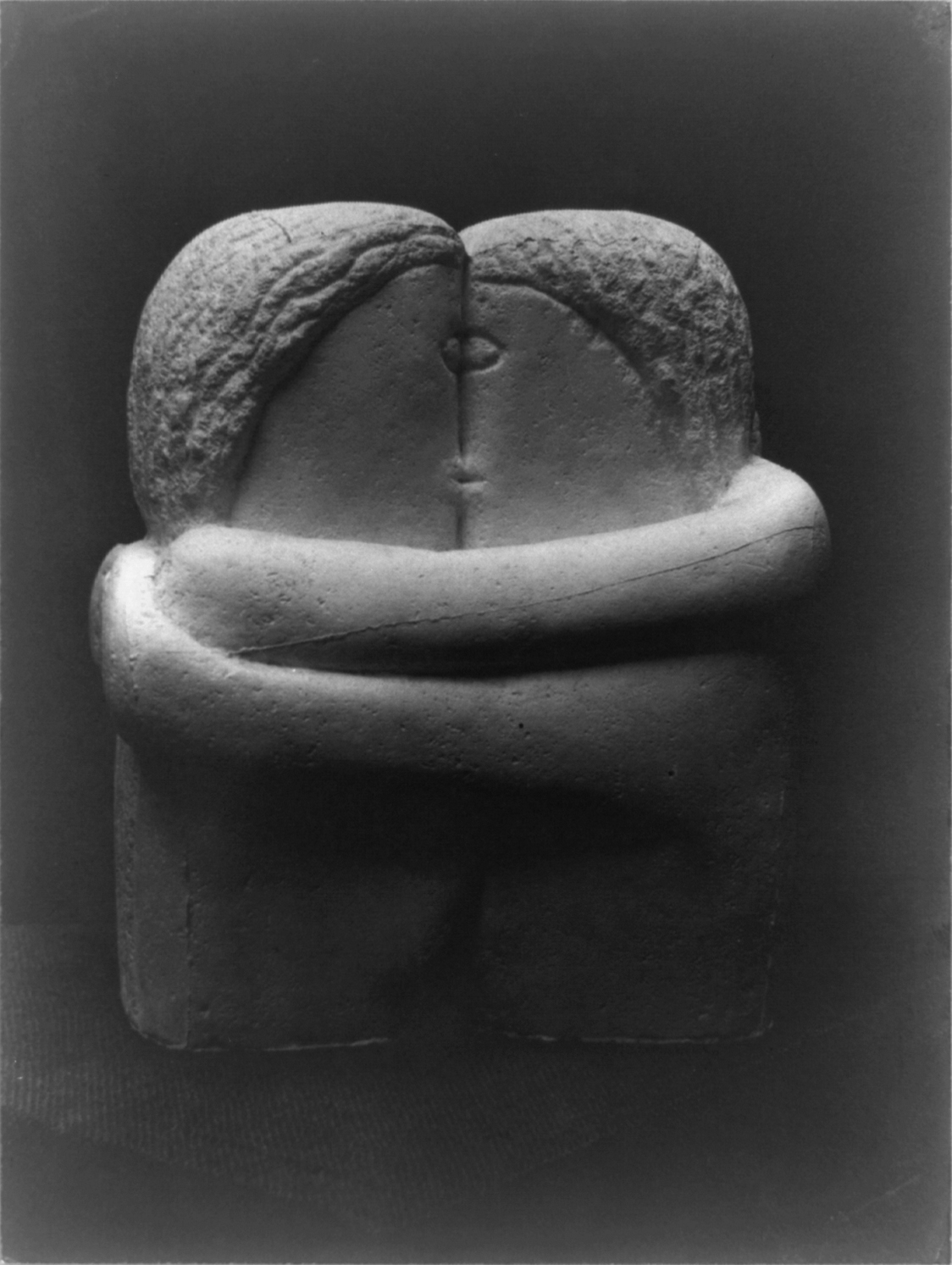
7. The previous post — the post that got me started on this list — discussed a Charlie Hebdo cover showing 2 men kissing which I assumed was an intentional allusion to the famous New Yorker cover showing a Jewish man and a black woman kissing, and Meade said: "You know what else you should have included?" I said: "Brancusi's 'The Kiss'?"


No, he was thinking of the famous photograph of a sailor kissing a nurse: "V-J Day in Times Square" by Alfred Eisenstaedt. Scanning my Google image search results, I saw Gustav Klimt's "The Kiss" and said: "As ubiquitous as Gene Simmons." No, I said: "How many dorm rooms have you seen this in?" And "There's also that Rodin."

8. For a less famous, less over-liked artwork called the kiss, consider Tino Sehgal's "The Kiss": "On the [Guggenheim Museum's] ground floor, a man and woman entwine in a changing, slow-motion amorous embrace.... As choreography it will hold no surprises for anyone familiar with contemporary dance. Taken as living sculpture, it has amusing moments: every so often, the performers strike erotic poses derived from Courbet, Rodin, Brancusi and Jeff Koons." I'd already thought of Rodin and Brancusi, but let's check out the Courbet and the Koons.

9. Hey, Koons (#8) and Coons (#2). It's like the stars are in alignment. Is there a constellation called The Kiss? No, but The Arctic Monkeys sang: "And her lips are like the galaxy's edge/And her kiss the color of a constellation falling into place."

10. "Kiss" is a very old word in English. The OED — giving the first meaning as "A touch or pressure given with the lips... in token of affection, greeting, or reverence; a salute or caress given with the lips" — has the oldest appearance of the word circa 1000:
Ælfric Homilies II. 32   Ic hine to minum cosse arærde.
I don't read English well enough to understand that, but the language becomes more recognizable by the 1380s, when a translated Bible had: "Kisse he me with the cos of his mowth." And here's a great poet: "Ah why refuse the blameless bliss? Can danger lurk within a kiss?"

April 19, 2014

"Many tribal courts cannot afford their own public defender and have only 'advocates' without law degrees to defend the accused."

"The Yaquis wouldn’t have been given the green light from the Justice Department to launch the pilot project without Acosta, a longtime public defender...."
Acosta’s office recently filed motions with the tribal court to dismiss the first three tribal arrests of non-Indian men, arguing that the tribe did not properly implement the new law, including notifying the public of its new jurisdiction over domestic violence cases.
The "new law" is an amendment to the Violence Against Women Act, which you can read here. It seems to have been adopted to pick up the slack for U.S. attorneys who are said to have declined to prosecute too many of the cases arising out of domestic violence by non-tribe members on Indian tribal lands.

From that second link, we see the requirements that the tribal court protect "defendants' rights under federal law," including due process, effective assistance of counsel, "Free, appointed, licensed attorneys for indigent defendants," and "a fair cross-section of the community in jury pools and not systematically exclude non-Indians."

July 15, 2010

University of Wisconsin lawprof Victoria F. Nourse has been nominated to the 7th Circuit.

Congratulations to my esteemed colleague!
Nourse was special counsel for the Senate Judiciary Committee from 1990 to 1993, where she was staff drafter of the Violence Against Women Act. She was also an appellate attorney for the U.S. Department of Justice from 1988 to 1990 and assistant counsel for the Senate Committee to Investigate the Iran-Contra Affair in 1987 and 1988.
Here's the Accuracy in Media report on her role working on the Violence Against Women Act, written in 2007, when then-Senator Joseph Biden was running for President:
... Biden has just released a book acknowledging that he wasn’t the sole author of the Violence Against Women Act (VAWA). This bill was Biden’s signature legislation. It resulted in tons of favorable publicity for him. But the book, Promises to Keep, reveals on page 240 that a female staffer was actually involved in drafting the legislation.

“The staffer, Victoria Nourse, and I wrote” the legislation, says Biden. However, his presidential website gives Biden sole credit for the legislation. It quotes Biden as saying that “What I’m most proud of in my entire career was writing the Violence Against Women’s Act because it is evidence we can change people’s lives, but the change is always one person at a time.” The term “writing,” as commonly understood, means that he wrote it. His office sent out a release calling the senator the “author” of the legislation. But “author,” like the term “writer,” has a definite meaning....

It’s true that Biden “introduced” VAWA. It is also accurate to say that he sponsored it. But to have paraded around the country for many years claiming to be the “author” or “writer” of the bill diminished the work of the female staffer who had been doing the bulk of the work behind the scenes. Later in the book, Biden refers to Nourse as his “lead staffer” on the bill, but that description, too, diminishes her work in this area.
This seems like a pretty minor criticism of Biden, but Nourse is honored to receive the recognition.

But — you may be asking yourself —wasn't the Violence Against Women Act held unconstitutional? The act had many provisions, and one of them — giving private citizens a federal tort claim against other private citizens — was held unconstitutional by the Supreme Court in a 5-4 decision in 2000. It does not manifest a lack of legal expertise for Nourse to have thought that this provision was constitutional back in 1994 when the act was passed. That was before the Gun Free School Zones Act case in which the Supreme Court, for the first time in over half a century, found that Congress couldn't rely on the Commerce Clause to legislate in a particular area. You may argue about whether VAWA was a good use of federal power and whether it was a good idea to use the federal courts to handle gender-based violence cases. Was VAWA good federalism and the wise allocation of judicial resources? But, I think, VAWA reflects well on Nourse, Nourse is an excellent nomination of the sort one would expect Obama to make, and Obama is the President with the judicial appointment power.

September 11, 2008

Fred Strebeigh on Joe Biden: "Ladies' Man: The backslapping, bloviating hero of women's rights."

Great article in the New Republic about the genesis of the Violence Against Women Act. Read the whole thing. I want to highlight the fact that a central figure in the story, Victoria Nourse, went on to become a lawprof at the University of Wisconsin.
The late '80s, Biden noticed, showed a rise in violent crimes against young women. Then, in December 1989, a man walked into a university classroom in Montreal with a hunting rifle, divided the students by sex, yelled that the women were all "a bunch of feminists," and killed 14 of them. Biden's aide Ron Klain handed the Senator an article in the Los Angeles Times by a friend who had clerked with Klain the year before at the Supreme Court, Lisa Heinzerling (now professor of law at Georgetown). Heinzerling connected that murder of "feminists" to a gap in U.S. law. Federal law tracking hate crimes targeted only, she wrote, a "victim's race, ethnicity, religion, or sexual orientation." Thus, she argued, "if a woman is beaten, raped or killed because she is a woman, this is not considered a crime of hate"--a legal loophole "welcome to no one but the misogynist."

Biden posed a challenge to [his staffer Victoria] Nourse: figure out what Congress should do, and start by looking at the marital-rape issue he had tried to tackle a decade earlier.....

Looking for a solution, Nourse drafted a proposal for the "Civil Rights for Women" section of what would become VAWA.... The goals of the civil rights section were grand: make women "free from crimes of violence motivated by the victim's gender." But its method was more modest: give victims of such violence the right to sue their attackers in federal court. Nourse grounded the section constitutionally both in the equal-protection guarantee of the Fourteenth Amendment and in the Commerce clause (partly via language echoing the Civil Rights Act of 1964, itself upheld by the Court under the Commerce clause).

Even before Biden introduced VAWA at Senate hearings on June 20, 1990, Nourse began seeking allies among women's groups in New York and Washington, D. C. Both she and Biden recall that "inside the-beltway women's groups" did not leap to assist. In Promises to Keep, Biden quotes one group member replying, "Oh, Victoria, you're a nice little girl, but you work for Joseph Biden. Why should we believe you?" Such distrust, he thought, came because he was not "pure" in his support for abortion--opposing federal funding of abortion though supporting a woman's right to choose....
Ultimately, the Supreme Court struck down that statutory right of action, saying that it did not fit under the Commerce Clause -- it didn't regulate any commercial activity -- and it didn't fit under the 14th Amendment -- because the 14th Amendment only deals with state action.
Joe Biden may have lost in a titanic struggle to expand the civil rights of women. But, along the way, he showed himself ready to follow the lead of female attorneys and judges. As Victoria Nourse told me in a recent e-mail from her desk at Emory Law School, where she is now a professor: "[I]n a day and age when Senators were still fondling interns in the Senate elevator, he not only protected me, he listened to me, my legal advice, and by extension, all the women who talked to me."

No one can pretend that getting Biden as vice president lifts women's spirits as high as they may go with the election of the first woman president. But no one will doubt that, on that wet day on the slippery Supreme Court steps, beneath his senatorial umbrella, Joe Biden was there--trying to stand tall for the rights of women.