20 ફેબ્રુઆરી, 2024
Reginald presents a dramatic reading of "Fast Car."


7 ફેબ્રુઆરી, 2024
About that revolution....
I love Talkin Bout a Revolution, but “we’re going to rise up and overthrow the system” was not exactly a novel musical theme by the late 1980s. https://t.co/QHYivpHvGL
— Megan McArdle (@asymmetricinfo) February 7, 2024
5 ફેબ્રુઆરી, 2024
"Taking the baton from Stevie Wonder, Annie Lennox sang the second portion of the 'In Memoriam' segment..."
From "Grammys 2024 performances, ranked from best to worst/Tracy Chapman and Luke Combs’s duet of ‘Fast Car’ was the highlight of the night, along with Joni Mitchell and Annie Lennox’s moving ballads" (WaPo).
14 જુલાઈ, 2023
"On one hand, Luke Combs is an amazing artist, and it’s great to see that someone in country music is influenced by a Black queer woman — that’s really exciting."
Said Holly G, "founder of the Black Opry, an organization for Black country music singers and fans," quoted in in "Tracy Chapman, Luke Combs and the complicated response to ‘Fast Car’/Combs’s remake of Chapman’s 1988 hit now dominates the country charts, renewing difficult conversations about diversity in Nashville" (WaPo).
[According to] Tanner Davenport, a Nashville native and co-director of the Black Opry: White country singers struck gold this past decade releasing songs heavily influenced by R&B and hip-hop, but few Black artists are even signed to major Nashville labels....
The immediate success of Combs’s “Fast Car,” Davenport said, “kind of just proves that when you put a White face on Black art, it seems to be consumed a lot easier.... This genre needs to expand their boardrooms and let marginalized people be in these rooms and make a bigger bet on these artists.”...
There are 2 very different issues here. 1. How is the country music genre defined and enforced (and to what extent does it exclude black artists who want to present themselves as within the country genre)? and 2. Should white artists cover songs that were originally written by/for black singers?
[T]he song has always had a particular significance in the Black and LGBTQ+ communities, Davenport said; the Black Opry performed a group singalong of “Fast Car” when it closed out its first show. (Chapman does not discuss her personal life, but writer Alice Walker has disclosed their relationship, which occurred in the 1990s.) “I think the song in general is pretty reflective for a lot of people who do identify as queer, and also for a person of color — the song almost seems like an anthem for us,” Davenport said. “It’s been pretty monumental in our lives, and I think it made us feel like we weren’t alone.”
So, actually, there are 4 issues here. Take the 2 spelled out above and replace "black" with "LGBTQ+."
Another issue is that there's a big difference between covering a new hit by a black/LGBTQ+ artist and covering an old song like "Fast Car." Tracy Chapman had her big hit 35 years ago. It is vastly in her interest for another artist to have a big hit covering it today. To convince straight white people not to cover the songs of songwriters who are not straight and white is to restrict the income of black/LGBTQ+ songwriters.
The author of the article, Emily Yahr, quotes an English professor who declares that "Fast Car," with its dream of driving a car away from painful circumstances, appeals to a wide audience:
Francesca Royster, author of “Black Country Music: Listening for Revolutions” and an English professor at DePaul University, said the song’s story of the narrator feeling trapped and trying to escape is “a really American iconography” about cars holding the promise of freedom. “This is something country music is very invested in, too: invested in, too: the American dream of reinvention and finding happiness after a life of struggle,” Royster said....
And yet:
... as someone who lived in Oakland, Calif., when “Fast Car” came out and saw how it connected to the queer community, she said, it’s difficult to see the success of Combs’s cover knowing that country music, with its historic emphasis on “tradition,” has generally shied away from highlighting LGBTQ+ artists and their stories — which is all part of the complexity of the current life of the song.
But there's nothing LGBTQ+ about the lyrics of that song. That's why the article has to say "part of the complexity of the current life of the song." Some people who like the original recording have a personal bond with it that connects it to things that drop out of the picture when it's sung by a straight white man. But the song stands apart from the original recording and from the artist most closely associated with it. A great song deserves multiple versions and it would be horribly unfair if black/LGBTQ+ songwriters were put in a separate category and protected from covers.
See, my old man's got a problem
He lives with a bottle, that's the way it is
He says his body's too old for working
His body's too young to look like his
At this point, I'm convinced I'm hearing about a sexual relationship. The singer, originally a woman, is unhappy with the man who won't work and doesn't even look good anymore. But then there's this:
When mama went off and left him
She wanted more from life than he could give
I said, "Somebody's gotta take care of him"
So I quit school and that's what I did
Oh, it's dad. Deadbeat dad. Bleh. Sure. Leave him. I always thought she was leaving an inadequate sex partner. "My old man"... in my head, those words resonate with Joni Mitchell:
28 જુલાઈ, 2021
Smiling at black people.
This is such powerful advice. ✊🥲
— Titania McGrath (@TitaniaMcGrath) July 28, 2021
When approaching a black person, it’s also helpful to gently hum a Tracy Chapman song to let them know you’re not a threat. pic.twitter.com/OADNhdnb4v
3 એપ્રિલ, 2021
"The liminal state of this song is punctuated by lulls of drones humming and possible ecstatic highs, but even as fractured and wild as it might all be..."
"... the power of getting through this speck of time is in your hands. While maybe you can’t directly relate to Chapman’s urgent promises about breaking the cycle of poverty and disappointment, you can loosely use O’Rourke’s scientific process for getting through any situation rife with angst, murk and the blah of it all. Listen hard enough, and the nearly sitcom-length middle can even feel short when the same big, bending sounds are crammed into little pockets of time that flitter away before you know it."
From "Tracy Chapman’s ‘Fast Car’ is a beautiful ballad. This 33-minute cover version takes it to a whole new place" by Hau Chu (WaPo).
17 એપ્રિલ, 2017
There's nothing substantial to read about the series finale episode of "Girls"...
1. I laughed when Hannah (the Lena Dunham character) got mad at Marnie (the Allison Williams character) for letting the song "Fast Car" play on the car radio and singing along. "Fast Car" is that 1988 Tracy Chapman recording that — in my experience — comes on the "Coffeehouse"-type channels of satellite radio far too often. The Wikipedia article on the song suggests why XM programmers think that's what will work on listeners who hang out on that part of the dial:
According to Metro Weekly critic Chris Gerard, "Fast Car" tells a grittily realistic story of a working poor woman trying to escape the cycle of poverty, set to folk rock music. The song's arrangement was described by Orlando Sentinel writer Thom Duffy as "subtle folk-rock," while Billboard magazine's Gary Trust deemed the record a "folk/pop" song. Dave Marsh said it was perhaps an "optimistic folk-rock narrative," whose characters are in a homeless shelter. American culture critic Jim Cullen believed that with songs like "Fast Car", Chapman brought a uniquely Black and feminist perspective to acoustic folk-rock's generally White, middle-class audience.When I hear the song, which I've heard way too many times over the last 30 years, I think of the well-off white people who love themselves too much for loving it. So I delighted at Hannah's annoyance at Marnie's loving the song. And I was crushed when absolutely the last thing that happened in the series was Hannah — as she got her baby to breastfeed at last — manifesting her long-awaited ascendance into adulthood by softly singing "Fast Car." My favorite thing about the episode — Hannah's irritation at Marnie's lame self-love at loving "Fast Car" — got ruined.
2. Meade — who tends to sit with me when I watch one of my shows — had a different reaction to "Fast Car." He thought it meant that Marnie — who was driving the car — was going to crash and kill them all. I said: "That's how they're going to end the series — just randomly kill everybody?!"
3. The story arc of the last season has been: Hannah got pregnant. In the final episode, the baby has arrived. We were spared having to endure an episode with labor pains, getting-to-the-hospital high jinks, pushing and screaming, umbilical cord twirling — all the theater of childbirth. But perhaps that was only because an earlier season had already given us a childbirth episode. We had many episodes of pregnant Hannah, and now, in the final episode, the baby is suddenly here. The drama/comedy is all about breastfeeding — the mechanics of breastfeeding and breastfeeding to represent everything about mother-and-child bonding. The story is really about the end of Hannah's life as the child to the recognition of herself as the mother. If the breasts repurpose themselves as milk dispensers — voila!
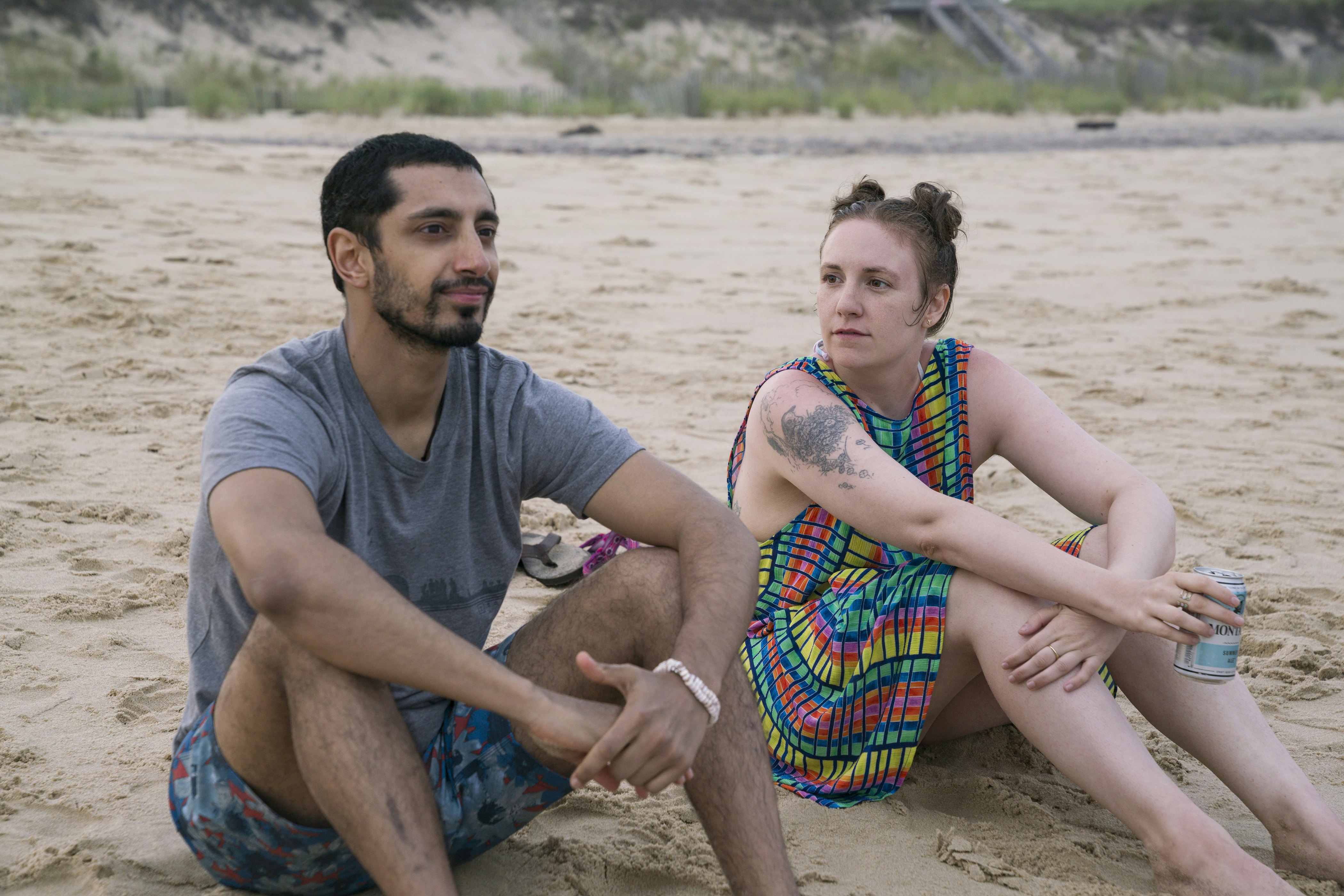
4. The baby appears to be black. Here's a picture of Hannah and Paul-Louis, the father of the baby. The actor playing the role is Riz Ahmed, a British man of Pakistani descent. It's as if the show's producers see race in terms of white and nonwhite. I suspect they thought it was racially enlightened to give the white main character a dark-skinned baby, but I found it distracting. How did the baby come out much darker than either parent? Maybe there's a scientific answer to how that could happen. I'm just saying it's distracting, and not just because I had to drift off into contemplating genetics. It's that I'm trying to imagine what they were thinking and how it related to the perennial criticism of the show that it is too much about the little problems of white people. Now, a little nonwhite baby comes into the world and saves Hannah. There's a lot of racial politics there to analyze, but the show didn't analyze it. My mind ran way off the track they wanted me to pay attention to. It was like the fast car in Meade's ideation.
5. The baby's name is Grover. That was the name Paul-Louis suggested over the telephone, when Hannah told him he was going to be a father and he wished her good luck. Why accept the absent father's weird name suggestion? She doesn't even know if the guy was thinking of President Grover Cleveland or Grover on "Sesame Street." Maybe there's some idea that if you don't get the last name from the father — the baby gets Hannah's last name (Horvath) — you should get the first name from the father. Some kind of feminist compromise. Grover's as good as any other name, isn't it? You can, for short, call him Gro, pronounced "grow." If you take out the verhorva, you've got gro[w]th. This series has been all about growth... and the lack of it. 6 seasons of lack of growth, and a final episode with a big magical growth spurt. Because: baby!
6. Each of Hannah's friends had made a pitch to be the baby's co-parent. (The show is not realistic.) In the final episode, Marnie is the one living in the charming upstate house with Hannah and the magical baby. She exults that she won — she is the best friend. As for that perfect house: Don't get distracted wondering how do these people get these houses? The show is not realistic.
7. But Marnie's only going to be in that house for a while. The stories of the other girls of "Girls" were wrapped up in the second-to-last episode, and this episode is concentrated on resolving the story of Hannah. But Marnie needs a send off too. We're prompted to understand that she won't stay in that house co-parenting with Hannah throughout Grover's childhood. That's Hannah's story to complete, which we're supposed to believe will happen because in the end the baby latches onto the nipple — the episode is titled "Latching" — and the screen goes black, the credits roll over sucking sounds, and Hannah is heard singing "Fast Car." The prompt for where Marnie's life story will go is her musing that she's always wanted to go to law school.
8. Law school! So this is the end of Marnie, going to law school?! Well, she was into reading those books about breastfeeding and she did swaddle the baby effectively. And then she proclaimed — right after saying law school was her heart's desire — that she loved rules. Ah, is that what drives people to law school, a love for rules? Maybe that's why I had a nightmare last night about being a terrible law professor. The students hate me because I won't stop all the nonsense and just tell them what the damned rules are already.
I'm stopping now. I started this list as my first post at about 6 a.m., but it was taking too long and wrote 4 other posts before coming back to this. And I think now the title of the post may be inapt. Surely, somebody else is opining on line, dealing with some of these themes — feminism, racial politics, names, law school. It's time to release this blog post out into the world — let it live a life of its own. I can't be coddling and swaddling this forever. Yes, there are only 8 points, and I could tweak it up to 10 for a round number. In fact, I could break up a couple points and get it up to 10 — or 3 and get it up to 11 — but I don't care. That would be Marnie-ish of me, and I'm not the Marnie....
17 ઑગસ્ટ, 2005
100 top albums of the 1980s.
1.London Calling, The Clash
2.Purple Rain, Prince
3.The Joshua Tree, U2
4.Remain In Light, Talking Heads
5.Graceland, Paul Simon
6.Born in the U.S.A., Bruce Springsteen
7.Thriller, Michael Jackson
8.Murmur, R.E.M.
9.Shoot Out The Lights, Richard and Linda Thompson
10.Tracy Chapman, Tracy Chapman
11.Get Happy!!, Elvis Costello
12.It Takes a Nation of Millions to Hold Us Back, Public Enemy
13.Diesel And Dust, Midnight Oil
14.So, Peter Gabriel
15.Let It Be, The Replacements
16.1999, Prince
17.Synchronicity, The Police
18.Dirty Mind, Prince
19.New York, Lou Reed
20.Pretenders, The Pretenders
One answer is that they gave him the second slot for "Purple Rain" and even put "Dirty Mind" at #18. ("Sign o' the Times" is #74.) Another answer is that the list was made in 1990.
What looks really out of place on this list today? Maybe my younger readers will agree with me that this list reeks of Baby Boomer.


 પોસ્ટ્સ