Showing posts with label Thomas Hardy. Show all posts

April 12, 2026

"I worked in a warehouse. It's where I felt so free. Then HR saw that video and terminated me."

I was good. I was great. I was busy moving freight. But I wanted to be funny, now the trucks will have to wait. I miss that icy freezer. I know that must sound odd, but now the smoke has cleared and my testicles  have thawed. I used to pick up pallets and I used to lift them high. It used to lift my spirits up. I felt like I could fly....

That's Blake Porter, via this Metafilter post by CrunchyFrog.

I enjoyed that. It was sweet and quirky, and I felt for the guy (even though I also think employers do need some rules about making your own videos at work, especially if you're working with heavy equipment like forklifts).

But it also got me wondering about Metafilter. I remember years ago, it had hot debate about political and social issues, but now it seems that everyone has agreed amongst themselves only to talk about sweet little quirky things and to be really nice to each other. It's a gentle pleasant atmosphere, but what the hell happened? What sapped all the vigor out of the place? If you go over there now, you'll see a post about what Isaac Asimov wrote about "1984" in 1980, how Jhumpa Lahiri is finding "quivering energy" in the works of Thomas Hardy, the rescue of a sea turtle, a walk to see (hear?) a sound sculpture, a bird that has relearned an old birdsong, a cat in a library, what rock art might be saying about Tasmanian tigers, etc. etc. 

Attempting to use Grok to explore my wonderment, I encountered the word "cozification." My search based on that word might have led me down various sweet quirky paths, but in the interest of keeping myself sharp and fast-moving, I decided to end this post with this screen shot (from Urban Dictionary) which I deem found art:

March 7, 2019

"A Qantas flight attendant who got blind drunk on peach martinis in a New York bar during a layover has lost his appeal to win his job back."

"Luke Urso, 24, claims he drank just 'two peach martinis and three gin and tonics' at the 230 Fifth Rooftop Bar in New York in 2017 but due to the bartenders 'free pouring' the cocktails, he ended up collapsing in the toilet and being rushed to hospital. Mr Urso believed that while he thought he was drinking five drinks, he had really consumed the equivalent to 14 standard drinks - resulting in him unable to work his shift the next day and Qantas having to foot the $20,000 hospital bill.... [The Australian Fair Work] full bench said Mr Urso's evidence could 'simply not be accepted' saying he 'could not seriously have thought that a drink in the nature of a peach martini would only contain one standard nip of alcohol,' it said. 'The evidence tends to suggest that he had significantly more than five drinks, in which case 'free pouring' loses whatever capacity it had to exonerate him,' it said."

From The Daily Mail.

Are you familiar with "nip" as a specific small amount (like a "shot")? I see there's an old word "nipperkin":
Nipperkin was still around as the nineteenth century turned into the twentieth, but lasted little longer.... There are a number of references to it in books of the period, as in The Dynasts by Thomas Hardy, published 1904-8 but set at the time of the Napoleonic wars: “I’d sooner have a nipperkin of our own real ‘Bristol milk’ than a mash-tub full of this barbarian wine!” [Bristol milk = sherry.]

Its name is so intimately tied to English and Scottish rural and domestic life that it comes as a mild shock to learn that the word is probably Dutch in origin and is related to the German and Dutch verbs nippen, to sip.

We still sometimes speak of taking a nip of spirits, often notionally for medicinal purposes, as a character did in The First Men in the Moon by H G Wells: “He recommended a nip of brandy, and set me the example, and presently I felt better.” Nip here is an abbreviation of nipperkin, in the looser sense of any small quantity. However, nip has some more specific senses: it’s a legal measure in Australia and New Zealand, of size 30ml; in the USA in particular it’s usually one-third of a local pint, a bottle size for high-alcohol beers like barley wine.
And what is "free pouring"? Is it wild or careless oversizing of portions? That's not what I'm seeing:

August 12, 2018

"I felt it as artificial, that sitting down to write a book."

"And that is a feeling that is with me still, all these years later, at the start of a book—I am speaking of an imaginative work. There is no precise theme or story that is with me. Many things are with me; I write the artificial, self-conscious beginnings of many books; until finally some true impulse—the one I have been working toward—possesses me, and I sail away on my year’s labor. And that is mysterious still—that out of artifice one should touch and stir up what is deepest in one’s soul, one’s heart, one’s memory.... Artificial though that novel form is, with its simplifications and distortions, its artificial scenes, and its idea of experience as a crisis that has to be resolved before life resumes its even course. I am describing, very roughly, the feeling of artificiality which was with me at the very beginning, when I was trying to write and wondering what part of my experience could be made to fit the form—wondering, in fact, in the most insidious way, how I could adapt or falsify my experience to make it fit the grand form.... 'I had an impression'—[Somerset Maugham wrote about Thomas Hardy] —'that the real man, to his death unknown and lonely, was a wraith that went a silent way unseen between the writer of his books and the man who led his life, and smiled with ironical detachment at the two puppets….'"

From "On Being a Writer" by V.S. Naipaul from the April 23, 1987 issue of The New York Review of Books. (Naipaul died yesterday.)

September 28, 2016

"'I don't see that I deserve to be put upon and stormed at for nothing!' concluded the small woman, bigly."

A quote from Thomas Hardy's "Far From the Madding Crowd," discovered just now as I — participating in this Facebook discussion — looked up "bigly" in the Oxford English dictionary.

concluded the small woman, bigly... that cracks me up.

June 5, 2014

Out of time... out of place...

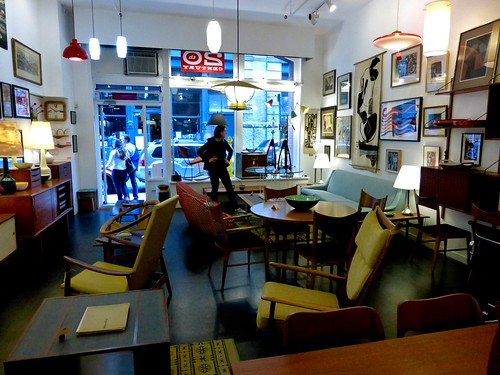
Here are 2 shops I photographed (with permission) as we were walking about in lower Manhattan over the weekend. One sells old furniture and accessories from the mid-20th century. These are not reproductions but it's wrong — we were gently corrected — to call them "antiques."

Untitled

The other place was called Carhartt, a brand we associate with rugged, inexpensive clothes sold in big-box stores like Farm & Fleet, but here the things were laid out as if everything was quite posh and elegant:

Untitled

It was explained that the company that made the clothes we knew had licensed its name for this pricey line, which actually made sense to me. Some guys have more money, like to shop in handsome environments, see value in softer, more flexible fabrics and slimmer, more fashionable cuts, and still want the ethos — the aura — of a manly man who'd buy his working and fishing clothes in a Farm & Fleet in Wisconsin.

We're living wherever we are, whenever we are. And yet we have our longings, and there will be shops that cater to our longings. There's a place somewhere. A place somewhen.

If you're thinking of saying "somewhen" is not a word or, hey, "somewhen" should be a word. I've got news: "Somewhen" is a word, Thomas Hardy used it in "Tess of the d'Urbervilles": "Yes, though nobody else should reproach me if we should stay together, yet somewhen, years hence, you might get angry with me for any ordinary matter, and knowing what you do of my bygones you yourself might be tempted to say words, and they might be overheard, perhaps by my own children."

July 2, 2013

"For great writers, retirement is a fairly recent career option."

"There have always been writers, like Thomas Hardy and Saul Bellow, who kept at it until the very end, but there are many more, like Proust, Dickens and Balzac, who died prematurely, worn out by writing itself. Margaret Drabble may have started a trend when, in 2009, at the age of 69, she announced that she was calling it quits. [Alice] Munro said she was encouraged by the example of Philip Roth, who declared that he was done last fall, as he was getting ready to turn 80. 'I put great faith in Philip Roth,' she said, adding, 'He seems so happy now.'"

June 2, 2007

Is today your birthday?

It's a good day...

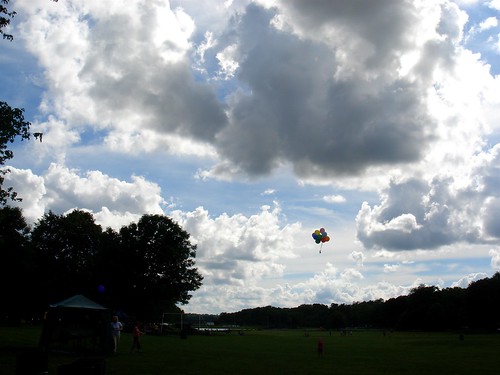
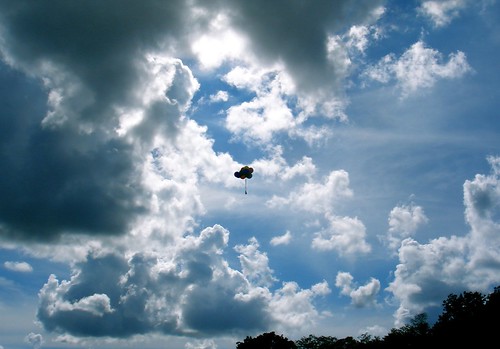
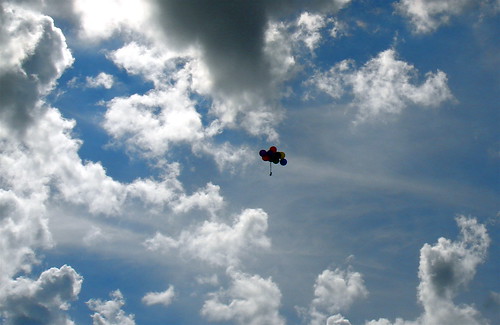
Balloons escape

To be born...

Balloons escape

The same day...

Balloons escape

As Lydia Lunch and Frank Rich ...

Balloons escape

And Jerry Mathers and the Marquis de Sade ...

Balloons escape

And Johnny Weismuller, Martha Washington, and Thomas Hardy ...

Balloons escape

You could go anywhere.

May 20, 2007

About that suggestion of mine that reading classes should use nonfiction books.

This post has really stirred people up.

Look, my main point is efficiency. Kids need to learn to read, and they should also be learning science and history too, so why not combine the two tasks? Reading would still be taught and, in the early years, would be the central focus of the lesson, but the texts would have an added benefit of getting started learning other academic subjects.

I'm not saying fiction isn't worth reading. I'm saying that it can be held for after hours pleasure reading. Frankly, I think this would increase the love of fiction. Here's this shelf of books that you can read when you finish your other work. You can take them home if you like. I think this would give them an aura of excitement. There are lots of people who have fiction forced on them and avoid it once they're out of school. My father would get passionate about his hatred of "The Return of the Native," which he was forced to read. Me, I read "The Return of the Native" and all of Thomas Hardy's novels on my own and loved them. Look at how kids read the Harry Potter books on their own. Put them outside of the classroom and let kids see them as a leisure treat.

In saying that, I don't mean to say they are just for fun and that there's nothing deep. I'm saying that reading fiction books is or should be intrinsically rewarding and that intrinsic reward is best felt when you are exercising free choice. And I also think that the depths in fiction are best absorbed in a free environment without an authority figure trying to lead you or tell you how to think. Much good fiction is about challenging authority, and I worry that authority figures will choose fiction that they approve of because it teaches the values they like. That's not my idea of how good fiction works.

Another thing I'm not saying is that we shouldn't have literature classes. I've been talking about reading classes, those learn-to-read sessions very young students have. Those students aren't delving into the subtleties of themes and language and so forth. I have no problem with literature classes that teach students how to analyze texts in some fairly deep way, as long as they don't destroy the pleasure and love of art. So perhaps literature classes should be elective.

I'm also not opposed to teaching history and science through the kinds of novels and storybooks that present the information accurately. And I think a history class could very well have students read novels that had an effect on history or how people think about history, like "Uncle Tom's Cabin" or "1984." I've taught a couple "Women in Law and Literature" seminars myself. (We'd read a court case and a novel that dealt with the same subject as the case.)

Finally, I'm not saying that young kids should be given badly written, boring text books as their early readers any more than my critics think they should be given badly written, boring storybooks. That assumption, at the core of many of the criticisms I've read, is so perverse that it makes your whole argument seem to be in bad faith. Or perhaps you have only read nonfiction when it was imposed on you by a teacher and you have never discovered its intrinsic rewards by reading it on your own free choice. I'll bet if you had a shelf of books for kids to choose for their free time and it had some nonfiction books like this one, lots of kids would pick them over fiction. And I think a lot of boys would be grateful and some girls might be inspired to go into careers that are more common for boys.

Writing this post, I discovered that I'd written on this topic before, inspired by a WaPo article called "Educators Differ on Why Boys Lag in Reading":
"A lot of teachers think of reading as reading stories," said Lee Galda, professor of children's literature at the University of Minnesota. "And in fact, a lot of boys, and not just boys, like nonfiction. But we keep concentrating on novels or short stories and sometimes don't think of reading nonfiction as reading. But in fact it is, and it is extremely important."

Teachers and parents have said boys generally prefer stories with adventure, suspense and fantasy and tend toward reading nonfiction stories and non-narrative informational books, as well as magazines and newspapers.
I wrote:
Maybe it would be easier to say that everyone wants to read what interests them and quite properly rebels at being told what to read. (Maybe boys just rebel more conspicuously than girls.)

It's one thing for the biology teacher to insist that you read a biology book, but if teachers are just trying to get kids to read, why shouldn't they provide a broad selection and give kids a chance to discover what they find interesting? It looks as though the biggest problem is that teachers are pushing too much literary fiction on kids. English teachers tend to be people who enjoy that sort of thing, but most people don't read it on their own. Why should we have an appetite for stories? And why should our appetite for stories be about elegantly described characters and their relationships (as opposed to adventure and fantasy)?

I used to take my sons to the bookstore and let them find whatever they were interested in. We used to hang out at Borders nearly every day, and I usually ended up buying a book or two. What did they want? Humor, especially in comic form (like "Life in Hell"). Collections of amazing science facts and other things that did not have to be read in linear fashion. (This was a big favorite.) Books about movies and music and other subjects they were interested in.
And here's another old post of mine, describing a group of 3 boys I saw at Borders, getting more excited about a book than I've ever seen kids get. But good luck getting your local teachers to include this one on their pleasure-reading shelf:


ADDED: Some email:
As a very young boy (7-11) I never bothered reading one book of fiction (Lord of the Rings changed that for me at the age of 16). All I read as a child were books on dinosaurs and books on the middle ages.

When I entered 7th grade and we began studying the 13th century, I knew more about early feudal crop rotation and the politics of southern France than my 8th grade teacher....honestly. I also knew the difference between the paleozoic and cretaceous periods. I also read books about lasers...college level books that I had no business reading (and despite not understanding any of it I enjoyed the reading.)

I had the pleasure of teaching English in South Korea for 3 odd years. I ditched the "learn English" type books in favor of beginning science and history books early on. I tell you, the boys AND girls had a fantastic time learning English while reading about how the early Greeks figured out the Earth was round, or how photosynthesis works.

I also made the poor kids memorize poetry, but that's neither here nor
there.

UPDATE: Among my many critics, I want to give the prize to this guy for writing "Althouse correctly notes that reading comprehension skills among high-school students are on the decline" -- not because he gave me credit for something but because I never said anything about reading comprehension skills among high school students! I hope he does an update, something like: Althouse correctly notes that reading comprehension skills among bloggers are on the decline.