In 2023 Gavin Newsom did what he called a "Red State" tour and visited Alabama, Florida and a few other red states.
— MAZE (@mazemoore) March 29, 2026
Newsom's wife said she brought her children to the red states so they could learn about racism, sexism, and bullying first hand. pic.twitter.com/CBx8gfUBc9
The South లేబుల్తో ఉన్న పోస్ట్లను చూపుతోంది. అన్ని పోస్ట్లు చూపించు
The South లేబుల్తో ఉన్న పోస్ట్లను చూపుతోంది. అన్ని పోస్ట్లు చూపించు
30 మార్చి, 2026
Have you heard from Newsom's wife?


8 నవంబర్, 2025
"And I did my little audition and they said can you do it more southern? And I'm like, are you shitting me?"
"It's like, you got to be shitting me. I said, well, what you have to understand is I actually did just get off the turnip truck from back there and this is how you talk.... And it was like, oh, I, I see what they're getting at. Yeah. So they wanted the Foghorn Leghorn — you know, now, ovah heah, what we have is — and... I grew up down there. I never heard that.... There are a lot of performances over the years where people who are not from the South played the part that actually used that accent. And they win Academy Awards and stuff. And I'm like, wow. So anyway, I didn't get this part. And the guy who got the part literally sounded like he was in the Bronx, but he was doing that thing, you know, I thought, wow, this is gonna be tough out here...."
Said Billy Bob Thornton, talking to Joe Rogan about the Southern accent.
Scroll back to 25:35 if you want to hear Joe link the Southern drawl to hookworm infection. I didn't think I'd hear Joe talking about "dewormers" again, but he does.
10 జనవరి, 2025
"Yes, they spent 4 years in the governor's mansion and 4 years at the White House, but the other 92 years, they spent at home in Plains, Georgia."
"And one of the best ways to demonstrate that they're regular folks is to take them by that home. First of all, it looks like they might have built it themselves. Second of all, my grandfather was likely to show up at the door in some 70s short shorts and crocs. And then you'd walk in the house and it was like thousands of other grandparents' house all across the South. Fishing trophies on the walls. The refrigerator, of course, was papered with pictures of grandchildren and then great grandchildren. Their main phone, of course, had a cord and was stuck to the wall in the kitchen like a museum piece. And demonstrating their Depression Era roots, they had a little rack next to the sink where they would hang Ziploc bags to dry...."
16 ఆగస్టు, 2023
"When it gets hot enough, as it has across the South in recent weeks, barefoot toddlers suffer second-degree burns from stepping onto concrete."
"People who fall on the blistering pavement wind up with skin grafts. Kids stay inside all day, 'trying to survive.' Windshield wipers glue themselves in place, and the ocean transfers heat back into your body. One electric blackout could bake thousands to death inside their homes. You would think people would flee such a hellscape expeditiously. But as record-breaking heat fries the Sun Belt, the region’s popularity only grows. The numbers, laid out recently in The Economist, are striking: 12 of the 15 fastest-growing cities in the U.S. are in the Sun Belt."
I'm reading an Atlantic article that purports to answer the question I've been asking: "Why People Won’t Stop Moving to the Sun Belt."
But does this article really know why people do what they do? The author gives us 3 reasons: 1. cheap housing, 2. "a 'business-friendly' environment," and 3. warm winters. That is, on point 3, the weather is still a reason to go there, not a reason to escape. Ah, well, the fear of the cold is deep-seated.
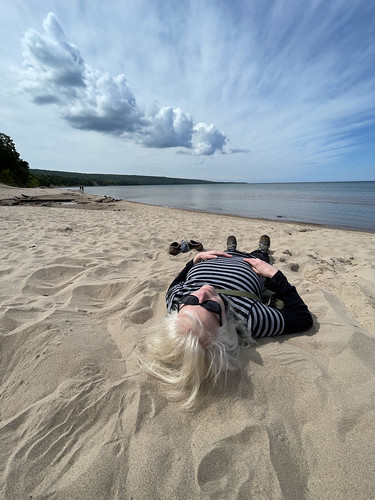
Here I am, lying on a nearly empty beach on the shore of Lake Superior, on August 14th, wearing 2 layers of long-sleeved shirt, experiencing what to me is the perfect temperature — 62°:
Why isn't everyone here? Ah, well, I like the emptiness. The sand was very fine and soft, the water perfectly clear... and swimmable if you're hale and exuberant.
6 జులై, 2023
"We were also puzzled by the way American waiters routinely congratulate you on your menu choice, rewarding you with 'Good choice,' 'Excellent' or even 'Awesome.' "
"You want fries with that? 'Awesome!'... [O]n our way to Houston, we passed a roadside church whose huge hoarding exhorted us to 'Give Up Lust — Take Up Jesus.' I thought that sign might be my most abiding memory, until I’d spent a few hours at the Space Center Houston. I never guessed I’d be so riveted by topics like the geology of the moon and how NASA astronauts train underwater.
But the cafeteria! It is astonishing, the best I’ve ever seen anywhere in a public building: brioche or sourdough sandwiches, homemade soups, hot roasts and grills, fresh tortillas, a salad bar to tempt the most die-hard carnivore, and no junk food in sight. It was a long way from the usual NASA fare of freeze-dried food in pouches and tubes...."
11 మార్చి, 2023
"Out-of-Towners Head to 'Climate-Proof Duluth'/The former industrial town in Minnesota is coming to terms with its status as a refuge for people moving from across the country because of climate change."
I took global warming seriously in 1984 when I decided to move to Madison, Wisconsin. I thought within about 10 years, everyone would notice the South had become unlivable, and a massive population shift would occur. Well, 40 years have passed, and it's just beginning to happen, this migration to the Upper Midwest. But I bet most people in the South will just laugh at this idea.
From the article:
25 అక్టోబర్, 2021
"Atlanta is still seething that Major League Baseball stripped the All-Star Game away from their beloved city this summer."
"Well, politics or not, there’s absolutely nothing MLB can do to stop Atlanta now.
Atlanta will host the World Series for the first time since 1999."
It's hard even to remember what offense Georgia committed that deserved the punishment imposed. Something un-woke? Something about voting regulations implying racism? Whatever... so now those terrible people are triumphing, and I don't think they're going to give up singing that doltish "Indian" tune while doing "the tomahawk chop."
The only alternative is another Southern city, those cheaters in Texas.
Ah, baseball is boring, all the Northerners sniff.
20 జులై, 2020
I didn't watch Trump's interview with Chris Wallace, but I'll read the transcript.
Why didn't I watch?! I told myself to watch, but I did not. I've turned away from watching the news on television. It's becoming a real aversion. I prefer to get my information from reading, so let's look at this transcript. I'll just do a few excepts, I think:
They have a dispute about how high the "mortality rate" is in the United States. I think that means the number of deaths in proportion to the population (not in proportion to the number of detected cases), and the website I look at puts the U.S. in 10th place. Wallace said we were in 7th place. Trump asserts, "I think we have one of the lowest mortality rates in the world." That's just wrong and Wallace tells him so. Trump doubles down, "I heard we have one of the lowest, maybe the lowest mortality rate anywhere in the world."
That sound crazily wrong, but he might be thinking the "mortality rate" is the ratio of deaths to cases. We do so much testing that we get a very high number of cases, and that causes the percent who die to look very low. Trump asks Kayleigh to get the numbers and insists, "I heard we had the best mortality rate... number one low mortality rate." Knowing this disarray looks bad, he says: "I hope you show the scenario because it shows what fake news is all about." Ridiculous to attack Chris Wallace like that, to call him "fake news" to his face.
WALLACE: But -- but this isn't burning embers, sir? This is a forest fire.Ugh. They're debating about the metaphor — the ember/flame distinction.
TRUMP: No, no. But I don't say -- I say flames, we'll put out the flames. And we'll put out in some cases just burning embers. We also have burning embers. We have embers and we do have flames. Florida became more flame like....
They don't talk about Mexico.... But you take a look, why don't they talk about Mexico? Which is not helping us. And all I can say is thank God I built most of the wall, because if I didn't have the wall up we would have a much bigger problem with Mexico....He wants to tell you about this wall he built "most of."
They have a dispute about how high the "mortality rate" is in the United States. I think that means the number of deaths in proportion to the population (not in proportion to the number of detected cases), and the website I look at puts the U.S. in 10th place. Wallace said we were in 7th place. Trump asserts, "I think we have one of the lowest mortality rates in the world." That's just wrong and Wallace tells him so. Trump doubles down, "I heard we have one of the lowest, maybe the lowest mortality rate anywhere in the world."
That sound crazily wrong, but he might be thinking the "mortality rate" is the ratio of deaths to cases. We do so much testing that we get a very high number of cases, and that causes the percent who die to look very low. Trump asks Kayleigh to get the numbers and insists, "I heard we had the best mortality rate... number one low mortality rate." Knowing this disarray looks bad, he says: "I hope you show the scenario because it shows what fake news is all about." Ridiculous to attack Chris Wallace like that, to call him "fake news" to his face.
2 ఏప్రిల్, 2020
"Stay-at-home orders have nearly halted travel for most Americans, but people in Florida, the Southeast and other places that waited to enact such orders have continued to travel widely..."
"... potentially exposing more people as the coronavirus outbreak accelerates, according to an analysis of cellphone location data by The New York Times. The divide in travel patterns, based on anonymous cellphone data from 15 million people, suggests that Americans in wide swaths of the West, Northeast and Midwest have complied with orders from state and local officials to stay home. Disease experts who reviewed the results say those reductions in travel — to less than a mile a day, on average, from about five miles — may be enough to sharply curb the spread of the coronavirus in those regions, at least for now."
From "Where America Didn’t Stay Home Even as the Virus Spread" (NYT). Graphs and maps at the link. Lots of bright red in the south, where the worst places have people averaging "travel" of over 3 miles a day.

It's interesting that our phone data is being used this way, but what's the problem if people are going out for a 3-mile walk? The data the NYT is using may have a rough correlation to whether people are getting together in groups, but I know I go out and get in an average of 3.5 miles, and I'm not doing anything that's not within Governor Evers's rules, which say:
ADDED: From the comments over at the NYT:
From "Where America Didn’t Stay Home Even as the Virus Spread" (NYT). Graphs and maps at the link. Lots of bright red in the south, where the worst places have people averaging "travel" of over 3 miles a day.

It's interesting that our phone data is being used this way, but what's the problem if people are going out for a 3-mile walk? The data the NYT is using may have a rough correlation to whether people are getting together in groups, but I know I go out and get in an average of 3.5 miles, and I'm not doing anything that's not within Governor Evers's rules, which say:
Individuals may leave their home or residence... To engage in outdoor activity, including visiting public and state parks, provided individuals... [at all times as reasonably possible maintain social distancing of at least six (6) feet from any other person]. Such activities include, by way of example and without limitation, walking, biking, hiking, or running. Individuals may not engage in team or contact sports such as by way of example and without limitation, basketball, ultimate frisbee, soccer, or football, as these activities do not comply with Social Distancing Requirements. Playgrounds are closed.To get to a state park, you've got to drive your car, but that's just you in your car. You're not exposing yourself or others when you're in that interior space. Does the NYT really want to promote the idea that we're covidiots if we don't stay inside our homes?
ADDED: From the comments over at the NYT:
I'm a Fed, but live in rural Oklahoma. I normally travel 33 miles each way to work in Oklahoma City M-F, but we're on telework order, so that part is down to zero. However, most of you can't imagine the distances we have out here. The nearest decent grocery store is 16 miles away, and a Walmart is about 22. So, if we go out food shopping once every two weeks, that could be 44 miles for that alone. The maps therefore are missing once critical element (which is admittedly VERY hard to compute), and that would be "Average Essential Travel Distance". That should be the denominator in a ratio, with the numerator being "Average Miles Traveled". To be fair, I do statistics for a living, and I wouldn't even begin to know how to estimate that denominator, other than to ask a sample of individuals to take a guess at it.But most of the commenters over there are picking up the message that I think the NYT intended to send: The people who vote for Republicans are ignorant and/or unwilling to act for the good of the whole.
7 సెప్టెంబర్, 2018
"Mr. Trump’s contempt for non-Ivy-educated lawyers is all the more striking, given that he has surrounded himself with them."
"His own lawyer, Jay Sekulow, took his law degree from Mercer University, in Macon, Ga. Michael Cohen, Mr. Trump’s personal lawyer for many years and tasked with more than a few important lawyerly duties, is a graduate of the Western Michigan University Thomas M. Cooley Law School, in Lansing, while another personal lawyer, Rudy Giuliani, went to New York University for law school. The president’s current White House counsel, Don McGahn, attended the Widener University School of Law, in Wilmington, Del."
From "In Defense of the Country Lawyer/Is Jeff Sessions a 'dumb Southerner' because he didn’t go to an Ivy League school? A law professor on President Trump’s contempt for the attorney general" (NYT) by Ronald J. Krotoszynski Jr., who's a lawprof at the University of Alabama, which counts Jeff Sessions among its alumni.
It's a weird elite/non-elite game he's playing, and the elite don't want to understand it. They want to stop it.
From "In Defense of the Country Lawyer/Is Jeff Sessions a 'dumb Southerner' because he didn’t go to an Ivy League school? A law professor on President Trump’s contempt for the attorney general" (NYT) by Ronald J. Krotoszynski Jr., who's a lawprof at the University of Alabama, which counts Jeff Sessions among its alumni.
[O]ne could argue that while an Ivy League school provides a wonderful education in the law, it quite often sets a person on a narrowly defined career path. On the résumés of the current Supreme Court, you find academic posts, high-level government positions, corporate law partnerships — but very little of the contact with everyday people that comes from, say, working as a trial lawyer.... [I]t is schools like the University of Alabama that are producing the type of lawyers whose careers teach them to understand and practice the kind of law that impacts most Americans.Trump is — somewhere in there — a big elitist. And that must drive the elitists mad. He really is one of them, isn't he? So why doesn't he stay in his place and know that he's far down in the pecking order of elitists? How can he jump over in amongst the non-elites and win crowds? Don't those people see how he looks down on them? He needs to get back over here where the elite can look down on him, the way he looks down on the non-elite lawyers he's got in his inner circle.
What’s more, there is something telling in Mr. Trump’s sneering contempt for Southern lawyers in particular. It intersects with a general contempt for the South as an intellectually backward region and for the stereotype of the “country lawyer” as a backward, benighted legal mind....
It's a weird elite/non-elite game he's playing, and the elite don't want to understand it. They want to stop it.
18 ఫిబ్రవరి, 2018
"Everything seems to go to seed along the Gulf: walls stain, windows rust. Curtains mildew. Wood warps. Air conditioners cease to function."
"In our room at the Edgewater Gulf Hotel, where the Mississippi Broadcasters’ Convention was taking place, the air conditioner in the window violently shook and rattled every time it was turned on. The Edgewater Gulf is an enormous white hotel which looks like a giant laundry, and has the appearance of being on the verge of condemnation. The swimming pool is large and unkempt, and the water smells of fish. Behind the hotel is a new shopping center built around an air-conditioned mall, and I kept escaping there, back into midstream America."
A passage from a book I'm reading that came back to me as we were talking about the South in the middle of the night. The book is "South and West: From a Notebook" by Joan Didion. A new reprint came out last month, but it tells the story of a road trip through the Gulf South that she made in 1970 (and a second trip in the west in 1976).
Here's another passage:
A passage from a book I'm reading that came back to me as we were talking about the South in the middle of the night. The book is "South and West: From a Notebook" by Joan Didion. A new reprint came out last month, but it tells the story of a road trip through the Gulf South that she made in 1970 (and a second trip in the west in 1976).
Here's another passage:
In New Orleans in June the air is heavy with sex and death, not violent death but death by decay, overripeness, rotting, death by drowning, suffocation, fever of unknown etiology. The place is physically dark, dark like the negative of a photograph, dark like an X-ray: the atmosphere absorbs its own light, never reflects light but sucks it in until random objects glow with a morbid luminescence. The crypts above ground dominate certain vistas. In the hypnotic liquidity of the atmosphere all motion slows into choreography, all people on the street move as if suspended in a precarious emulsion, and there seems only a technical distinction between the quick and the dead.
26 ఆగస్టు, 2017
"Might it be that non-Southerners, for cultural reasons, simply cannot understand why it’s difficult for Southerners to execrate their ancestors, even if their ancestors did bad things?"
"That thought came back to me after listening to this amazing episode of Malcolm Gladwell’s Revisionist History podcast. It’s about country music, and what sets it apart from other American musical genres. Malcolm Gladwell is not the first person I would go to for insight into how country music works, but boy, was this great."
Writes Rod Dreher at The American Conservative in "Sad Songs." I haven't listened to Gladwell's podcast yet, but Dreher ends his column with an invitation to listen to The Band’s “The Night They Drove Old Dixie Down”:
I can't embed that without thinking of something I read in The New Yorker this week: "Who Owns the Internet?/What Big Tech’s monopoly powers mean for our culture," by Elizabeth Kolbert:
By the way, the 3rd verse that Dreher talks about is the one with the lines: "Like my father before me, I will work the land/And like my brother above me, who took a rebel stand/He was just eighteen, proud and brave/But a Yankee laid him in his grave...." It made me think of the 140 Confederate soldiers whose nearby graves I visited the other day, after Madison's mayor, Paul Soglin, got a memorial removed. I took photographs...
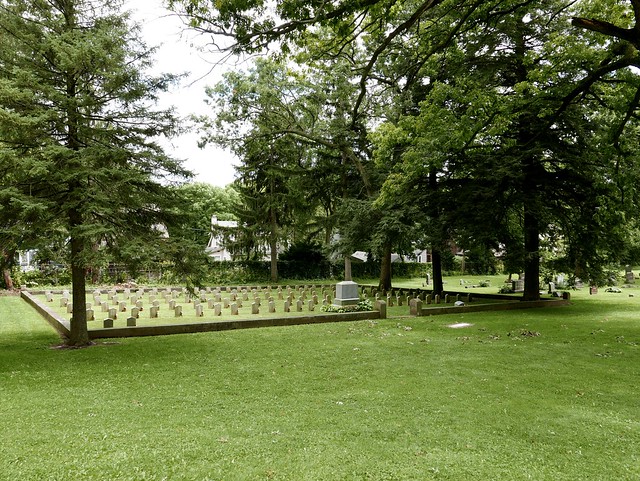
... but only later did I learn that the headstones do not mark individual graves. What's under the ground is, in fact, a mass grave. The individual stones are a later effort at imposing dignity — an effort that corresponds to the effort we are experiencing today, the withdrawal of dignity.
Writes Rod Dreher at The American Conservative in "Sad Songs." I haven't listened to Gladwell's podcast yet, but Dreher ends his column with an invitation to listen to The Band’s “The Night They Drove Old Dixie Down”:
Listen especially to the third verse — the land, family, death, defeat — and know that for very many of us, that is the South. It’s not the whole South. “Strange Fruit” is also the South. But it’s one true story of the South, and if you can’t feel the tragedy and the heartbreak of a poor, proud Southern man laid low in this song, friend, I cannot help you:
I can't embed that without thinking of something I read in The New Yorker this week: "Who Owns the Internet?/What Big Tech’s monopoly powers mean for our culture," by Elizabeth Kolbert:
Consider the case of Levon Helm. He was the drummer for the Band, and, though he never got rich off his music, well into middle age he was supported by royalties. In 1999, he was diagnosed with throat cancer. That same year, Napster came along, followed by YouTube, in 2005. Helm’s royalty income, which had run to about a hundred thousand dollars a year... dropped “to almost nothing.” When Helm died, in 2012, millions of people were still listening to the Band’s music, but hardly any of them were paying for it. (In the years between the founding of Napster and Helm’s death, total consumer spending on recorded music in the United States dropped by roughly seventy per cent.) Friends had to stage a benefit for Helm’s widow so that she could hold on to their house....Here's the album. You can still buy it.
By the way, the 3rd verse that Dreher talks about is the one with the lines: "Like my father before me, I will work the land/And like my brother above me, who took a rebel stand/He was just eighteen, proud and brave/But a Yankee laid him in his grave...." It made me think of the 140 Confederate soldiers whose nearby graves I visited the other day, after Madison's mayor, Paul Soglin, got a memorial removed. I took photographs...
... but only later did I learn that the headstones do not mark individual graves. What's under the ground is, in fact, a mass grave. The individual stones are a later effort at imposing dignity — an effort that corresponds to the effort we are experiencing today, the withdrawal of dignity.
9 ఫిబ్రవరి, 2017
Some historical background on the Senate's Rule 19 (which was used to shut up Elizabeth Warren the other day).
From Robert A. Caro, "Master of the Senate: The Years of Lyndon Johnson III" (pages 92-93):
Courtesy and courtliness were characteristics of the southern aristocracy— and of the Senate, where these traits were not only esteemed but were reinforced by the body’s rules. The rules imposed a verbal impersonality on debate to ensure civility and formality. All remarks made on the floor were required to be addressed not directly to another senator but to “Mr. President” (the presiding officer at the time)— a device that functioned as a psychological barrier between antagonists. Senators speaking on the floor were also required to refer to each other only by title, a device which placed the emphasis on the office rather than the individual (“If I may venture to offer a reply to the distinguished senior Senator from North Dakota”) and was therefore, as a Senate historian notes, “a safeguard against asperities in debate and personalities of all kinds.”
29 ఫిబ్రవరి, 2016
Why wouldn't Donald Trump "unequivocally condemn David Duke and say that [he doesn't] want his vote or that of other white supremacists in this election"?
I'm seeing the news stories about Donald Trump's inability/unwillingness to distance himself from white supremacist groups. Let's take a closer look at the key dialogue, which took place on "State of the Union" with Jake Tapper:
Trump responds:
Tapper continues:
ADDED: Scott Adams — who's devoted months to explaining Trump's genius — reacted very strongly to this interview and posted yesterday to say "I disavow Trump." Disavow, eh? Or does he condemn?
Later — I don't know quite when — he added 2 updates.
First, he said what he was doing was "getting out of the splatter zone." What's splattering is racism, and Adams wants Trump to deal with it on his own, not with the help of any more of Adams's explanations of how it's all genius.
Second, he kind of needed to disavow the disavowing:
AND: Trump is blaming the "lousy earpiece." That may sound feeble, but let me tell you. When I was watching the show on my own yesterday, before any of this story went big, I was saying to Meade, "I think there's something wrong with the earpiece," and: "You know they could really screw with him by messing up the sound." Here's what Trump is saying today:
TAPPER: I want to ask you about the Anti-Defamation League, which this week called on you to publicly condemn unequivocally the racism of former KKK grand wizard David Duke, who recently said that voting against you at this point would be treason to your heritage. Will you unequivocally condemn David Duke and say that you don't want his vote or that of other white supremacists in this election?That's some strong language. Trump might want to distance himself from these people, but Tapper is asking him to condemn an individual and to reject the votes of a vague set of persons. That's hard to do, but a politician is normally expected to step right up and do it, lest he give his antagonists any raw material to use to depict him as a racist. Of course, Trump is already used to people depicting him as a racist, and he already knows he can withstand their attack and even get benefit from it. And here's Super Tuesday coming up, with all those southern states. Who knows how many voters he's being asked to tell not to vote for him? Maybe Trump actively wants to signal to these people that he's their guy, and maybe he wants to signal to a much broader group that some slick media character isn't going to lure him back toward that place known as political correctness.
Trump responds:
TRUMP: Well, just so you understand, I don't know anything about David Duke. OK? I don't know anything about what you're even talking about with white supremacy or white supremacists. So, I don't know. I don't know, did he endorse me or what's going on, because, you know, I know nothing about David Duke. I know nothing about white supremacists. And so you're asking me a question that I'm supposed to be talking about people that I know nothing about.That's 7 times he said I don't know. There's something weird about that. Why not say it once, twice, or even 3 times and then stop? He could have said: You're asking me to condemn a particular individual and I don't know him. I don't know what he said. I don't condemn people without knowing the details. That's not fair. I'm a very fair guy. Something more like that. Saying I don't know 7 times is going to make us start thinking — maybe around the 5th or 6th time — that you do know, you're denying, and you even want us to know that you know.
Tapper continues:
TAPPER: But I guess the question from the Anti-Defamation League is, even if you don't know about their endorsement, there are these groups and individuals endorsing you. Would you just say unequivocally you condemn them and you don't want their support?Tapper sticks to his question form. He wants Trump to condemn people (not just distance himself from them) and to say he doesn't want votes from a whole, large, undefined group. That makes it hard to say "yes" to Tapper's question, but a good communicator knows how to ignore the verbatim question and frame an answer to say exactly what he wants. That's what Trump does:
TRUMP: Well, I have to look at the group. I mean, I don't know what group you're talking about. You wouldn't want me to condemn a group that I know nothing about. I would have to look. If you would send me a list of the groups, I will do research on them. And, certainly, I would disavow if I thought there was something wrong.Tapper is hot for the kill:
TAPPER: The Ku Klux Klan?Suddenly, for the first time, he's naming a group that you can't say you don't know. Only an ignoramus doesn't know the Ku Klux Klan, and it seems obvious that anyone with any pretense to the American mainstream would want to make sure the KKK name doesn't get stuck on him. Does Trump spring into self-protection mode? He keeps calm:
TRUMP: But you may have groups in there that are totally fine, and it would be very unfair. So, give me a list of the groups, and I will let you know.He's steadfast in his position that fairness demands more detail, and — to be more cynical — gives the subject a push to float it past Super Tuesday — after all the Southern voters — who knows their precise affiliations? — have cast their votes.
TAPPER: OK. I mean, I'm just talking about David Duke and the Ku Klux Klan here, but...Tapper strives for the sound bite... or maybe he's genuinely perplexed that Trump won't react in the self-protective mode that normally works in interviews like this. Trump has one more line before Tapper gives up and goes on to the cooler topic of who'd be Trump's veep.
TRUMP: I don't know any -- honestly, I don't know David Duke. I don't believe I have ever met him. I'm pretty sure I didn't meet him. And I just don't know anything about him.And that's how it peters out on camera. But the media have picked it up and are playing it for what it's worth today, the day before the big primaries. And for all I know, that's what Trump wants, the media virally spreading his message to disaffected white people: Unlike everyone else, Trump won't shun you.
ADDED: Scott Adams — who's devoted months to explaining Trump's genius — reacted very strongly to this interview and posted yesterday to say "I disavow Trump." Disavow, eh? Or does he condemn?
Later — I don't know quite when — he added 2 updates.
First, he said what he was doing was "getting out of the splatter zone." What's splattering is racism, and Adams wants Trump to deal with it on his own, not with the help of any more of Adams's explanations of how it's all genius.
Second, he kind of needed to disavow the disavowing:
In the 2D world of reason it makes no sense to disavow someone I never avowed in the first place for not disavowing someone else when in fact the person I disavowed did disavow that other person.Ha ha. But, see, Adams is beyond that, beyond the 2D world where it doesn't make sense. That's why there's something to disavow. Unsaid things are very real in his dimension — the dimension where Trump's speech operates and that Adams has seen and explained — and therefore must be unsaid. His explanations have created the feeling of an endorsement and he needs to break you of that feeling.
AND: Trump is blaming the "lousy earpiece." That may sound feeble, but let me tell you. When I was watching the show on my own yesterday, before any of this story went big, I was saying to Meade, "I think there's something wrong with the earpiece," and: "You know they could really screw with him by messing up the sound." Here's what Trump is saying today:
"I'm sitting in a house in Florida with a very bad earpiece that they gave me, and you could hardly hear what he was saying. But what I heard was various groups, and I don't mind disavowing anybody, and I disavowed David Duke and I disavowed him the day before at a major news conference, which is surprising because he was at the major news conference, CNN was at the major news conference, and they heard me very easily disavow David Duke.... Now, I go, and I sit down again, I have a lousy earpiece that is provided by them, and frankly, he talked about groups.... He also talked about groups. And I have no problem with disavowing groups, but I'd at least like to know who they are. It would be very unfair to disavow a group, Matt, if the group shouldn't be disavowed. I have to know who the groups are. But I disavowed David Duke.... Now, if you look on Facebook, right after that, I also disavowed David Duke. When we looked at it, and looked at the question, I disavowed David Duke. So I disavowed David Duke all weekend long, on Facebook, on Twitter and obviously, it’s never enough. Ridiculous."
3 ఫిబ్రవరి, 2016
"The full ranking of states, from the fastest-talking to the slowest..."
"1. Oregon 2. Minnesota 3. Massachusetts 4. Kansas 5. Iowa 6. Vermont 7. Alaska 8. South Dakota 9. New Hampshire 10. Nebraska 11. Connecticut 12. North Dakota 13. Washington 14. Wisconsin..."
How far down the list do you need to go to get to a southern state? To #17, Florida. But you have to go to #28 to get to another southern state (Virginia), and a lot of northerners relocate to Florida.
How far up from the bottom of the list do you need to go to get to a northern state? To #41, Ohio.
How far down the list do you need to go to get to a southern state? To #17, Florida. But you have to go to #28 to get to another southern state (Virginia), and a lot of northerners relocate to Florida.
How far up from the bottom of the list do you need to go to get to a northern state? To #41, Ohio.
28 డిసెంబర్, 2015
Once, Hillary Clinton "went undercover" as a white woman in the South.
The NYT has an article "How Hillary Clinton Went Undercover to Examine Race in Education" that gets this comment:
As a 75-year old African-American am I supposed to be impressed by yet another piece of Clinton-propaganda from the NYTimes?? No thank you; been there, seen all of that and more, and find this effort to be sorely lacking in journalistic seriousness or any other kind of objective informational service. Has the intervening 43 years of history made a difference in us, her, the US? I'm beginning to have my doubts. Not to mention how a White female goes "undercover" in the White south?? What was she pretending to be, or not to be?ADDED: To answer the question, Hillary was undercover in the sense that she was pretending to be a mother who wanted to place her child in a private school — in Dothan, Alabama in 1972 — and seeking to be assured that there would be no black children in the school. Hillary was a Yale law student, working on a project designed to test whether schools were engaged in race discrimination. The NYT portrays this work as daring:
“It was dangerous, being outsiders in these rural areas, talking about segregation academies,” said Cynthia G. Brown, a longtime education advocate who did work similar to Mrs. Clinton’s. She added, “We thought we were part of the civil rights struggle, definitely.”So she was "undercover" in the sense that she was winning the confidence of people who would have closed themselves off to her if they knew what she was trying to do to them. If this is, indeed, propaganda for Hillary Clinton, it has a downside. She's good going undercover, winning confidence to get to a place where she can pursue an agenda, which, if known, would have caused people to keep her out? That's not, generally, the message a presidential candidate wants to send.
6 అక్టోబర్, 2015
"In Paul Theroux’s new book, 'Deep South,' the superficial stereotypes pile up at once."
"In the first scene, it’s a 'hot Sunday morning' in Tuscaloosa, Ala., and there’s mention of snake-handling and talking in tongues, poverty, holy-roller churches, a black barbershop, gun shows, college football, the requisite Faulkner quote ('The past is not dead . . . ') and even a sassy black lady ('You lost, baby?'). So far, I haven’t left the first page."
Jack Hitt hits the rueful Theroux.
That's all very interesting, but I'm just going to say a couple things about that Faulkner quote, which, Hitt slightly misses, putting "not" where the dramatic and time-related word "never" belongs: "The past is never dead. It's not even past."
Jack Hitt hits the rueful Theroux.
That's all very interesting, but I'm just going to say a couple things about that Faulkner quote, which, Hitt slightly misses, putting "not" where the dramatic and time-related word "never" belongs: "The past is never dead. It's not even past."
This line is often paraphrased, as it was by then-Senator Barack Obama in his speech "A More Perfect Union." In 2012, Faulkner Literary Rights LLC filed a copyright infringement lawsuit against Sony Pictures Classics over a scene in the film Midnight in Paris, in which a time-traveling character says, "The past is not dead! Actually, it's not even past. You know who said that? Faulkner. And he was right. And I met him, too. I ran into him at a dinner party." In 2013, the judge dismissed Faulkner Literary Rights LLC's claim, ruling that the use of the quote in the film was de minimis and constituted "fair use."Obama's paraphrase was: "The past isn't dead and buried. In fact, it isn't even past."
17 జులై, 2015
Cass Sunstein says "Gone With the Wind should not be mistaken for a defense of slavery or even the Confederacy."
"[Margaret] Mitchell is interested in individuals rather than ideologies or apologetics. She parodies the idea of 'the Cause,' and she has no interest in 'States’ Rights.' She is elegiac not about politics, but about innocence, youth, memory, love (of all kinds), death, and loss (which helps make the book transcend the era it depicts). Irrevocably stuck in the past, and a bit of a ghost, Ashley Wilkes reminds Scarlett of 'the sad magic of old half-forgotten songs,' and 'the far-off yelping of possum dogs in the dark swamp under cool autumn moons and the smell of eggnog bowls, wreathed with holly at Christmas time,' and 'Stuart and Brent with their long legs and their red hair and their practical jokes,' and 'a whisper and a fragrance that was Ellen,' Scarlett’s mother, who died during the war. Mitchell draws a sharp distinction between those pathetic souls who keep hearing that sad magic, like Ashley, and those who want to move forward, like Scarlett and Rhett. Her own heart ultimately sides with the latter. But she also cherishes, and tries to capture, the magic, the yelping, the practical jokes, and a mother’s whisper.... [The Confederate flag] should be taken down. But even so, it would be a mistake to disparage the sad magic of half-forgotten songs. Americans have good reason to remember the sweetness, and the deaths, of the countless real-world Tartletons—and never to dishonor those who grieve for them."
From "Finding Humanity in Gone With the Wind/The classic novel shows that individual lives cannot be reduced to competing sets of political convictions."
From "Finding Humanity in Gone With the Wind/The classic novel shows that individual lives cannot be reduced to competing sets of political convictions."
24 జూన్, 2015
Of all the presidential candidates, Democrat Jim Webb comes closest to accepting the Confederate battle flag.
Here's his statement on Facebook:
This is an emotional time and we all need to think through these issues with a care that recognizes the need for change but also respects the complicated history of the Civil War. The Confederate Battle Flag has wrongly been used for racist and other purposes in recent decades. It should not be used in any way as a political symbol that divides us.Mother Jones has this background on Webb:
But we should also remember that honorable Americans fought on both sides in the Civil War, including slave holders in the Union Army from states such as Missouri, Kentucky, Maryland and Delaware, and that many non-slave holders fought for the South. It was in recognition of the character of soldiers on both sides that the federal government authorized the construction of the Confederate Memorial 100 years ago, on the grounds of Arlington National Cemetery.
This is a time for us to come together, and to recognize once more that our complex multicultural society is founded on the principle of mutual respect.
In his 2004 book Born Fighting, a popular history of Scots-Irish immigrants in the United States, Webb complained that present-day attacks on the Confederacy and the Confederate flag were part of "the Nazification of the Confederacy." The book included a lengthy attack on post-Civil War Reconstruction policies, and Webb claimed that the federal government "raped the region" during this period. The passage was repeated in his memoir, published in 2014.
"The entire region has been colonized from the outside, impoverishing basic infrastructure such as schools and roads while the banking system and corporate ownership sent revenues from Southern labor to the communities of the north," he wrote in his memoir. The damage done, he contended, "in some measure validated much of the resentment expressed toward the Yankee and his minions."...
Webb's longtime strategist, Dave "Mudcat" Saunders, is an even more ardent fan and defender of the Confederacy. As the New Yorker reported in 2008, Saunders "sleeps under a Rebel-flag quilt, and when challenged on such matters he has invited his inquisitors to 'kiss my Rebel ass'—his way of making the point that when Democrats are drawn into culture battles by prissy liberal sensitivities they usually lose the larger war." Saunders is currently advising Webb on his potential presidential campaign.
29 జనవరి, 2015
Do Americans get the Midwest? Can a candidate with a midwestern accent and demeanor ever get elected?
When's the last time we elected a Midwesterner President? Ford doesn't count. He wasn't elected. You have to go back to Eisenhower and by the time we elected him, he wasn't just from Kansas anymore. He was from The World — The World War. And Kansas isn't even really the Midwest I think of as the Midwest. It's too far south. When's the last time we had a President from the North that is not the East?
Here's a list the home states of all the Presidents. I was surprised to see that I could have said we have a President right now from the Midwest! It never occurred to me — even as I rewatched that Bloggingheads segment — to think of Barack Obama as a Midwesterner, despite his connection to Illinois. His demeanor and his accent don't come across as midwestern. I think of him as coming from Hawaii.
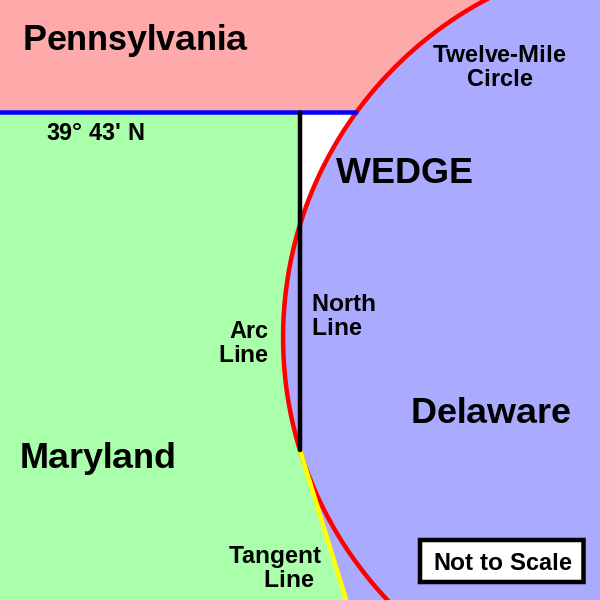
I think we've never had a President from the North that is not the East. We've had a lot of Presidents from Ohio, and in that video clip, where I'm talking about Scott Walker's chances as a midwestern-style person, Bob Wright gets fixated on Ohio Governor Kasich, but Ohio isn't what I mean when I say Midwest. Note that I have lived in Wisconsin for the last 30 years, so I have an idea of the Midwest (and the North), but I consider myself from the "mid-Atlantic region," born and mostly raised in Delaware — just about exactly at the place where the Mason-Dixon line would cross if the mapmakers hadn't switched to using a compass when drawing the head on the little man called Delaware....
I am an insider/outsider in the Midwest. I think I get the cultural style that one sees in people like Tim Pawlenty and Scott Walker who seem too bland for outsiders. I mean that I also get The Not Getting of It. It might help that my mother and her family were from Michigan. Bob is from Texas, which is a big place, so maybe that's why he blithely groups Wisconsin with Ohio. He also sneered at the notion that Delaware is the South. I forgot to ply him with the question whether Texas is the South, but we were running out of time.
This post has become a grab bag of issues, so I'll load in one more, because news broke as I was writing this: "Lindsey Graham officially launches presidential exploratory committee." In the Bloggingheads clip embedded above, I talked about the problem of a Southern accent for a Republican candidate and say I think Americans have trouble with Lindsey Graham because of his accent. But the discussion of Midwesterners is not so much about the accent — though it is a problem if it's too exaggerated (as in the movie "Fargo") — it's the modest, low-key, seemingly bland style. But that problem could be an advantage. People might be in the mood for modest blandness. Of course, Scott Walker's opponents won't accept that picture of the man. They demonize him. How do you demonize modest blandness? Oh, it's an old game here intra-Wisconsin.
దీనికి సబ్స్క్రయిబ్ చేయి:
పోస్ట్లు (Atom)


 పోస్ట్లు


