"The band covered 'Little Bit O’ Soul' on its 1983 album 'Subterranean Jungle.' The ever-arty Talking Heads gave their own disjointed spin to '1,2,3, Red Light' while performing in their early years at CBGB, the Bowery club that was a cradle of punk rock. No less a rock purist than Lester Bangs, the storied gonzo critic, eventually gave bubblegum its due in the 1992 book 'The Rolling Stone Illustrated History of Rock & Roll.' 'The basic bubblegum sound could be described as the basic sound of rock ’n’ roll,' he wrote, 'minus the rage, fear, violence and anomie that runs from Johnny Burnette to Sid Vicious.'"
The links in the text go to the Ramones and Talking Heads covers, but here's a Spotify playlist I made of the original version of those 2 songs along with all the other Kasenetz and Katz songs named in the obituary. It's all great stuff — 9 songs, 22 minutes:
"... was surely meant to be barbecued chicken wings. Not (entirely) displeased with my catch, he introduced me to his production editor — the person in a publishing house in charge of hiring copy editors and proofreaders.... In my early days, I would sulk in my office with the door closed if I found out that one of my books included a typo. A sentence referring to 'geneology' once sent me into a blue funk for hours.... I’m occasionally asked whether I can make my way through the world without shivering under the constant bombardment of typos.... [O]nce, watching the movie 'My Week With Marilyn,' I elbowed my husband sharply in the ribs over a prescription bottle, visible on a night table for approximately a second and a half, whose label read 'Tunial' instead of 'Tuinal.'
'I think it must hurt sometimes to live in your brain,' my husband has said on occasion, not unkindly. But, as he also notes, in a kind of nursery rhyme mantra, 'Your strengths are your weaknesses, your weaknesses are your strengths.'"
I don't want to send Dreyer into a blue funk, but if I were writing an essay that had the line "passing reference to barbecued chicken ribs," I would not also have "elbowed my husband sharply in the ribs." It's a repetition of a distinctive image — ribs — for no recognizable reason. That's a language mistake. Make it your husband's arm. You're in a movie theater. It was more likely his arm that you elbowed anyway, wasn't it? You just liked "ribs," but your feeling of liking it came, I'll bet, from having seen it so recently.
And here's the Wikipedia entry for Tuinal, a Eli Lilly sleeping pill introduced in the late 1940s and now discontinued:
I was just stumbling around in Wikipedia, researching the insult "greasy," skimming through the subject of the "greaser sub-culture" — "The band Sha-Na-Na models their on-stage presence on New York City greasers (the band members themselves were mostly Ivy Leaguers)" — which led me to the article on "Sha Na Na":
Conceived by George Leonard, then a graduate student in humanities, Sha Na Na began performing in 1969 at the height of the hippie counterculture, and achieved national fame after playing at the Woodstock Festival, where Rob Leonard, the president and bass singer of the band, sang the lead on “Teen Angel” when the band opened for their friend Jimi Hendrix. Their 90-second appearance in the Woodstock film...
... brought the group national attention and helped spark a 1950s nostalgia craze that inspired similar groups in North America, as well as the Broadway musical Grease (and its feature film adaptation), the feature film American Graffiti and the TV show Happy Days....
That was a culturally powerful 90 seconds!
From 1969 until 1971, the band played at, among other places, the Fillmore East and Fillmore West, opening for such bands as the Grateful Dead, the Mothers of Invention, and the Kinks. When Sha Na Na began headlining at other venues, one of their opening acts was Bruce Springsteen...
On their album The Golden Age of Rock and Roll, the lead singer taunts the audience on one of the live tracks by announcing, "We've got just one thing to say to you fuckin' hippies, and that is that rock and roll is here to stay!"
Americans are always looking back to a golden age. Compare "Make America Great Again." Question whether Donald Trump's present day version of "you fuckin' hippies" is any less satirical than Sha Na Na's. They're all Ivy Leaguers restyling American culture for the edification and education of the American People.
And how about those Ramones? How much of a comedy routine were they? And how did they interface with American politics? I'll just say that at the time, in the 70s, I regarded them as a comic act, and let me give you this from Wikipedia:
[Joey and Johnny] were politically antagonistic, Joey being a liberal and Johnny a conservative. Their personalities also clashed: Johnny, who spent two years in military school, lived by a strict code of self-discipline, while Joey struggled with obsessive-compulsive disorder and alcoholism....
First, let it be known that I am of a mind with the likes of Mark Steyn, Tucker Carlson, Glenn Reynolds and most of his contributors at Instapundit, as well as Breitbart and Milton Friedman. In short, I am what they now call an arch-conservative. So I do not find patriotism or patriotic sentiment hard to bear; believe me, I'm all in.
Problem is Lee Greenwood and his song. As a bona fide failed songwriter living in Nashville for over 30 years, I can tell you that God Bless the USA is widely reviled, both for its construction, the timing of its release, and its author. It is a horrible, terrible, amateurish song about on the level of If I Said You Had a Beautiful Body Would You Hold It Against Me (Bellamy Bros. from about the same era). Putting aside for a minute the fact that Lee Greenwood is the very epitome of an oily Vegas lounge singer (which is what he was), the song itself is an embarrassment, chock-full-o' patriotic phrases poorly strung together, poor rhymes you can see the writer stretching for from a mile away, and bad grammar (not on purpose). There is no build up in either the melody or the lyrics.
As someone who actually cries when reading the Gettysburg Address and who loves quality songs from He Stopped Loving Her Today, to Georgia on My Mind, to Yesterday, to I Just Wanna Be Sedated, I cringe whenever God Bless the USA comes on. It is so transparently a piece of merch and so poorly constructed at that, it just makes my teeth hurt.
I'll stick with God Bless America.
It's "I Wanna Be Sedated," not "I Just Wanna Be Sedated," but I'd like to think Nashveganite was making a sly, subtle reference to the "at least I know I'm free" in "God Bless the U.S.A." The Ramones did not say they wanted nothing more than to be sedated. They wanted other things too. They wanted to be taken to the airport and put on a plane, for example. Lee Greenwood, on the other hand, expressed love for the country based on a single factor: knowledge of freedom.
While I'm at it, let me say that I've been thinking a lot about the phrase "God bless..." — not only in patriotic songs but in person-to-person interactions, post-sneezing and otherwise. It seems religiously wrong. Quite aside from dragging God into the mundane and the political, is it telling God what to do? I think the linguistic explanation is that it's a shortened form of "May God bless [you/America]" and merely expresses a hope.
There's strong Biblical support for "God bless you," and we may learn something from studying the classic form in the Old Testament: "The Lord bless you and keep you; the Lord make his face to shine upon you and be gracious to you; the Lord lift up his countenance upon you and give you peace." What about the New Testament? Did Jesus tell us to say "God bless you"? Interestingly enough, Jesus said: "Bless those who curse you, pray for those who abuse you." Perhaps American Christians should be singing "God bless North Korea."
After last night's concert, wet from the rain and up past my bedtime, I wrote this list in my iPad to prompt me to remember things I might blog about. I didn't number the list, but now I see there are 9 items. Would have stretched for a 10th if I'd noticed. Since I'm getting a late start blogging, I'll give you the list for its enigmatic value and update item by item as I explain (or attempt to remember) the meaning:
Head high, glow sticks, no
Mansplainer lists jimi etc
Curly headed guy reeks, anosmia
Iphones
Diaries
Rain
Fifty years, first album
Whitest crowd
Standing os
Head high, glow sticks, no — Before the concert a woman came around to foist glow sticks on us. I said "no" approximately 10 times, with added protestations about not wanting the responsibility and concern about the potential for toxic leakage. But she would not take "no" for an answer. I ended up with a glow stick and instructions to break it to light it up and wave it around during "Hold Your Head Up." After she left, I said to Meade: "Whatever happened to no means no? If this were a rape trial, she'd be guilty."
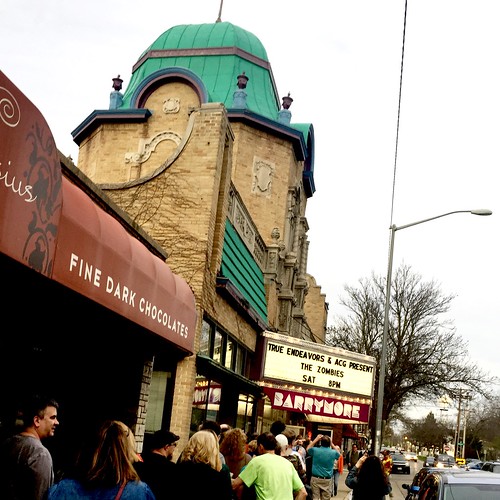
The woman was not an employee of the theater, just a big fan, she said. A big fan of Argent, I guess. "Hold Your Head Up" is not a Zombies song, but the biggest hit of the band the Zombies' keyboard player Rod Argent formed after The Zombies. I did not follow Argent — it's prog rock — but I have heard the song on the radio enough to find it catchily familiar. It lends itself to glow-stick foolery in the chorus, which has a triumphant "Hold your head up WOMAN/Hold your head up WOMAN." You can stab the stick up and forward in a Heil, Argent salute on the "WOMAN." And trust me, the word is "woman," not "WHOA!" Rod Argent explained that to us.
Mansplainer lists jimi etc — Since it was general admission, you get there early and once you get that seat you want, you're going to have to sit in it for a good 40 minutes before the music starts. What to do with your time? You could talk, or you could try to read while the man in back of you talks. Who he talked to, I don't know, because he did all the talking. He was suffering from the delusion that his seatmate would admire him if he told her, one by one, about every concert he attended approximately half a century ago, complete with quotes from his father — "I don't care who the hell is playing" — can you imagine? Jimi was playing. One story like that, fine. But the man had an endless list, the next story always cued up and ready to stop the other person from offering the slightest contribution. At one point, I nudged Meade and started to lean over to whisper something like "That guy's concertsplaining" but Meade's slight smile and nod was enough to communicate to me that he and I were thinking exactly the same thing. You can't eavesdrop on Althouse and Meade doing mental telepathy in Row H.
Curly headed guy reeks, anosmia. That seat I was hoping would stay empty, the one right in front of me, between 2 couples, got filled at the last minute by a late-sixies-ish — in more ways than one — man with a big head of curly gray hair. Oh, no, he's sitting in front of me and he has big hair. Why'd I have to get the big hair guy? My problem was merely visual. (And, really, he only blocked my view of a large black box, which looked like the same box that temporarily deafened me in the right ear when I saw The Ramones play The Barrymore on May 27, 1995, just 3 weeks after we'd seen Mike Watt and The Foo Fighters.) But I'm differently abled. I have anosmia. Meade is more olfactorily aware. After the concert, Meade said: "That guy reeked of weed."
Iphones. Speaking of visuals. So distracting. Put them away, people. I considered getting my phone out to get one picture, but I thought it was too selfish, this idea that I should get one too. But it wasn't that everyone in the theater felt entitled and inclined to take one picture. It was that about 2% of the people thought it was okay to hold up their phone and video an entire segment. The screen looks very bright in the dark audience and it points back at everyone behind you. And maybe it's just me — the screen addict — but when I see the lit screen, I have to look at it. It's just riveting, even though it's nothing but an annoyance.
Diaries. There was no opening act, just 2 parts to The Zombies' performance. (The first set was a variety of things, including the aforementioned "Hold Your Head Up" and The Zombies' big hits "Tell Her No" and "She's Not There," and the second half was a second-by-second, live reproduction of the highly admired, influential studio album "Odessey and Oracle." (The spelling error on "Odyssey" is in the original.))
Between sets, I was reading on my iPhone. Arts & Letters Daily sent me to a review of a couple of books about graphomaniacs, including a woman who had written a diary that consisted of 148 volumes. The diarist, we're told, "never improves, never grows into art," because "She is deafened by solipsism." And: "Hers is probably the longest diary in history."
David Sedaris has kept a diary for forty years, during which he has filled a hundred and fifty-three handmade notebooks. The following entries, which document Sedaris’s years in Chicago, have been taken from the forthcoming book “Theft by Finding: Diaries (1977–2002),” which is out on May 30th from Little, Brown.
153?! That's more than 148, the number of volumes in "probably the longest diary in history." Kind of surreal to find that statement refuted numerically in the very next thing I read. And then there's the whole idea that the graphomania of the diarist is inherently limiting. People who write obsessively like that are solipsists, going nowhere. The career of David Sedaris tells a different story.
Rain. When the concert let out, it was raining and the car was 5 blocks away. No umbrellas or rain gear. It's funny how you can go years and years without getting soaked in rain. We're pretty good at avoiding getting caught in the rain, and I could have avoided it last night too by accepting Meade's offer to wait under the marquee...
... while he got the car, but I wanted to be with him. Enjoyed driving home with the rain on the street lengthening the lights...
... into glow sticks.
Fifty years, first album.The Zombies first album — which made up much of the first set — was an important part of the record collection that mattered so much to me in the mid-60s, when I was a teenager. The album came out in 1965, when I was 14. It was strange to think of being that teenager half a century ago, listening to that album on a record player something like this...
... and now to be so much older and to be hearing the band live, and they're older too but they sound just the same. One of the original Zombies has died, but the rest, along with me, are still living in the world, still enjoying the same songs, played the same way.
What would the person of the past — the me in the bedroom with the record player — have thought if she were to know that she'll get to see The Zombies live, but it will be 50 years from now, and it will be these songs — "Tell Her No," "She's Not There" — sounding just about exactly like this record she's playing over and over?
I think she would have found it very weird. In 1965, 50 years ago was 1915. No one was excited about songs from 1915 in 1965. My parents were still clinging to songs from 20 years ago, from 1945, and I thought they were hopelessly stuck in the past. In 1965, everything seemed to be changing every year. Just 2 or 3 years ago seemed very different and already replaced by much more advanced material. Ah, but no, in 50 years, you'll still be in love with the mid-60s music, and you won't be home alone — like you are now — with records. You'll be out in a theater jam-packed with people who feel the same way.
Whitest crowd. I said it to Meade as we were standing in line and I said it again as we were in our seats waiting for the show to start: "This is the whitest crowd I have ever been in."
Standing os. Standing ovations. I have never experienced so many standing ovations. The Zombies got a huge standing ovation just for walking out on the stage. For both sets. And they got a standing ovation after every song. And they got at least a partial standing ovation in the middle of some songs. At first, I could appreciate all the love, but after a while, I was getting cynical. All right. Settle down. Or even despairing: Now, mere clapping will seem like an expression of hatred.
I did some research. Are there too many standing ovations? Here's Ben Brantley in the NYT:
I would like to make the case, officially and urgently, for the return of the sitting ovation. Because we really have reached the point at which a standing ovation doesn’t mean a thing....
The S.O. (if I may so refer to a phenomenon that no longer warrants the respect of its full name) has become a reflexive social gesture, like shaking hands with the host at the end of a party.
Or, to put it in cruder and more extreme terms, it’s like having sex with someone on the first date, whether you like the person or not, because you think it’s expected.
And here's the English point of view, from Michael Henderson in The Telegraph:
Although the standing ovation purports to honour the performer, it is usually about the person who stands. It is, more often than not, a gesture of self-reward, or self-congratulation. It is a way of saying: “I have paid a few bob for this ticket, and I have got my money’s worth.”...
But this canker in our theatre-going is also rooted in a narcissism that has spread through all parts of life. ... It is about letting it all hang out, without embarrassment – or, as some pop psychologist put it after the death of Diana, Princess of Wales, it’s “emotional literacy.” Ah yes, of course.
At cricket matches, the cameras love to linger on those odd folk who dress up as Saracens and cavemen. Even at the rugby, a game played and watched by manly chaps, every try offers an excuse to let off rockets, metaphorically and sometimes literally. And to think they used to shake hands and say: “Jolly well done, sir!”
Ah, I wonder what The Zombies thought of us Americans, us Madisonians. We, most of us, must have thought, flattering ourselves, that we were showering them with love, rousing them to higher an higher heights. So eternally youthful, so bursting with energy. That's what the standing o-ers seem to think of ourselves. But perhaps The Zombies, being English, are more like Henderson in The Telegraph, and they'd prefer a more modest response. As John Lennon once said:
"... the directly Ramones-inspiring, 4th wall breaking cry of 'Second Verse, same as the first'.. to what extent could this track be considered an overlooked antecendent of the punk rock movement?"
That's an internet discussion I encountered after reading jr565's comment — "in regards to Henry Viii - now we know where the Ramones got their 'second verse, same as the first' from" — on last night's post about the #1 songs of 1965.
Here's how the song looked as interpreted by Patty Duke (in her Cathy persona) on her old TV show in 1965:
Here's the adorable original Peter Noone (in his Herman persona):
Born Erdelyi Tamas in Budapest, Hungary, and known professionally as Tom or T. Erdelyi, Ramone played [drums] on the first three epoch-making Ramones albums....
Joey Ramone died of lymphoma in 2001; Dee Dee succumbed to a drug overdose in 2002; and Johnny expired from prostate cancer in 2004.
Tommy died of bile duct cancer. Here's a clip of Tommy Ramone from 2012, talking about NYC songs, including The Ramones' "Rockaway Beach" (which he does in acoustic form):
I'm playing that and Meade — from the next room — says: "Boring. Sounds like a guy just making up stuff on State Street."
“We started auditioning drummers, but they just couldn’t grasp the concept of the band — the speed and simplicity,” Mr. Erdelyi said in a 2011 interview with the website Noisecreep. “So I’d sit down and show them what we were looking for and the guys just finally said, ‘Why don’t you do it?’ So I gave it a try and that’s when the sound of the band sort of solidified.”...
Official songwriting credits were shared by the full band. But Mr. Erdelyi was the primary author of several of the Ramones’ early classics, including “Blitzkrieg Bop,” which opens their first album with the chant “Hey ho, let’s go!” and features lyrics that boil teenage angst down to its most basic and kinetic:
What they want, I don’t know
... right now. Listen here. [UPDATE: The live broadcast is over now. But you can stream or download it here.]
NOTE: He's there to talk. There's also music that's not his. Don't let me confuse you into mistaking Elvis for Crack.
AT 10:20 CT: The music part is over and Crack is talking now.
AT 10:43: They are going through some kind of countdown of greatest recordings of all time (from the "psychedelic soul" view point), and I like that the Little Richard song is "Rip It Up." That's my favorite Little Richard song. AND: Trying to retrospectively add a Little Richard tag to this blog, I discover a hidden reference to Little Richard in the dialogue from the Beatles' movie "Hard Day's Night": "Have you no natural resources of your own?... You could learn more by gettin' out there and living!"/"Out where?"/"Any old where! But not our little Richard. Oh, no. When you're not thumpin' them pagan skins you're tormenting your eyes with that rubbish."
AT 10:50: Crack gives a shout-out to "Meade and Ann."
AND: Actually the countdown is of Uncle Ray’s Top 100 Albums. You can see the whole list here. Little Richard's "Little Richard, “Here’s Little Richard," is #78, and I don't know the criteria for picking the track from the album.
11:10: After Uncle Ray says he loves on-line trolls, Crack disagrees and says: "It can get very dark." And the next subject is Nirvana, because Nirvana's "Unplugged" is next on the list (at #74). Crack expresses great appreciation for Kurt Cobain, "including the way he took himself out. He was very definitive about that." The album cut playing is "All Apologies."
11:25: Discussion of the n-word. (NSFW on the music that follows.)
11:42: After Ray played Meatloaf (which I had to turn way down), Crack said: "Meatloaf is the perfect example of why The Ramones were so necessary."
11:45: Crack finds more misogyny in Led Zeppelin than in rap.
11:55: Ray says Crack will be back next week "unless you get a job," and Crack says: "You're as bad as people on line."
Mr. Seacrest said he intended the clothes to reflect what he wears. When manufacturers proposed lilac and green, he said "I wouldn't wear that," he recalled, in a recent telephone interview. "Sometimes they've said to me, 'You wouldn't wear this color but people like this color. They want to buy that color.' " Some shades of green made it into the neckwear collection, just "not bad leprechaun green," Mr. Seacrest said. Lilac was scrapped for blues and charcoals....
I love the word "curate" as used these days euphemistically to upgrade a certain sort of activity, to imbue the appropriation of the creative work of others with creativity of its own, making the selection and presentation perhaps even more refined and praiseworthy that the original work. I see the Oxford English Dictionary is watching this development, with a new meaning, a draft addition from 2011:
trans. In extended use: to select the performers or performances to be included in (a festival, album, programme, etc.); (also) to select, organize, and present (content), as on a web site.
1982 N.Y. Times 24 Jan. ii. 8/1 The Kitchen presented three different programs of ‘New Performances from P.S. 122’, curated by and including Mr. Dennis....
2003 Record (Kitchener-Waterloo, Ont.) (Nexis) 20 Feb. f6 You have every reason to be wary of a Ramones tribute album curated by Rob Zombie.
2006 Play: N.Y. Times Sports Mag. June 44/2 As you wade through the millions of words on ESPN.com, you wonder if anyone is curating what reaches the screen....
2010 W. J. Martin & X. Tian Bks., Bytes & Business iii. 45 Publishers will be..engaged in the business of generating, curating and aggregating content.
Conservatives are fond of the quote "People sleep peaceably in their beds at night only because rough men stand ready to do violence on their behalf." It's attributed in that form to George Orwell, though apparently the closest he got to saying it was:
I know Obama's quote is (hilariously) defective in its failure to give any significance to the work a business owner has put into his own business, but the reason Obama's quote is important that it's not merely an obviously incorrect overstatement, but that it reveals his frame of mind in putting the efforts of the collective people over the work of the individual.
But Obama opponents, in their eagerness to exploit that quote, are forgetting about the ways in which conservatives like to call attention to the dependency of the individual upon the collective.
So now, they've installed it higher — 20 feet off the ground. The last surviving Ramone, Marky, thinks it's too hard to see now. It's too high. Maybe they just need "a better way to attach it."
Yesterday's last post, with its showy outdoor insects -- bee and butterfly -- lured the cowering, timorous bug from the shadows. It's not easy hopping about on the keyboard, and these days there are new dangers. Here then, in full, is what blogging cockroach had to say:
ooh that is such a beautiful picture
brings a tear to my beady eyes to think of a world of light and air and pretty flowers while i'm stuck under the fridge in the dark except when i can get to tommy's computer --tommy is the boy whose computer i use-- and all that beauty makes me think of music too --you know i have the transmigrated soul of a composer-- and i do wish tommy would put on the music i ask for
now, what music does that scene remind you of... me, i think of a bartok string quartet tommy's usually playing the ramones
anyway, speaking of air tommy's mom got a new macbook air you know the one you could wrap fish in if you're not careful tommy wants one too says it will eat less space in his back pack only trouble is i watched mom snap that thing shut --whap-- i asked tommy how could he make sure he wouldn't just slam that sucker shut when i'm in the middle of a comment he says there's lots of room between the keys sorta like an old typewriter my great great great, etc. grandfather had to hop around on, but could also hide in when the time came no room to hide near modern technology i'm afraid my only hope would be to flatten myself out next to the command key, which has a flower on it
anyway, i told tommy he could just leave me the fish after mom mistook the computer for a freezer bag
she was wondering if she could get a glass of sancerre to calm her nerves at the genius bar
I'm touched by the solace of the non-flower on the command key, and I wonder what a tear would look like in beady eyes of a cockroach. How can I show my feeling? I've added a thumbnail of the picture that moved the little beastie and a link to help readers understand his ancestry. A here's one more thing, evidence that I did trouble myself, yesterday, to look into the eyes of the insect...
... with apologies that it was an outdoorsy fellow, with a real flower.
ADDED: Yes, that's a moth, not, as I wrote, a butterfly. I talk about this mistake -- and blogging cockroach -- in the new vlog.
2. I think about blogging the item — you know, the obvious (being supported by the French isn't helpful for a guy who's getting called elitist) — but first, since I'm already in the middle of an iChat with my Obama-supporting son John, I quote the title of the article to him. He's all "Who's Oba?" And I'm "What's nia?" He wonders if it's pronounced "Obama - NIA" or "oh - BAH - MAY - nee - uh." I observe that "Obamamania" would have the word "mama" in it. The blogging gears of my head are trying to engage. Is some fear of the mother figure causing resistance manifested at the orthographic level? Fear of Hillary? And then John responds "Obamamamamania."
3. Suddenly, all I want to do is listen to the song "Papa Oom Mow Mow," but I don't know how to spell it. (I miss the "Oom." I think it's just "Oo.") And you have to spell to do internet. But I happen to know that song is by The Trashmen, and I know another song by them that I can spell, so I figure I'll get into YouTube that way, and the hard-to-spell song should come up in the suggestions. So I look up "Surfin' Bird."
6. YouTube reminds me that the song was used in "Full Metal Jacket":
7. I start to think that the use of "Surfin' Bird" in "Full Metal Jacket" is a more interesting subject for blogging than the French (who, by the way, are responsible for Vietnam).
8. In the film clip, "Surfin' Bird" turns into "Papa Oom Mow Mow" and I refocus on my simple desire to hear a cool song from my younger days.
9. John comes through with the proper "Oom" spelling and a link to Wikipedia, which doesn't mention The Trashmen version of the song, only the earlier Rivingtons doo wop version. It turns out that the Rivingtons also made the precursor to "Surfin' Bird," which they called "Bird Is the Word." I barely remember the doo wop "Papa Oom Mow Mow," but I find it on YouTube as the soundtrack to a video about coffee. Coffee distracts me:
10. I still can't find "Papa Oom Mow Mow" by The Trashmen. By now, I realize that the available recording of "Surfin' Bird" ends, as it does in the movie clip, with "Papa Oom Mow Mow." But I am almost certain that The Trashmen released "Papa Oom Mow Mow" as a free-standing single before "Surfin' Bird." Yet this 1964 album of theirs makes me doubt my own memory. But I had the 45!
11. I realize my post is going to be the story of my little Sunday morning journey across the internet and into the canyons of my 1960s memories. I'm going to post it as a list, perhaps an 11-item list, and then, I'm going to sit back and see what it causes you to talk about.
Have you been watching Bill O'Reilly interviewing Howard Stern this week? It's been highly amusing. In my view, Stern wipes the floor with O'Reilly -- though, as a visual image, I'd prefer O'Reilly wiping the floor with Stern, Stern bearing the greater physical resemblance to a mop. He's so tall and skinny and that hair! But the hair has lost its old Ramones feeling. Now each curl is meticulously arranged, including the long strand that hangs over his eye, trying to act like it just fell forward, but rigidly twirled just so. He must have a hairdresser who follows him everywhere (like Valerie Cherish's Mickey). What do you think Stern's curl-wrangler gets paid?
Stern is so sharp that he makes O'Reilly look smushy. The O'Reilly bluster just can't get going. O'Reilly seems cowed by the knowledge of how damned much money Stern is getting from Sirius radio. Is it $500 million? Stern wouldn't quite say. Is it $500 million? O'Reilly kept asking.
News Hounds -- "We watch FOX so you don't have to" -- summarizes last night's Stern/O'Reilly encounter:
"Who's your audience?" O'Reilly asked.
Stern set the tone for the rest of the interview by answering, "Strippers, hookers and crack whores." Then he tried to explain that he always envisions his audience as a guy going to to work, a buddy in the locker room talking honestly about reality....
From all this, somehow O'Reilly concluded that Sterns audience was a "blue collar guy." Stern shot back with the analysis of the Scarborough Report which concluded that his audience was highly educated and high income.
O'Reilly didn't like that and made a crack about having lesbians on his show. Stern didn't blink answering, "There will always be lesbians. I will give the people lesbian's because theres nothing sexier than two women getting it on." One can only imagine what Bill was thinking?
Before O'Reilly could respond to the lesbian comment, Stern turned to O'Reilly's merchandise sales making cracks about all the "kazari". "Who's walking around with a Bill O'Reilly briefcase?" he wondered. O'Reilly got all indignant and self righteous about giving 100% to charities like Habitat For Humanity but Stern claimed that he didn't believe it.
Making fun of O'Reilly he quipped, "Come outside with me right now!" O'Reilly then suggested that Stern could build houses for poor lesbians.
Stern then accused O'Reilly of selling the stuff out of ego and demanded a jacket for free. O'Reilly offered it on the condition that he wear it. "I won't wear it but I'll give it to a crack whore."
I have a little hearing loss in my right ear as a permanent memorial to you. Here's the NYT obit. Blog readers may enjoy this political part:
Mr. Ramone was often at odds with the members of his band, over dress, politics and relationships. A staunch Republican, Mr. Ramone clashed with Joey over that singer's liberal causes, and when the band was inducted to the Rock and Roll Hall of Fame, Mr. Ramone said, "God bless President Bush, and God bless America."
UPDATE: Let me add two things. First, an emailer called attention to this line of the NYT obit: "Mr. Ramone once described his guitar style as 'pure, white rock 'n' roll, with no blues influence.'" Elsewhere, the obit calls his style "fast, buzz-saw blasts of noise [that] laid the foundation for a school of rock guitar" and quotes him as saying "I wanted our sound to be as original as possible. I stopped listening to everything." I hadn't noticed that "pure, white" line when I first read the obit, and I have to admit that I can't help reading that and finding it racist or at least too racial to be an appropriate thing to want to say, even given the extra latitude given rock musicians. But the emailer notes that we commonly call music black, and I'm sure Eric Clapton's obituary will emphasize that he adopted a black style. So is there something wrong with calling a style "white"? I mean, other than as a put-down.
Second, I wanted to note that one of the long answers in today's NYT crossword puzzle is the name of The Ramones last album ("Adios Amigos"). The clue contains no reference to The Ramones, but I wonder if this was just a coincidence or a deliberate tribute to The Ramones.
"Punks will tell me, `Punk and capitalism don't go together,' " [22-year-old Nick] Rizzuto said. "I don't understand where they're coming from. The biggest punk scenes are in capitalist countries like the U.S., Canada and Japan. I haven't heard of any new North Korean punk bands coming out. There's no scene in Iran."
That photograph by Richard Perry is the photo of the year for me. I don't even know how to say how much I love that photograph!
The article notes:
Johnny Ramone, the guitarist for the Ramones, has been an outspoken Republican for years, and some skinhead bands have blended the punk aesthetic with their extreme right-wing views.
(Just go ahead and lump Republicans and skinheads together!)
I like this quote from Ian MacKaye (of Fugazi) who "likened the punk aesthetic to furniture":
"Once it's built you can put it into any house," he said. "You can be a lefty and go to Ikea or you can be a right-winger and go to Ikea." Punk, he said, "is a free space where anything can go — a series of actions and reactions, and people rebelling and then rebelling against rebelling."
I am a participant in the Amazon Services LLC Associates Program, an affiliate advertising program designed to provide a means for me to earn fees by linking to Amazon.com and affiliated sites.
Encourage Althouse by making a donation:
Make a 1-time donation or set up a monthly donation of any amount you choose:





 పోస్ట్లు


