Subheadline: "It wasted $750K during the Trump years and freely handed out Ambien and Provigil." The article links to a recent report from the Department of Defense’s Office of the Inspector General, which covered the years 2009 and 2018.
Read the report to see what it has to say about whether things were worse during the Trump administration. It looks as though the main problem was the failure to substitute generic drugs for name brands, which seems to resonate with Trump's own business, so heavy on the name brand.
This story made me think about the JFK conspiracy scene in the movie "Slacker":
Pretty fine little film. Not sure whether it has the intended effect — seems too pro-violence! — but I'm a fan of Linklater's early film "Slacker," so, whatever.
ADDED: Source material from Linklater's 2011 movie "Bernie":
That's a quote from I don't know who, passed along to me by a reader I do know, and linking to this:
ADDED: "This music" — according to the email — refers to "Lofi," defined as "a new offshoot of hip-hop." My understanding of the music term "lo-fi" was not something new or growing out of hip-hop. I remember it as something from the 1990s that grew out of indie rock... but, obviously, the same word could be used independently by 2 different things, either out of ignorance, a desire to confuse, or based on a belief that the earlier usage was more or less dead.
During the 1990s, the media's usage of the word "indie" evolved from music "produced away from the music industry's largest record labels" to a particular style of rock or pop music viewed in the US as the "alternative to 'alternative'". Following the success of Nirvana's Nevermind (1991), alternative rock became a cultural talking point, and subsequently, the concept of a lo-fi movement coalesced between 1992 and 1994. Centered on artists such as Guided by Voices, Sebadoh, Beck, and Pavement, most of the writing about alternative and lo-fi aligned it with Generation X and "slacker" stereotypes that originated from Douglas Coupland's novel Generation X and Richard Linklater's film Slacker (both released 1991). Some of the delineation between grunge and lo-fi came with respect to the music's "authenticity". Even though Nirvana frontman Kurt Cobain was well known for being fond of Johnston, K Records, and the Shaggs, there was a faction of indie rock that viewed grunge as a sell-out genre, believing that the imperfections of lo-fi was what gave the music its authenticity.
In April 1993, the term "lo-fi" gained mainstream currency after it was featured as a headline in the New York Times. The most widely-read article was published by the same paper in August 1994 with the headline "Lo-Fi Rockers Opt for Raw Over Slick"....
Rap is only mentioned in the "See also" links at the bottom of the article, as Cloud rap ("Cloud rap (also known as trillwave or based music) is a microgenre of hip hop music... typically characterized by its 'hazy,' lo-fi production") and SoundCloud rap ("SoundCloud rap is a music genre that originated on the online audio distribution platform SoundCloud... characterized as 'simplistic, subdued beats, often with snippets of strings and sometimes complemented with emo chords, paired with lyrics that ping-pong between braggadocio and nihilism, with lots of sex and odes to heavy narcotics').
"... after lawmakers went public with a torrent of accusations leveled against him by nearly two dozen current and former colleagues from the White House medical staff," the NYT reports.
I was surprised at the headline because I'd heard Trump say over and over that it was up to Jackson to decide whether he would resign, but I see in the third paragraph that it was Jackson, issuing the statement saying that he was withdrawing:
“Unfortunately, because of how Washington works, these false allegations have become a distraction for this president and the important issue we must be addressing — how we give the best care to our nation’s heroes,” Dr. Jackson said in a statement provided by the White House press office.
He said that the charges against him were “completely false and fabricated.”
What was he accused of? What came out yesterday was the worst:
In one instance, Dr. Jackson stood accused of providing such “a large supply” of Percocet, a prescription opioid, to a White House Military Office staff member that he threw his own medical staff “into a panic” when it could not account for the missing drugs, the document said.
In another case, at a Secret Service goodbye party, the doctor got intoxicated and “wrecked a government vehicle.”
And a nurse on his staff said that Dr. Jackson had written himself prescriptions, and when caught, had simply asked a physician assistant to provide him with the medication.
ADDED: The idea of a White House doctor handing out drugs calls to mind the JFK conspiracy theory buff in the movie "Slacker":
In the movie "Slacker" — which I was just talking about in the previous post — there's a scene where a young woman browsing in a bookstore is accosted by a JFK-assassination-theory buff whose opening line is "Hey, I see you're reading Rush to Judgment":
"Oh, that's an excellent book.... You know, you're reading one of the greatest books on the subject; it's great. Rush to Judgement has all that testimony from all the witnesses that were never called before the Warren Commission. Like Mrs. Aquilla Clemmons, who was that maid who lived on Patton Street who saw the Tippet shooting... and it wasn't Oswald that did it — of course you know it WAS Jack Ruby... This is also the book that's got the testimony of Sam Holland, you know the Prince of the Puff of Smoke. Yeah, he was up there on the overpass over Dealy Plaza and he was able to see just everything...."
"We are obsessed with our city’s identity and sense of community, and we are particularly wary of outsiders who come in promising to change us.... A collision of communitarian social activism with Ayn Rand-style technology disruption was probably inevitable. 'Wrong fight. Wrong time. Wrong town,' said Ron Marks, an alum of the old punk rock scene who had a role in 'Slacker.' To be clear: The city never told Uber and Lyft to leave. But it did insist that they play by our rules and have drivers be fingerprinted, just like cabbies — particularly after the police investigated at least seven alleged sexual assaults by ride-share drivers in 2015. Instead, the companies responded by helping to put Proposition 1 on the ballot: They would be absolutely exempt from fingerprinting by the city. Period. That was the second mistake. They arrogantly confused a convenience for a few as a necessity for the many.... Uber and Lyft have claimed they will reduce the nation’s traffic, but in Austin they just added to the aggravation...."
Well, not only is "The Life of Pi" one of my all-time favorite books, but "Slacker" is one of my all-time favorite movies. So my first question is, which one was Ron Marks? He played the role of the Bush Basher, who's just a guy we see in one little scene, ranting about Bush:
Anyway, obviously, Austin thinks it's special. It is special! And one thing about it is the traffic is horrible — not just way overcrowded, but aggressive as hell. The other drivers want you the hell out of there. I am not surprised these people voted against Uber drivers crowding them in their fiercely guarded car space. I know all about the highway version of the "sense of community" they have down there.
I was reading those 2 things this morning after getting halfway through the second episode last night. I'd watched episode 1 in it's entirety a few days before. I'd noticed the critical attention the show was getting, and Matthew McConaughey had just won the Oscar, so I gave it a chance. Why did I stop midway through episode 2? It wasn't the sex. It was the mumbling. Between McConaughey and the other guy who looks too much like him (Woody Harrelson), it was way too much 2 guys mumbling. This show could not fill the aching gap left by "Breaking Bad," which we watched, all 60 episodes in just about exactly 60 days. In "Breaking Bad," not only was it easy to tell Aaron Paul and Bryan Cranston apart, but the 2 actors frequently spoke quite clearly.
"Mesmerizing. He speaks like how a Beckett novel reads, just with some surferisms thrown in. Ending is about as bleak as Beckett, too. Someone get that guy a wet suit and a hug if it's real, which I doubt. Still mesmerizing either way."
I thought it seemed like an extra scene from the movie "Slacker."
Oh, but no one can step in and imitate Rush. With the exception of Mark Steyn, all of Rush's guest-hosts mostly make you think about how much better Rush is and: When is Rush coming back? (Steyn does his own thing, and it's brilliant. I prefer him to Rush.)
It would have been foolish for Rove to go all bombastic and over-confident on his first radio show, so Varadarajan's criticism is lame:
Rove, by comparison [to Rush], is a lightweight. What we learned today is that he does not have the voice for radio. By that I mean not just that his timbre is too thin, his tenor too brittle, but also that he has little oratorical or rhetorical structure, and no apparent ability to cast a spell over listeners.
Ha. He's from Austin, Texas. He sounds like a character from the movie "Slacker." I found that charming ... disarming. Rush gets a lot of his oratorical power from his self-conception as an outsider — actively excluded from the power-elite in Washington. Rove is the opposite — so self-restraint is good.
Reading his weekly column in The Wall Street Journal, one was already aware of the modesty of his mind. In fact, his column has done much to baffle many Americans: How on earth did this man become the dark genius of the liberal imagination? Listening to him riff on the radio, one was filled with retrospective alarm: Was this the mastermind in the Bush White House?
Oh, Tunku! Do you really imagine the President, in his confidential, private conversations, listening to a Limbaugh-like blowhard overwhelming him with a big rant? Try to imagine why Rove's style works in the context in which he was highly successful. Gentleness and friendly, quiet, sound advice... is it really such a puzzle?
We almost never watch movies. We're too fragmented. But "Slacker" is fragmented, and, thinking we could put up with that, we ended up watching the whole thing. In the end of the movie — and I realize I've watched the beginning many times and the end only a few — the camera flashes on the book "Growing Up Absurd." We were trying to remember the author's name, and Meade got it right. We were talking about what a verbal tic it used to be to call everything "absurd."
But it's slightly maddening when you feel there's a word, and you just can't pull it out of your brain. A colleague of mine is looking for a word that expresses a phenomenon embodied in these 3 examples:
1. I go to the track and place a bet on a horse because its name is the same as my son's and the jockey is wearing #5, which is my son's hockey jersey number.
2. I can't decide what to order for lunch so I decide that I'll order whatever the person in front of me orders.
3. I'm not sure what color car to purchase so I decide to purchase the color of the next car that drives by my house.
Now, I think #1 is distinctly different from 2 and 3, because in #1, she knows what the answer is when she adopts the rule. In #2 and #3, she excitingly adopts the rule and locks herself into a result that is unknown. But all 3 are about adopting a rule to make a decision while knowing that there is nothing about the rule that will improve the quality of the decision. One could superstitiously believe that the rule would make the decision good or religiously believe — in examples 2 and 3 — that God knew you'd adopted the rule and was giving you a sign about what was the right decision. And one could think that the rule would generate randomness where somehow a nonrandom decision seemed bad. But basically, the decisionmaker is being playful or poetic.
So is there a word for this?
And do you have any good examples of using this sort of decisionmaking — colorful and exciting rules you've made for yourself? Obviously, there are a lot of standard ways approaches like rolling the dice or consulting the Magic 8 ball, but how about some weird stuff? Or why not make up a rule for yourself about something right now and do it? Got a decision to make? Make it based on something strange and as-yet-undetermined. And tell us about it.
***
This made me think of "Slacker" — one of my favorite movies. We see 2 women walking along the sidewalk. One says: "The next person who passes us will be dead within a fortnight." But that's not a case of the phenomenon my colleague means – not unless we're supposed to view the speaker as a murderer choosing a victim. The standard interpretation is that she's a psychic.
ADDED: Someone in the comments mentions Dadaism, and that reminds me of "A Book of Surrealist Games." I think example #3 could be seen as a sort of surrealist game. The more we talk about these examples, the more I think they are 3 different things. Several commenters have said that #1 is superstition, and I think it is either superstition — in the form of overvaluing a coincidence — or a sentimental delight in coincidence. #2 seems to be conformity or a rational bet based on a tiny amount of evidence. Someone who is eating here is eating that, so maybe he knows what's good. Only #3 is surrealist and dangerous — but nowhere near as much as if you'd chosen the color of your car based on something other than the color of someone else's car. Chances are it will be an ordinary car color, and at least someone else has seen fit to get a car that color. That said, I saw a bright purple car 2 days ago. It looked like hell. And I love the color purple. It just looks like hell on a car.
That was the challenge last night on "Top Chef," which this post won't spoil, but there are spoilers at here, where I read about it. (I haven't watched this season of "Top Chef." Maybe I'll catch up with it later. Is it good this time around?) Anyway, Jim Hu, at the link, thinks the contestants made pretty lame movie choices. They should have been less literal, more creative, and more cleverly knowing about the content of a good movie. His choices:
Wizard of Oz: Rainbow trout with artichoke hearts and a poppy seed crackers. Spartacus. Escargot... and oysters. Duck Soup. Perhaps an exception to the obviousness rule, but how can you not do this? The Godfather: Fish baked in parchment.
The main entree could be Dances with Wolves Buffalo steaks. Or you could do Silence of the Lambs, but only if you serve the lamb with fava beans Citizen Kane Rose sorbet
Commenters, surely you have some ideas! Me? Well, my favorite movie already is about dinner: "My Dinner With Andre." To be creative and knowing, we'd have to get past the potato soup and squab and come up with something from inside the stories Andre tells. Maybe something covered in coarse salt to represent sand — Andre eats sand in the Sahara Desert (and laughs). [ADDED: Actually, he doesn't laugh: "We weren't trying to be funny. I started, and then he started, and we just ate sand, and threw up. That was — that was how desperate we were."]
Let me go on to the rest of the favorite movies I list in my Blogger profile:
"Aguirre the Wrath of God." This should not be an opportunity to serve Spanish or Brazilian food. I'd be all about the seaweed. (When they're really hungry they pull algae out from between the logs of the raft.)
"Crumb." The first thing I think of here is a drawing of a can labeled "[unwritable word] Hearts." Next, I think of Maxon Crumb ingesting a long strip of cloth dipped in water (to clean out his innards). Let's skip this movie.
"Grey Gardens." Paté on crackers! [ADDED December 20, 2014, after watching this movie again: ice cream right out of the container, Wonder Bread, cat chow, and corn on the cob.]
"32 Short Films About Glenn Gould." Pills!
"Limelight." Hmmm. Limes? No, the lime in limelight is not the fruit.
"It's a Gift." Kumquats!
"Dr. Strangelove." To drink: nothing but distilled water. [AND: Pure grain alcohol!] Food: a big buffet table. And every night: a food fight. That's our restaurant gimmick: We encourage the patrons to throw food. "The Grave of the Fireflies." In this movie, a Japanese animation, children starve. Must skip. "The Nights of Cabiria." Too easy of an excuse to make Italian food. Nothing specific comes to mind. "Fast, Cheap & Out of Control." Well, we can't serve lions or mole rats. Robots are not edible. We'd have to come up with some way to make topiary shapes out of things. "Slacker." Sorting through my memories of this movie, I'm just seeing a lot of coffee. IN THE COMMENTS: The name Ted Turner comes up, and there's a suggestion that his movie would be "Soylent Green."
Do you have a comfort movie? This would be a movie you rewatch in times of stress, when you want to create a comfortable environment for yourself. My son John says he uses the "Back to the Future" movies to mellow out at exam time. He says a lot of people his age -- mid-20s -- have "The Princess Bride" as their comfort movie? So, what's yours?
When I was in college -- in the days before home video -- one campus cinema always showed Marx Brothers movies at exam time. It was understood that this was what you watched to escape the stress. I was trying to think of what I would have now that fits in this category. I was going to say "My Dinner with Andre," "Slacker," "Fast ,Cheap and Out of Control," and "Grey Gardens." But John is disqualifying these choices on the ground that these are actually movies that I consider great, not the sort of junk food that we're trying to talk about here. It's true that I don't have any not-actually-great movies that I like to rewatch for comfort's sake. He says that I use TV reality shows for this. He's right. You know, the other day I watched three episodes of an old season of "Survivor."
(Song that John is playing that is amusing me while I write this post: "Nuages"... by Django Reinhardt. I'm looking for a YouTube clip of that for you, but what I'm seeing is that everyone tries to play that song.)
HEY: This post has a vlog:
And John never found the clip.
OH: I thought of one -- look, we watched it the day I wrecked my car -- "Serial Mom."
"I'm talking about form. I'm talking about content. I'm talking about interrelationships. I'm talking about God, the devil, Heaven, Hell. Do you understand?"...
"Play the game, Harding. Play the game. Play the game. Play the game, Harding."...
"I don't think he's overly psychotic, but I still think he's quite sick."...
"What do you think you are, for Chrissake, crazy or something? Well, you're not. You're not. You're no crazier than the average a**h*le out walking around on the streets, and that's it."...
"Time spent alone only increases the feeling of separation."....
"The best thing we can do is go on with our daily routine."
I hadn't gone out to a movie theater, I think, since last December January. (The movie was "Capote.") I'd been considering various movies but never quite got sufficiently motivated until today. It's not just that I wanted to see "A Scanner Darkly." It's that it was also disgustingly hot out, and that pushed me over the edge.
I love Richard Linklater -- the director -- mostly from "Slacker," which will always be one of my very favorite movies. And I'm interested in Philip K. Dick enough to care. I also like flat animation a lot, even thought Linklater's watery, flow-y rotoscoped style, which I'd seen in "Waking Life," is not my favorite thing. But that was enough. I finally went to the movies.
I took some folded up notebook paper in case I wanted to write down quotes for a blog post. Here, let me put this through my scanner (darkly):
The word "bigs" is supposed to be "bugs." I wrote that during the first scene, which was harrowing... and involved bugs. I forgot I'd already written on that side of the fold when I wrote down a sentence from a long conversation three hopeless Substance D addicts had about a guy who wanted to be an imposter -- like the guy Leonardo DiCaprio played in "Catch Me If You Can" -- but he figured out he could just be an imposter imposter: "You could just pose as an imposter, it would be a lot easier."
Despite the seeming charm of that, this is not a film that finds drug use cute. It's very hallucinatory, so it's most likely to draw in an audience that is interested in drugs, but it is devastatingly antidrug, to the point where it made me feel guilty for writing that post last week about psilocybin. Just say no, kids, or you will be scrounging around in the dirt of an endless cornfield trying to pick the little blue flowers of death.
The film was quite brilliant, and if you think about it hard you can figure out what happened. Presumably, it helps to have read the book, which I haven't. It would probably be more enjoyable the second time for me, to notice all the details now that I understand the story.
While I've got the scanner fired up and receiving my handwritten notes, here are the (extensive!) notes I made for podcast #55:
They seem hallucinatory in the afterglow of "A Scanner Darkly."
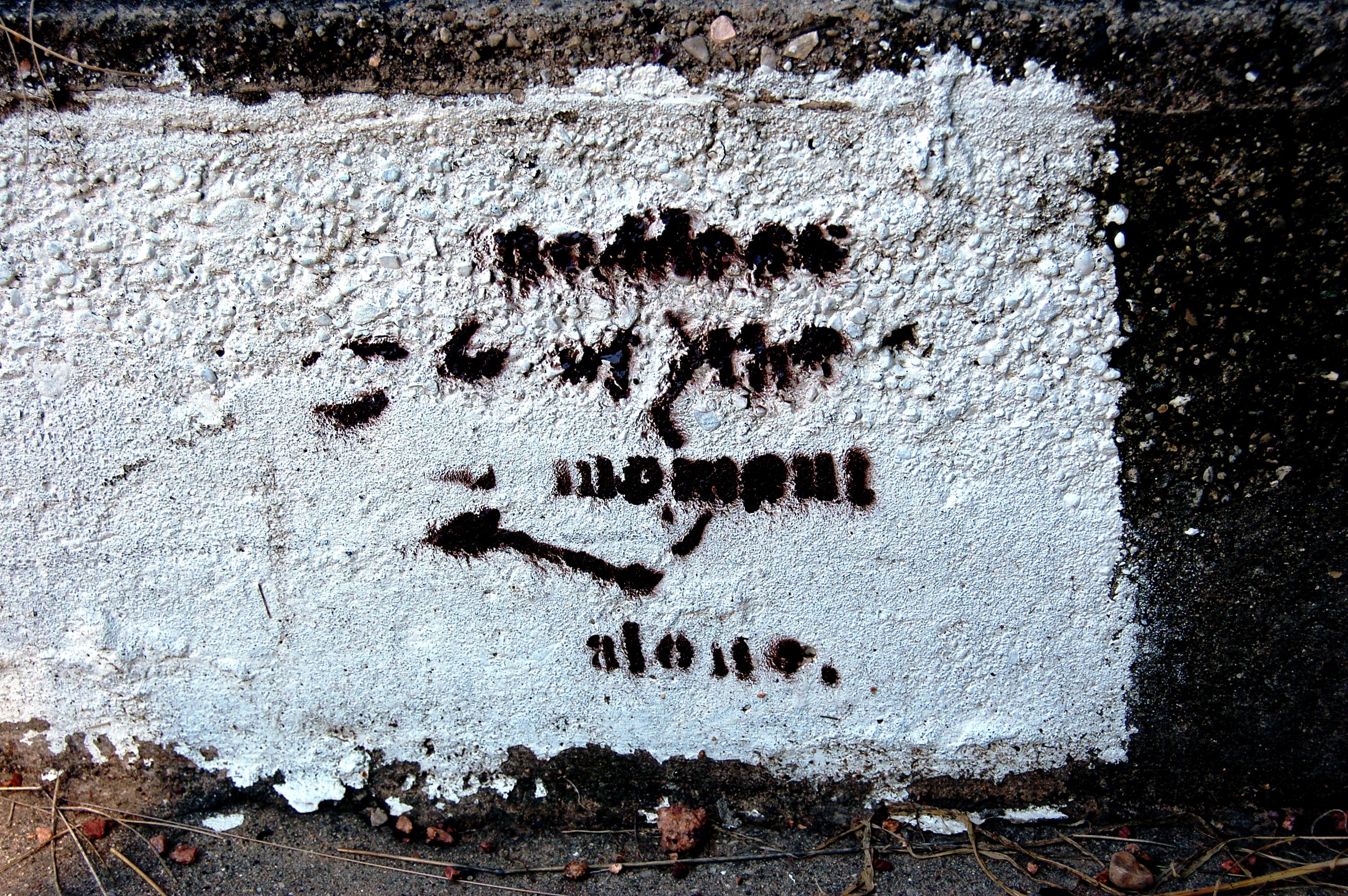
I'm fascinated by the almost legible. Have you ever imagined there were words somewhere that you could almost read? That's a theme in the movie "Waking Life," by the way. Did you like that movie? Did you like it as much as "Slacker"? I ask, deviating from the theme in a Slackerish way. In "Waking Life," the subject is the way you can't read in a dream. If you try, you won't be able to make out the words.
Maybe if you're getting a bit psychotic — struggling with that brain asymmetry — or using some psychotropic drugs, you'll think you're seeing letters rising up out of textured surfaces like that curb. Don't lose yourself trying to read those nonexistent words.
This subject is making me think of "The Shining," where the little boy keeps trying to read a word on the wall until finally he can and it's very shocking. Good horror idea! There must be many other stories about mysteriously nearly readable writing.
Here's a picture of my ex-husband from long ago. He's reading a book, and you can almost read the title of the book. Why does near legibility make the book seem so important? Why such fascination with things we can't quite see or understand?
I loved the movie "Coffee and Cigarettes" (which is newly available on DVD). Keep in mind that two of my favorite movies are "My Dinner With Andre" and "Slacker" before regarding my opinion as a recommendation. Here's the beautiful "Coffee and Cigarettes" website.
When a movie is broken into a series of vignettes as this one is, critics usually can't resist saying which vignette is the best and grousing that some vignettes are better than others. With an ordinary movie, it doesn't seem worth saying that some scenes are better than others! But with each vignette, you get a new set of two or three actors, so it's hard not to single out, for example, Cate Blanchett. Patty Duke style, she plays two cousins who have the same face, but different hair, clothes, mannerisms, attitudes. The final vignette is especially poignant. It features Taylor Mead, so unrecognizably older than he was in the Andy Warhol movies -- like "Lonesome Cowboys" -- where we loved him so much.
I must get back to watching "Dead Man," which, like "Coffee and Cigarettes" is directed by Jim Jarmusch. I watched about a third of that movie once and then got distracted by something -- too long ago to remember what. I'll have to go back to the beginning now. But the gorgeous black and white photography of "Coffee and Cigarettes" -- which looked great on the Sony HDTV -- makes me want to get back to "Dead Man." Longtime readers may remember that I bought "Dead Man" along with four other DVDs back in March when I went on a Johnny Depp-focused buying spree.
Ah! The new Critierion Collection DVD of "Slacker" just arrived! How exciting! How many times have I watched my deteriorating old VHS copy of this film, which I never saw in the theater. Nice packaging. Lots of extras. Why isn't this on the list of favorite movies on my profile? I'll add it.
I am a participant in the Amazon Services LLC Associates Program, an affiliate advertising program designed to provide a means for me to earn fees by linking to Amazon.com and affiliated sites.
Encourage Althouse by making a donation:
Make a 1-time donation or set up a monthly donation of any amount you choose:


 Posts
Posts