Showing posts with label Samuel Johnson. Show all posts

August 4, 2025

Clutching the lunch cloche.

I'm just reading the New Yorker article, by Lauren Collins, called "The Case for Lunch/Notes on an underappreciated meal." I'm not going to appreciate or fail to appreciate the meal called "lunch." I just want to snip out 2 things that stirred my love for language:
Per Samuel Johnson’s dictionary, the word “lunch” likely derives from “clunch” or “clutch,” meaning “as much food as one’s hand can hold.”... 
It was lunch, so there was sunshine, streaming into the dining room, backlighting the cursive lettering on the plate-glass windows. I felt as though I had just put on a cloche and pulled up a seat in the cafeteria of a Hopper painting....

"Cloche" — which means "bell" in French — is a bell-shaped hat:

March 1, 2025

Space tourism is idiotic... as is the use of the word "historic" to describe non-achievements by women.

But The Daily Mail tells us: "Lauren Sanchez, Katy Perry and CBS Mornings co-host Gayle King have left fans shocked after it was announced they are heading to space. It was revealed on Thursday that the Jeff Bezos's partner, 55, the pop star, 40, and the news anchor, 70, are part of the Blue Origin's historic all-women crew, which will blast off in the spring."

The fan "shock" is only over the sheer randomness. Katy Perry in space! I wasn't thinking about that.

As for "historic"... I'm reminded of the old Samuel Johnson quote: "Sir, a woman’s preaching is like a dog’s walking on his hind legs. It is not done well; but you are surprised to find it done at all." That is, calling this non-achievement "historic" is actually a sexist putdown.

To wallow in the idiocy, watch Lauren Sanchez do TikTok:

June 26, 2023

July 7, 2021

"The specifically English hatred of patriotism has long been kept alive by its intellectual classes, the people who, as George Orwell wrote, 'would feel more ashamed of standing to attention during God Save the King than of stealing from a poor box.'"

"Because England was not the creation of intellectuals, patriotism has never been an intellectual pastime. The ecstasies of 19th-century Romantic nationalism which gave birth to Germany and Italy were forged by poets, musicians and the re-assemblers of lost national epics and folk traditions. By this time England had been muddling along for a millennium. Unlike nations ushered into being by Enlightenment intellectuals which enshrined philosophical abstractions as national principles ('liberty, equality and fraternity' for Republican France, 'freedom' for the United States), British patriotism comes from below. Accordingly it is usually defined in hilariously prosaic terms: queueing, warm beer, roast beef, rain. These are all things disliked by intellectuals.... Our long tradition of national self-hatred has in some ways stress-tested the national consciousness. Self-hatred doesn’t portend a 'chasm.' It is something we are long-sufferingly accustomed to. Things are more dangerous in brittler, prouder America." 

From "It’s deeply British to question our patriotism/A tradition of tolerating dissent is a sign of national strength rather than something to fret over" by James Marriott (London Times).

We're brittler than Brits, he says. And prouder. He sounds proud, you might say, but not proud of his country, and that's his point about pride.

I do think our intellectuals look down on patriotism too, though less amusingly. There's a lot of expression of patriotism in America because most of us don't take our cues from intellectuals. I'm sure at least half of my readers are, right now, rankling at my acceptance of Marriott's word "intellectuals" to refer to America's present-day elite.

The top-rated comment at the London Times quotes James Boswell’s "Life of Johnson" (entry dated April 7, 1775):

Patriotism having become one of our topicks, Johnson suddenly uttered, in a strong determined tone, an apothegm, at which many will start: “Patriotism is the last refuge of a scoundrel.” But let it be considered, that he did not mean a real and generous love of our country, but that pretended patriotism which so many, in all ages and countries, have made a cloak for self-interest.

March 28, 2021

"... simultaneously transforming into hyperventilating country club snots with sweaters tied around their necks in 1980s movies."

I don't know who "the Bruenigs" are, and I haven't paid too much attention to the metamorphosis of Yglesias, but I have been following the transformation of Glenn Greenwald and Andrew Sullivan, and these tweets strike a chord.

I've got to hypothesize that this has something to do with the financial incentives at Substack, where Yglesias, Greenwald, and Sullivan have relocated. Again, I have no idea about "the Bruenigs." 

It's possible that when Yglesias/Greenwald/Sullivan says something that jibes with conservative ideology, it gets massive linkage that translates to cold hard cash. Imagine trying to think with such static. 

Or do you have more of the Samuel Johnson view of it? "No man but a blockhead ever wrote except for money." Maybe it's hard to imagine writing without feeling that your fingers tapping on the keyboard are printing money? It's the definition of professional.

I have no idea, really, what Yglesias/Greenwald/Sullivan are doing — what they consciously believe they are doing, what they want deep down, how they really lean politically, and whether they're authentic in their writing. I can only decide what sort of thing I want to read — what to invite into my head.

July 2, 2020

"We grow weary when idle"/"That is, sir, because others being busy, we want company; but if we were idle, there would be no growing weary; we should all entertain one another."

An old conversation — between Boswell and Johnson — that's quoted in a 2016 post of mind called "Shhhh!"

That quote begins one of my favorite books, "An Apology for Idlers" by Robert Louis Stevenson. I've called it to your attention a few times, and I think that whenever I do, I flag 2 other books I like about idleness: "Essays in Idleness" by the Buddhist monk Kenko and "In Praise of Idleness" by Bertrand Russell.

Idleness is an important topic! And I wasn't even thinking — until I got to this sentence — about it's special applicability to our predicament in the time of coronavirus.

Here are 3 recent items about idleness:

1. "How Idleness Was an Early Form of Meditation for Ancient Humans" (Great Courses Daily): "Many researchers believe that people have historically spent a lot of time meditating, even if they didn’t call it meditation per se. We think of modern life as being much easier and more convenient than what’s historically been typical, but that’s a myth....  When food was plentiful [in ancient times], it’s estimated that people could find what they needed to sustain themselves—to feed themselves and their children—surprisingly quickly.... For most of the time that Homo sapiens has been around, we’ve naturally had a lot of down time.... '[O]ur brains are, and may always have been, built to require—or at least benefit from—a certain amount of meditation just to maintain normal function.... The meditation practice I’m suggesting isn’t about looking for a clever new way to enhance the function of your brain.'"

2. "The Secret Power of Idleness/The brain does some of its best work when we take a break" (Psychology Today): "When we are busiest, our brains are not necessarily doing very much. Conversely, when we take a break and engage in some apparently mindless pursuit like playing solitaire, walking, or shoveling snow, our problem-solving brains kick into overdrive.... Aristotle celebrated the value of leisure as a cornerstone of intellectual enlightenment. He believed that true leisure involves pleasure, happiness, and living blessedly. It is more than mere amusement and is impossible for those who must work most of the time...."

3. "Celebrating Literature’s Slacker Heroes, Idlers and Liers-In" (NYT): "By 'library of indolence' I mean novels like 'Oblomov,' Ivan Goncharov’s satire about a man who hates to leave his bed, and 'Bartleby, the Scrivener,' Herman Melville’s long short story about the clerk whose motto is 'I would prefer not to.' ... The wittiest and most profound [book]... is Tom Hodgkinson’s 2005 classic 'How to Be Idle.'..... He recommends not clicking on news radio upon waking. He nails me entirely when he writes, 'A certain type of person feels it is their duty to listen to it, as if the act of merely listening is somehow going to improve the world.'... 'The lie-in — by which I mean lying in bed awake — is not a selfish indulgence but an essential tool for any student of the art of living, which is what the idler really is. Lying in bed doing nothing is noble and right, pleasurable and productive.'"

December 2, 2019

"Inviting the administration now to participate in an after-the-fact constitutional law seminar with yet-to-be-named witnesses only demonstrates further the countless procedural deficiencies..."

"... that have infected this inquiry from its inception and shows the lack of seriousness with which you are undertaking these proceedings. An academic discussion cannot retroactively fix an irretrievably broken process."

Wrote White House Counsel Pat Cipollone in a letter to House Judiciary Committee Chair Nadler. The hearing in question, is scheduled for December 4th, and — as Cipollone understands "from rumors and press reports" and not from any official notice — "will consist of an academic discussion by law professors."

ADDED: I must say that as a longtime law professor, I'm finding the disrespect for law professors inadequate. You heard me right. I do not for one minute believe that the 3 lawprofs the Judiciary Committee will put on display will be speaking as if they are conducting something that deserves to be called an "academic seminar." But I understand Cipollone's refraining from getting into the problem of the politicalization of the academic field of constitutional law.

AND: "Seminar" is an interesting word. It's only been in the English language since the late 19th century, according to OED. It was originally something done in German universities, "a select group of advanced students associated for special study and original research under the guidance of a professor" and it came to mean "a class that meets for systematic study under the direction of a teacher." The oldest appearance in English is:
1889 A. S. Hill Our English v. 209 In New York and Washington, if I am not misinformed, ‘seminars’ are periodically held, at which a clever woman coaches other clever women in the political, literary, and ethical topics of the day.
Clever women. You can really feel the insult in "clever." In Samuel Johnson's dictionary (1755), the entry for "clever" is: "This is a low word, scarcely ever used but in burlesque or conversation; and applied to any thing a man likes, without a settled meaning."

January 13, 2019

Confusing headline of the day: "Nancy Pelosi Spanks the First Brat."

Hint: It's Maureen Dowd's new column.

It caught my eye because here in Wisconsin, a brat — rhymes with "squat" — is a very popular sausage. So what's "spanking the brat"? Seems like another one of the many euphemisms for masturbation.

But the NYT is not Wisconsin, so it must be brat — rhymes with "slat" — "a child, so called in contempt" (to quote Samuel Johnson's "Dictionary of the English Language").

What brat would Nancy Pelosi be spanking? I'm thinking Alexandria Ocasio-Cortez or maybe Rashida Tlaib — one of the impish new House members.

But no! It's Trump! It's always Trump. Everywhere you look...
When Trump said he could “relate” to federal workers who are now going without pay, it may have been the most audacious lie he told all week....

As Pelosi told reporters: “He thinks maybe they could just ask their father for more money. But they can’t.” She also leveled the barb on Trump in person.

Pelosi deploys what she calls her “mother of five” voice on our tantrum-prone president, perhaps in an effort to reparent him. But how do you discipline the world’s brattiest 72-year-old?
The headline writer equates the use of a "mother of five" voice with spanking. I think Pelosi wants to pose as the adult and make Trump look like the child, but isn't the person resorting to physical violence the one who is immature?

And even if you think Trump can be childish, there wasn't anything childish about saying that he relates to the federal workers who are going without pay. That's the kind of routine presidential expression of calm empathy that people often complain about not getting enough of from President Trump. Dowd tells us that Trump is "tantrum-prone," but — whether that's true or not — his statement of empathy — whether that's bullshit or not — is not like a tantrum.

Dowd exults in Pelosi's patronizing (matronizing?) tone, used against the President of the United States. I'm wondering how this choice of attitude will work in the coming campaign season. Should the Trump opponents treat him as if he is "the world’s brattiest 72-year-old" and address him in a "mother of five" voice? It seems to me Hillary Clinton already tried that and it didn't work. It didn't work when he was not yet President and it was hard to picture him as President. But now he is President. I'm thinking the disrespect is dangerous. It can backfire, especially on those who really believe in and delight in their disrespect. Remember Hillary and "deplorables"!

***

By the way, "matronize" — as a humorous way to say that a woman is patronizing — is a usage that's been around since the 19th century. Among the examples in the OED:
a1854 E. Grant Mem. Highland Lady (1988) I. xvi. 349 An extraordinary woman, once a beauty and still a wit, who was now matronising two elderly young ladies.
1966 New Statesman 25 Nov. 786/3 She has the usual phrases about ‘the self-contained universe constituted by a work of art’, and Sartre is matronised for faltering in his ‘faith in the power of an artistic structure to stand up on its own’.
"Matronize" is a real word, with nonjocose meanings: "To act as a matron," "To chaperone" ("Lady Maclaughlan..will Matronize you to the play"), "to act as hostess to (a party, etc.)" ("The lady who was matronizing the tea recognized him"), and "to render matronly" ("Childbed matronizes the giddiest Spirits").

January 24, 2018

"Since 'Drag Race' first aired in 2009, the conversation around identity and gender has shifted tremendously."

"For all the show has done to challenge its audience’s notions of masculinity and femininity, it has shied away, until the most recent season, from any serious discussion about the ways the drag community intersects the trans one. There have been trans queens on the show, but the topic is a touchy one in the drag community. For most drag artists, the point is the performance; it is not their sole identity. But for those queens who identify as trans or nonbinary, their stage persona is not necessarily a performance. The centerpiece of the show is the contestants’ transforming themselves into queens, and then, after each competition, taking off their wigs and removing synthetic breasts to reappear as men. For years, 'Drag Race' prioritized entertainment over any nuances of the culture. Much of the queens’ vernacular, body language and movements come from the drag world’s — especially white queens’ — interpretation of black femininity. I’ve always been uncomfortable with that phenomenon, despite how much I enjoy the show. In his essay '"Draguating’ to Normal,"' the academic Josh Morrison argues that by using the bodies of women, people of color and other marginalized groups, 'through an often loving, well-intentioned impersonation of them,' drag 'unintentionally does them discursive violence.'"

From "Is ‘RuPaul’s Drag Race’ the Most Radical Show on TV?/The reality-television competition that began nine years ago has evolved to reflect an era fixated on gender and identity — and the boundary-pushing spirit of its star." (NYT).

What, exactly, is "discursive violence"? "Discursive" means "Of or characterized by reasoned argument or thought; logical, ratiocinative. Often opposed to intuitive" (OED).
1667 Milton Paradise Lost v. 488 Whence the soule Reason receives, and reason is her being, Discursive, or Intuitive; discourse Is oftest yours, the latter most is ours.
It can also mean refer to going "from one subject to another, esp. in a rapid or irregular manner; extending over or dealing with a wide range of subjects; expansive; digressive," like:
1791 J. Boswell Life Johnson anno 1774 I. 440 Such a discursive exercise of his mind.
Or — and I suspect this is what roils the mind of "the academic" quoted in the NYT — "Relating to discourse or modes of discourse." This is a meaning that took flight in the 1960s:
1961 Philos. Rev. 70 80 The word ‘God’ looks the same in any discursive context, whether narrative, factual, or formal....
And the most recent quote is this, which I can't help but think the OED intended to laugh at:
2011 C. West in G. Rockhill & A. Gomez-Muller Politics of Culture & Spirit of Critique vi. 114 Deploying that voice in..a variety of different discursive strategies, a variety of different modes of rhetorical persuasion as well as logical argumentation in order to make some kind of impact on the world.

October 4, 2017

We sent you Unclubbable Neil!

Forgive me, but I need to talk about Jeffrey Toobin again. I started the blog-day with a long Toobin-focused post, but now I'm reading Instapundit:
MORE SUPPORT for my theory, expressed earlier, that Ruth Bader Ginsburg was the source in that Jeffrey Toobin anti-Gorsuch piece from last week. If RBG can’t handle having Gorsuch around, perhaps she should retire.
The first link there goes to the same Toobin piece I already wrote about and the second one goes to an Instapundit post titled "I’M GONNA GO WITH 'NOT BADLY ENOUGH'" and linking to a Jeffrey Toobin piece from a few days ago titled "How Badly Is Neil Gorsuch Annoying the Other Supreme Court Justices?"

There's something I want to talk about in that other Toobinity:
As Linda Greenhouse observed in the Times at the end of Gorsuch’s first term, he managed to violate the Court’s traditions as soon as he arrived. He dominated oral arguments, when new Justices are expected to hang back. He instructed his senior colleagues, who collectively have a total of a hundred and forty years’ experience on the Court, about how to do their jobs. Dissenting from a decision that involved the interpretation of federal laws, he wrote, “If a statute needs repair, there’s a constitutionally prescribed way to do it. It’s called legislation.” Perhaps he thought that the other Justices were unfamiliar with this thing called “legislation.” Gorsuch also expressed ill-disguised contempt for Anthony Kennedy’s landmark opinion legalizing same-sex marriage in all fifty states. Earlier this year, the Court’s majority overturned an Arkansas ruling that the state could refuse to put the name of a birth mother’s same-sex spouse on their child’s birth certificate. Dissenting, Gorsuch wrote, “Nothing in Obergefell spoke (let alone clearly) to the question.” That “let alone clearly” reflected a conservative consensus that Kennedy’s opinion was a confusing mess.

Perhaps Gorsuch will, as the years pass, prove to be a more clubbable colleague; or perhaps he’ll decide, at least socially, to go his own way....
A more clubbable colleague...


Oh, sorry. I'm supposed to read that like a New Yorker reader, someone who is upper class or striving to feel upper class. Here's the Oxford English Dictionary definition of "clubbable":
Having such qualities as fit one to be a member of a club; sociable.

1791 J. Boswell Life Johnson anno 1783 II. 475 Boswell (said he) is a very clubable man. [Johnson is said to have used unclubable sometime earlier: see unclubbable adj.]
Okay, let's see "unclubbable." (Unclubbable/That's what you are/Unclubbable/That's Gorsuch so far....) "Unclubbable" is the older word, and "clubbable" is the back-formation. The OED defines "unclubbable" as said of a person who is "not suitable for membership of a club owing to lack of sociability or desire to conform; (of a characteristic) that does not inspire friendly relations; unsociable." The oldest usage in print is:
?1764 F. Burney Early Jrnls. & Lett. (1994) III. 76 Sir John was a most unclubable man!
So the question becomes: Is the Supreme Court a social club, where the old members have their established manner and the new man must fit in? One thing that's very unclublike: The Court doesn't get to decide if it wants to let the new person in. He's been sent in by the President and the Senate, who got their power from the people, and we're a diverse bunch, quite rowdy and ornery many of us. You wouldn't want me in your club, and I'm a lot nicer than many — probably millions — of very rude folk who vote.  

We sent you Unclubbable Neil and you're stuck with him. We clubbed you over the head with him.

September 18, 2017

Google celebrates the birthday of Samuel Johnson.


"As a popular search engine marks the great lexicographer’s birthday, it’s a good time for some defining questions. Can you get them right without googling?" (The Guardian). ("What is Johnson defining here? 'To deprive a dog of something, nobody knows what, under his tongue, which is said to prevent him, nobody knows why, from running mad.'") I got 5/10.

"Who was Samuel Johnson? The father of the modern dictionary's funniest entries" (The Telegraph). ("Lexicographer: A writer of dictionaries; a harmless drudge that busies himself in tracing the original, and detailing the signification of words.")

"Samuel Johnson: Who is this literary figure, what did he do and why is he so important?"
(Independent).
The primary reason for Johnson’s enduring appeal though, outside of his own remarkable achievements in print, is surely the ongoing popularity of James Boswell’s fantastically detailed Life of Samuel Johnson (1791).... Boswell recalls such delightful comic incidents as Johnson good-naturedly dismissing Burke as “a vile Whig”, rebuking Goldsmith for being “loose in his principles” and declining a repeat visit backstage to visit Garrick at the theatre because, “the silk stockings and white bosoms of your actresses excite my amorous propensities.” His opinions on everything from remarriage ("the triumph of hope over experience") to women vicars* and the merits of Alexander Pope are preserved for the ages in a work whose value cannot be overstated.
Don't forget Johnson's "Grammar of the English Tongue." That's the one I keep in my Kindle. Sample:

March 19, 2017

Goodbye to Jimmy Breslin.

"Jimmy Breslin, Legendary New York City Newspaper Columnist, Dies at 88," the NYT reports.
With prose that was savagely funny, deceptively simple and poorly imitated, Mr. Breslin created his own distinct rhythm in the hurly-burly music of newspapers. Here, for example, is how he described Clifton Pollard, the man who dug President John F. Kennedy’s grave, in a celebrated Herald Tribune column from 1963 that sent legions of journalists to find their “gravedigger”:

“Pollard is forty-two. He is a slim man with a mustache who was born in Pittsburgh and served as a private in the 352nd Engineers battalion in Burma in World War II. He is an equipment operator, grade 10, which means he gets $3.01 an hour. One of the last to serve John Fitzgerald Kennedy, who was the thirty-fifth President of this country, was a working man who earns $3.01 an hour and said it was an honor to dig the grave.”

And here is how he described what motivated Breslin the writer: “Rage is the only quality which has kept me, or anybody I have ever studied, writing columns for newspapers.”
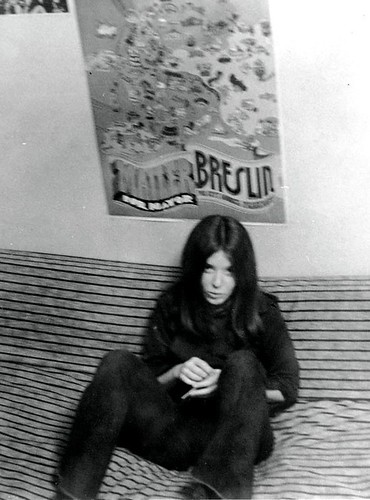
This is me, in 1970, sitting under a Mailer/Breslin poster:

Althouse in 1970, age 19
PHOTO CREDIT: Stephen Cohen.

The NYT obit makes no mention of the political frolic with Mailer, but here's an earlier article, from when Mailer died (2007), "Mailer’s Nonfiction Legacy: His 1969 Race for Mayor":
His running mate for City Council president was the columnist Jimmy Breslin, who suspected the worst from the very beginning: that Mr. Mailer was serious....

Mr. Breslin recently recalled Mr. Mailer’s arguing brilliantly at Brooklyn College that the minds of white and black children would grow best if they were together in the same classrooms. One student interrupted: “We had a lot of snow in Queens last year and it didn’t get removed,” he said. “What would you do about it?” To which Mr. Mailer, abruptly dislodged from his lofty oratorical perch, replied that he would melt the snow by urinating on it.

Mr. Mailer’s political nadir was a campaign rally at the Village Gate nightclub where he vilified his own supporters as “spoiled pigs.” Mr. Breslin left the rally early. He later told a friend, “I found out I was running with Ezra Pound.” Mr. Breslin was referring not to Pound’s poetry, but to his insanity.

Mr. Mailer’s “left-conservative” platform called for a monorail, a ban on private cars in Manhattan and a monthly “Sweet Sunday” on which vehicles would be barred from city streets, rails or airspace altogether. He championed self-determination — the city itself would secede and become the 51st state. Individual neighborhoods would be empowered to govern according to their own prerogatives, which could range from compulsory free love to mandatory church attendance. 
I love the random resonances of blogging: Ezra Pound just came up 2 days ago. Poets. Poetry. I love it all. Even the "lofty oratorical perch." Reminds me of that famous Samuel Johnson line: "Sir, a fish's preaching is like a dog's walking on his hind legs. It is not done well; but you are surprised to find it done at all."

And I love that poster.


New York City — the 51st State. Makes me think of that old song:
As easy it was to tell black from white
It was all that easy to tell wrong from right....
How many a year has passed and gone
And many a gamble has been lost and won
And many a road taken by many a friend
And each one I’ve never seen again
I wish, I wish, I wish in vain
That we could sit simply in that room again....
But it's all lost to the distant past. I'm not 19 anymore. Norman's gone. Jimmy's gone. The is-he-insane blustery assemblage of masculinity isn't a satirical mayoral candidate but President of the United States. And there's no newspaper columnist to give a damn about.

August 27, 2016

Shhhh!

"Study Says Lazy People Are Smarter."

IN THE COMMENTS: rehajm said (efficiently): "Natural efficiency."

Tim Maguire said: "The smart people we've heard of aren't lazy." And by that, I assume he means that the smart and lazy people are being efficient by not drawing attention to themselves. The workplace is often administered by people who want to see that you're hard at work. The stupidest waste of time is looking busy, but it would be stupid to attract the supervision of somebody who will impose the requirement of looking busy when you have worked out ways of getting things done efficiently and want to benefit from your cleverness, not cede all the benefits to your overseer.

I have been in situations where a colleague will go on about how stressed out and terribly busy she is and assert that so are we all. The dead silence in a roomful of professors is ludicrous. You know damned well that many — I hope most — have figured out ways to work very efficiently and enjoy the freedom and flexibility of the job. But no one with an eye on self-protection will stand up and admit to not being a workaholic. And so stressed-out, busy-busyness is the atmosphere that prevails because the ones who talk are the ones who haven't found the lazy-smart path (or they have and want to deny its legitimacy for some sadistic reason).

ADDED: I recommend "Essays in Idleness" by the Buddhist monk Kenko, "In Praise of Idleness" by Bertrand Russell, and "An Apology for Idlers" by Robert Louis Stevenson (commission earned through those links).

That last of those begins:
BOSWELL: We grow weary when idle.

JOHNSON: That is, sir, because others being busy, we want company; but if we were idle, there would be no growing weary; we should all entertain one another.

Just now, when everyone is bound, under pain of a decree in absence convicting them of lèse-respectability, to enter on some lucrative profession, and labour therein with something not far short of enthusiasm, a cry from the opposite party who are content when they have enough, and like to look on and enjoy in the meanwhile, savours a little of bravado and gasconade. And yet this should not be. Idleness so called, which does not consist in doing nothing, but in doing a great deal not recognized in the dogmatic formularies of the ruling class, has as good a right to state its position as industry itself....
Gasconade... There's a word you haven't used in a sentence recently, I'll bet.

January 10, 2016

"El Chapo Speaks/A secret visit with the most wanted man in the world," by Sean Penn begins with an epigraph from Montaigne.

The epigraph is: "The laws of conscience, which we pretend to be derived from nature, proceed from custom."

Here's the article, in Rolling Stone, in case you want to make sense of the aphorism. Me, I can't wade through this stuff. First paragraph:
It's September 28th, 2015. My head is swimming, labeling TracPhones (burners), one per contact, one per day, destroy, burn, buy, balancing levels of encryption, mirroring through Blackphones, anonymous e-mail addresses, unsent messages accessed in draft form. It's a clandestine horror show for the single most technologically illiterate man left standing. At 55 years old, I've never learned to use a laptop. Do they still make laptops? No fucking idea! It's 4:00 in the afternoon. Another gorgeous fall day in New York City. The streets are abuzz with the lights and sirens of diplomatic movement, heads of state, U.N. officials, Secret Service details, the NYPD. It's the week of the U.N. General Assembly. Pope Francis blazed a trail and left town two days before. I'm sitting in my room at the St. Regis Hotel with my colleague and brother in arms, Espinoza.
I don't need to visit the interior of the Mind of Sean Penn. Do they still make movie stars? No fucking idea! It's 6:31 in the morning. Another pre-dawn in Madison, Wisconsin. No lights, no buzzing, no cops, no popes. I'm hanging out here with my husband, Meade... oh? Do you think I should get to some point?

What I like about this article is that it's the article that everyone must read but no one will read. Or, maybe, if you scroll down about 20 screens worth of blabber you will get to the boldfaced questions and read some of that. These questions are prefaced with: "Of the many questions I'd sent El Chapo, a cameraman out of frame asks a few of them directly, paraphrases others, softens many and skips some altogether." So what's it worth? Example:
Did your drug business grow and expand when you were in jail?

From what I can tell, and what I know, everything is the same. Nothing has decreased. Nothing has increased....

With respect to your activities, what do you think the impact on Mexico is? Do you think there is a substantial impact?

Not at all. Not at all....

Do you have any dreams? Do you dream?

Whatever is normal. But dreaming daily? No....
The answers are flat and opaque — unrevealing — even as the questions get more Barbara Walters-y. Look at this one:
If I ask you to define yourself as a person, if I ask you to pretend you are not Joaquín, instead you are the person who knows him better than anybody else in the world, how would you define yourself?
Well, if I knew him – with respect, and from my point of view, it's a person who's not looking for problems in any way. In any way.
Yes, it's perfectly inane. I skipped over a lot of text, but I never saw anything that justified the high-tone epigraph: "The laws of conscience, which we pretend to be derived from nature, proceed from custom." El Chapo wasn't revealing much and Sean Penn couldn't pull any story out of him. I think El Chapo got played by his own vanity. He wanted to be the subject of a biopic. That's why he made this connection. And from what I'm reading elsewhere, Sean Penn seems to have led the authorities to recapture El Chapo. I guess whatever role he played there is not something he wants too much attention for.

Anyway... epigraphs: "In literature, an epigraph is a phrase, quotation, or poem that is set at the beginning of a document or component." That's from Wikipedia, which warns: "Not to be confused with epitaph, epigram, or epithet." An epigraph, to me, implies that what follows will benefit from being looked at through that brief statement. It's tantalizing, no?

Wikipedia gives a few examples of epigraphs, including the Samuel Johnson quote — "He who makes a beast of himself gets rid of the pain of being a man" — that begins Hunter S. Thompson's "Fear and Loathing in Las Vegas." "Fear and Loathing in Las Vegas" was originally published in Rolling Stone, and reading Sean Penn's hyper-personal raving style — "Do they still make laptops? No fucking idea!" — I had the feeling he aspired to Thompsonesqueness... to make a beast of himself, perhaps, and get rid of the pain of writing like a professional journalist.

Do they still make professional journalists? No fucking idea!

ADDED: The night the Rolling Stone article goes up, Sean Penn appears at a fundraiser... alongside his ex-wife Madonna. The Daily Mail article with the photos says Penn "unwittingly led the Mexican authorities to" El Chapo and that he's "now under investigation." Madonna and Sean, together again — a good move for both of them.

September 29, 2015

Harridan or catastrophe?

If there is to be a Word of the Day this morning on the blog, it will be either "harridan""Carly makes it harder for Hillary to claim she must be flat and bland lest people see her as a screeching harridan" — or "catastrophe""It just irritates the heck out of me.  Unknown catastrophe. We know that an unknown catastrophe some years ago brought about by climate change destroyed all the water on Mars."


UPDATE: "Harridan" wins, as I guessed it would, since people are attracted to women, even "a decayed strumpet," as Samuel Johnson defined the word in his famous dictionary. I'm flattered that you chose it, not because I am a decayed strumpet, but because I came up with the word myself, and "catastrophe" was a quoted word (from Rush Limbaugh, who was himself quoting someone, a NASA scientist).

The OED defines "harridan" as "A haggard old woman; a vixen; ‘a decayed strumpet’ (Johnson): usually a term of vituperation." The OED's historical quotes include:
a1745 Swift Misc. Poems (1807) 57 The nymphs with whom you first began, Are each become a harridan.
1860 R. W. Emerson Considerations in Conduct of Life (London ed.) 241 This identical hussy was a tutelar spirit in one house, and a harridan in the other.
The Emerson is the one that seems to need more context. Who was this woman? And yet the Swift poem is so wonderful — rhyming "blab it" with "habit" —  I want to copy it here:
Copy of the Birth-Day Verses on Mr. Ford

COME, be content, since out it must,
For Stella has betray'd her trust;
And, whispering, charged me not to say
That Mr. Ford was born to-day;
Or, if at last I needs must blab it,
According to my usual habit,

February 26, 2015

"If you could require the president to read one book, what would it be?"

"Not a book but a poem, Johnson’s The Vanity of Human Wishes," writes Terry Teachout, who, because he feels like it, is answering the questions that a NYT editor (Pamela Paul) asked of someone else (David Brooks). (Brooks would require the President to read the essay, “Rationalism in Politics,” by Michael Oakeshott.)

You're probably not the President — and if you are: Greetings, my President! — but you can read "Rationalism in Politics" here — "no man can hope to be successful whose reason has become inflexible by surrender to habit or is clouded by the fumes of tradition" — and here's "The Vanity of Human Wishes":

April 19, 2014

Obama treats Keystone as the political football he apparently thinks it is.

I like the football metaphor in the Time headline: "Obama Punts On Keystone Pipeline."

ADDED: Wikipedia has an article on "Political football." It quotes William Safire's "Political Dictionary" definition — "To thrust a social, national security, or otherwise ostensibly non-political matter into partisan politics" — and displays this 1889 cartoon satirizing the doings of the Benjamin Harrison administration:


The caption is: "What can I do when both parties insist on kicking?"

AND: The (unlinkable) OED traces the term back to 1833 (and I assume it's not what Americans call "football")
1833   Essex Standard (Colchester) 9 Nov.,   Out-generalled by every petty state that choses [sic] to make it worth its while to deceive us—the political football of Europe—England.
The second example has a mixed metaphor:
1841   Congressional Globe 30 Jan. 119/1   These lands were nothing but a bone of contention—a political football, bandied about first by one party and than the other.
That example makes me wonder not only about the origin of "bone of contention" but also "bandy."  "Bone of contention" is (obviously) something that people fight over the way dogs fight over a bone. But does "bandy" inject a third metaphor into the mix?

February 28, 2014

"If others examined themselves attentively, as I do, they would find themselves, as I do, full of inanity and nonsense."

"Get rid of it I cannot without getting rid of myself. We are all steeped in it, one as much as another, but those who are aware of it are a little better off — though I don’t know."

Wrote Michel de Montaigne, evincing one of 2 personality types perceived and examined by David Brooks
Montaigne was more laid back, and our culture is more comfortable with his brand of genial self-acceptance and restraint. 
The other "brand" of which Brooks speaks has Samuel Johnson as its mascot.
We can each pick what sort of person we would prefer to be. But I’d say Johnson achieved a larger greatness. He was harder on himself. He drove himself to improve more strenuously. He held up more demanding standards for the sort of life we should be trying to live, and constantly rebutted smugness and self-approval.

Montaigne was a calming presence in a country filled with strife, but Johnson was a witty but relentless moral teacher in a culture where people were likely to grade themselves on a generous curve, and among people who spent more time thinking about the commercial climb than ultimate things.
Brooks wants us to be harder on ourselves, more rigorous and self-critical, less self-accepting and easy going. He'd like the japing, flying Montaignes of modern-day commentary to subordinate themselves — ourselves! — to the brooding, snooty analysts who delve into history and sort people into 2 categories and chide us to improve ourselves.

And what got him off on that mental jag? I bet it was all the guff he got last month when he soberly advised us against using marijuana:
[My friends and I, having smoked marijuana, reached a] stage, which I guess all of us are still in, of trying to become more integrated, coherent and responsible people. This process usually involves using the powers of reason, temperance and self-control — not qualities one associates with being high.

I think we had a sense, which all people have, or should have, that the actions you take change you inside, making you a little more or a little less coherent. Not smoking, or only smoking sporadically, gave you a better shot at becoming a little more integrated and interesting. Smoking all the time seemed likely to cumulatively fragment a person’s deep center, or at least not do much to enhance it.
So marijuana makes you more like Montaigne, less like Samuel Johnson. How annoying to the Johnsons of this world to have the Montaignes enjoying the fragmentation. How annoying to the Brookses of this world to have the whole crazy internet mocking his call to sobriety.

August 21, 2013

"Even though the feminist project has been underway for decades now, plenty of people still view women doing work..."

"... especially nonservice work, in the same boggled way that you look at a dog walking on its hind legs. Is it still a dog? How can this be?"

Writes Amanda Marcotte, mangling or accidentally getting close to the famous Samuel Johnson quote:
I told him I had been that morning at a meeting of the people called Quakers, where I had heard a woman preach. Johnson: "Sir, a woman's preaching is like a dog's walking on his hind legs. It is not done well; but you are surprised to find it done at all."
It's not that anyone thinks the woman preaching ceases to be a woman or the dog walking on its hind legs ceases to be a dog. It's that people act impressed simply because it happened and fail to hold the creature to the normal standard that would apply to men. I think Johnson's quote is regarded as quite sexist, but — looking only at this quote and not the whole body of Johnson's sayings and writings — it can almost be defended. It's patronizing to mention that a woman did something as if that's remarkable. Did she do it well? If you think women are as capable as men, that should be the question. But Johnson speaks in an aphoristic form that implies that women will never be able to preach well. He did not say — or Boswell did not transcribe his saying —You say a woman preached as you might say a dog walked on his hind legs; let me know when a woman preaches well.

July 8, 2013

"Why Catastrophic Airline Crashes Have Become More Survivable."

"Over the many decades of commercial air travel, the airlines have learned more and more about why airplanes crash and how passengers survive."
Airplane manufacturers, for instance, are building passenger seats much stronger — they're able to withstand 16 Gs of force. So they don't rip off the floor and go flying through the cabin, injuring passengers, as they did years ago....

"A lot of effort was put into slowing down the spread of fire after a crash landing, making the materials in the interior of the cabin more fire resistant and also changing the materials such that they wouldn't emit very highly toxic fumes," [says Hans Weber, president of TECOP International].
People are doing a great job too:
After Flight 214 broke apart, flight attendants were able to quickly deploy the inflatable slides and get everyone off the plane before the fire erupted.
Credit to the flight attendants and to the passengers getting up and out of there. You'd never know, watching the crowds shuffling about in the airport and drinking and drowsing on board that ordinary people can move in such an efficient and coordinated manner.

Imminent death — as the old saying goes — concentrates the mind wonderfully.

Ah! What we could do if we faced a sudden stark threat, as our ancestors did in evolutionary times! We inherited the capacities they needed then, but we've got so little use for them these days. We go to action movies and ride roller coasters or paraglide to activate the antiquated bodily systems. It's not that we're nostalgic for danger, but built into our depths, there's a need for something that we — in no conscious sense — desire.

Still, if the moment comes, no matter how drunk or obese or debilitated you might be, you will get up out of that seat and — exactly when it's your turn, following the orders of the very flight attendant you may have complained to over nothing 10 minutes ago — plunge down that slide.