Showing posts with label Saddam. Show all posts

August 10, 2017

"A 100-foot statue depicting a Chinese deity was covered with an enormous sheet this weekend in East Java Province, Indonesia..."

"... after Muslims threatened to tear the colossus down amid mounting ethnic and religious tensions across the country," the NYT reports.
The Islamist campaign against the statue, a depiction of the third-century general Guan Yu, who is worshiped as a god in several Chinese religions, began online and soon spread to the gates of a Chinese Confucian temple in Tuban, near the Java Sea coast, where the figure was erected last month.

On social media, Muslims assailed the statue as an “uncivilized” affront to Islam and the island’s “home people,” and a mob gathered this week outside the East Java legislature in the city of Surabaya to demand its destruction.
How did such a statue get erected in the first place? Here are the demographics of the province of East Java. Ethnicity:
Javanese (80%), Madurese (18%), Indian (10%), Chinese (2%)
Religion:
Islam (96.36%), Christianity (2.4%), Buddhism (0.6%), Hinduism (0.5%), Confucianism (0.1%), Kejawen also practised
Is it about wealth and foreign influence? The NYT article says Muslim Indonesians are afraid "that as Beijing becomes more dominant in the region — exerting financial and military influence — ethnic Chinese will profit at the expense of Muslims."

Look at the photograph of Guan Yu. The military general as god is holding a sword so huge that it's sticking out from under the enormous sheet. The Times quotes the Indonesia director for Human Rights Watch, who criticizes the Muslims for using a "hostile interpretation" of the Quran to argue that the statue shows "that China is dominating Indonesia." But why put up a statue other than to say something?

One of the Muslims who's opposing the statue is quoted saying: "Actually we can allow them to build the statue, just not as high as it was and it should be in the temple, not outside... We are tolerant."

Why didn't that argument get made before the huge thing went up? Reading about the Guan Yu statue made me remember writing about colossal statues in the past. From a post I wrote in 2014:
Let's realize that throughout history statuary has been used to intimidate people. What's all that ancient Egyptian sculpture about if not to cow people into abject submission?


Think of all the Lenin and Stalin statues. And how about Saddam Hussein's despicable "Victory Arch"?

That post wasn't about a big intimidating god-warrior like Guan Yu, but about a life-size sculpture of a man stumbling forward in his underpants. That sculpture — "Sleepwalker," by Tony Matelli — upset some Americans at Wellesley College. They didn't throw a big sheet over "Sleepwalker," but they did put orange safety cones and yellow "caution" tape around him.

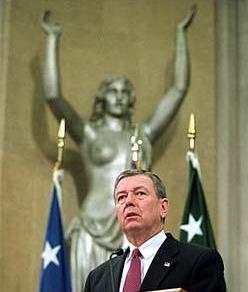
ADDED: Remember when the U.S. Department of Justice spent $8,000 on a big old drapery to cover the half-nude "Spirit of Justice" statue after photographers seemed too interested in framing Attorney General John Ashcroft with the looming breasts over his head?

October 4, 2015

Trump seems to say we'd be better off with Saddam Hussein and Gaddafy still in power — and a stronger Assad.

On "Meet the Press" today. Watch the clip at the link. The text is going to look garbled, which is why I'm saying "seems":
Republican presidential candidate Donald Trump, when asked if he believes the Middle East would be better today if Moammar Gadhafi of Libya and Saddam Hussein of Iraq were still in power, responded, "It's not even a contest."

He related the situations in both of those countries with what is currently happening in Syria and seemed to endorse a stronger President Bashar Assad, even while admitting that he is "probably a bad guy."

"You can make the case, if you look at Libya, look at what we did there — it's a mess — if you look at Saddam Hussein with Iraq, look what we did there — it's a mess — it's [Syria] going to be same thing," the real estate mogul said.
The real estate mogul said!

June 13, 2014

"We will not be sending U.S. troops back into combat in Iraq."

Said President Obama, observing that what is happening now in Iraq is not simply a military problem and blaming the leaders of the Iraqi government for not doing enough to overcome sectarian differences.

ADDED: At Slate, Reihan Salam writes "We Never Should Have Left Iraq/A U.S. military presence could have mollified Sunnis and prevented the new civil war." Excerpt:
Under Saddam, Iraq’s Shia plurality was subjugated by its Sunni minority. The fear among Sunnis has long been that once the Shias come to power, they would be the victims of all manner of reprisals. A similar dynamic has long been at play in Syria, where the Assad regime, closely tied to the Alawite minority, rules over a Sunni majority. It also played a role in the Bosnian civil war, where various ethnic groups fought desperately to avoid minority status, which many believed would amount to a death sentence.

"Polish town installs lime green statue of Lenin taking a leak."

"The statue replaces a more traditional sculpture of Lenin that was removed in 1989, following the fall of communism in Poland. The piece, dubbed the ‘Fountain of the Future,’ is designed to encourage debate...."

ADDED: I oppose, in addition to communism, tag proliferation, but this was the post that made me do what I'd resisted in the past, making a tag for Lenin. Having done so, I went back and added the tag to 11 old posts with the name Lenin and it's an interesting lot — including:

February 22, 2014

"How can man know himself? He is a dark and hidden thing."

Said Nietzsche, quoted in the Wall Street Journal's review of the book "Mindwise" by Nicholas Epley. If you can get past the subscription wall, there's an entrancing Robert Capa photograph of a man in a mask, furthering this blog's theme this morning. (If you can't see it there, see it here.)

There's also this excerpt, for what it's worth:
Consider, Mr. Epley says, the differences between Adolf Hitler and Saddam Hussein. In September 1938, Neville Chamberlain, as well as other leaders around the world, believed Hitler when he said he wouldn't invade Czechoslovakia (turns out he was just buying time to get his invading forces maximally prepared). Some six decades later, President George W. Bush, as well as other leaders around the world, failed to believe Saddam Hussein when he said he had no weapons of mass destruction. (He didn't, though according to the postwar Iraq Survey Group's conclusions, he valued the ambiguity as a deterrent and led even his own army to conclude that he did.)
IN THE COMMENTS: Quoting the part about Saddam, dhp said:
The best way to lie is to tell the truth unconvincingly.
Which raises the question whether Bush lied when he expressed a belief in the lie Saddam told in the form of telling the truth unconvincingly.  Did Bush correctly perceive that Saddam intended to be disbelieved and then fall for the lie that Saddam did have WMD or did Bush mean to be taken as a liar who in fact knows that Saddam is trying to lie by telling what Bush knows is the truth, that Saddam does not have WMD?

December 21, 2011

"We gave Saddam a fair trial, and we will give Hashemi a fair trial too."

Assurances to the Kurds, who are urged to hand over Tariq al-Hashemi, Iraq's VP, a Sunni Muslim, accused of terrorism. The President of Iraq is Shiite, and the U.S. pulled its military out of the country a few days ago.

July 5, 2011

"The Mother of All No-Brainers."

Headline for a David Brooks column.

I wonder how many other clichés from the 90s could be stuck together ridiculously. Maybe you don't remember, but "the mother of all [blank]" was ubiquitous after Saddam Hussein called the 1991 Gulf War "the mother of all battles."

I've never liked the expression "no-brainer," because I tend to picture things concretely, and the image upsets me. Anyway, it's particularly inapt with "mother of." You're combining extreme largeness with absolute nothingness. How big is zero? It's big! It's infinitely huge!

Researching this post, I ran into another expressions I thought you should know about:
tr;dl  

Literally: "too rambley; didn't listen". This spoken phrase is a take off of the popular "tl;dr" (too long; didn't read). Pronounce the letters, namely "tee are. dee ell". This verbal response indicates you stopped listening as the other person was blathering on for too long and you lost interest.

Sarah: So what do you want to do for dinner tonight? We can do Mexican, Italian or Chinese. I want to invite Steve and Kathy, but of course you know that Steve does not like Chinese and Kathy can't eat late. But the only good Italian place is really crowded so the wait would be really long early.. which I guess leaves either that burrito place.... or that not so good Italian place, where the waiter was rude to us the last time. So, what do you think?

Russell: tr;dl
Ha ha. So, hypothetically: you're Sarah. Do you laugh or get mad?

That reminds me, I didn't tell you what I thought of that David Brooks column: tl;dr

April 8, 2009

"I have it on pretty good information from the marines on detail in Iraq that they showed Saddam the movie."

"Over and over again – which is a pretty funny thought. That's really adding insult to injury."

So say Trey Parker and Matt Stone, about their movie "South Park: Bigger, Longer And Uncut" (which depicts Saddam as Satan's gay lover.) They also say they received an autographed photograph of the overthrown dictator.

August 21, 2008

What did Rick Warren have in mind when he asked does evil exist and what do we do about it?

A segment from my new Bloggingheads with Bob Wright is almost all about evil (but look at the tags to get an idea of the subjects covered):

June 29, 2008

"'My name is such a vanilla, white-girl American name,' said Ashley Holmes of Indianapolis..."

"... who changed her name online 'to show how little meaning "Hussein" really has.'"

She's one of those young Obama supporters who've adopted "Hussein" as their middle name.

I assume they see themselves as good-hearted and idealistic, but:

1. How did you become estranged from your own name, to regard it — as opposed to yourself — as vanilla, white, female, and American, and to think of that combination in a negative way?

2. Why do you think the name "Hussein" has little meaning and that people who have that name appreciate your demonstration that is has little meaning? You're propagating the idea that "Hussein" is a dirty word — associated only with Saddam Hussein — that ought to be deactivated by repetition, as opposed to an honorable name within a respected tradition.

IN THE COMMENTS: Pelkabo said:
Hilarious. The photo, and the entire story, are right out of "Stuff White People Like".

Don't these kids realize that what they're doing makes them appear even whiter?

So true. I added the link to SWPL.

MORE IN THE COMMENTS: XWL said:
My first thought at the photo atop the NYT article, 'That's totally Obambacrombie & Fitch'...

May 9, 2008

Does this statue of Martin Luther King, Jr. look too much like that statue of Saddam Hussein we pulled down in Baghdad?

WaPo reports:
A powerful federal arts commission is urging that the sculpture of Martin Luther King Jr. proposed for a memorial on the Tidal Basin be reworked because it is too "confrontational" and reminiscent of political art in totalitarian states.

The U.S. Commission of Fine Arts thinks "the colossal scale and Social Realist style of the proposed statue recalls a genre of political sculpture that has recently been pulled down in other countries," commission secretary Thomas Luebke said in a letter in April.

By law, no project like the memorial can go forward without approval from the commission, the federal agency that advises the government on public design and aesthetics in the capital.

A model of the statue has been built in China. The project's chief architect, Ed Jackson Jr., huddled with advisers this week in Ann Arbor, Mich., to discuss ways to address the commission's objections before sculpting of the granite statue begins.

"We said: 'Okay, this is what the commission said. How best can we achieve that and retain what we have accomplished thus far?' "

It is the second time in recent months that the memorial to the slain civil rights leader has come under fire. Last year, critics complained after a Chinese sculptor known for his monumental works of figures such as Mao Zedong was selected to create King and other elements of the memorial in China.
The sculpture — you can see the model of it at the link — is to be 28 feet tall. That's 8 feet taller than the statue of Abraham Lincoln in the Lincoln Monument, but Lincoln is sitting down, so the scale is somewhat smaller. If you've ever seen the Lincoln statue in person, you know it's huge, much bigger than it seems in photographs. It's actually quite weird, I think. But why shouldn't the MLK monument be on a similar scale? And once you decide you want a large statue of a man, what is going to prevent it from looking like social realist sculptures? It's inherent in the concept. If social realist statues bother you, maybe you shouldn't order a colossus.

That said, perceptions of this particular colossus may be affected by 2 things:

1. The knowledge that the sculptor — Lei Yixin — is Chinese and made big statues of Mao Zedong.

2. Racism. You see a black man and you worry that he's angry or on the verge of a violent outburst. This man looks "confrontational."

Now, are these inappropriate considerations that we need to put aside in order to judge the statue properly? It's not obvious.

As to influence #1, the choice of the sculptor has already taken place, and it's not fair to reject him now for what we knew of him then. Nevertheless, we may expect him to express American values and even to exaggerate those values so that an average viewer who knows the sculptor made Mao statues will not see anything Maoist about the MLK statue. The sculptor has got a deficit to make up, and we ought to think about that as we judge his work. That's the argument that it's acceptable to not to overcome influence #1.

As to influence #2, you know very well that you should not be racist. But perhaps we should take into account that people viewing the statue are human and will therefore perceive a statue of a black man through whatever racism remains in their thought patterns. If there is to be a statue honoring a black man, perhaps the sculptor must make a special effort to avoid a depiction that prompts any racist perceptions. That's the argument that it's acceptable not to overcome influence #2 in judging the statue.

Now, with that in mind, what do we think of the Commission's criticism?
Its general design was approved by the seven-member federal commission that year, based on drawings of the Stone of Hope that showed a more subtle image of King, from the waist up, as if he were emerging organically out of the rock, the commission said....

Commission members said the sculpture "now features a stiffly frontal image, static in pose, confrontational in character," Luebke wrote. They "recommended strongly that the sculpture be reworked, both in form and modeling" and cited "precedents of a figure emerging from stone in the works of sculptors such as Michelangelo and Rodin."

The commission objected to what it perceived as the loss of the subtle way King seemed to be coming out of the stone in the drawings, Luebke said.

"I think that the metaphor of Dr. King being merged with the natural forces of this stone is absolutely essential to avoid colossal monumentalization," commission member N. Michael McKinnell said at the April 17 meeting.
So the large block of stone is crucial to the design. It's abstract and metaphorical. I have to agree that it looks like the sculptor wanted to depict a freestanding human figure and mainly annoyed at the restrictive block of stone connected to it. Yet that itself is metaphorical. Those Michelangelo sculptures Luebke is talking about were slaves. Their oneness with the stone expressed slavery. The MLK image should not relate to the stone in quite the same way. I think the real issue here is whether the thing is well sculpted. To my eye, it is not. The figure-stone relationship is not interesting or beautiful.

But the emerging-from-the-stone problem is less troublesome than the crossed arms. Jackson (the architect) defends the stance, and notes that they had a photograph of MLK with his arms crossed like that. But of course, there are innumerable photos of MLK and most of them, I'm sure, would never suggested themselves as a good model for a large statue. The point is the sculptor and his team liked the attitude of confrontation. They wanted MLK the "warrior." One consultant said they rejected the notion of MLK as "pacifist, placid, kind of vanilla." But crossed arms expressed resistance and even rejection. Much as MLK had cause to express such things in his lifetime, the question is what one expression do we now want carved in stone. Shouldn't he be more positive and welcoming? Shouldn't he love us now that we love him?

Or are we only thinking that way because we haven't gotten used to it?

Would you reject the brooding, downcast Lincoln sculpture if you were seeing it for the first time?


Oh, good Lord, he's so depressed! His clothes are horribly sagging. And he's slumping in that chair with his big, gawky hands hanging over those big Roman fasces. Fascism!

October 8, 2004

Black soap.

Kausfiles writes:
If a man says he has a gun, acts like he has a gun, and convinces everyone around him he has a gun, and starts waving it around and behaving recklessly, the police are justified in shooting him (even if it turns out later he just had a black bar of soap). Similarly, according to the Duelfer report, Saddam seems to have intentionally convinced other countries, and his own generals, that he had WMDs. He also convinced much of the U.S. government. If we reacted accordingly and he turns out not to have had WMDs, whose fault is that? Why doesn't Bush make that argument--talking about Saddam's actions in the years before the U.S. invasion instead of Saddam's "intent" to have WMDs at some point in the future?
I wouldn't be surprised to hear Bush pick up this neat form for an argument he is already making. And in case you're thinking the image is inelegant--because who has a black bar of soap?--there is a legendary black soap. It's Erno Laszlo's Sea Mud Soap. Remember Woody Allen/Alvy Singer obsessing over Annie Hall's black soap in "Annie Hall"?

OLD WOMAN
Don't tell me you're jealous?

ALVY
Yeah, jealous. A little bit like Medea.
Lemme, lemme-can I show you something,
lady?

(He takes a small item from his
pocket to show the woman)

What I have here ... I found this in the
apartment. Black soap. She used to wash
her face eight hundred times a day with
black soap. Don't ask me why.

OLD WOMAN
Well, why don't you go out with other
women?

ALVY
Well, I-I tried, but it's, uh, you know,
it's very depressing.

That was Erno Laszlo soap. And by the way, you ought to be grateful you're even allowed to buy this soap:
Among his clients were the Duchess of Windsor, Gloria Vanderbilt, Doris Duke, Greta Garbo, Lilian Gish and Paulette Goddard. As the 1940s turned into the 1950s, the Erno Laszlo Institute had over 3,000 clients. Mrs. Vincent Astor, Mrs. Stavros Niarchos, Mrs. Gianni Agnelli, Mr. Truman Capote, The Begum Aga Khan and, in 1954, the Duke of Windsor, were numbered among its members. In the 1960s, the list was enlarged by Audrey Hepburn, Yul Brynner, Hubert de Givenchy, Mrs. John Fitzgerald Kennedy and many more. In the pictures of Marilyn Monroe's death bed in August 1962, her Laszlo preparations could be seen on her bedside table.

The Erno Laszlo Institute was a closed society of the rich, famous and powerful. One needed to be recommended to gain admittance, and a single reference alone was often not good enough. In 1954 (?), each consultation visit cost $75, an unheard-of sum at the time. The Doctor's time was limited. He could only see a limited circle of persons.

In the 1970s, Barbra Streisand, Diane Keaton, Yoko Ono, Madonna, Woody Allen, Sting, Val Kilmer and James Spader joined. Later, Erno Laszlo products could be seen in films like Bonfire of the Vanities, Working Girl, Annie Hall and Final Analysis.

Erno Laszlo remained severe even with his most famous clients. In June 1963, the doctor cautioned the President's wife, Mrs. Kennedy not to put more oil or cream on her face. As she admitted having made changes to his instructions, he firmly replied: "You cannot make changes!" He also refused to remove Katherine Hepburn's freckles, when she asked him to remove them. He declined, saying they were an integral part of the Hepburn beauty.

When Ava Gardner insisted that she had followed his instructions, he told her: "Excuse me, but you are lying". - "How would you know?" - "Your skin tells me. You have not been doing your ritual. When you do, then you may come back, but not before." As the fiery brunette refused to leave, he came as close as he ever had to actually throwing a patient out the door. When she finally realized that she could not get away with any ruse, she calmed down and agreed to follow the Doctor's instructions.
But if you don't have $32 black soap to carve into a gun, you can use white soap and use black shoe polish to make it look like a gun, as Woody Allen--him again--did in "Take the Money and Run."