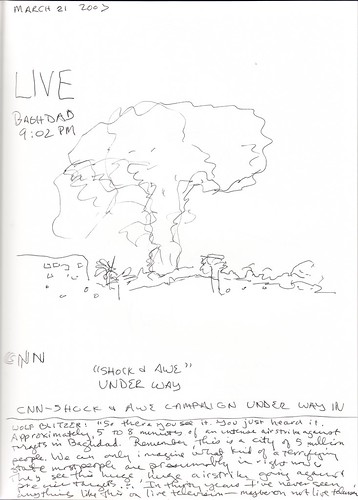
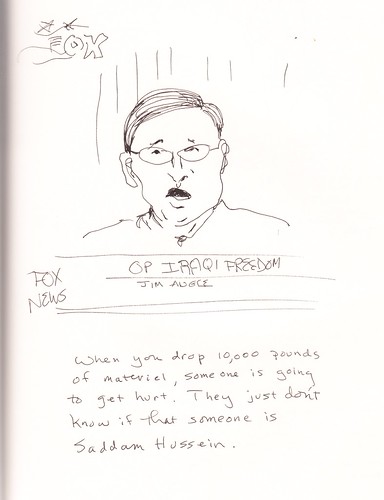
On Fox News, Jim Angle says "someone is going to get hurt" — the hope was it would be Saddam Hussein:
Shep Smith waxed poetic about "white flashes... peppering the night air" (because pepper is white):
I have long said that we should have kept the oil in Iraq – another area where my judgement has been proven correct. According to CNN, ISIS made as much $500 million in oil sales in 2014 alone, fueling and funding its reign of terror. If we had controlled the oil, we could have prevented the rise of ISIS in Iraq – both by cutting off a major source of funding, and through the presence of U.S. forces necessary to safeguard the oil and other vital infrastructure. I was saying this constantly and to whoever would listen: keep the oil, keep the oil, keep the oil, I said – don’t let someone else get it.It sounds extreme — especially "to the victor belonged the spoils." The idea should be that the oil should cover the expenses of liberating and protecting the people of Iraq. Nearly everyone seems to have forgotten that the Bush administration talked about the Iraq invasion in these terms:
If they had listened to me then, we would have had the economic benefits of the oil, which I wanted to use to help take care of the wounded soldiers and families of those who died – and thousands of lives would have been saved. This proposal, by its very nature, would have left soldiers in place to guard our assets. In the old days, when we won a war, to the victor belonged the spoils. Instead, all we got from Iraq – and our adventures in the Middle East – was death, destruction and tremendous financial loss.
Ahead of and shortly after the US invasion of Iraq in 2003, a number of officials, including former Defense Secretary Donald Rumsfeld and his deputy Paul Wolfowitz suggested the war could be done on the cheap and that it would largely pay for itself. In October 2003, Rumsfeld told a press conference about President Bush's request for $21 billion for Iraq and Afghan reconstruction that "the $20 billion the president requested is not intended to cover all of Iraq's needs. The bulk of the funds for Iraq's reconstruction will come from Iraqis -- from oil revenues, recovered assets, international trade, direct foreign investment, as well as some contributions we've already received and hope to receive from the international community." In March 2003, Mr. Wolfowitz told Congress that "we're really dealing with a country that could finance its own reconstruction." In April 2003, the Pentagon said the war would cost about $2 billion a month, and in July of that year Rumsfeld increased that estimate to $4 billion.
He would “call a press conference in about November and just turn it loose,” he said in the audio diary. “You need someone in this job” who could give his “total last ounce of energy, and I’ve had” that “up until now, but now I don’t seem to have the drive.”Energy. That's Trump's favorite buzzword, used most notably against Elder Bush's son Jeb.
“Maybe it’s the letdown after the day-to-day” 5 a.m. calls “to the Situation Room; conferences every single day with Defense and State; moving things, nudging things, worrying about things, phone calls to foreign leaders, trying to keep things moving forward, managing a massive project.... Now it’s different, sniping, carping, bitching, predictable editorial complaints.”As for the criticism of Cheney and Rumsfeld, I'll briefly note Elder Bush's tendency to call everyone "iron-ass":
"[Dick Cheney] just became very hard-line.... Just iron-ass...."
“I’ve concluded that Lynne Cheney is a lot of the eminence grise here – iron-ass, tough as nails, driving,” he said...
“I think [Rumsfeld] served the president badly... I don’t like what he did, and I think it hurt the president having his iron-ass view of everything...."
The director famously profiled another polarizing defense secretary, Robert McNamara, in his 2003 film 'The Fog of War'; that movie brought Morris and Michael Williams the Oscar for best documentary. The Rumsfeld film's U.S. release date has not been finalized.I love Morris, and "Fog of War" was great. I look forward to seeing how Rumsfeld handles the intense Interrotron interrogation. By the way, I see that Rumsfeld is criticizing Obama's approach to war in Syria.
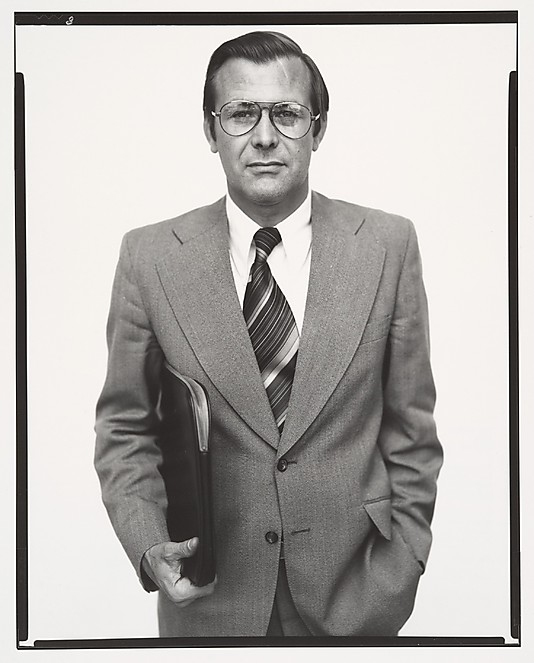
They're there at every level. We live in an enormously litigious society and the Congress contributes to that. As a result, there's practically no step that's made by anyone in the Pentagon and in the Department of Defense where they do not take into account the legal implications and consult lawyers about it....
There's a pattern in the department, at the top level, the chairman and the chief and the Joint Chiefs will recommend some rules of engagement for a certain circumstance. It will then be sent down the chain of command and it will get to the next command level, maybe the Combatant Commander, and the Combatant Commander will look at it, and then he will not want to violate it. So he might take a little tuck in it. And then it goes down to the next level. And it's got now it's in a country commander. And he looks at it and he doesn't want to break the rule so he takes a little tuck in it. You end up with four or five layers down there taking tucks and you end up with some rules of engagement that don't look like what the chairman of the Joint Chiefs or the Joint Chiefs of Staff or even the Combatant Commander intended. Now why is that? Well, it's fear. It's because of our litigious society. It's because of Congress overseeing things and having hearings.
Let me see if I have this straight, we can get the memos of a defense secretary in a time of war before the administration he worked for is even out of office, but we cannot get the memos of the first lady 7 years after her administration is over?
[N]ot many Republican lawmakers would speak up for Gonzales even if they were sure Bush would stick with him. He is the least popular Cabinet member on Capitol Hill, even more disliked than Rumsfeld was. The word most often used by Republicans to describe the management of the Justice Department under Gonzales is "incompetent."...Painful.
The saving grace that some Republicans find in the dispute over U.S. attorneys is that, at least temporarily, it draws attention away from debate over an unpopular war. But the overriding feeling in the Republican cloakroom is that the Justice Department and the White House could not have been more inept in dealing with the president's unquestioned right to appoint -- and replace -- federal prosecutors.
The I-word (incompetence) is also used by Republicans in describing the Bush administration generally. Several of them I talked to cited a trifecta of incompetence: the Walter Reed hospital scandal, the FBI's misuse of the USA Patriot Act and the U.S. attorneys firing fiasco. "We always have claimed that we were the party of better management," one House leader told me. "How can we claim that anymore?"
You suspect, deep down, that he's probably doing more or less what he needs to do. We can't just click our heels and get out of Iraq--the consequences would be disastrous. And the current strategy isn't working. You have said so yourself. Last fall you called for replacing Rumsfeld. You've complained that there weren't enough troops. What's more, you've heard good things about General David Petraeus from colleagues with military expertise. So now Bush has fired Rumsfeld, put Petraeus in command, and sent in more troops. Maybe this new approach deserves a chance to work?Is that what they really think? I'd guess they were thinking this new approach doesn't deserve a chance, because it's not going to work. In Kristol's account, the members of Congress go on to undercut the President's efforts for little reason other than their own political advantage.
A divided panel of the United States Court of Appeals for the District of Columbia Circuit, which will soon decide an important case concerning detainees at Guantánamo Bay, Cuba, rejected a friend-of-the-court brief submitted in the case by [seven retired federal] judges. Two former chief judges of the court were among those rebuffed....Mikva interviews that it's not political, it's personal: the judges are just mad at him for opposing those free vacations people like to give them.
“It certainly tells you,” Mr. Rivkin said, “how at least some of the D.C. Circuit judges feel about the anti-Bush-administration judicial activism by their former colleagues.”...
The two former chief judges on the brief, Abner J. Mikva and Patricia M. Wald, were appointed by President Jimmy Carter.
Ronald D. Rotunda, a law professor at George Mason University, said it was an unexceptional application of a sensible policy.The court's opinion -- for Judges David B. Sentelle and A. Raymond Randolph -- is very short, little more than an invocation of a sentence in Advisory Opinion No. 72 of the U.S. Judicial Conference Committee on Codes of Conduct:
“There is no particular reason why former judges should be able to leverage their titles in litigation,” Professor Rotunda said.
Stephen Gillers, a law professor at New York University, disagreed. “It’s more than petty,” Professor Gillers said of the brief’s rejection. “It’s unnecessary and insulting.”
Judges should insure that the title 'judge' is not used in the courtroom or in papers involved in litigation before them to designate a former judge, unless the designation is necessary to describe accurately a person's status at a time pertinent to the lawsuit.That opinion appears in full in Judge Judith W. Rogers's dissenting opinion, and you can see there that the concern was the appearance of partiality where a judge calls one lawyer "Mr." and the other lawyer "Judge," not any larger question about whether judges have a sufficient interest in the litigation to justify filing an amicus brief. In this case, here's how they phrased their interest:
Amici are retired federal judges who have dedicated their professional careers to our judicial system. The issue presented by these consolidated cases challenges the integrity of that system: may this Court sanction life-long detention in the face of credible allegations that the evidence upon which the detention is based was secured by torture?Basically, the judges offer their judicial opinion. As the dissenting judge notes, the U.S. Supreme Court accepts briefs from former federal judges whose interest is solely a judicial perspective. In Hamdan v. Rumsfeld, there was a brief from former federal judges whose stated interest was only that they were former federal judges and had an opinion on the issues in the case.
[T]he reason that they are filing the brief is that they are hoping that their experience and past accomplishments will impress the judges and Justices who may consider the case, and will move those active judges to pay special attention to the arguments in the brief. (They may also hope that the public and the bar will pay such special attention as well.) But there seems to be nothing nefarious in that -- the whole point of having amicus briefs be signed rather than anonymous is so that the court may consider, for whatever it's worth, the identity of those making the argument as well as the contents of the argument.Orin Kerr suspects that the retired judges are probably just allowing their names to be used on briefs they didn't work on and know little about. Maybe this should be discouraged, but it wasn't worth rejecting the brief.
[N]o one who knows George H.W. Bush thinks that moment was only about Jeb....She goes on to speculate about the younger Bush's feelings:
Surely Mr. Bush knew--surely he was first on James Baker's call list--that the report would not, could not, offer a way out of a national calamity, but only suggestions, hopes, on ways through it. To know his son George had (with the best of intentions!) been wrong in the great decision of his presidency--stop at Afghanistan or move on to Iraq?--and was now suffering a defeat made clear by the report; to love that son, and love your country, to hold these thoughts, to have them collide and come together--this would bring not only tears, but more than tears.
He has been shorn of much--his place in the winner's circle, old advisers. A man who worked for Richard Nixon reminded me the other night that when Nixon fired Haldeman and Ehrlichman, "he lost his asbestos suit." He lost his primary protectors and loyalists. President Bush is now without a similar layer. Old staffers gone, Rumsfeld gone, Cheney marginalized, Condi and Karen off representing. And the ISG. And the loss of Congress.Why hasn't the ordeal registered on George W. Bush's face? His foes would, I think, say it's a sign of his idiocy. He's too shallow and witless to have processed the information. His fans must think it's depth of character (if not divine inspiration). Peggy says:
And yet the president presents himself each day in his chesty way, with what seems a jarring peppiness.
It is part of the Bush conundrum--a supernal serenity or a confidence born of cluelessness? You decide. Where you stand on the war will likely determine your answer. But I'll tell you, I wonder about it and do not understand it, either what it is or what it means. I'd ask someone in the White House, but they're still stuck in Rote Talking Point Land: The president of course has moments of weariness but is sustained by his knowledge of the ultimate rightness of his course . . .I haven't heard an "outsourcing" joke in a while. Not that that's really a joke. It's nothing all that special for parents to suffer for their children. Once our children are not babies anymore, we have to release them into the world and see what happens. It's a dangerous thing about having children. It's like having a second body that can experience pain, but you can't control what that body does. You can't avoid that pain. But your suffering as a consequence of what happens to them doesn't save them from pain. It may make it worse. Didn't you refrain from telling your parents things that would only make them feel bad? If your parents are deceased and something bad happens to you, don't you think about how they didn't have to suffer the pain of knowing that? So it's a joke-like end to a column that raises a serious question: Why hasn't wartime presidency ravaged GWB the way it ravaged Lincoln, LBJ, and Nixon?
If he suffers, they might tell us; it would make him seem more normal, which is always a heartening thing to see in a president.
But maybe there is no suffering.
Maybe he outsources suffering. Maybe he leaves it to his father.
Repeating what others have said, George Bush is a child of privilege. People like that (I am one) never worry, because we are Fortune's children. Roosevelt wasn't ravaged by WWII.
My conspiracy theory: The memo is a fake. I've read several different places that Rumsfeld despises acronyms, never uses them, and doesn't allow them to be used in documents he reads or dictates.
Stephen B: If your acronym theory is correct, here's another one that crept in, "Korean Katusas"
Katusa is an acronym for Korean augmentee to the U.S. Army.
I worked on Secretary Rumsfeld's personal staff for three years and at least the writing style is consistent with his. He does use acronyms, and especially in snowflakes, those nasty things that come drifting down from his office that ruin your chances of going home on time.
All I can say is based on writing style, it seems authentic.
Why do insurgent gangs, who have vastly smaller resources and manpower than the American soldiers they fight, continue to try to kill those soldiers? The answer is, because they believe they only have to kill a few more, and the soldiers will leave. They need not inflict a military defeat (which would be impossible, given the strength of the American military)--all they need to do is survive until American voters decide to throw in the towel, which might happen at any moment.Much more at the link. Stuntz's main point is that people -- like Rumsfeld -- who apply the principles of business to war are making a profound mistake.
The proper response to that calculation is to make emphatically clear that the fight will not end until one side or the other wins, decisively
[H]e has been amazed at Rumsfeld's ability to be at once brashly know-it-all and disarmingly homespun. "It was a wonderful mixture of arrogance and 'Aunt Harriet' language" like goodness gracious, Trillin says. "I don't think anybody can match that."I like sharp, colorful characters on the public scene. But if you don't approve of what someone is doing, too much style is irritating as hell. Presumably, the new guy will present a blander image, part of the whole new program of making everybody feel better about everything.
... Trillin writes that Rumsfeld conducted his press briefings "as if trying patiently to explain the obvious to a class of slow third-graders. (Might you prefer to be briefed by someone less arrogant and condescending? Yes. Do we always get what we want? Of course not.)"


 Posts
Posts


