Showing posts with label Renoir. Show all posts

April 2, 2026

"When I once interviewed him, he had an orchestra playing live for us. He had the kind of paintings Spain would go to war with [Italy] over."

Said Antonio Mascolo, a journalist in Parma, quoted in "Thieves steal works by Cézanne, Renoir, Matisse in less than 3 minutes/Four masked men are believed to have forced their way through an entry gate, grabbed the paintings and escaped by climbing a fence, Italy’s Carabinieri said" (WaPo).

The museum is The Magnani Rocca Foundation museum in the town of Traversetolo. It was not well guarded. We're told the paintings might be worth $10 million total. 

The paintings are Renoir’s “Fish,” Cézanne’s “Cup and Plate with Cherries” and Matisse’s “Odalisque on the Terrace.” Will we miss them?


Hey, remember the old "Renoir Sucks at Painting" Instagram account?

August 26, 2019

I'm a longtime fan of "Renoir Sucks at Painting," and now here comes the New Yorker art critic, Peter Schjeldahl with "Renoir's Problem Nudes"...

... subtitled "An argument is often made that we shouldn’t judge the past by the values of the present, but that’s a hard sell in a case as primordial as Renoir’s." And I can see people at Instapundit getting exercised about about the political judgment of high art.

First, I must observe that Schjedahl doesn't mention Max Geller, called "the leader of a group called Renoir Sucks at Painting" in the 2015 Atlantic article "Why Absolutely Everyone Hates Renoir/The protestors in Boston who declared even God despises the maligned Impressionist might be on to something."

Schjedahl is speaking out now — 4 years after "Renoir Sucks" peaked — because there's a new exhibit, "Renoir: The Body, the Senses." He writes:
The reputation of the once exalted, still unshakably canonical, Impressionist has fallen on difficult days. Never mind the affront to latter-day educated tastes of a painting style so sugary that it imperils your mind’s incisors; there’s a more burning issue. 
The art historian Martha Lucy, writing in the show’s gorgeous catalogue, notes that, “in contemporary discourse,” the name Renoir has “come to stand for ‘sexist male artist.’ ” Renoir took such presumptuous, slavering joy in looking at naked women—who in his paintings were always creamy or biscuit white, often with strawberry accents, and ideally blond—that, Lucy goes on to argue, the tactility of the later nudes, with brushstrokes like roving fingers, unsettles any kind of gaze, including the male. I’ll endorse that, for what it’s worth.
Lucy makes the painting sound better than it is.  I don't see what's bad about a painter of nudes being sensuously involved with the fleshly characters he's depicting. Why leap to calling it sexist? My guess? It's way to justify the exhibition of this insipid stuff. It's not bad painting; it's bad politics — and that infuses the show with modern-day relevance.

Here, take a look:
Schjedahl writes, "Renoir’s women strum no erotic nerves in me," and he complains about "the carnal tapioca, the vacant gazes, the fatuous frolic." But:
Everything in Renoir that is hard to take and almost impossible to think about, because it makes no concessions to intelligence, affirms his stature as a revolutionary artist. 
"Almost impossible." The reason I find it hard to think about is that I'm not sure what is meant by making "no concessions to intelligence." It cannot be that Renoir is intellectually challenging! I think it must mean the opposite, that Renoir didn't have any intellectual aspirations.
He stood firmly against the past in art and issued a stark challenge to its future. 
Renoir doesn't seem firm and stark at all. He's more... gelatinous. But Schjedahl is probably just saying that Renoir distinguished himself from the earlier academic style and later artists distinguished themselves from Renoir.
You can’t dethrone him without throwing overboard the fundamental logic of modernism as a sequence of jolting aesthetic breakthroughs, entitled to special rank on the grounds of originality and influence. 
He belongs on the time line. That doesn't mean he belongs on a throne.

June 25, 2019

"For one thing, Biden's political instincts are hideously out of tune with the times and the electorate."

"Most recently he stirred up a multi-day scandal by speaking fondly about his friendship with the late Senator James Eastland, one of the most violently feral racists ever to sit in Congress (and the bar for that qualification is extremely high)."

From "Are Democrats really going to trust Joe Biden with their 2020 hopes?" by Ryan Cooper (The Week).

Hideously... recently... fondly... violently... extremely... That's a lot of "-ly." There should be a vertiginously high bar for adverbs, with or without all the "-ly"s. Who writes like that? I don't know, but I want to focus eagle-eyedly on "hideous" — with or without the "-ly."

"Hideous" is the word of the moment because of the publication of E. Jean Carroll's "Hideous Men/Donald Trump assaulted me in a Bergdorf Goodman dressing room 23 years ago. But he’s not alone on the list of awful men in my life" (in New York Magazine). That article is an excerpt from a forthcoming book, but the book is not called "Hideous Men." It's called "What Do We Need Men For?: A Modest Proposal." As a book title, it would be bothersomely close to "Brief Interviews with Hideous Men" and thus dangerously, insouciantly invites comparison to David Foster Wallace.

What did David Foster Wallace think about "-ly" adverbs? From his essay "Twenty-Four Word Notes" (in Both Flesh and Not: Essays):
Impossibly    This is one of those adverbs that’s formed from an adjective and can modify only adjectives, never verbs. Modifying adjectives with these sorts of adverbs—impossibly fast, extraordinarily yummy, irreducibly complex, unbelievably obnoxious—is a hypereducated speech tic that translates well to writing. Not only can the adverbs be as colorful/funny/snarky as you like, but the device is a quick way to up the formality of your prose without sacrificing personality—it makes whoever’s narrating sound like an actual person, albeit a classy one. The big caveat is that you can’t use these special-adv.-with-adj. constructions more than once every few sentences or your prose starts to look like it’s trying too hard.
Anyway... I was naturally and bizarrely wondering if "hideous" was getting inappropriately and tediously overworked in the press in the last few days. There's "I do have values, I swear, I just can’t recall what they are" by Alexandra Petri (WaPo):
I value the family, a theoretical entity against which people are making hideous strides all the time, mainly by being themselves in public or in private but on occasion by the throwing of unwanted parades.
There's "More and more people loathe Renoir. Is it time for a revival?" by Sebastian Smee (again, in WaPo):
Can a great exhibition redeem a less than great artist? I ask this knowing it is the wrong question. It is wrong not just because huge numbers of people think Renoir is, in fact, great, as well as adorable, joyous and life-affirming. But also because, for many of the rest of us, Renoir is not “less than great.” He is awful. Hideous. Beyond the pale. Asked for her take on Renoir, a discerning friend replied that his works provoked “visceral disgust.” His canvases, she said, were “like a painted version of Sweet’N Low.”
From "A Step-by-Step Guide to Detoxing from Your Winter Burrito Diet/Weaning off the winter is not an easy journey. We've got your back" by Kade Krichko (Powder):
Like most things, burritos are healthy in moderation. However, when your food pyramid is actually a cylinder wrapped in tin foil and you just purchased an infomercial blanket that looks like a tortilla, it might be time to face the facts.... In addition to burning that hideous tortilla blanket, take all of your burrito punch cards out of your wallet and put them into a lockbox....
From "Congress flails after Trump’s deportation ultimatum" (Politico):
“This is a response to the most hideous thing we have seen in our country — that people are dying, that children are dying right now at our hands, in our name,” Rep. Jan Schakowsky (D-Ill.) said leaving the roughly 90-minute meeting, visibly upset by the discussion. “There may be changes going into it but the message is we will not tolerate this kind of child abuse that's going on right now.”
From "The Ugliest/Best Chrysler LeBaron of All Time Could Be Yours" (Automobile):
The car has honestly always struck us as being so bad, it’s good, and this re-creation strikes just the right balance of hideous and unique.
From "Starting an Instagram Clique Fixed My Fear of Group Friendships/My friendships with other women were hard-earned, closely guarded one-on-ones, until I accidentally started a thriving Instagram community" by Lauren Menchling (Vice):
I'd been interrogating new acquaintances to wildly mixed results for decades until I finally stumbled upon the real conversational secret to instantaneous platonic intimacy. The magic word is clogs. Bring up clogs, and watch what happens to the person you’ve been struggling to make chit-chat with. Her shoulders will ease, she’ll laugh, and she’ll tell you about the hideous shoes that her great aunt Rose used to stomp around in—or she’ll show you a picture of the exorbitantly priced Rachel Comey pair that she's close to buying. She’ll tell you that her husband hates clogs, but she doesn’t care, or that she refuses to become one of those depressing clog-and–sack dress ladies. Love them or hate them, everybody has feelings about clogs.
From "China forcibly harvesting organs from religions detainees killing many" (The Independent):
Part of the programme is to transform China’s organ transplant as a tourist spot, “where people needing organ transplants will pay huge sums to receive an organ. China has never adequately explained where it is getting these organs from.” The alleged victims include those practicing the spiritual meditative practice known as Falun Gong in addition to Uyghur Muslims, some Tibetan Buddhists and House Church Christians.

“The conclusion shows that very many people (detainees) have died indescribably hideous deaths for no reason, that more may suffer in similar ways and that all of us live on a planet where extreme wickedness may be found in the power of those, for the time being, running a country with one of the oldest civilisations known to modern man,” Sir Geoffrey Nice QC says.
I can't tell if "hideous" has become unusably trite, but I do see that it's deployed in 2 different ways — sometimes to describe something truly horrible (such as murderous organ harvesting) but most commonly in the comically dramatic aversion to relatively trivial ugliness (like clogs, that Chrysler LeBaron, paintings by Renoir, and random Biden gaffes).

August 3, 2018

At the Green Beard Café...

P1170817

... you can talk all night.

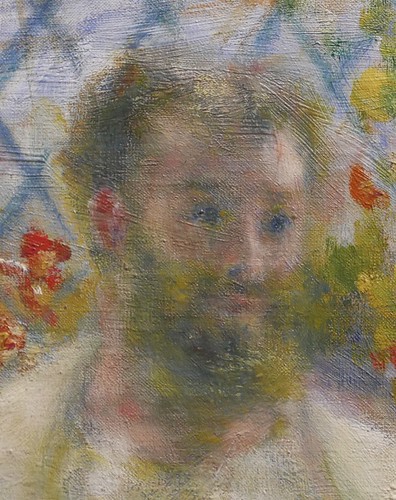
And don't think I photographed that detail of "Lunch at the Restaurant Fournaise" because I thought it was well painted!

Remember you can use the Althouse Portal to Amazon.

August 2, 2018

At the Summer Girl Café...

P1170821

... you can daub and smudge all your comments.

March 29, 2018

"In his fifteenth satire, Juvenal had scoffed at Egyptians for allegedly worshipping onions..."

"... 'What a holy race (o sanctas gentes) to have such divinities springing up in their gardens.'* Sir Walter Raleigh, in an anti-Catholic mood, compared such worship of food to the sacrament of Holy Communion, where Christians munch on their god. John Donne, George Herbert, and Robert Herrick all followed Raleigh’s lead, joking, as Herbert wrote, of anyone 'who makes a root his god.' Thus, [the scholar Tom] Tashiro notes, 'the lowly onion was touched with divinity and thereby entered into the works of a few great poets.' When Rome seemed less of a threat, onions seemed less ripe for poetry. 'Only with the passing of time,' Tashiro concludes, 'in the nineteenth century, on the Continent, would the onion again receive the attention of great writers—of the Scandinavians and of the Russians—for whom it became a symbol of the self and would have moral virtues.' Tashiro is presumably alluding to Grushenka’s parable in The Brothers Karamazov: a guardian angel gives a wicked woman in hell one last chance at salvation. Did she ever do one good deed? Yes, she once gave an onion to a beggar. The angel appeals to God who says, fine, take that onion and yank her out of the lake of fire with it. Other sinners hold onto her feet, hoping for a free ride, but she kicks them off. 'I’m the one who’s getting pulled out, not you,' she says. 'It’s my onion.' At that very moment, the onion breaks. For some reason, I think of this parable whenever I drive by the Colt Armory, on Interstate 91 in Hartford, with its incongruous onion dome, bright blue and studded with gold stars.** It’s my Second Amendment, I imagine someone saying."

From "Renoir’s Onions" by Christopher Benfey (in The New York Review of Onions).

Here are Renoir's Onions, in case you're wondering how Benfey got from Egypt to The Brothers Karamazov to the Second Amendment:


These are crazy times, but a man once took that much time to paint 6 onions, and now we have Trump... and no hell.

________________

* Juvenal wrote, "Who knows not... what monsters demented Egypt worships? One district adores the crocodile, another venerates the Ibis that gorges itself with snakes. In the place where magic chords are sounded by the truncated Memnon, and ancient hundred-gated Thebes lies in ruins, men worship the glittering golden image of the long-tailed ape. In one part cats are worshipped, in another a river fish, in another whole townships venerate a dog; none adore Diana, but it is an impious outrage to crunch leeks and onions with the teeth. What a holy race to have such divinities springing up in their gardens! No animal that grows wool may appear upon the dinner-table; it is forbidden there to slay the young of the goat; but it is lawful to feed on the flesh of man!"

** Here's an image of that dome (cc Onasill ~ Bill Badzo):

Hardford Connecticut ~ United States Fire-Arms Manufacturing Company, Inc. ~  Colt Armory Complex

March 7, 2018

"In 1897 he railed against the automobile as an ‘idiotic thing’ and a symbol of ‘decadence’, insisting that ‘there is no need to go so fast’..."

".. he denounced the invention of the railway as a ‘crazy idea’ which had resulted in ‘too much coming and going’; in 1904, he confessed to the journalist C L de Moncade (with some justice), ‘I am the worst old fogey there is among the painters.’ This suspicion of modern technology went hand in hand with a suspicion of broader social changes. Extremely needy for male friendship, Renoir took a dim view of women’s intellectual abilities and described feminist authors such as George Sand and Juliette Adam as ‘calves with five hooves’. At the height of the Dreyfus Affair in the 1890s, Renoir threw in his lot with the conservative Right and slandered French Jews as rootless cowards."

From a review of a "Renoir: An Intimate Biography."

The notion that Renoir was a bad painter has already been discussed on this blog here, here, and here.

December 9, 2017

"I know he brought you into his office to show you porn, I know he made sexual innuendos to you. I know this because you told me so in DC..."

"... and you even used the words sexual harassment. You said you would warn off other women thinking of clerking for him. And if there’s a woman out there he harassed worse than you, do you really want to be pitted against her? Because that’s what it would be. I’m worried that this is what he’s asking you to do — to be the female, intelligent face of his defense and make whoever it is accusing him look like a stupid slut, and then he hopefully never has to actually address those allegations."

Wrote "fellow romance novelist Eve Ortega" to Heidi Bond, who clerked for 9th Circuit Judge Alex Kozinski and "who went on to clerk for the Supreme Court and now works as a romance novelist writing under the name Courtney Milan," quoted in the WaPo article "Prominent appeals court Judge Alex Kozinski accused of sexual misconduct."

Bond is now saying that the judge "called her into his office several times and pulled up pornography on his computer, asking if she thought it was photoshopped or if it aroused her sexually.... One set of images she remembered was of college-age students at a party where 'some people were inexplicably naked while everyone else was clothed.' Another was a sort of digital flip book that allowed users to mix and match heads, torsos and legs to create an image of a naked woman."

The "pornography" wasn't related to any legal case. I'm putting "pornography" in quotes because I don't think of photographs of a naked person as "pornography." Is this Renoir painting pornography?
It's bad — it's atrocious! — but it's not pornography. If I ask you whether you find those Renoir women sexually attractive, am I sexually harassing you? Is the workplace hostile if X lets you see that he's looking at a picture of a naked person and asks if you find that naked person sexually attractive? I mean, anybody can see from the vantage point of today that it's a bad idea to interact like that in the workplace, but I think a proportionate reaction would be to agree that we shouldn't be doing that and move forward.

A few personal footnotes:

1. I've met Judge Kozinski and like him, though I haven't seen him in a long time. I think he's more casual, freewheeling, and individualistic than most judges. In fact, what I remember most about talking to Judge Kozinski is that when he attempted to tell me how to become a federal judge, I said I didn't want to be a federal judge: it's better to be a law professor, precisely because you have more personal freedom and can express yourself in a less conventional, more individualistic style.

2. The only time I've ever watched actual pornography was in the chambers of the federal judge I was clerking for. A box of VCR tapes had been seized by the U.S. government en route to some man whose wife actually showed up in court to argue that those tapes were good for her relationship with her husband. So the videos needed to be watched to determine if they reached the level of "obscenity" within the meaning of First Amendment law. I have a vivid image of seeing "my" judge reading legal briefs next to a TV screen closeup of well-lit genitalia.

3. My idea of the meaning of "pornography" is grounded in the 1980s and early 90s when feminists set aside the concept of "obscenity" and spoke instead of "pornography," which they defined as "the graphic sexually explicit subordination of women through pictures and/or words." That idea for legislation had a lot of problems and never got very far, but the point is, it was an effort to get at the real problem of the subordination of women. I was a law professor when those things were happening and I wrote and taught about some of these subjects, and the ideas about subordination and inequality still affect what I think about claims relating to seeing pictures of people naked.

And...

Here's the Amazon page for Courtney Milan. People seem to like her books. I've never read any of them. I don't look at pornography and I don't read romance books. Just my personal preference. But I was amused by the biographical statement on that Amazon page:
Before she started writing historical romance, Courtney got a graduate degree in theoretical physical chemistry from UC Berkeley. After that, just to shake things up, she went to law school at the University of Michigan and graduated summa cum laude. Then she did a handful of clerkships with some really important people who are way too dignified to be named here. She was a law professor for a while. She now writes full-time.
I too was a law professor for a while and now write full-time. I'm impressed by her background and her career choices, including the earlier sloughing off the lawprof persona and recreating herself as a freely expressive writer.

ADDED: Here's an article from 2015 on Heidi Bond/Courtney Milan. This seems to be from the University of Michigan Law School, presenter her as a successful alumna. We're told that her romance novels, set in the 19th century, include details about "judges, lawyers, and courts as well as epidemiological studies and complex calculus."
“Everything that happens and everything that I learn or think or feel is fair game for ending up in a book,” she says. “All these things are tools that can be used.”...
Her encounters with Judge Kozinski are part of "everything that happens," and perhaps she has used that somewhere in her writing, which sounds high-level (and I'm not going to look down my at romance novels (to the extent that I'm an art snob, it's not about sticking to the high side of the high-art/low-art distinction)).

Bond/Milan also seems to have done very well financially:
In early 2014, Yahoo Finance ran a story featuring Bond among a handful of other writers with the headline: “These Romance Writers Ditched Their Publishers for E-Books-and Made Millions.”

“Some of the most exciting entrepreneurs in the U.S. today aren’t hoodie-wearing app developers,” the article says, “they’re women writing books for women and making millions in the process.” The article quotes Bond as one of the pioneering authors who decided to stop selling her books to mainstream publishers and instead launch her novels independently. The result yielded more control over what she was producing while successfully targeting e-book readers who wanted to buy digital copies of books often for less money and more frequently than traditional publishing could produce them....

October 12, 2015

"On the merits of the case, I would have identified with the [Renoir Sucks at Painting] people at a time... when I had left the first class of people who like Renoir and had yet to join the second."

Writes Peter Schjeldahl in The New Yorker. The 2 groups are:

1. "[T]he young, discovering that art might be something they understand. Renoir’s winsome subjects and effulgent hues jump in your lap like a friendly puppy. He’s easy."

2. "[T]hose who have stopped fortifying their self-esteem with pride in their sophistication."

Hmm. I don't know. I detect pride in #2. I think there's a post #2 position. But then, perhaps, there is, somewhere out there, #3.

October 7, 2015

"Why do so many people think he’s good? Have you looked at his paintings?"

"In real life, trees are beautiful. If you take Renoir’s word for it, you’d think trees are just a collection of green squiggles."
Renoir is considered a good painter because his work is featured in museums, [Max] Geller added. But upon further inspections of his paintings, that line of argument “seems pretty fallacious”....

The Renoir Sucks at Painting... Instagram account... has even received the wrath of Genevieve Renoir, who says she is the painter’s great-great-granddaughter.

On one photo, Genevieve commented: “When your great-great-grandfather paints anything worth $78.1m dollars … then you can criticize. In the meantime, it is safe to say that the free market has spoken and Renoir did not suck at painting.”

Geller, who turned her comment into its own post on the account, said: “I think that is one of the most absurd and insane arguments for anything, the idea that we should let the free market dictate quality.”
Ms. Renoir's argument — staunchly opposed by Geller — bears an intriguing similarity the old free-speech argument that Oliver Wendell Holmes made back in 1919: "[T]he best test of truth is the power of the thought to get itself accepted in the competition of the market."

Would you call that — using Geller's words — "most absurd and insane argument for anything, the idea that we should let the free market dictate quality."

August 9, 2014

Maybe girls will buy it if it's pink...


That's Penguin's new cover for the Roald Dahl classic "Charlie and the Chocolate Factory," as seen at "The five worst book covers ever." The other 4 are so much less bad that it's scarcely worth pretending this is a real listicle (even if writing a listicle were something worth aspiring to).

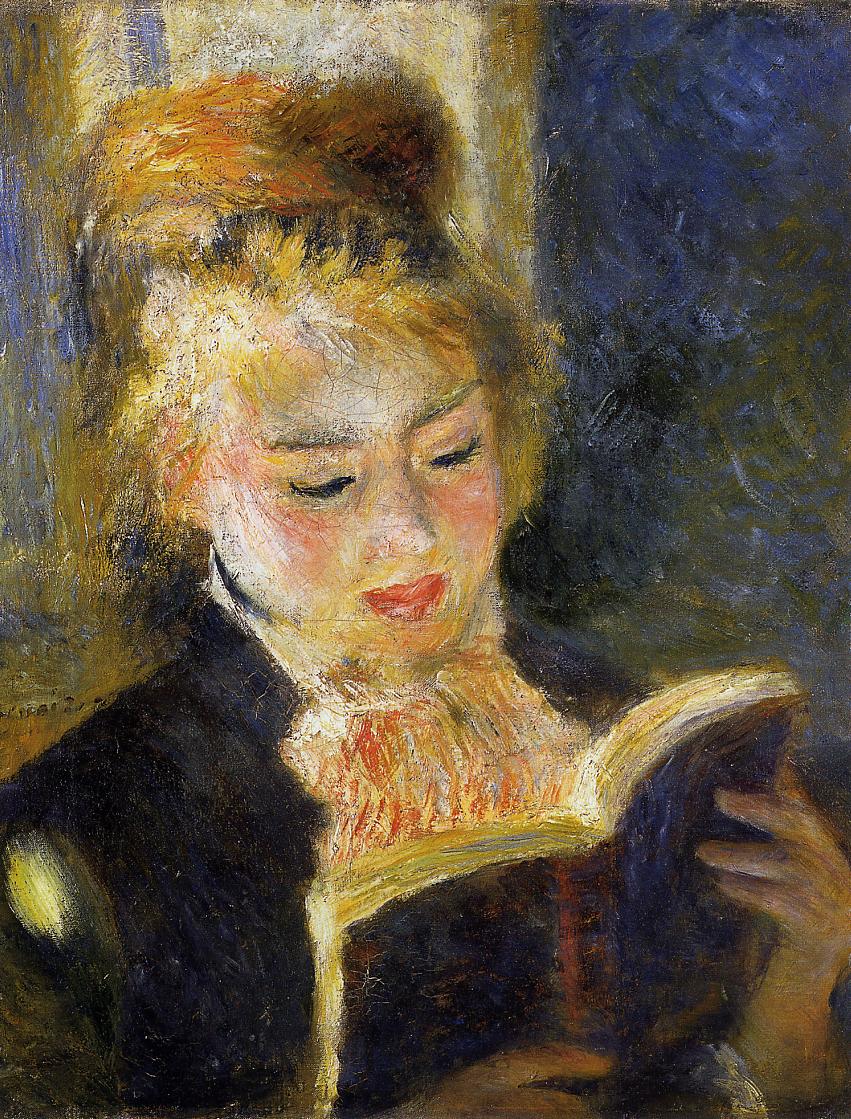
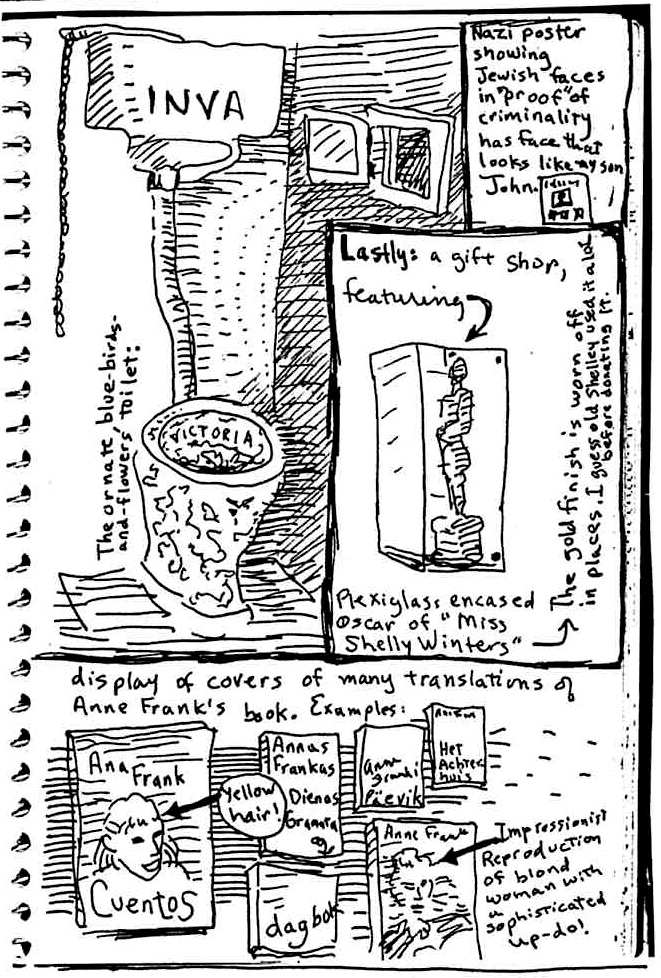
The worst book covers I ever saw were on display at the Anne Frank house in Amsterdam, where I traveled in 1993. This was in the days before digital photography when I traveled without a camera in what I consider my "Get Me a Table Without Flies, Harry" period. On page 33 of what I call my "Amsterdam Notebooks" — at the bottom of the second image — I wrote and sketched about the various copies of the diary, translated into many different languages, with the Spanish version — "Cuentos" — featuring a smiling blonde girl and the French version reproducing an 1877 Renoir portrait of a rosy-skinned blonde woman in the most absurdly comfortable, cossetted circumstances imaginable:

June 15, 2011

"WI Supreme Court validates Walker union law — now will Quinn pay up on Bears-Packers bet?"

"[I]t's time to put some pressure on Illinois' hapless governor, Pat Quinn."

Here's some pressure on Quinn from last April:
Quinn was scheduled to fulfill the bet on Feb. 21 at Feeding America Eastern Wisconsin, a food bank in Milwaukee. But he canceled because Democrats and Republicans in Wisconsin were at each other's throats at the time. Plus, Walker was trying to steal Illinois jobs....

I asked Walker's office if they'd like to publicly condemn Quinn for his foot-dragging and perhaps throw him under the Packers team bus. They didn't seem too upset...

There's one other bet that hasn't been satisfied yet. We're still waiting for the Carnegie Museum of Art in Pittsburgh, the city we vanquished in the Super Bowl on Feb. 6, to lend us the Renoir painting, "Bathers With Crab," as they promised. We want our "lounging, fleshy females," as our art critic described it.
We want our lounging fleshy females...


... and our fleshy governor from the south. In a soup kitchen. Pronto!

December 29, 2009

"hate audio books where women speak man's part."

This is a Google search that brought a couple readers to my blog — to a post that wasn't about being annoyed when female audiobook readers do the dialogue of male characters. But it's a good topic for discussion! I too hate the way female readers — especially the really dramatic ones — do male voices. They macho it up ridiculously. I have an audiobook of "Lady Chatterley's Lover" — read by Emilia Fox — and the male characters all sound so brutish. Some of that is in the text, but I'd like the text to speak for itself.
"No; my heart's as numb as a potato, my penis droops and never lifts its head up, I dare rather cut him clean off than say 'shit!' in front of my mother or my aunt... they are real ladies, mind you; and I'm not really intelligent, I'm only a 'mental-lifer'. It would be wonderful to be intelligent: then one would be alive in all the parts mentioned and unmentionable. The penis rouses his head and says: How do you do? -- to any really intelligent person. Renoir said he painted his pictures with his penis... he did too, lovely pictures! I wish I did something with mine. God! when one can only talk! Another torture added to Hades! And Socrates started it."
I'd rather try to figure that out without a woman trying to sound like the man who would say that.

Released Guantanamo detainees did not respond to art therapy the way we were hoping.

They, apparently, went on to plan the Christmas Day bombing.

1. What does this say about art? Is art ineffectual or — think about it! — quite powerful? It seems to me that serious artists are not about using art to become serene members of the community. They try to make strong statements and shake complacent conformists. Épater la bourgeoisie. Terrorist ideology + art should = explosion.* Now, of course, it was probably incredibly lame art therapy, in which case it was laughably ineffectual. I just want you to think about what a despicable use of art this was all around. Whether it was weak art or strong art, it was not something to be prescribed to turn men away from terrorism.

2. These men — Guantanamo prisoner #372, Said Ali Shari and prisoner #333, Muhamad Attik al-Harbi (who for some reason has now changed the Harbi to Awfi) — were released in 2007, during the Bush Administration. So, that is Bush's fault. If Obama supporters want to take advantage of the argument that it's Bush fault, they must encourage Obama to take a harsher position than Bush did against the Guantanamo detainees. Could that happen? Hardly. But maybe Obama will toughen up about the detainees. He may have wanted to do that anyway, and the Flight 253 near-disaster gives him leverage for moving his position.

***

* I hope you haven't forgotten how some artists talked about 9/11. Here's an item printed in The Guardian on September 11, 2002:
The artist Damien Hirst said last night he believed the terrorists responsible for the September 11 attacks "need congratulating" because they achieved "something which nobody would ever have thought possible" on an artistic level....
"The thing about 9/11 is that it's kind of an artwork in its own right. It was wicked, but it was devised in this way for this kind of impact. It was devised visually."

Describing the image of the hijacked planes crashing into the twin towers as "visually stunning", he added: "You've got to hand it to them on some level because they've achieved something which nobody would have ever have thought possible, especially to a country as big as America.

"So on one level they kind of need congratulating, which a lot of people shy away from, which is a very dangerous thing."

Referring to how the event changed perceptions, he added: "I think our visual language has been changed by what happened on September 11: an aeroplane becomes a weapon - and if they fly close to buildings people start panicking. Our visual language is constantly changing in this way and I think as an artist you're constantly on the lookout for things like that."

AND: "Renoir said he painted his pictures with his penis... he did too, lovely pictures!" And Abdulmutallab attempted to create a "visually stunning" plane crash with his bomb-augmented penis.