Ipinapakita ang mga post na may etiketa na Muhammad Ali. Ipakita ang lahat ng mga post

Hunyo 15, 2026

A woman dies and this is how she is remembered? For her "burning hatred for Trump"?


Now, this is just very sad. Imagine dying and that's the headline — how you burned with hate. Thanks, family. Thanks for remembering the hate.

Can you think of any other example of a person of note whose admirers remember them after their death for their burning hatred? I resorted to AI to search for examples of this kind of post-death praise for hating and I couldn't find one example. The closest I came was Muhammad Ali. He "hated" Frazier. Said things like "It's gonna be a killa and a chilla and a thrilla when I get that gorilla in Manila." 

Mayo 30, 2024

I've got a bit of a theme going now, so I'm going to have to talk about what Jerry Seinfeld said.

And I'm choosing the A.V. Club article, because it's got an excellent headline, "Jerry Seinfeld still talking, even though Pop-Tarts movie came out like a month ago/Seinfeld was waxing nostalgic for 'cultural hierarchy' and 'dominant masculinity' for some incomprehensible reason."

I like the generosity of crediting Jerry with reason, and I feel challenged to comprehend what the A.V. Club writer, William Hughes, purports not to comprehend. And it better not just be that Jerry Seinfeld, a comedian, was joking. That would be boring. Let's read. Jerry went on Bari Weiss's podcast and...
Seinfeld agreed, in the interview, with Weiss’ assertion that part of the guiding philosophy of the ’60s-set Unfrosted—which contains, among other things, a scene that is literally Mad Men fan fiction, complete with Jon Hamm and John Slattery reprising their parts—was a return to that age of “style.” “I miss a dominant masculinity,” Seinfeld said, being careful, admittedly, to note that he doesn’t consider himself part of the list of “real men” he admires. (Including JFK, Muhammad Ali, Sean Connery, and, apparently, Howard Cosell.) “Yeah, I get the toxic thing,” he said with deliberate dismissiveness. “But I still like a real man.”

Pebrero 10, 2019

Talk in the Raturday Night Café and the Google search it inspired.

Click to enlarge and clarify...


Here's a link to last night's café.

"Marriage is the death of hope" brings up webpages that purport to quote Woody Allen. I'm dubious.

"Marriage is the death of romance" gets me to some boring relationship advice plus the assertion that it's the translation of a Chinese proverb:
I'm dubious. It used to be very common to hear characters on TV (often in ads) say "Ancient Chinese wisdom" (in a fake Chinese accent) followed by something in the form of a proverb (almost always a manifestly fake proverb).

"Marriage is the death of love" gets me to boring relationship advice, some more groping after a Chinese proverb, and a review of a play about Maynard Jackson, "the first African-American mayor of a major U.S. city, elected in Atlanta in 1973":
[Playwright Pearl Cleage has a] sagacious way with words, and epigrammatic pearls like "There's no greater cynic than a failed romantic" (a variation on George Carlin’s "Scratch a cynic and you will find a disappointed idealist"). Later, when Evey recalls an epiphany of self-discovery in Paris, she tells J.P., "Marriage is the death of love."
Ha ha. Scratch me, I'm a failed cynic.

Have you thought about Maynard Jackson recently? Did you know he fought Muhammad Ali?
“The only thing that really worries me is what happens if I hit him, for his sake and for mine as well,” [Mayor] Jackson said.

“[He] will not land one punch in one round, and if he dreamed it, he better wake up and apologize!” Ali responded....
But Jackson won with a technical knockout:
“Those trunks he had saved him because he had them too high.,” Ali told reporters. “I couldn’t hit him low because you’re not supposed to hit below the belt. He came with the trunks up to his breast, therefore I couldn’t hit him in the effective spots ‘cause he’s so big, he’s like a balloon, and if you hit him he’ll bust.”

Enero 7, 2018

“I have nothing to declare except my genius" — said Oscar Wilde.

Or maybe he didn't say that, but, whatever. It's one of the best-loved Oscar Wilde sayings.

So I wouldn't be so sure I knew "How Actual Smart People Talk About Themselves." That's the title of a piece at The Atlantic by James Fallows, who's implicitly talking about himself, implicitly assuring us that he is a smart man who knows the smart people. That is, he is one of the elite who got snookered in the last election.

But the people Fallows talks about in his article are scientists and computer people. Wilde was a brilliant humorous writer, famous, especially, for short, hilarious sentences. Trump is much more like Wilde than like Bill Gates and that guy who won the Nobel Prize in medicine when he was in his 40s.

Here's Fallows:
Virtually none of them (need to) say it. There are a few prominent exceptions, of talented people who annoyingly go out of their way to announce that fact. Muhammed Ali is the charming extreme exception illustrating the rule: he said he was The Greatest, and was. Most greats don’t need to say so....
Once you admit there's an exception, you've got to say Trump is not like the exception. But Trump is like Muhammad Ali. He's making his reputation in large part by speaking entertainingly to the public. And, like Oscar Wilde's declaration of genius, Ali's proclamation of greatness felt like exuberant, extroverted fun to those who loved him. What Trump is doing feels like that too. If you hate Trump, you'll balk at that, but you need to know that there were many people who reacted negatively to Ali's "I am the greatest." I remember it very well, because I loved "I am the greatest" at the time, and I remember why I loved it. It was liberating. You could throw off your inhibition and proclaim your greatness.

Setyembre 7, 2017

"Who killed Davey Moore/Why an’ what’s the reason for?/'Not me,' says the man whose fists/Laid him low in a cloud of mist"

"Who came here from Cuba’s door/Where boxing ain’t allowed no more/'I hit him, yes, it’s true/ But that’s what I am paid to do/Don’t say "murder," don’t say "kill"/It was destiny, it was God’s will.'"


Bob Dylan put those words in the mouth of Ultiminio Ramos Zaqueira — Sugar Ramos — who came here from Cuba's door after Fidel Castro banned all professional sports. Ramos — who was only 5'4½" — won the featherweight crown from Davey Moore on March 21, 1963. Moore — who was only 5'2" — was favored to win, but after the 10th round Moore conceded, and shortly after that, Moore said to his manager, Willie Ketchum, “My head, Willie, it hurts something awful!” 3 days later, Moore died. Now, it's 54 years after that, and Sugar Ramos has died (NYT).
“It was my night, my glory,” he told Sports Illustrated in 1964. “I won fair and square. I beat him after he almost knocked me silly in the seventh round. I came back and beat him good. Then he dies, and nobody remembers that Ramos fought a good fight and won.”
Here's something Bob Dylan said when he performed the song in 1964:
This a song about a boxer.... It's got nothing to do with boxing, it's just a song about a boxer really. And, uh, it's not even having to do with a boxer, really. It's got nothing to do with nothing. But I fit all these words together... that's all... It's taken directly from the newspapers, Nothing's been changed... Except for the words.
How many Bob Dylan songs are about boxing? He sings Paul Simon's song "The Boxer." Of his own songs, besides "Davey Moore," there's the song about Hurricane Carter. ("Rubin could take a man out with just one punch/But he never did like to talk about it all that much/It’s my work, he’d say, and I do it for pay...") And there's "I Shall Be Free No. 10":
I was shadow-boxing earlier in the day
I figured I was ready for Cassius Clay
I said “Fee, fie, fo, fum, Cassius Clay, here I come
26, 27, 28, 29, I’m gonna make your face look just like mine
Five, four, three, two, one, Cassius Clay you’d better run
99, 100, 101, 102, your ma won’t even recognize you
14, 15, 16, 17, 18, 19, gonna knock him clean right out of his spleen
I guess Dylan got over his censoriousness about boxing. "Who Killed Davey Moore?" — which I think was written about a year earlier — seems like a flat-out condemnation of the sport of boxing, blaming everybody. After Davey Moore died, there were demands that boxing should be outlawed. Dylan's protest song is part of that. "I Shall Be Free No. 10" goes with Dylan's turn away from protest, the 1964 album "Another Side of Bob Dylan." Who knows how serious Dylan ever was about condemning boxing? Maybe he was just carelessly ripping something out of the newspaper and it had "nothing to do with nothing" for him. "I Shall Be Free" — unlike the earlier "Davey Moore" — is about personal freedom. It's Rabelaisian:
I’m gonna grow my hair down to my feet so strange
So I look like a walking mountain range
And I’m gonna ride into Omaha on a horse
Out to the country club and the golf course
Carry The New York Times, shoot a few holes, blow their minds
ADDED: "Bob Dylans Boxing Addiction":
Bob Dylan owns the complex that includes The 18th Street Coffee House in Santa Monica. It has or had a gym in the back. Ray “Boom Boom” Mancini trained Bob Dylan there. In Ray’s word’s “Bob has his own private gym. Best gym I’ve ever been in. On the wall there are pictures of Joe Louis, Ali, Frazier, Muddy Waters, the Rolling Stones. The heavyweights of boxing and music. First time I was over there we were sparring and just to keep him honest I would tap him with a left or right....

Oktubre 10, 2016

The so-called "town hall" debate.

It wasn't much of a "town hall" debate was it? I felt sorry for those people who had to sit and be background for 90 minutes. There were so few of them. Each one stood out and had to sit still and look alive, but though they were few, most never got called on. Those who did get a shot asked the most simple, pathetic questions. As I try to recall the questions this morning, they all seemed to be a short plea: What will you do to encourage people like me?

The candidates mostly ignored the person and even the question and plugged in something they wanted to talk about. They never did any of the sort of emotive, bonding-with-the-questioner performance that we are urged to think of when we hear the words "town hall debate." They ran out the clock, and then one of the moderators — in the guise of a "follow-up" question — would replace the "town"person's question with something more specific.

Here's the transcript of last night's debate. I'm going to read the questions and test myself. Am I right about what I just said? (Or do you need me to talk about the fly that landed on Hillary Clinton's face or the way Trump and Hillary didn't shake hands at the beginning and did shake hands in the end? Meade wanted me to rewind and get a video of the fly's antics. I could be first with the news of the fly! Have you ever heard of insect politics? Neither have I. Insects... don't have politics. They're very... brutal. No compassion, no compromise. We can't trust the insect. We rewound and laughed a lot, but I left it to the internet to take the pictures.)


Question 1 came from a teacher. She wanted to know if the candidates "feel" they are "modeling appropriate and positive behavior for today’s youth." Hillary, going first and setting the tone, boosted the ego of the townswoman by pronouncing her question "very good" and "important." She then proceeded to ignore the question and go into her standard line "our country really is great because we’re good." That's been her pat answer to Trump's banal "Make America Great Again." So when Trump got his turn, he knew where to go: His "whole concept" has been "to make America great again." A typical cascade of short sentences flowed out of that mental prompt, and nothing got back to the townswoman's question.

Oktubre 7, 2016

"To make America the greatest is my goal/So I beat the Russian and I beat the Pole..."

From the poetry of Muhammad Ali... which I found after I'd likened Trump to Muhammad Ali. I was participating in a Facebook discussion of a Politico article titled "Trump blows off debate tune-up/In this public town-hall rehearsal, Trump shows he’s put in as little 'prep' as the first time." Trump was quoted saying:
“I said forget debate prep. I mean, give me a break... Do you really think that Hillary Clinton is debate-prepping for three or four days. Hillary Clinton is resting, okay?”
I'd already posted "Isn't this a lot like the way Muhammad Ali would talk before a fight? It's performance..." So it blew my mind when I searched for something about what Ali would say and I found that old rhyme that was so close to Trump's "Make America great again."

Hunyo 4, 2016

How the Supreme Court decided the draft evasion case against Muhammad Ali.

It's hard to remember the details, and today's obituary's don't linger on this topic. For example, the NYT obituary just says: "As Ali’s draft-evasion case made its way to the United States Supreme Court, he returned to the ring on Oct. 26, 1970, through the efforts of black politicians in Atlanta."

But Ali had been convicted in 1967 and sentenced to 5 years in prison. The Supreme Court case that ultimately kept him out of prison came in 1971. What did the Court decide? Here's the very unusual inside story, found in "The Brethren" by Bob Woodward and Scott Armstrong:
Apart from the complicated war and draft issues, there were racial overtones to the case.... Public sympathy was growing for Ali, but at the same time the Black Muslim faith had been portrayed as separatist, antiwhite and bizarre....

"In later life Ali became something of a secular saint, a legend in soft focus."

"He was respected for having sacrificed more than three years of his boxing prime and untold millions of dollars for his antiwar principles after being banished from the ring; he was extolled for his un-self-conscious gallantry in the face of incurable illness, and he was beloved for his accommodating sweetness in public. In 1996, he was trembling and nearly mute as he lit the Olympic caldron in Atlanta. That passive image was far removed from the exuberant, talkative, vainglorious 22-year-old who bounded out of Louisville, Ky., and onto the world stage in 1964 with an upset victory over Sonny Liston to become the world champion. The press called him the Louisville Lip. He called himself the Greatest."

From "Muhammad Ali, Titan of Boxing and the 20th Century, Dies at 74."

ALSO: "But Ali had his hypocrisies, or at least inconsistencies. How could he consider himself a 'race man' yet mock the skin color, hair and features of other African-Americans, most notably Joe Frazier, his rival and opponent in three classic matches? Ali called him 'the gorilla,' and long afterward Frazier continued to express hurt and bitterness."

AND: From my perspective, as someone who was 13 years old in 1964 when Cassius Clay emerged in the popular culture, he seemed to have invented self-promoting bragging. My parents' generation held values of modesty and sportsmanship. You shouldn't verbalize your self-esteem, especially in a way that vaunted yourself over others. You should achieve and be admirable and then, perhaps, other people will praise you.

As my parents and their coevals saw it, Clay was teaching the young people the wrong values, including the idea that you can push beyond your area of actual achievement — in Clay's case, boxing — and insult your opponents about something unrelated — such as the way they look. You could not only call yourself beautiful, but the other person ugly. To young people, like me, that seemed very funny and fun and liberating.

(I don't really want to mention Donald Trump in this post, but the connection is too obvious. Who are we? How did we get here?)

Nobyembre 21, 2015

5 videos I watched, none of which seem capable of supporting a free-standing blog post.

1. On Facebook, somebody got me watching this parody video of Hillary Clinton singing "I Will Survive." Amusing enough that I looked up the YouTube page of Maximum Suffrage. Lots of stuff there, as yet unwatched by me.

2. I didn't know "Convos with my..." got a second child (like the first, amusingly played by an adult). I watched "Asking Nicely."

3. Charles Grodin, in 1995, as a talk show host, riffs for 6 minutes surrealistically introducing Jerry Lewis. (I started watching Jerry Lewis interview videos on YouTube a while back, for reasons I don't remember, and YouTube keeps suggesting more Jerry Lewis videos, and this is never going to end, because I keep watching them, and I'm not going to stop, because they are all so weird, including some where Lewis is the host, like here, interviewing Cassius Clay.)

4. The Grateful Dead in a live performance of "It Takes a Lot To Laugh, It Takes a Train To Cry." I got there as a result of a conversation that was mostly about "Ballad of Thin Man," prompted by reading this old 1965 interview in which Nora Ephron tried to get him to identify Mr. Jones and Dylan said: "He's actually a person. Like I saw him come into the room one night and he looked like a camel. He proceeded to put his eyes in his pocket. I asked this guy who he was and he said, 'That's Mr. Jones.' Then I asked this cat, 'Doesn't he do anything but put his eyes in his pocket?' And he told me, 'He puts his nose on the ground.' It's all there, it's a true story." Meade seemed to believe that Mr. Jones was Leonard Bernstein, but "That Party at Lenny’s" that Tom Wolfe described in "Radical Chic" took place in 1966. The word "camel" does appear in that greatest-of-all-time article, in this sentence: "Forty years ago firms flogging things like Hardman pianos, Ponds cold cream, Simmons metal beds and Camel cigarettes found that matrons in the clans Harriman, Longworth, Belmont, Fish, Lowell, Iselin and Carnegie were only too glad to switch to their products and be photographed with them in their homes, mainly for the sheer social glory of the publicity."

5. "Yeah, I'd like to see a video of a young person singing 'Eve of Destruction,'" I said after commenting in yesterday's post about the death of P.F. Sloan, who wrote the lyrics. The hit single was by Barry McGuire, who was 30ish, and I watched the video of a TV performance I remembered from 1965. I wrote: "Watching it again, I'm struck by the inappropriateness of McGuire's age. The lyrics are ridiculous coming from an adult. They're a perfect expression of teenage confusion about the world. Coming from an adult, it's mental or stupid." I found this, by Bishop Allen. It becomes noticeably "Eve of Destruction" at 3:44, but only the chorus is used, in the changed form: "And I tell you over and over and over again, my friend/That I'm down with you, even on the eve of destruction." I'd like to see a video of a teenager singing the original lyrics earnestly and sincerely.

Agosto 16, 2015

At the Jet Lag Café...

P1140717

... I'm still on Pacific Time, but I'll be fully back soon. Watching the Sunday morning shows with Meade. Meanwhile, carry on. Talk about whatever you like.

P1140716

Hunyo 10, 2014

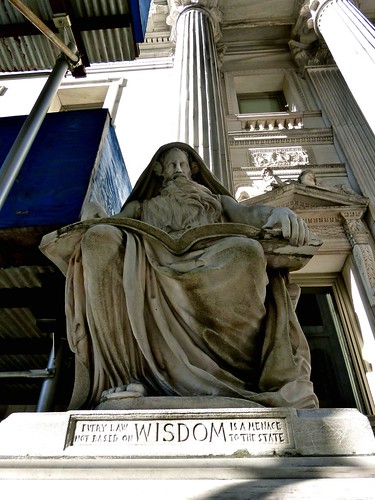
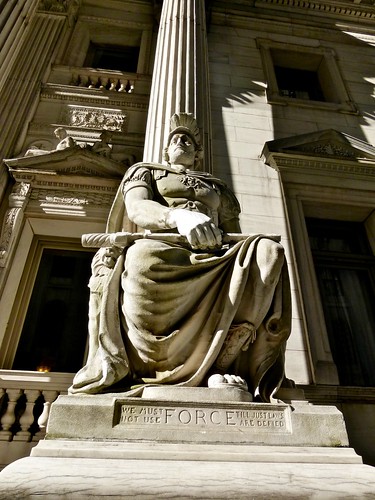
"Every law not based on WISDOM is a menace to the state"/"We must not use FORCE till just laws are defied."

Stunning inscriptions on 2 sculptures at the entrance to the New York Supreme Court Appellate Division, First Department in Manhattan:

Untitled

Untitled

According to this PDF from the court, the "Wisdom" sculpture is "an old man." It doesn't say it's Moses. Just some old guy. But the "Force" sculpture, we're told "is a composite of General Ulysses S. Grant, General Nelson A. Miles, and Admiral Francis M. Bunce." Actually, there is a Moses statue elsewhere on the building, at the roof line:

Untitled

There are various other historical figures, like Zoroaster and Confucius, and I see in the PDF that Muhammad was one of them until his image was removed and destroyed back in 1955, at the request of the governments of Egypt, Pakistan, and Indonesia.

Be that as it may, it's the inscriptions that fascinate me. I think that these are original aphorisms, composed for these sculptures, and that they were intended to paraphrase widely understood propositions of American law. Nevertheless, the precise words, taken literally, are quite extreme. I was surprised to see them on the courthouse. How differently cases would come out if these 2 phrases were binding law, taken seriously? 

Pebrero 25, 2014

"Incredibly, the loud-mouthed bragging, insulting youngster had been telling the truth all along."

Wrote the NYT, describing the fight that took place 50 years ago today:
Cassius Clay won the world heavyweight title tonight when a bleeding Sonny Liston, his left shoulder injured, was unable to answer the bell for the seventh round.

Immediately after he had been announced as the new heavyweight champion of the world, Clay yelled to the newsmen covering the fight: "Eat your words." Only three of 46 sports writers covering the fight had picked him to win....

The fight was Clay's from the start. The tall, swift youngster, his hands carelessly low, backed away from Liston's jabs, circled around Liston's dangerous left hook and opened a nasty gash under Liston's left eye....

But the kid hadn't lied. All those interminable refrains of "float like a butterfly, sting like a bee," had been more than foolish songs....
The youngster... the kid....

Enero 12, 2013

"Only RGIII can make the Redskins change their name. Here’s why he won’t."

Says WaPo sportswriter Mike Wise:
Pro players who take on controversial social debates are gone, replaced by athletes whose goal is to not offend... There is no Muhammad Ali, who lost his heavyweight boxing title as a conscientious objector to the Vietnam War. There is no Jim Brown, arguably the greatest running back in NFL history, who found more meaning in bringing rival L.A. gang members together than in playing on the gridiron, where, he realized, he was just “a highly paid, over-glamorized gladiator.”

There is no Arthur Ashe, the late tennis champion and civil rights activist, who in 1985 was arrested outside the South African Embassy in Washington during an anti-apartheid rally. There’s not even a Curt Flood, the St. Louis Cardinal who didn’t accept a trade to another team in 1969, appealing to the U.S. Supreme Court in a landmark case that paved the way for free agency.
Sports stars (and other pop culture stars) have clout, but what do they know about the political issues they could influence? Wouldn't the best, most ethical stance be to acknowledge their lack of qualification outside of their field of expertise?
“Have you thought about what it’s like to play for a team that’s named the Redskins?” I asked. “Because a lot of American Indians and others feel that’s a derogatory term.”

“I’m not qualified to speak on that,” Griffin said. “I didn’t even mean to stir up the other thing, so I’m not going to touch that one.”
Isn't that exactly right? Shouldn't more celebrities do that?

(By the way, "the other thing" refers to that "down with the cause... cornball brother" business.)

Enero 10, 2009

Another obituary: Charles Morgan Jr., the lawyer who argued "one person, one vote" in the Supreme Court.

The civil rights lawyer who won Reynolds v. Sims has died at the age of 78.
In 1962, Mr. Morgan and other young Alabama lawyers filed a lawsuit to force the reapportionment of the Alabama Legislature. The rural counties of south Alabama had many times the voting strength of the more urban north, allowing the old planter elite to control the Legislature. In 1964 the Supreme Court ruled in the case, Reynolds v. Sims, and ordered a more equitable apportionment. Along with similar cases from other Southern states, Reynolds established the doctrine known as one-person-one-vote, which increased the political power of African-Americans and urban voters.
You can listen to the argument here. (It's a 3-hour argument, and Morgan goes second, so settle in.)

Morgan also won the case the kept Muhammad Ali from being drafted and led the ACLU effort to get Richard Nixon impeached. He also got in trouble with the ACLU in 1976, when he opposed Jimmy Carter and said, stupidly, "I could never vote for anybody with a Southern accent. That’s bigotry, and that makes you a bigot."

Here's a 1979 review of Morgan's autobiography "One Man, One Voice" (a review written by Howell Raines):
What is missing here is a more thoughtful discussion of how hostility toward the rich and the well-favored went into the making of the passionate populist that Mr. Morgan always has been in his civil rights practice.

Mr. Morgan is hard on lawyers, too, especially those who practice what he calls "Frankfurterism" — a coinage reflecting Mr. Morgan's view that the late Associate Justice Felix J. Frankfurter "could always find legal reasons for refusing to do the right thing." The author's hero is the late Associate Justice Hugo Black, the Alabamian who helped change a cautious court dominated by Frankfurter into an aggressive defender of First Amendment rights.
I typed out that passage — it's a PDF that wouldn't let me cut and paste — because there are so many things about it that interest me. Most notably, Raines, writing in 1979, exhibits the attitude toward the Supreme Court that I saw when I was a law student at NYU from 1978 to 1981. I remember one lawprof who wanted us law review editors to write about the demise of Frankfurterism. There was a great confidence that the vigorous enforcement of constitutional rights was mandatory and notions of judicial restraint were backward and, in fact, bigoted.

Note, too, how judicial activism seems like a completely positive and appropriate attitude for the Court. The court should be "aggressive" and "a defender." That makes the Court sound like an activist lawyer. And "cautious" is pejorative. Today, the Justices often fight over different kinds of restraint, and no one tries to look like an activist. The norms are entirely different.

And look at how Raines conceives of activism specifically in terms of the First Amendment. You don't see that anymore. Those who like judicial activism today emphasize privacy rights, due process, and equal protection. Back then, freedom of expression was the core value. When and how did that change? I can't answer that question in a blog post, not this one anyway.