Ipinapakita ang mga post na may etiketa na Mapplethorpe. Ipakita ang lahat ng mga post

Agosto 1, 2023

"Pee-wee’s television stint ended in infamy when Reubens was arrested on a charge of indecent exposure in a porn theater. Late-night hosts pounced..."

"... and so did the news media. CBS took reruns of his show off the air. The controversy now seems preposterously overblown. That happened just one year before Sinead O’Connor’s career suffered a blow from her protest on 'Saturday Night Live' against sexual abuse in the Roman Catholic Church — an episode that has come under new examination after her death last week. It’s clear that dopey moralizing scandals are far from a hallmark of our age alone...."


That awful arrest took place in 1991, O'Connor's tearing of a photograph of the Pope happened in 1992. If you lived though that era — the NYT considers it an entire "age"! — do you remember with any specificity the kind of "moralizing"? I remember the Robert Mapplethorpe photographs and the obscenity case against 2 Live Crew. I remember "Pornography is the theory, rape is the practice." If the "age" that is 1991-1992 is expansive enough to go back to 1985, I remember when 11-year-old Karenna Gore activated her mother by playing Prince's "Darling Nikki."

If only there were blogging back then! The "dopey moralizing scandals" — is that the right phrase? — of the time had to do with fearsome sexuality. I don't think it's wise to explain them as transitory dopiness. We can always predict that 3 decades later we will look back and think we were dumb, but it's also dumb to think that there's no worthy morality, just "dopey moralizing."

By the way, the opposite of "dopey" — which means stupefied by sleep or a drug — is "woke."

Disyembre 4, 2017

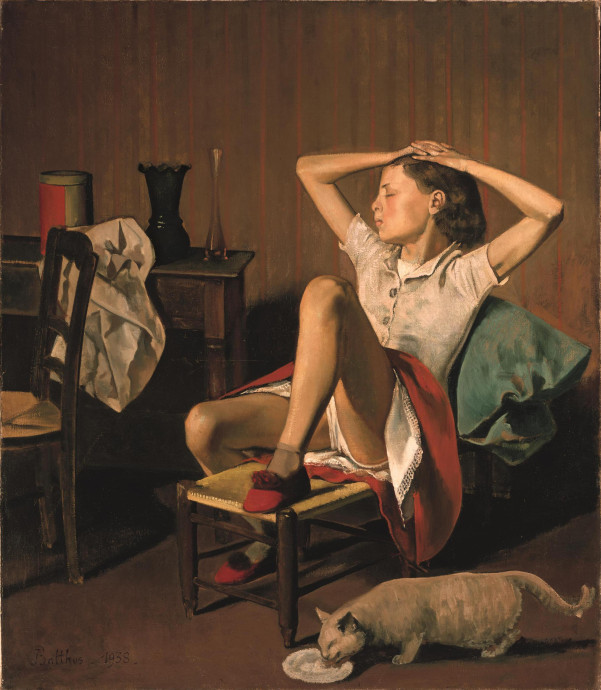
The Metropolitan Museum of Art declines to remove a painting that is — according to a petition — "undeniably romanticizing the sexualization of a child."

The painting, by Balthus, is “Thérèse Dreaming." The NY Post has the article, showing the painting (which shows a young girl posed so we get a good look at her underpants).

From the petition: "I am simply asking The Met to more carefully vet the art on its walls, and understand what this painting insinuates. Ultimately, it’s a small ask in consideration of how expansive their art collection is… how overtly sexual the painting is, and the current news headlines highlighting a macro issue about the public health and safety of women."

The NY Post informs us not only that Bono sang at Malthus's funeral, but that Elle Macpherson was also in attendance. Does that vouch for him somehow or is it just a way to nudge us idiots to understand that Balthus was famous? (Not famous enough for my spellchecker to lay off changing his name to Malthus.)

Anyway, the museum's spokesperson shows no empathy for the feelings of our era — The Reckoning  — but loftily informs us that its "mission is to collect, study, conserve, and present significant works of art across all times and cultures in order to connect people to creativity, knowledge, and ideas." And "Moments such as this provide an opportunity for conversation, and visual art is one of the most significant means we have for reflecting on both the past and the present."

So here's the painting:


Let's have the conversation.

I'll just start by saying that I saw the Robert Mapplethorpe exhibit in Boston in 1990, and one of the photographs showed a young girl — younger than "Thérèse" — and she was posed so that we could look up her skirt and there were no underpants. I remember that the elite media portrayed those who said this was wrong as unsophisticated. The photograph conveyed the charming innocence of a child, we were told.

Ah, yes, here's a NYT article, from 1996, "PHOTOGRAPHY VIEW; The Child, the Adult Within and the Blur Between," by Vicki Goldberg, talking a bit about that photograph, "Rosie."
The fact that, though clothed, [4-year-old Rosie] unwittingly displays her genitals puts the spectator in a slightly uneasy position; besides, her expression could be read as wariness.

Mapplethorpe had an agenda: "Children are sexual beings," he said, "but it's an area that makes most people feel uncomfortable."...

[In the 19th century, c]hildren were not yet considered sexual beings, which is why Lewis Carroll could get away with taking nude shots of little girls, at least for a while, and why Freud would later encounter such resistance to his theories of infantile sexuality....
Speaking of Lewis Carroll, here's an excellent New Yorker article from 2015, "Go Ask Alice/What really went on in Wonderland," by Anthony Lane. Excerpt (beginning with a letter from Carroll):
I have a little friend here, Lily Gray, child of Dr. Gray, and one of my chief beach friends at Sandown this year. She is 5, a graceful and pretty child, and one of the sweetest children I know (nearly as sweet as Gertrude)—and she is so perfectly simple and unconscious that it is a matter of entire indifference to her whether she is taken in full dress or nothing. My question is, are you going to allow Gertrude (who I think is also perfectly simple and unconscious) to be done in the same way?
It is impossible to read this now without horror. The politesse, the pointing up of sweetness, and the ascribing of “entire indifference” to the child evoke the classic stratagems of the pedophile, planning his campaign and convincing others (and, more important, himself) that he is doing no wrong—that there is no victim but merely a willing collaborator....

Oktubre 7, 2015

"The decidedly not-safe-for-work image, which cannot be reproduced here, can be easily found through a search engine."

Sentence in a NYT article about the sale at auction of a Robert Mapplethorpe photograph for $478,000. The photo, "Man in Polyester Suit," was part of an exhibition for which Mapplethorpe was criminally prosecuted in 1990.

Abril 17, 2015

"For all the righteous concern people expressed about the welfare of my children, what most of them failed to understand was that taking those pictures was an act separate from mothering."

"When I stepped behind the camera and my kids stepped in front of it, I was a photographer and they were actors, and we were making a photograph together. And in a similar vein, many people mistook the photographs for reality or attributed qualities to my children (one letter-­writer called them 'mean') based on the way they looked in the pictures. The fact is that these are not my children; they are figures on silvery paper slivered out of time. They represent my children at a fraction of a second on one particular afternoon with infinite variables of light, expression, posture, muscle tension, mood, wind and shade. These are not my children at all; these are children in a photograph. Even the children understood this distinction...."

Writes Sally Mann, whose very arty photographs of her (sometimes naked) children were published to much elite acclaim in 1992 and — simultaneously — intense criticism as “manipulative,” “sick,” “twisted,” “vulgar” — in part because of what Mann calls the "cosmically bad timing" of coinciding with the controversy about Robert Mapplethorpe’s photographs. Mapplethorpe had "included images of children along with sadomasochistic and homoerotic imagery," and: "Into this turbulent climate, I had put forth my family pictures."

From the comments there (at the NYT):
There is absolutely no question that Sally Mann is a photographic artist of great stature. There is also no question that were she not, she would have had her children taken from the home decades ago, and probably would have been jailed. If the father down the block from Mann took similar photos and made them public, he would have been thrown under the jail house. She was, and remains, ethically tone deaf - at best. To use one's children, who cannot possibly understand the ramifications of what they are doing, as one's subjects to create sexually charged images, is the grossest violation of the concept of informed consent. and is inexcusable.

Pebrero 5, 2015

Did the NYT "sexualize children" or just reference the title of Patti Smith's memoir?

Instapundit links — with the jab "Propriety is for the little people" — to some breathless shaming by Ira Stoll under the heading "Times Sexualizes Children":
"Just Kids" is the headline on a New York Times "T" magazine photo spread featuring a model on her back on a half-bare mattress on the floor. The text with the picture asserts that "virginal white lace paired with leather and suede evokes the sexy decadence..." 
Dot dot dot. What is elided after "sexy decadence"? ".... of Patti Smith’s punk-rock days..."

"Just Kids" is the title of Smith's National Book Award winning memoir about her starving-artist days in New York City with Robert Mapplethorpe. They considered themselves "just kids," but they were in their early 20s.

Now, there may be a whiff of underage-sex to the NYT photo spread, the NYT may have consciously (or unconsciously) sought to titillate readers with the word "kids," and if some conservative had somehow produced the same pictures and text liberals would have gone in for the kill, BUT you cannot convincingly or intelligently make that argument without acknowledging the Patti Smith title!

AND: Eliding Patti Smith looks like deliberate distortion.

ALSO: The models don't look at all like children or even like teenagers below the age of consent. And we refer to adults with words like "kid," "boy," "girl," and even "baby" all the time. Next time some man refers to a woman as his "girlfriend," why not accuse him of pedophilia? I mean, if you'd like to be regarded as insane. Now, calm down and listen to that paean to pedophilia great love song "Be My Baby." Or, here's a Slate article about the 1909 pop song "I Love, I Love, I Love My Wife—But Oh! You Kid!"
The appeal of “Oh, You Kid!” lay mainly in that slangy endearment, “kid.” Like another novel usage of the period, “baby,” “kid” held a hint of pillow-talk intimacy—a frisson that was enhanced by the threat to “scold” the kid who fails to deliver a quick kiss.


AND: One of the most-loved lines in the history of cinema is "Here's looking at you, kid." Humphrey Bogart was not infantilizing Ingrid Bergman.

Nobyembre 18, 2010

"There is nothing in our material world more beautiful than the book," says Patti Smith, winning the National Book Award.

Last night, in the nonfiction category, for her memoir "Just Kids" about her relationship with Robert Mapplethorpe:
Accepting the award to applause and cheers, Ms. Smith — clearly the favorite of the night — choked up as she recalled her days as a clerk in the Scribner bookstore as a young woman.

“I dreamed of having a book of my own, of writing one that I could put on a shelf,” she said. “Please, no matter how we advance technologically, please don’t abandon the book. There is nothing in our material world more beautiful than the book.”
Congratulations to Patti Smith. She's a longtime favorite of mine.

I used to hang out in bookstores and buy piles of books. Nowadays, I hang out of the internet, and though I read many, many hours a day, it's mostly on the computer screen. When I've had enough screen time, I like to listen to audiobooks. There are 27 audiobooks in my iPhone at the moment. But I do occasionally choose to have my reading in old-fashioned book form. This year, of the few books I bought, one was "Just Kids."

I'm not really into the romanticism of the physical object that is the book. I think the internet is more beautiful than a book. But is the internet "in our material world"?

Hulyo 26, 2009

"New York magazine derided [Dash Snow] for making art by ejaculating on copies of The New York Post...."

"... he blew up that section of the article, ejaculated on the copy and displayed it at an art show in Los Angeles."

Dash Snow, dead of a drug overdose, at 27.
His sadness and his money and his drugs were a powerful dynamic, said Jack Walls, a close friend of Mr. Snow’s who is a former lover of the photographer Robert Mapplethorpe: the sadness was abetted by the drugs, the drugs abetted by the money.

Mr. Walls distinguished Mr. Snow from working-class addicts like William S. Burroughs, Herbert Huncke — and himself. “It was like his money never ran out,” Mr. Walls said. “When it came to doing drugs, he could do these marathons for days and days on end. In my day, in Huncke’s day, in Burroughs’s day, when we wanted a fix, we had to go work — we couldn’t just sit around getting high for three straight weeks.”