લેબલ Louisiana સાથે પોસ્ટ્સ બતાવી રહ્યું છે. બધી પોસ્ટ્સ બતાવો
લેબલ Louisiana સાથે પોસ્ટ્સ બતાવી રહ્યું છે. બધી પોસ્ટ્સ બતાવો
19 જુલાઈ, 2026
"I can tell you're a Louisiana boy," says Senator Kennedy to Theo Von.
KENNEDY: You can have an AI assistant, and give them almost unfettered authority to book you a plane ticket or rent you a car or remind you to have your oil changed or, you know, buy some Fig Newtons at the grocery store.
THEO: Yeah. They're pretty, they're not bad.
KENNEDY: I love Fig Newtons.


29 એપ્રિલ, 2026
"The justices, split along ideological lines, ruled that the voting map was an unconstitutional racial gerrymander."
"In her dissent, Justice Elena Kagan accused the court’s conservative majority of gutting the Voting Rights Act."
From "Live Updates: Supreme Court Strikes Down Louisiana Map in Voting Rights Case" (NYT).
From "Live Updates: Supreme Court Strikes Down Louisiana Map in Voting Rights Case" (NYT).
Although the justices struck down Louisiana’s map, the court’s conservative majority upheld the constitutionality of the Voting Rights Act itself. Voting rights groups had feared that the court might use the case to gut the remaining provisions of the landmark civil rights law.
AND: Here's the opinion: Louisiana v. Callais. It's 6-3, in the usual way, and Justice Alito writes for the majority.
9 મે, 2025
"Robert Francis Prevost, the Chicago-born cardinal selected on Thursday as the new pope, is descended from Creole people of color from New Orleans."
"The pope’s maternal grandparents, both of whom are described as Black or mulatto in various historical records, lived in the city’s Seventh Ward, an area that is traditionally Catholic and a melting pot of people with African, Caribbean and European roots. The grandparents, Joseph Martinez and Louise Baquié, eventually moved to Chicago in the early 20th century and had a daughter: Mildred Martinez, the pope’s mother. The discovery means that Leo XIV, as the pope will be known, is not only breaking ground as the first U.S.-born pontiff.... It’s unclear whether the new pope has ever addressed his Creole ancestry in public, and his brother said that the family did not identify as Black.... Creoles, also known as 'Creole people of color,' have a history almost as old as Louisiana. While the word Creole can refer to people of European descent who were born in the Americas, it commonly describes mixed-race people of color. Many Louisiana Creoles were known in the 18th and 19th centuries as 'gens de couleur libres,' or free people of color. Many were well educated, French-speaking and Roman Catholic...."
From "New Pope Has Creole Roots in New Orleans/His ancestry, traced to a historic enclave of Afro-Caribbean culture, links Leo XIV to the rich and sometimes overlooked Black Catholic experience in America" (NYT).
From "New Pope Has Creole Roots in New Orleans/His ancestry, traced to a historic enclave of Afro-Caribbean culture, links Leo XIV to the rich and sometimes overlooked Black Catholic experience in America" (NYT).
ADDED: Haven't there been Popes of mixed race before — in all this long history? Grok offers 3 possibilities:
24 માર્ચ, 2025
Did anyone listen to the oral argument this morning in the racial gerrymandering case?
I listened to some of it, and now I'm reading "Supreme Court hears pivotal Louisiana election map case ahead of 2026 midterms/The Supreme Court decision could reshape Louisiana's election map and may redefine rules for gerrymandering nationwide ahead of the 2026 midterm elections" (Fox News).
This is a painful topic — I've taught it in conlaw many times — because of the conflict between the constitutional requirement of equal protection (which one might think frowns rather severely on race discrimination), and the statutory interpretation, which requires that states create majority minority districts. The Constitution ought to win, you might think, but what if you really want the statute to win?
Unfortunately, the linked article doesn't tell us anything about the oral argument. I'll try to update with a better article or material from the transcript.
29 ઑગસ્ટ, 2021
"Hurricane Ida made landfall in Louisiana on Sunday as a Category 4 storm.... The storm’s maximum sustained winds on Sunday morning reached 150 miles an hour, closing in on the 157 m.p.h. winds of a Category 5 storm...."
"The storm has New Orleans directly in its path.... The storm could also wreak serious havoc farther inland, in places like greater Baton Rouge, where a number of areas have been devastated by inland flooding in recent years from much less powerful storms.
Hurricane Ida will bring 'extremely threatening storm surge inundation of 9 feet or higher' between Burns Point, La., and Ocean Springs, Miss., the Hurricane Center warned.
In some places the surge could be as high as 16 feet.... Governor Edwards [said] 'We can sum it up by saying this will be one of the strongest hurricanes to hit anywhere in Louisiana since at least the 1850s'.... The storm made landfall on the 16th anniversary of the landfall of Hurricane Katrina.... The trajectory and strength of Ida will present a high-stakes test of the levees, flood walls, pumps and gates that were reinforced around New Orleans after Katrina.... ... Mr. Edwards said that the pandemic had thwarted plans to evacuate hospitals.
'Evacuating these large hospitals is not an option because there are not any other hospitals with the capacity to take them'...."
30 ઑગસ્ટ, 2020
"And I’m here to support the great people of Louisiana. It’s been a tremendous state for me... It’s very important that I was here..."
Said President Trump, speaking in in Lake Charles, Louisiana yesterday, 2 days after it was hit by Hurricane Laura. Transcript.
Classic Trump: It’s been a tremendous state for me... It’s very important that I was here...
Here's some detail about Trump's trip, surveying the damage and interacting with people on the ground.
Trump is quite different from George W. Bush, who, after Katrina hit Louisiana, chose to view the damage from the seat of his airplane. He got blasted for looking detached and uncaring. He wrote about it in his book "Decision Points":
Classic Trump: It’s been a tremendous state for me... It’s very important that I was here...
Here's some detail about Trump's trip, surveying the damage and interacting with people on the ground.
Trump is quite different from George W. Bush, who, after Katrina hit Louisiana, chose to view the damage from the seat of his airplane. He got blasted for looking detached and uncaring. He wrote about it in his book "Decision Points":
I’ve often reflected on what I should have done differently that day. I believe the decision not to land in New Orleans was correct. Emergency responders would have been called away from the rescue efforts, and that would have been wrong. A better option would have been to stop at the airport in Baton Rouge, the state capital. Eighty miles north of the flood zone, I could have strategized with the governor and assured Katrina victims that their country stood with them. Landing in Baton Rouge would not have saved any lives. Its benefit would have been good public relations. But public relations matter when you are president, particularly when people are hurting. When Hurricane Betsy devastated New Orleans in 1965, Lyndon Johnson flew in from Washington to visit late at night. He made his way to a shelter in the Ninth Ward by flashlight. “This is your president!” he called out when he arrived in the dark and crowded space. “I’m here to help you!” Unfortunately, I did not follow his example.You've got to take the consequences of modesty and restraint. You may hear it lauded many years after you serve in office, when your old job is occupied by a man who's chosen not to follow your model of modesty and restraint. How does that make you feel, seeing how much those people who hated on you are hating the new guy for being the opposite of you?
17 ઑગસ્ટ, 2016
Why aren't people paying more attention to the terrible flooding in Louisiana?
Do you think it's the lack of a name?
“This is a historic flooding event,” Gov. John Bel Edwards said Tuesday. “When you have a storm that is unnamed — it wasn’t a tropical storm, it wasn’t a hurricane — a lot of times people underestimate the impact that it would have....”I don't:
The name "Katrina" got attached to what was mainly a flood, but I think the lack of attention isn't so much the lack of a name but the lack of a President people feel like attacking. But don't worry, sufferers of natural disasters, we're going to have one soon.
17 જુલાઈ, 2016
"I swear to God I love this city, but I wonder if this city loves me. In uniform, I get nasty hateful looks..."
"... and out of uniform some consider me a threat. I’ve experienced so much in my short life and these last 3 days have tested me to the core.... This city MUST and WILL get better. I’m working in these streets so any protesters, officers, friends, family or whoever, if you see me and need a hug or want to say a prayer. I got you."
Wrote Montrell L. Jackson on July 8.

One of the police officers shot dead today in Baton Rouge.
Wrote Montrell L. Jackson on July 8.
One of the police officers shot dead today in Baton Rouge.
5 ઑક્ટોબર, 2014
"The Most Ambitious Environmental Lawsuit Ever/A quixotic historian tries to hold oil and gas companies responsible for Louisiana’s disappearing coast."
There's a lot of fascinating material in this NYT Magazine article by Nathaniel Rich, but I'm just going to pick out a few things that might motivate you to read the whole thing rather than to think: New York Times Environmentalism.
1. It's not about global warming or carbon emissions. Louisiana is losing land at a bizarrely fast rate, but it's because of a reversal of the process that built the land up in the first place: "As the Mississippi shifted its course over the millenniums, spraying like a loose garden hose, it deposited sand and silt in a wide arc. This sediment first settled into marsh and later thickened into solid land. But what took 7,000 years to create has been nearly destroyed in the last 85. Dams built on the tributaries of the Mississippi, as far north as Montana, have reduced the sediment load by half. Levees penned the river in place, preventing the floods that are necessary to disperse sediment across the delta. The dredging of two major shipping routes, the Mississippi River Gulf Outlet and the Gulf Intracoastal Waterway, invited saltwater into the wetlands’ atrophied heart." None of that is attributable to the gas and oil industry, but they did dig a lot of wells, canals, and pipelines that seem to have accelerated the inflow of the saltwater.
2. The title of the article reveals its hook: A supposedly heroic underdog, in this case a political journalist named John Barry, who spent a long time writing a book called "The Ambition and the Power" and was in the middle of writing another book — "Roger Williams and the Creation of the American Soul" — when he got distracted by Hurricane Katrina and concluded that "people died because of cynical decisions made by shortsighted politicians drawing on bad science." Back in those days, Bobby Jindal was a member of Congress, and Barry met with him and "left in total disgust." Is Barry contemplative and public-spirited, or is Barry a politico who hates Bobby Jindal? The fact that the second option even occurs to me while reading this article — framed on Barry's heroics — suggests that's the correct one.
3. Stray football hate: "When discussing his public battles, he often summons football metaphors. 'Writing is pretty isolated,' he said. 'I enjoy the action. I like to fight.'" Where's the football metaphor? Action? Fighting?
4. Stray intellectualism: "For Barry, the battle for New Orleans’s survival would be fought along the Santayana-Hegel axis." Santayana is George Santayana, best known for the aphorism "Those who cannot remember the past are condemned to repeat it." Hegel, unlike Santayana, apparently needs no first name (or, really, would require 3 more names if we weren't on a single-name basis with him)...

... Hegel — doesn't he look like he's wearing glasses when he's not? — said a lot of things. Whatever Hegel's most famous quote is, he also said — and this is the source for the concept of a Santayana-Hegel axis — "The only thing we learn from history is that we learn nothing from history."
5. Flare up of bad science in an article impugning the bad science of others: "The sea is rising along the southeast coast of Louisiana faster than it is anywhere else in the world." (Thanks to The Drill SGT, in the comments, for pointing to that.) Connected waters — such as the Gulf of Mexico and all of the oceans of the world — rise in one big, flat unit. "The sea" may be encroaching on the land in Louisiana faster than anywhere else in the world, but that's mainly because the land isn't getting continually regenerated with mud from upstream. I read that sentence as an effort to slip in some global warming alarmism, which, as noted in #1, supra, is not what this story is about.
6. Louisiana has a Coastal Master Plan, which is supposed to cost $50 billion, with $20 billion of that coming from the BP oil spill settlement. Barry's lawsuit is based on a calculation about who should pay the remaining $30 billion: "Because the industry conceded responsibility for 36 percent of land loss, it should pay its part: $18 billion would be a start." That's a calculation of the damages. A successful lawsuit requires a basis for liability. The liability argument is premised on 100 years of violating permits. But whether that's enough to win or not, the article reveals that the lawyers "hoped, perhaps quixotically, that after filing their lawsuit, other parishes and levee boards across the state would join the effort, with the goal of achieving a larger settlement with the entire industry." Is filing a frighteningly huge and complex lawsuit with the aim of forcing your opponent to settle anything like anything that happened in "Don Quixote"?
7. Not getting the Rotary Club. Barry, on the advice of a lobbyist, gave presentations at Rotary Club meetings. The NYT writer ascribes this thought to Barry: "If he could sway hostile crowds at Rotary Clubs, shouldn’t he be able to persuade enough legislators to kill a bill?" (The bill would deprive the regional levee board, the plaintiff in the lawsuit, of power to bring the suit.) My experience with the Rotary Club is limited a single event here in Madison, but there's one thing that was outstandingly clear: These people are dedicated to principles of friendliness and goodwill. Barry encountered "hostile crowds at Rotary Clubs"? But he swayed them? I find that hard to believe. I think it's more likely that he felt — or could tell himself and others — that he swayed people because he had reason to believe they didn't like his lawsuit, but they evinced the civility and good feeling to which the club dedicates itself.
8. The meat of the article has to do with the Louisiana legislature considering a series of bills aimed at depriving the plaintiff of standing to bring the lawsuit. The NYT writer outlines a story of oil and gas company lobbyists and legislators changing their minds over small favors like "funding for a new roof for a V.F.W. hall in his district." I see a lot of compression in this sentence: "Some of the bills were seen as overly broad, raising the fear that they might endanger the incipient BP settlement; others were voted down over constitutional concerns." Were minds changed or was legislative text refined? In the end a bill passed, Governor Bobby Jindal signed it, and the last hope for the lawsuit is an argument to the federal judge that the bill is unconstitutional (or that it doesn't, on its text, deprive the levee board of standing in federal court). The judge is Nannette Jolivette Brown, who was appointed by Barack Obama. Meanwhile, Bobby Jindal is working on repopulating the board, which is currently 5-4 in favor of continuing its lawsuit.
9. There's political pressure on Jindal to fund the Coastal Master Plan, and the end of the lawsuit could focus attention on that. Having promoted the lawsuit-ending legislation, he could see a glorious self-interest in balancing his environmental image by extracting that $18 billion from the oil and gas companies. His term ends in January 2016, a presidential election year. Jindal's stalled at 3% in the polls. Impress us, Bobby!
10. Barry was a member of the levee board when the lawsuit was filed, and he'd been accused of joining the board for "ulterior motives." So he pledged not to write about the lawsuit. But now, as the last paragraph of the article tells us, he's considering breaking that pledge. So the hero of the NYT Magazine article will be the (pledge-breaking) hero of his own book? Last sentence of the article: "But John Barry, John Barry insists, would be just a minor character." Damn, a paraphrase! I'm going to infer that our hero didn't get the words out quite so elegantly.
1. It's not about global warming or carbon emissions. Louisiana is losing land at a bizarrely fast rate, but it's because of a reversal of the process that built the land up in the first place: "As the Mississippi shifted its course over the millenniums, spraying like a loose garden hose, it deposited sand and silt in a wide arc. This sediment first settled into marsh and later thickened into solid land. But what took 7,000 years to create has been nearly destroyed in the last 85. Dams built on the tributaries of the Mississippi, as far north as Montana, have reduced the sediment load by half. Levees penned the river in place, preventing the floods that are necessary to disperse sediment across the delta. The dredging of two major shipping routes, the Mississippi River Gulf Outlet and the Gulf Intracoastal Waterway, invited saltwater into the wetlands’ atrophied heart." None of that is attributable to the gas and oil industry, but they did dig a lot of wells, canals, and pipelines that seem to have accelerated the inflow of the saltwater.
2. The title of the article reveals its hook: A supposedly heroic underdog, in this case a political journalist named John Barry, who spent a long time writing a book called "The Ambition and the Power" and was in the middle of writing another book — "Roger Williams and the Creation of the American Soul" — when he got distracted by Hurricane Katrina and concluded that "people died because of cynical decisions made by shortsighted politicians drawing on bad science." Back in those days, Bobby Jindal was a member of Congress, and Barry met with him and "left in total disgust." Is Barry contemplative and public-spirited, or is Barry a politico who hates Bobby Jindal? The fact that the second option even occurs to me while reading this article — framed on Barry's heroics — suggests that's the correct one.
3. Stray football hate: "When discussing his public battles, he often summons football metaphors. 'Writing is pretty isolated,' he said. 'I enjoy the action. I like to fight.'" Where's the football metaphor? Action? Fighting?
4. Stray intellectualism: "For Barry, the battle for New Orleans’s survival would be fought along the Santayana-Hegel axis." Santayana is George Santayana, best known for the aphorism "Those who cannot remember the past are condemned to repeat it." Hegel, unlike Santayana, apparently needs no first name (or, really, would require 3 more names if we weren't on a single-name basis with him)...
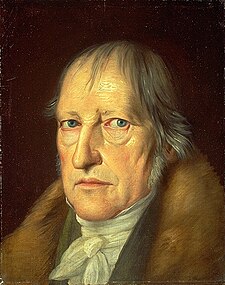
... Hegel — doesn't he look like he's wearing glasses when he's not? — said a lot of things. Whatever Hegel's most famous quote is, he also said — and this is the source for the concept of a Santayana-Hegel axis — "The only thing we learn from history is that we learn nothing from history."
5. Flare up of bad science in an article impugning the bad science of others: "The sea is rising along the southeast coast of Louisiana faster than it is anywhere else in the world." (Thanks to The Drill SGT, in the comments, for pointing to that.) Connected waters — such as the Gulf of Mexico and all of the oceans of the world — rise in one big, flat unit. "The sea" may be encroaching on the land in Louisiana faster than anywhere else in the world, but that's mainly because the land isn't getting continually regenerated with mud from upstream. I read that sentence as an effort to slip in some global warming alarmism, which, as noted in #1, supra, is not what this story is about.
6. Louisiana has a Coastal Master Plan, which is supposed to cost $50 billion, with $20 billion of that coming from the BP oil spill settlement. Barry's lawsuit is based on a calculation about who should pay the remaining $30 billion: "Because the industry conceded responsibility for 36 percent of land loss, it should pay its part: $18 billion would be a start." That's a calculation of the damages. A successful lawsuit requires a basis for liability. The liability argument is premised on 100 years of violating permits. But whether that's enough to win or not, the article reveals that the lawyers "hoped, perhaps quixotically, that after filing their lawsuit, other parishes and levee boards across the state would join the effort, with the goal of achieving a larger settlement with the entire industry." Is filing a frighteningly huge and complex lawsuit with the aim of forcing your opponent to settle anything like anything that happened in "Don Quixote"?
7. Not getting the Rotary Club. Barry, on the advice of a lobbyist, gave presentations at Rotary Club meetings. The NYT writer ascribes this thought to Barry: "If he could sway hostile crowds at Rotary Clubs, shouldn’t he be able to persuade enough legislators to kill a bill?" (The bill would deprive the regional levee board, the plaintiff in the lawsuit, of power to bring the suit.) My experience with the Rotary Club is limited a single event here in Madison, but there's one thing that was outstandingly clear: These people are dedicated to principles of friendliness and goodwill. Barry encountered "hostile crowds at Rotary Clubs"? But he swayed them? I find that hard to believe. I think it's more likely that he felt — or could tell himself and others — that he swayed people because he had reason to believe they didn't like his lawsuit, but they evinced the civility and good feeling to which the club dedicates itself.
8. The meat of the article has to do with the Louisiana legislature considering a series of bills aimed at depriving the plaintiff of standing to bring the lawsuit. The NYT writer outlines a story of oil and gas company lobbyists and legislators changing their minds over small favors like "funding for a new roof for a V.F.W. hall in his district." I see a lot of compression in this sentence: "Some of the bills were seen as overly broad, raising the fear that they might endanger the incipient BP settlement; others were voted down over constitutional concerns." Were minds changed or was legislative text refined? In the end a bill passed, Governor Bobby Jindal signed it, and the last hope for the lawsuit is an argument to the federal judge that the bill is unconstitutional (or that it doesn't, on its text, deprive the levee board of standing in federal court). The judge is Nannette Jolivette Brown, who was appointed by Barack Obama. Meanwhile, Bobby Jindal is working on repopulating the board, which is currently 5-4 in favor of continuing its lawsuit.
9. There's political pressure on Jindal to fund the Coastal Master Plan, and the end of the lawsuit could focus attention on that. Having promoted the lawsuit-ending legislation, he could see a glorious self-interest in balancing his environmental image by extracting that $18 billion from the oil and gas companies. His term ends in January 2016, a presidential election year. Jindal's stalled at 3% in the polls. Impress us, Bobby!
10. Barry was a member of the levee board when the lawsuit was filed, and he'd been accused of joining the board for "ulterior motives." So he pledged not to write about the lawsuit. But now, as the last paragraph of the article tells us, he's considering breaking that pledge. So the hero of the NYT Magazine article will be the (pledge-breaking) hero of his own book? Last sentence of the article: "But John Barry, John Barry insists, would be just a minor character." Damn, a paraphrase! I'm going to infer that our hero didn't get the words out quite so elegantly.
1 નવેમ્બર, 2012
Did Chris Christie "sudden love-in" with Obama hurt Mitt Romney?
"Sudden love-in" is the Washington Post's terminology.
It's good politically because it's a vivid demonstration of devotion to public service and the capacity to rise about partisanship and do the things that need to be done.
Compare the Christie's interaction with Obama to the way Louisiana Governor Kathleen Blanco interacted with President Bush after Hurricane Katrina. Here's how Bush described some of it in his book "Decision Points" (at page 308-309):
There is no professed motivation for Christie’s newfound feelings for the president, other than that the two men are now partners in a massive effort to rebuild his state. Asked about the election on “Fox & Friends,” Christie said, “I have no idea, nor am I the least bit concerned or interested,” adding: “If you think right now I give a damn about presidential politics, then you don’t know me.”I want to say Chris Christie is saying and doing the right thing, not only morally and in his own political interest, but in the interest of Mitt Romney and the GOP. Saying it's not political and acting like politics are suspended, the best approach morally, happens also to be the best approach politically.
It's good politically because it's a vivid demonstration of devotion to public service and the capacity to rise about partisanship and do the things that need to be done.
Compare the Christie's interaction with Obama to the way Louisiana Governor Kathleen Blanco interacted with President Bush after Hurricane Katrina. Here's how Bush described some of it in his book "Decision Points" (at page 308-309):
The initial plan had been for me to land at the New Orleans airport, pick up Governor Blanco and Mayor Nagin, and survey the damage on an aerial tour. But on the Marine One flight from Mississippi, we received word that the governor, mayor, and a Louisiana congressional delegation were demanding a private meeting on Air Force One first.
The tone started out tense and got worse. The governor and mayor bickered. Everyone blasted the Federal Emergency Management Agency for failing to meet their needs. Congressman Bobby Jindal pointed out that FEMA had asked people to email their requests, despite the lack of electricity in the city. I shook my head. “We’ll fix it,” I said, looking at FEMA Director Mike Brown. Senator Mary Landrieu interrupted with unproductive emotional outbursts. “Would you please be quiet?” I had to say to her at one point.
2 ડિસેમ્બર, 2010
"It's like Charles Darwin and his theory is a saint. You can't touch it."
Some Louisiana citizens think the Louisiana textbook advisory panel isn't doing a good enough job of implementing the Louisiana Science Education Act of 2008.
The LSEA instructs educators to promote "critical thinking skills, logical analysis, and open and objective discussion of scientific theories being studied including, but not limited to, evolution, the origins of life, global warming, and human cloning." It also allows teachers and school districts to use "supplemental textbooks," which are just code words for creationist and pro-intelligent design materials.
15 જૂન, 2010
Let's watch Obama's big speech.
7:06: He's laying out a "battle plan" to fight the leak at the bottom of the Gulf of Mexico. He's "deploying" the military.
7:08: What to do during the "siege." A decision has been made to speak in military terms. Of course, he's not the first President to ask us to think about a nonmilitary problem in military terms. The War on X... the moral equivalent of war....
7:12: To make sure this won't happen again, Obama is establishing a commission.
7:15: We need to "jump start" the "clean energy" future. There's "the potential" to create "millions of jobs" but "only" if we "act together." We need to do something big at the national level to make this happen. Some people say we can't afford this, but he's saying we can't afford not to do it. He's vague about what this will be. The only thing he won't accept is doing nothing. He won't accept the "paltry limits of conventional wisdom." So even though we don't "precisely know" what we need to do, we will do it. Like we did in WWII and in going to the moon. We'll do something. And it will have to be big, but we don't know what it is. Then he drops from that scarily high level of abstraction and the unknown to... shrimpers. Something about shrimp people. We must think BIG and... shrimpy.
7:20: And suddenly, it's getting religious. I think he's bringing this speech in for a landing, because... it's a bit prayer-like. There's a "hand" that will "guide us." And — yes — it is the end: "May God bless America."
7:26: Well, that was a terrible speech! When it wasn't grim and dreary, it was grandiose. But the grandiosity was so vague... and half-hearted. Oh! The malaise!
AND: Here's the text of the speech. This is the part that interested me most:
He cites a bunch of modest ideas that have been suggested and says we should think about them, then says that we have to do something, even though you could take all those things together, impose them, and still not break what he calls our "addiction" to fossil fuel. He blathers about WWII and the moon landing -- as noted above -- and talks about "what has defined us as a nation": "the capacity to shape our destiny.... Even if we’re unsure exactly what that looks like. Even if we don’t yet know precisely how we’re going to get there. We know we’ll get there." That is so hopelessly grandiose and vague, and to keep us from looking at it too long and despairing, he's all: Look! Shrimp!
7:08: What to do during the "siege." A decision has been made to speak in military terms. Of course, he's not the first President to ask us to think about a nonmilitary problem in military terms. The War on X... the moral equivalent of war....
7:12: To make sure this won't happen again, Obama is establishing a commission.
7:15: We need to "jump start" the "clean energy" future. There's "the potential" to create "millions of jobs" but "only" if we "act together." We need to do something big at the national level to make this happen. Some people say we can't afford this, but he's saying we can't afford not to do it. He's vague about what this will be. The only thing he won't accept is doing nothing. He won't accept the "paltry limits of conventional wisdom." So even though we don't "precisely know" what we need to do, we will do it. Like we did in WWII and in going to the moon. We'll do something. And it will have to be big, but we don't know what it is. Then he drops from that scarily high level of abstraction and the unknown to... shrimpers. Something about shrimp people. We must think BIG and... shrimpy.
7:20: And suddenly, it's getting religious. I think he's bringing this speech in for a landing, because... it's a bit prayer-like. There's a "hand" that will "guide us." And — yes — it is the end: "May God bless America."
7:26: Well, that was a terrible speech! When it wasn't grim and dreary, it was grandiose. But the grandiosity was so vague... and half-hearted. Oh! The malaise!
AND: Here's the text of the speech. This is the part that interested me most:
As we recover from this recession, the transition to clean energy has the potential to grow our economy and create millions of jobs -– but only if we accelerate that transition. Only if we seize the moment. And only if we rally together and act as one nation –- workers and entrepreneurs; scientists and citizens; the public and private sectors.This is the anti-capitalist move. There is all this opportunity, but free enterprise and capitalism can't take advantage of it. We need a top-down, government-imposed scheme, he announces. He doesn't explain why. It's an article of faith.
Now, there are costs associated with this transition [towards energy independence]. And there are some who believe that we can’t afford those costs right now. I say we can’t afford not to change how we produce and use energy....This is such embarrassing cliché rhetoric: Some say we can't do it. I say we can't not do it.
He cites a bunch of modest ideas that have been suggested and says we should think about them, then says that we have to do something, even though you could take all those things together, impose them, and still not break what he calls our "addiction" to fossil fuel. He blathers about WWII and the moon landing -- as noted above -- and talks about "what has defined us as a nation": "the capacity to shape our destiny.... Even if we’re unsure exactly what that looks like. Even if we don’t yet know precisely how we’re going to get there. We know we’ll get there." That is so hopelessly grandiose and vague, and to keep us from looking at it too long and despairing, he's all: Look! Shrimp!
Each year, at the beginning of shrimping season, the region’s fishermen take part in a tradition that was brought to America long ago by fishing immigrants from Europe. It’s called “The Blessing of the Fleet,” and today it’s a celebration where clergy from different religions gather to say a prayer for the safety and success of the men and women who will soon head out to sea....It's the shrimp and religion combo platter. Yummy!
7 ડિસેમ્બર, 2008
15 ઑગસ્ટ, 2008
"Dogs are your friend... Not to say I don't like my chickens, but they are not my friend."
Cockfighting is now outlawed in every state in the union — as Louisiana caves to mainstream decorum.
22 જુલાઈ, 2008
"I am personally opposed to the death penalty, but I am also opposed to courts taking fundamental decisions away from American voters."
Says lawprof Neal Kumar Katyal, who is representing the state of Louisiana as it seeks to reopen the Supreme Court case Kennedy v. Louisiana:
Jeffrey L. Fisher, a law professor at Stanford who represented the defendant in the case, Patrick Kennedy, said “rehearing is completely unnecessary.” Military law does not apply to Mr. Kennedy, a civilian, Professor Fisher said, and Congress has not made child rape a capital offense for civilians.As I have already said, I think it is very important for the Supreme Court to rehear the case. The Court's analysis of "the evolving standards of decency that mark the progress of a maturing society" surveyed the law throughout the United States and drew conclusions without realizing that Congress, which represents all the states, had recently approved of the death penalty for the rape of a child (in a law applying to crimes in the military). From the now embarrassingly inadequate opinion:
Professor Fisher added that military law has long made rapes of both adults and children capital offenses in some circumstances. The innovation of the 2006 law was only to break out children as a separate category.
According to the petition filed Monday, the 2006 law is powerful evidence of the direction of public sentiment. “While Congress has not, as yet, applied the death penalty to child rape in the civilian context,” the petition said, “the recent trend (not to mention the general parity between military and civilian law today) indicates that it may very well do so, if given the opportunity.”
Louisiana reintroduced the death penalty for rape of a child in 1995. See La. Stat. Ann. §14:42 (West Supp. 1996).... Five States have since followed Louisiana’s lead: Georgia, see Ga. Code Ann. §16–6–1 (2007) (enacted 1999); Montana, see Mont. Code Ann. §45–5–503 (2007) (enacted 1997); Oklahoma, see Okla. Stat., Tit. 10, §7115(K) (West 2007 Supp.) (enacted 2006); South Carolina, see S. C. Code Ann. §16–3–655(C)(1) (Supp. 2007) (enacted 2006); and Texas, see Tex. Penal Code Ann. §12.42(c)(3) (West Supp. 2007) (enacted 2007); see also Tex. Penal Code Ann. §22.021(a) (West Supp. 2007)...This crucial passage is junk now.
By contrast, 44 States have not made child rape a capital offense. As for federal law, Congress in the Federal Death Penalty Act of 1994 expanded the number of federal crimes for which the death penalty is a permissible sentence, including certain nonhomicide offenses; but it did not do the same for child rape or abuse....
The evidence of a national consensus with respect to the death penalty for child rapists, as with respect to juveniles, mentally retarded offenders, and vicarious felony murderers, shows divided opinion but, on balance, an opinion against it. Thirty-seven jurisdictions—36 States plus the Federal Government—have the death penalty. As mentioned above, only six of those jurisdictions authorize the death penalty for rape of a child....
6 જુલાઈ, 2008
The Washington Post says the Supreme Court's mistake requires it to reconsider the ban on the death penalty for rape of a child.
It's absolutely right:
ADDED: Has the Supreme Court case ever used the expression "out of whack"? No. The word "whack" only appears once in the Supreme Court's cases, in a one-sentence rejection of jurisdition in a case called Whack v. Maryland, 450 U.S. 990 (1981).
Is it "out of whack" or "out of wack"? If you go by Google hits, you'll think it's "out of wack" — but that's "out of whack." "Wack" means crazy. It's a back-formation from "wacky." As a noun, it means "a person regarded as eccentric." "Whack," as a noun, is a "a sharp, swift blow." I know, it makes little sense to say the reasoning is out of a person regarded as eccentric or out of a sharp, swift blow, but trust me, the standard, idiomatic expression is "out of whack."
Here's some history:
The majority determined that capital punishment for child rape was unconstitutional, in part because a national consensus had formed against it. As evidence, the court noted that "37 jurisdictions -- 36 States plus the Federal Government -- have the death penalty. [But] only six of those jurisdictions authorize the death penalty for rape of a child." Actually, only two years ago, Congress enacted a death penalty for soldiers who commit child rape, as part of an update to the Uniform Code of Military Justice (UCMJ). Irony of ironies: The court has cast doubt on the constitutionality of an act of Congress based on the erroneous claim that the statute did not exist....The opinion doesn't cohere as written. The dissenting opinion doesn't cohere. It's an egregious mistake that throws all the reasoning out of whack. Fix it!
The Supreme Court's legitimacy depends not only on the substance of its rulings but also on the quality of its deliberations. That's why we think the court needs to reopen this case -- even though we supported its decision. The losing party, Louisiana, still has time to seek a rehearing, which the court could grant with the approval of five justices, including at least one from the majority. The court could limit reargument to briefs on the significance of the UCMJ provision. We doubt the case will come out much differently; we certainly hope not. But this is an opportunity for the court to show a little judicial humility. Before the court declares its final view on national opinion about the death penalty, it should accurately assess the view of the national legislature.
ADDED: Has the Supreme Court case ever used the expression "out of whack"? No. The word "whack" only appears once in the Supreme Court's cases, in a one-sentence rejection of jurisdition in a case called Whack v. Maryland, 450 U.S. 990 (1981).
Is it "out of whack" or "out of wack"? If you go by Google hits, you'll think it's "out of wack" — but that's "out of whack." "Wack" means crazy. It's a back-formation from "wacky." As a noun, it means "a person regarded as eccentric." "Whack," as a noun, is a "a sharp, swift blow." I know, it makes little sense to say the reasoning is out of a person regarded as eccentric or out of a sharp, swift blow, but trust me, the standard, idiomatic expression is "out of whack."
Here's some history:
At one time, [whack] could mean a share in a distribution, a portion; this sense was originally thieves’ cant — Francis Grose, in his Dictionary of the Vulgar Tongue of 1785, has “Whack, a share of a booty obtained by fraud” (could physical violence have been involved in some cases?). British English has a couple of phrases that retain that sense. One is pay one’s whack, to pay one’s agreed contribution to shared expenses. Another is top whack, or full whack, for the maximum price or rate for something (“if you go to that shop, you’ll pay top whack”).
There are some other old figurative senses, including a bargain or agreement (which evolved out of the idea of a share), and an attempt at doing something (“I’ll take a whack at that job”). These are mostly American, and it was in the US that the sense you refer to first appeared, in the latter part of the nineteenth century. There seems to have been a phrase in fine whack during that century, meaning that something was in good condition or excellent fettle. (It appears in a letter by John Hay, President Lincoln’s amanuensis, dated August 1863, which describes the President: “The Tycoon is in fine whack. I have rarely seen him more serene and busy. He is managing this war, the draft, foreign relations, and planning a reconstruction of the Union, all at once”.) It doesn’t often turn up in writing, though, so there’s some doubt how widespread it was.
To be out of whack would then have meant the opposite — that something wasn’t on top form or working well.
2 જુલાઈ, 2008
What if federal law allows the death penalty for raping a child and the Supreme Court analyzed "evolving standards of decency" without noticing?
It happened!
A military law blog pointed out over the weekend that Congress, in fact, revised the sex crimes section of the Uniform Code of Military Justice in 2006 to add child rape to the military death penalty. The revisions were in the National Defense Authorization Act that year. President Bush signed that bill into law and then, last September, carried the changes forward by issuing Executive Order 13447, which put the provisions into the 2008 edition of the Manual for Courts-Martial.What an immense shame and embarrassment for everyone involved in this case — especially for all of the Justices of the Supreme Court!
Anyone in the federal government — or anywhere else, for that matter — who knew about these developments did not tell the court. Not one of the 10 briefs filed in the case, Kennedy v. Louisiana, mentioned it....
Dwight Sullivan, a colonel in the Marine Corps Reserve who now works for the Air Force as a civilian defense lawyer handling death penalty appeals.
Mr. Sullivan was reading the Supreme Court’s decision on a plane and was surprised to see no mention of the military statute. “We’re not talking about ancient history,” he said in an interview. “This happened in 2006.”
1 જુલાઈ, 2008
McCain and Obama both criticized the Supreme Court for rejecting the death penalty for the rape of a child, but McCain points to the real distinction.
WaPo reports:
A Senator can only question this one individual and vote up or down. When someone with the qualifications of Anthony Kennedy, David Souter, Ruth Bader Ginsburg, or Stephen Breyer is nominated, it is very hard for a Senator to justify voting no, even if he would not have nominated that person. In fact, he should vote yes — out of an understanding of the President's role and respect for the people who elected that President.
Indeed, as I said at the time of his confirmation, it was outrageous to vote against the spectacularly qualified John Roberts:
A year ago, Obama talked about why he rejected John Roberts. Roberts said "he saw himself just as an umpire":
McCain emphasized that he would seek out Supreme Court appointees along the lines of Chief Justice John Roberts and Justice Samuel Alito, saying they're the kind of jurists who will rule in favor of crime victims.This is exactly the point I wanted to see made. What is Obama's counterattack? From the WaPo piece:
"They will be the kind of judges who believe in giving everyone in a criminal court their due: justice for the guilty and the innocent, compassion for the victims, and respect for the men and women of law enforcement," he said. "In all of criminal justice policy, we must put the interests of law-abiding citizens first -- and above all, the rights of victims."...
While McCain noted that Sen. Barack Obama (D-Ill.) criticized [Kennedy v. Louisiana], he suggested that Obama would back the same kind of liberal justices who overruled the Louisiana law this month.
"More to the point, why is it that the majority includes the same justices he usually holds out as the models for future nominations?" he said. "My opponent may not care for this particular decision, but it was exactly the kind of opinion we could expect from an Obama Court."
Obama spokesman Tommy Vietor questioned why McCain would suggest only "an Obama Court" would produce rulings like the kind the Court just issued concerning child rapists, when the GOP senator backed four of the five judges who just ruled the death penalty was not appropriate for such crimes.What's disingenuous is Vietor's argument. The role of the President and the role of a Senator are very different when it comes to Supreme Court appointments. The President's nomination identifies one person from the pool of possible nominees and therefore has a tremendous amount of latitude in searching for someone who he thinks will decide cases to his liking, who shares his ideology.
"Senator McCain voted for 4 of the 5 judges who supported this flawed ruling, which is why this attack is particularly disingenuous and nothing more than the same old Bush-style politics that the American people are tired of," Vietor said....
A Senator can only question this one individual and vote up or down. When someone with the qualifications of Anthony Kennedy, David Souter, Ruth Bader Ginsburg, or Stephen Breyer is nominated, it is very hard for a Senator to justify voting no, even if he would not have nominated that person. In fact, he should vote yes — out of an understanding of the President's role and respect for the people who elected that President.
Indeed, as I said at the time of his confirmation, it was outrageous to vote against the spectacularly qualified John Roberts:
As to those 22 Democrats who voted no, they have openly embraced an ideological view of the Court from which they can never credibly step back. For them, appointing Supreme Court Justices is a processes of trying to lock outcomes in place, and we shouldn't believe them if in the future they try to say otherwise.Of course, Barack Obama was one of the 22.
A year ago, Obama talked about why he rejected John Roberts. Roberts said "he saw himself just as an umpire":
“But the issues that come before the court are not sports; they’re life and death. We need somebody who’s got the empathy to recognize what it’s like to be a young teenage mom.”If you really believe that about the cases that are determined by "heart," wasn't Kennedy v. Lousiana a heart case? Writing for the majority, Anthony Kennedy said:
Obama said that 95 percent of cases can be judged on intellect, but that the other 5 percent are the most important ones.
“In those 5 percent of cases, you’ve got to look at what is in the justice’s heart, what’s their broader vision of what America should be."
It is an established principle that decency, in its essence, presumes respect for the individual and thus moderation or restraint in the application of capital punishment....Surely, this is what Obama wants from a Justice. How can he credibly assert otherwise?
[We] insist upon confining the instances in which capital punishment may be imposed....
As it relates to crimes against individuals, ... the death penalty should not be expanded to instances where the victim’s life was not taken....
25 જૂન, 2008
McCain on the child rape/death penalty case. UPDATE: Obama opposes the decision too!
"As a father, I believe there is no more sacred responsibility in American society than that of protecting the innocence of our children. I have spent over twenty-five years in Congress fighting for stronger criminal sentences for those who exploit and harm our children. Today’s Supreme Court ruling is an assault on law enforcement’s efforts to punish these heinous felons for the most despicable crime. That there is a judge anywhere in America who does not believe that the rape of a child represents the most heinous of crimes, which is deserving of the most serious of punishments, is profoundly disturbing."
UPDATE: So that was McCain's response, and Obama opposes the decision too:
UPDATE: So that was McCain's response, and Obama opposes the decision too:
"I have said repeatedly I think the death penalty should be applied in very narrow circumstances, for the most egregious of crimes... [But] I think that the rape of a small child, 6 or 8 years old, is a heinous crime, and if a state makes a decision that under narrow, limited, well defined circumstances, the death penalty is at least potentially applicable, that does not violate our Constitution."So, Obama has (cleverly or sincerely) deprived McCain of an issue, it seems. And yet the most relevant question is Supreme Court appointments. You might think that it's rather predictable that Obama, given the opportunity to nominate a new Justice, will choose someone who would almost surely have joined today's majority. Ask him: You've said you oppose the Supreme Court's decision in Kennedy v. Louisiana, but does that mean you will try to pick Justices in the mold of Roberts, Scalia, Thomas, and Alito. See? You don't need to ask. You already know the answer. But don't be too confident that McCain would choose Justices who would have joined today's dissent. I wouldn't bet on that either.
આના પર સબ્સ્ક્રાઇબ કરો:
પોસ્ટ્સ (Atom)


 પોસ્ટ્સ


