Karel Capek लेबलों वाले संदेश दिखाए जा रहे हैं. सभी संदेश दिखाएं

12 जुलाई 2019

What is the history of science fiction?


That's Aubrey Beardsley's illustration Lucian's 2nd-century satire "True History," which I'm reading about in the Wikipedia article "History of Science Fiction."
Typical science fiction themes and topoi in True History include: travel to outer space, encounter with alien life-forms (including the experience of a first encounter event), interplanetary warfare and planetary imperialism, motif of giganticism, creatures as products of human technology, worlds working by a set of alternative physical laws, and an explicit desire of the protagonist for exploration and adventure. In witnessing one interplanetary battle between the People of the Moon and the People of the Sun as the fight for the right to colonize the Morning Star, Lucian describes giant space spiders who were "appointed to spin a web in the air between the Moon and the Morning Star, which was done in an instant, and made a plain campaign upon which the foot forces were planted..." L. Sprague de Camp and a number of other authors argue this to be one of the earliest if not the earliest example of science fiction or proto-science fiction. However, since the text was intended to be explicitly satirical and hyperbolic, other critics are ambivalent about its rightful place as a science fiction precursor.... Lucian translator Bryan Reardon is more explicit, describing the work as "an account of a fantastic journey - to the moon, the underworld, the belly of a whale, and so forth. It is not really science fiction, although it has sometimes been called that; there is no 'science' in it."
There are many other precursors to science fiction at the linked article, which I am reading this morning after blogging about "War with the Newts." I only singled out Lucian's "True History" because I like Aubrey Beardsley (who drew his pictures in the late 19th century).

"Odd as it may appear, a gardener does not grow from seed, shoot, bulb, rhizome, or cutting, but from experience, surroundings, and natural conditions."

"When I was a little boy I had towards my father’s garden a rebellious and even a vindictive attitude, because I was not allowed to tread on the beds and pick the unripe fruit. Just in the same way Adam was not allowed to tread on the beds and pick the fruit from the Tree of Knowledge in the Garden of Eden, because it was not yet ripe; but Adam—just like us children—picked the unripe fruit, and therefore was expelled from the Garden of Eden; since then the fruit of the Tree of Knowledge has always been unripe."

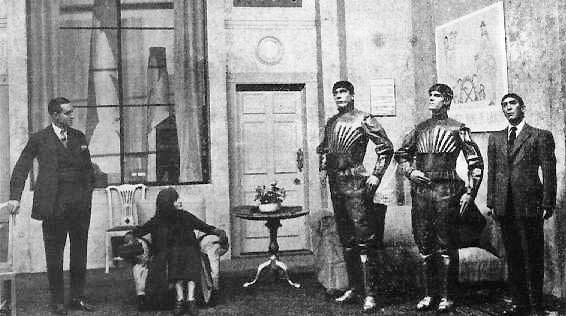
From "The Gardener's Year" by Karel Capek, which I'm reading this morning because Meade began exclaiming about it when he read the first post of the day, the one about the robot umpire, where I mentioned a play by Karel Capek, "R.U.R.," the origin of the term "robot."

Capek's brother Josef suggested the word, which is based on the Czech word "robota," which meant the forced labor of serfs and is based on the word "rab," which means "slave." In the play, from 1920, the robots carry out a revolution.

"The Gardener's Year" has great illustrations that are by the brother, Josef....


That was originally published in 1931.


If you think the drawing style is derivative of James Thurber, here's how Thurber was drawing in 1927...


... and in 1931:


Drawings captured from "James Thurber: Writings & Drawings."

Anyway... Meade says he read "The Gardener's Year" in the 1980s. He got very enthusiastic about it this morning. I said, that's so weird because I just put a Karel Capek book in the Kindle a couple weeks ago — "War with the Newts."


From the Wikipedia article on "War with the Newts":
On August 27, 1935, Čapek wrote, "Today I completed the last chapter of my utopian novel. The protagonist of this chapter is nationalism. The content is quite simple: the destruction of the world and its people. It is a disgusting chapter, based solely on logic. Yet it had to end this way. What destroys us will not be a cosmic catastrophe but mere reasons of state, economics, prestige, etc."

"If you ask a baseball purist, they’ll hate it. They love the manager coming out of the dugout and yelling at the home plate umpire. They love the hitter telling the umpire he’s wrong after he strikes out."

"This system will completely change all that," said home plate umpire Brian deBrauwere, quoted in "Baseball history made: Inside the debut of robot umpires" USA Today.

The automated ball-strike system (ABS) is not what I think of when I hear "robot." The human umpire is still standing there behind the plate and announces the balls and strikes, but he's not making his own calls, he's hearing the call made by "a large Doppler radar screen high above home plate." It's nothing that looks like a human being. The word "robot" has grown over the years to include what we used to just call "automation." "Automated" is the word used in the official name of the product,  automated ball-strike system, but "robot" is a more exciting word. It comes from the 1920 play "R.U.R." by the Czech writer, Karel Čapek...


R.U.R. = Rossum's Universal Robots. This play comes up in crossword puzzles all the time, you may know.

Anyway... in automated ball-strike system, the plate umpire still has independent work. As deBrauwere put it:
"Yeah, it takes something out of the umpire’s hands, but it places additional focus on other things we’re responsible for. Every other decision we have to make will now be magnified. Every check swing, every fair-foul, every safe or out will be even more important now."
And if the system malfunctions, he's got to go back to calling the balls and strikes.

The catcher bemoaned his loss of influence: "As a catcher, I don’t really like it too much because it takes away from my skill at receiving the ball. But if it helps the game, obviously at the big league level, that’s what we’re all here for." That is, there are ways of tricking a human umpire that will be of no use with the radar.

There are benefits for the pitcher: "Some of the pitches they call strikes (now) don’t look like strikes. It looks like a ball and TrackMan calls it a strike. It’s just different. Every pitch I've thrown (high in the strike zone) has been a ball my whole career, since I was 6 years old until now. It's different to see them called a strike." That is, some strikes trick the batter and the human umpire. The pitcher will get a new advantage.