Jules Feiffer లేబుల్‌తో ఉన్న పోస్ట్‌లను చూపుతోంది. అన్ని పోస్ట్‌లు చూపించు

21 జనవరి, 2025

"In October 1956, Mr. Feiffer strolled into the office of The Village Voice, which had been founded the previous year, and offered to draw a regular strip for nothing."

"First titled 'Sick, Sick, Sick,' it eventually became 'Feiffer.' (He was not paid, he later wrote, until 1964.) With his signature sketchy, scribbly lines, Mr. Feiffer sought to bring to a six- or nine-panel format a level of visual simplicity and intellectual sophistication akin to what William Steig and Saul Steinberg had done with their cartoons in The New Yorker. Often devoid of backgrounds and panel borders, Mr. Feiffer’s strip focused almost exclusively on dialogue, gestures and facial expressions.... He would present a couple bickering with each other in profile, or someone in therapy, often with the speaker facing the reader.... Complacent, self-satisfied white liberals were a frequent target, and he upbraided them mercilessly.... The leotard-clad Dancer, who first appeared in 1957, was inspired by a girlfriend. She was... Mr. Feiffer wrote, 'abused and exploited by men.... but where [her male counterpart, based on himself] grew defensive and angry over the years, the Dancer retained her faith. She danced, fell, got to her feet, tripped, sailed aloft, came crashing to earth, rose stubbornly and kept dancing.'"


Feiffer also wrote the screenplay for "Carnal Knowledge" and the Robert Altman version of "Popeye," and his play "Little Murders" became one of my favorite movies from 1971:

16 ఫిబ్రవరి, 2021

What exactly is Joe Rogan's problem with Mayor De Blasio's "Open Culture" program?

Is Rogan mocking the style of dance or is he fretting about the transmission of covid-19 outdoors? Or is it something else — De Blasio paying attention to the arts when he could be tending to health and economics (even though the arts are a core component of NYC's economy)? Is it that when people are suffering and deprived of the normal components of ordinary life, ballet is never the answer?

ADDED: Whatever Rogan might have in mind, I want to step back and consider a larger topic: Is art superfluous, a frill that you get to after the basics are satisfied? I think human beings produce and want to experience art even when they are deprived and suffering. There's a difference, however, between the art of the suffering people and art staged by the government to entertain the public. 

The source and the nature of the art is different. Is it an expression of suffering or is it an amusement intended to distract people and keep them from demanding too much from the government? 

The ballet in that video does not express any real feeling about our current predicament. It's more: We have dancers who can't perform in the usual theater setting that you probably can't afford anyway, so lucky you, they're willing to bestow their talents on you out here in the streets.

ALSO: I'm thinking about those Jules Feiffer dancers....

13 సెప్టెంబర్, 2020

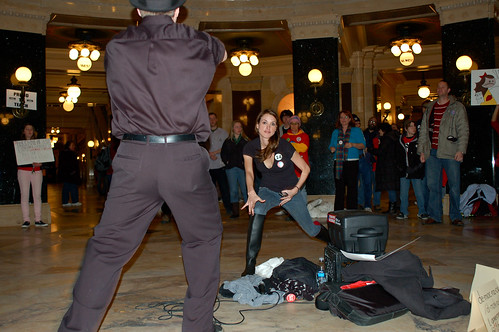
This is what it's like...


ADDED: It's like a Jules Feiffer cartoon come to life.


ALSO: I'm reminded of the point in the 2011 Wisconsin protests when it seemed as though things had turned into "some sort of glamour protest."

DSC_0018
(Photo by Meade.)

24 డిసెంబర్, 2019

"No one encouraged me to be a cartoonist.... I showed my work and they just said, 'I didn’t know you were this unhappy.'..."

"My dream was to be a working cartoonist for the Village Voice... Because that was Jules Feiffer, Mark Alan Stamaty, Stan Mack. There was something very idiosyncratic, very New York, about them, all social comment and not a gag panel. And the New Yorker cartoon was a gag panel. I liked that, but I had no interest in doing that. I didn’t see myself as part of that. I submitted because I thought, Why not? I was working for the Voice and for the Lampoon, and I thought I should try The New Yorker. It’s cartoons—same deal. I think it was a Wednesday—I called up and found their drop-off day, and I left my portfolio. And that’s pretty much what I’ve been doing ever since. I was absolutely flabbergasted and terrified when I found out I had sold something.... ... I went in to see [Lee Lorenz, the New Yorker’s art editor] and he pulled out a cartoon, and he said, ‘We want to buy this! Are you excited?’ ‘Yeah, I am,’ I said. I thought I might be dreaming. A little bit out of body. I noticed that the lights were very like my elementary school. I liked that it’s not exactly shabby but nothing trying to impress you. Places that are trying to impress me always scare me. They don’t impress me, but they scare me. He told me that Shawn [William Shawn, the magazine’s longtime editor] really liked my work. And I had no idea who Shawn was! I assumed it was a first name, someone named Sean, like Sean Connery, who somehow was allowed to like your work. I nodded. ‘That sounds good.’ I did meet him later, and he doffed his hat and I doffed mine, and I wondered why I was doing this."

From "Scenes from the Life of Roz Chast/In the past four decades, the cartoonist has created a universe of spidery lines and nervous spaces, turning anxious truth-telling into an authoritative art" (in The New Yorker).

Speaking of exciting scenes in the life of an artist, I selected that quote and cut and pasted it here before reading it to the end, and I was flabbergasted to see Sean Connery come up. It's so utterly random. The previous post, which I started writing because I was interested in Dennis Hopper's photography, moved through a sequence of things and ended up on Sean Connery. I'd just created a new tag for "Sean Connery" and added it retrospectively to 3 other posts. Sean Connery had popped up only 3 times in 16 years of writing on this blog, and now, this morning, in the space of a few minutes, he's popped up twice. All 5 of the Sean Connery appearances on this blog have been minimal and random. I'll list them in the order of importance — importance with regard to Sean Connery — with the least trivial thing at #1:

5. Roz Chast heard the last name "Shawn" and thought of the first name "Sean," as in "Sean Connery."

4. Darrell Hammond was identified (in 2011) as the SNL actor who impersonates "Al Gore, Bill Clinton, Donald Trump and Sean Connery."

3. Dream-casting a movie based on a new Sandra Day O'Connor biography in 2005, one commenter pictures "a cameo appearance from Sir Sean Connery as Robert Bork, who turns out to have been the arch-villain all along!"

2. This morning's discussion of the 1995 Sean Connery movie "Just Cause."

1. My revelation that I haven't seen a James Bond movie since the last Sean Connery Bond movie, "Diamonds Are Forever" ("It was 1971, and we thought James Bond was absurdly passé").

11 జూన్, 2019

"I do stand behind white people needing to talk to other white people on how to undo whiteness."

"Can I keep refining it and doing it differently and better? Yeah, and I will forever and ever. But I believe in this space as one tool."

Said Laura Humpf, quoted in "Seattle yoga teacher’s ‘Undoing Whiteness’ class: Founded on deep purpose, it’s triggered outrage" (Seattle Times).
“I was seeing white people show up in yoga spaces in racist ways,” says Humpf.... Humpf opened Rainier Beach Yoga in 2014. She says the practice coupled with reflecting on white supremacy’s role in society helped her understand how racism manifests itself internally, including defensiveness, perfectionism and the “white savior complex.” It’s these attitudes, among others, the class seeks to neutralize.

The evening workshops feature Humpf and co-facilitator RW Alves sounding off words such as “oppression” and “liberation” to about a dozen students. The paired participants then physically interpret them, posing to form human sculptures. The exercise is one of many intended to highlight how both body and mind can absorb “the conditioning of whiteness.”...

People attracted to the class are mostly racial-justice-minded white people looking to go beyond an “intellectualized” view of how racism harms everyone, according to student Anne Althauser.

“When this ‘Undoing Whiteness’ yoga class came up, I felt like it answered two cravings of mine — to work through racism and how I hold whiteness in my body, and to bring an anti-racist lens to an appropriated practice that so many of us white folks participate in. If I’m only “woke” in mind but not body, I will only continue playing out harmful, subliminal racist actions unintentionally,” says Althauser, a longtime yoga practitioner....
That name is strangely similar to my own.  And the image of self-purifiers inventing their own pose as the word "oppression" is shouted out at them and worrying about the racism lurking inside their body while proclaiming their conscious mind "woke"... it's just too silly to worry about.

And isn't yoga cultural appropriation?

The song playing over the hotel lobby speaker while I'm trying to write this is "Play That Funky Music, White Boy."

IN THE COMMENTS: This story made me think of Jules Feiffer, so I was happy to see tcrosse had the same feeling and found the perfect cartoon for the occasion. ADDED: Here's the link to the great cartoon! Sorry, I'd forgotten it.

28 సెప్టెంబర్, 2017

"There are many pornographers, but what, within the realm of pornography, earns you a substantial obituary in The New York Times?"

"Some day we'll see how they treat Hugh Hefner, who made pornography clean, commercial and classy, but today we read about the death of Al Goldstein: '... The manifesto in Screw’s debut issue in 1968 was... 'We promise never to ink out a pubic hair or chalk out an organ...'... Apart from Screw, Mr. Goldstein’s most notorious creation was Al Goldstein himself, a cartoonishly vituperative amalgam of borscht belt comic, free-range social critic and sex-obsessed loser.... ' In later years, it became impossible to get famous for being a loud sleazy guy with a magazine, and the idea of anyone 'inking' out pubic hair seems mostly puzzling...."

So I wrote back in 2013, and now the day has come when I can read the substantial obituary for Hugh Hefner in the NYT. I've already written 2 posts, the first 2 of the day, on the death of the gargantuan cultural icon Hugh Hefner. Let me then, at long last, get to the NYT obituary:
Hefner the man and Playboy the brand were inseparable. Both advertised themselves as emblems of the sexual revolution, an escape from American priggishness and wider social intolerance. Both were derided over the years — as vulgar, as adolescent, as exploitative, and finally as anachronistic. But Mr. Hefner was a stunning success from his emergence in the early 1950s. His timing was perfect.

He was compared to Jay Gatsby, Citizen Kane and Walt Disney, but Mr. Hefner was his own production. He repeatedly likened his life to a romantic movie; it starred an ageless sophisticate in silk pajamas and smoking jacket, hosting a never-ending party for famous and fascinating people.

The first issue of Playboy was published in 1953, when Mr. Hefner was 27 years old, a new father married to, by his account, the first woman he had slept with.

He had only recently moved out of his parents’ house and left his job at Children’s Activities magazine. But in an editorial in Playboy’s inaugural issue, the young publisher purveyed another life:

“We enjoy mixing up cocktails and an hors d’oeuvre or two, putting a little mood music on the phonograph and inviting in a female acquaintance for a quiet discussion on Picasso, Nietzsche, jazz, sex.”
A boy's fantasy of adulthood and sophistication.
Mr. Hefner began excoriating American puritanism at a time when doctors refused contraceptives to single women and the Hollywood production code dictated separate beds for married couples. As the cartoonist Jules Feiffer, an early Playboy contributor, saw the 1950s, “People wore tight little gray flannel suits and went to their tight little jobs. You couldn’t talk politically.... You couldn’t use obscenities. What Playboy represented was the beginning of a break from all that.”...

In “The Playboy Philosophy,” a mix of libertarian and libertine arguments that Mr. Hefner wrote in 25 installments starting in 1962, his message was simple: Society was to blame. His causes — abortion rights, decriminalization of marijuana and, most important, the repeal of 19th-century sex laws — were daring at the time. Ten years later, they would be unexceptional.

“Hefner won,” Mr. Gitlin said in a 2015 interview. “The prevailing values in the country now, for all the conservative backlash, are essentially libertarian, and that basically was what the Playboy Philosophy was. It’s laissez-faire. It’s anti-censorship. It’s consumerist: Let the buyer rule. It’s hedonistic. In the longer run, Hugh Hefner’s significance is as a salesman of the libertarian ideal.”
Born in 1926, he was raised "with a lot of repression" by Methodists, but he found his way through drawing comics, first as a child, in high school (where he "'I reinvented myself' as the suave, breezy 'Hef,"  and in college as the editor of the humor magazine. He came up with Playboy as "a vehicle for his slightly randy cartoons."

What did his cartoons like like? I found this (click to enlarge and read ("This is me, dreaming about women in general!"))

More here.

The NYT devotes the mid-section of the obituary to the feminist challenge. Gloria Steinem did undercover research as a "bunny" in the Playboy Club in 1963 and discovered that it's hard work, the outfits are uncomfortable, and the customers are (as the Times puts it) "vulgar."
Another feminist critic, Susan Brownmiller, debating Mr. Hefner on a television talk show, asserted, “The role that you have selected for women is degrading to women because you choose to see women as sex objects, not as full human beings.” She continued: “The day you’re willing to come out here with a cottontail attached to your rear end. …”

Mr. Hefner responded in 1970 by ordering an article on the activists then called “women’s libbers.” In an internal memo, he wrote: “These chicks are our natural enemy. What I want is a devastating piece that takes the militant feminists apart. They are unalterably opposed to the romantic boy-girl society that Playboy promotes.”

The commissioned article, by Morton Hunt, ran with the headline “Up Against the Wall, Male Chauvinist Pig.” (The same issue contained an interview with William F. Buckley Jr., fiction by Isaac Bashevis Singer and an article by a prominent critic of the Vietnam War, Senator Vance Hartke of Indiana.)

Mr. Hefner said later that he was perplexed by feminists’ apparent rejection of the message he had set forth in the Playboy Philosophy. “We are in the process of acquiring a new moral maturity and honesty,” he wrote in one installment, “in which man’s body, mind and soul are in harmony rather than in conflict.” Of Americans’ fright of anything “unsuitable for children,” he said, “Instead of raising children in an adult world, with adult tastes, interests and opinions prevailing, we prefer to live much of our lives in a make-believe children’s world.”
The 3 quoted sentences from that internal memo are fascinating. The first 2 talk tough, calling for a hard fight, but the third one makes an argument that belongs in a sweet, soft fight: The feminists want to say that we're alienating men and women — with domineering men and oppressed, insignificant women — but we're the ones who are for "the romantic boy-girl society." What do women want? A lot of us love the ideal of a romantic boy-girl society. It's interesting that Hef wrote "boy-girl" and yet later publicly talked about the "adult world" and rising above the "make-believe children’s world."

Marilyn Monroe appears twice in the obit, first as the nude model in the first issue of Playboy and second as the long dead body in a mausoleum next to which the newly dead body of Hugh Hefner will lie.