Showing posts with label Gustave Doré. Show all posts

May 6, 2022

This is a reference to "The Inferno" — to the 9th Circle of Hell — right?

I'm just focusing on this SCOTUSblog tweet from 4 days ago:

I thought "the gravest, most unforgivable sin" was an absurd overstatement. I can think of far more horrible sins. Murder springs to mind first. Mass murder. Torture murder. And so on.

But I realized, no, in Dante's "Inferno," the lowest circle of hell is not for murder. It's for treachery:

Trapped in the ice, each according to his guilt, are punished sinners guilty of treachery against those with whom they had special relationships. The lake of ice is divided into four concentric rings (or "rounds") of traitors corresponding, in order of seriousness, to betrayal of family ties, betrayal of community ties, betrayal of guests, and betrayal of lords. This is in contrast to the popular image of Hell as fiery; as Ciardi writes, "The treacheries of these souls were denials of love (which is God) and of all human warmth. Only the remorseless dead center of the ice will serve to express their natures. As they denied God's love, so are they furthest removed from the light and warmth of His Sun. As they denied all human ties, so are they bound only by the unyielding ice." This final, deepest level of hell is reserved for traitors, betrayers and oathbreakers (its most famous inmate is Judas Iscariot).

May 8, 2021

"Musk is the first person from the business world to host SNL since Donald Trump in 2015...."

"Such unorthodoxy could give both Musk and [SNL producer Lorne] Michaels what they want: an important new audience for Michaels, and a humanization of Musk during a time of fierce anti-1-percenter sentiment. It also could blow up in their faces.... Musk will arrive on SNL just a week after four astronauts aboard a SpaceX Dragon capsule successfully splashed down at night in the Gulf of Mexico.... Musk has also garnered notice for his quixotic tunnel plans, his cryptocurrency investments, an unexpected move to Texas, an infamous Joe Rogan podcast appearance, a more infamous cybertruck failure, his belief that pandemic lockdowns were ‘fascist,’ and skeptical comments about the coronavirus vaccine, though he later walked those back.... 'I think Lorne recognizes if he just keeps playing to liberals on the coasts, his audience will wither,' said a late-night television veteran familiar with his thinking who spoke on the condition of anonymity to preserve a relationship with the producer. 'So he’s trying something.' But those efforts are fraught; previous attempts at audience expansion have backfired. In 2019, Michaels hired the working-man’s comic Shane Gillis in part to appeal to Middle America but had to let him go just days later when it was revealed Gillis had used racist and homophobic slurs. Another bid for red-state audiences came last October with the naming of the young country star Morgan Wallen as musical guest. That blew up, too, when Wallen was seen partying maskless in an Alabama bar...."

Writes Steven Zeitchik in "Elon Musk is being brought in to save SNL’s sagging ratings. He could sink the show in other ways. In the entertainment and business worlds, there is an argument in favor of the unorthodox host — as well as plenty of warnings" (WaPo).

Zeitchik seems way overinvested in preserving "SNL" as a bastion of liberal/woke politics. Or is he beset with flashbacks over that 2015 Trump appearance? That all seemed like good fun — even a good way to hurt Trump — and then look what happened! 

And I can't let this go without mention: "Musk has also garnered notice for his quixotic tunnel plans." He doesn't just get notice. He garners notice. That is he saves up the notice in garners — a "garner" being a granary or a storehouse for corn. "Garner" was a noun for centuries before it was a verb, and as a verb it's a dead metaphor, but some of us — me, chiefly — remember the dead. 

If I worked on this post all day, I could figure out a way to connect garnering to "quixotic," because the reference is to Don Quixote, and Don Quixote famously tilted at windmills, so you have 2 things connected to grain — mills and garners. But I have some restraint. I'll just show you this fantastic Gustave Doré illustration:

April 14, 2019

I learned a new word yesterday: "rodomontade."

It means: "A vainglorious brag or boast; an extravagantly boastful, arrogant, or bombastic speech or piece of writing... Extravagant boasting or bragging; bravado; boastful or bombastic language" (OED).

The word is based on the name Rodomonte — "a character in the Italian romantic epic poems Orlando innamorato by Matteo Maria Boiardo and Orlando furioso by Ludovico Ariosto" (Wikipedia).

Gustave Doré illustrates the character:

It's a useful word — "rodomontade" — don't you think? It's also spelled "rhodomontade," which is how I saw it, in the wonderful book I just started reading, "I Am a Cat" by Natsume Soseki:
[Asked “How many rats have you caught so far?”] I answered “Actually, though I’m always thinking of catching one, I’ve never yet caught any.”

Blacky laughed immoderately, quivering the long whiskers, which stuck out stiffly round his muzzle. Blacky, like all true braggarts, is somewhat weak in the head. As long as you purr and listen attentively, pretending to be impressed by his rhodomontade, he is a more or less manageable cat.
I had "I Am a Cat" in my Kindle ready to read when I finished "Kafka on the Shore," in which the main character reads and talks about Soseki (and in which there are a lot of talking cats)

According to Wikipedia, Soseki (1867-1916) is "becoming trendy" because he is Murakami's favorite author.

September 11, 2017

In the aftermath of the storm....


... please feel free to talk about anything.

(The image is "Lake in Scotland after a Storm" (from 1875–78, by Gustave Doré).)

September 7, 2017

At the Rabelais Café...


... have a taste of conversation.

The engraving is from the 1870s, by Gustave Doré, illustrating "Gargantua and Pantagruel" — written in the mid-1500s by Rabelais, who is under discussion in this earlier post today. That picture is used — in a recent issue of The Paris Review — to introduce an essay by Robert D. Zaretsky, who "argues that we’ve lost sight of the grotesque—and of the immense floodgates of laughter that it alone can open":
Laughter that upends hierarchies and undoes centuries of moral self-seriousness, leaving no one unscathed as it washes over the masses. Looking at Rabelais... Zaretsky wonders how we lost our way—and why we can no longer mock ourselves along with those in power: “Grotesqueness was not an insult, but instead an insight into the human condition. More than half a millennium later, in a world dominated by indignation and outrage, and largely abandoned by laughter, a dose of the grotesque might help to better digest events, if only by having a good—and right kind of—laugh... For medieval man, laughter was the great leveler. Preceding Martin Luther’s priesthood of all believers was Rabelais’s priesthood of all belly-laughers. Inclusive and communal, laughter left no one untouched; no less universal than faith, it was a bit more subversive...”
So sit down and, with a dose of the grotesque, digest the events of our self-serious time.

January 29, 2015

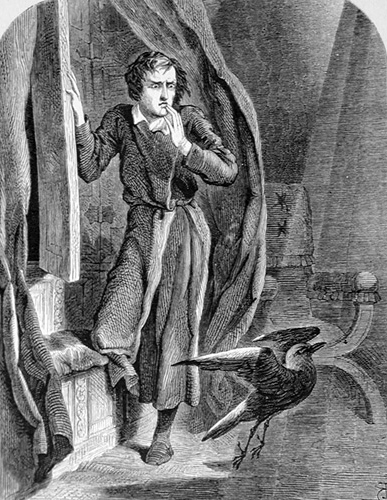
170 years ago, this evening (dreary)... "while I pondered, weak and weary/Over many a quaint and curious volume of forgotten lore..."


Edgar Allan Poe's poem "The Raven" is first published — January 29, 1845 — in the New York Evening Mirror.
Poe claimed to have written the poem very logically and methodically, intending to create a poem that would appeal to both critical and popular tastes, as he explained in his 1846 follow-up essay "The Philosophy of Composition.".... Poe chose a raven as the central symbol in the story because he wanted a "non-reasoning" creature capable of speech....
The poem inspired illustrators. I chose the one by John Tenniel (whose "Alice in Wonderland" illustrations are so familiar) to begin the post, but the Gustave Doré approach seems to fit the tone better.


That goes with the last lines about the Raven forever sitting above the door, as "the lamp-light o'er him streaming throws his shadow on the floor/And my soul from out that shadow that lies floating on the floor/Shall be lifted—nevermore!"  which — as I read it tonight, 170 years later — feels like the inspiration for Neil Young's "Big birds flying across the sky/Throwing shadows on our eyes... The chains are locked and tied across the door... Helpless, helpless, helpless."