I believe — based on this Hill article — that was yesterday and not at a campaign stop but at Biden's own campaign headquarters.
How can it be that Trump is not for anything? He's for a strong southern border, for example. Obviously, that can be rephrased into being against something: He's against an open border. What does Biden think he's saying? Was there some longer, more specific speech that enumerated good things that Biden supports and that Trump is against, and Biden decided to ditch the enumeration and substitute "everything"?
Meanwhile, Trump would like you to know he looks like Elvis. He's for Elvis. That's not nothing.
"Mr. Dylan has put his words out into the world in vessels with too many dimensions to be broken down into elements: as songs. Think of a song as thrillingly alive with the furies of creation, discovery and experiment, with the resolution of each verse reaching a pitch of such insistence, humor and force that the next has to push further or die. Think of 'Highway 61 Revisited,' from 1965 — a song that Mr. Dylan performed last week at the Desert Trip festival in Indio, Calif...."
That's Greil Marcus, writing in the NYT putting an important spin on the argument why it made sense for Bob Dylan to win the Nobel Prize in Literature: It's not whether a song can be detached from its music and regarded as a poem, but the song as a song, at one with its music.
And I love Marcus's first paragraph, on why it's not surprising that the novelist Don DeLillo did not win the Nobel Prize in Literature this year.
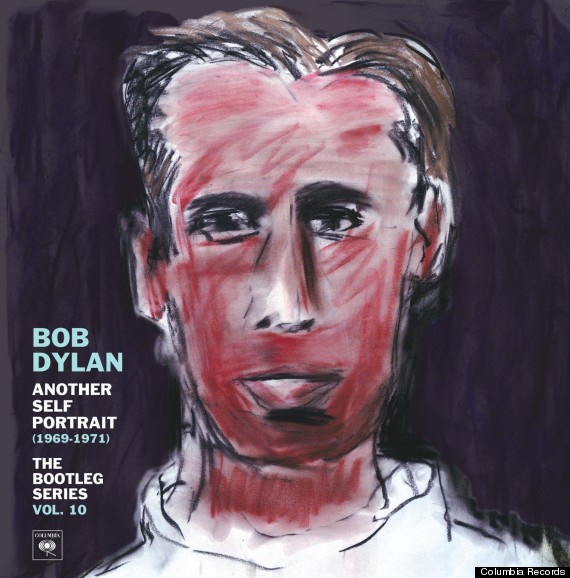
The trouble with painting/drawing portraits is everyone gravitates to the question whether it looks like the person it's supposed to be. That's a good reason — if you like doing portraits — to choose subjects who aren't well-known. Alternatively, use a camera. You might get credit for making one person look like someone else.
... the one about which Greil Marcus asked in Rolling Stone: "What is this shit?" (Here, please credit me for resisting making a Santorum joke.)
Comparing the 2 selfies, we see a consistent approach to the upper lip/lower lip proportion, the the Scarecrow-from-the-Wizard-of-Oz nose, the hair part deeply denting the forehead (making it look like a lopsided heart), the cut off jawline with jowls, and the un-level ears (though the down ear is now up and the up is down*). The biggest difference, other than skin tone, is in the eyebrows. Gone is the amazement of youth. The old man has seen it all, but he's still looking.
_________________________
*Old lyric that resonated (after a search for "up" and "down"):
Oh, the only decent thing I did when I worked as a postal clerk
Was to haul your picture down off the wall near the cage where I used to work
Was I a fool or not to try to protect your identity?
You looked a little burned out, my friend, I thought it might be up to me
When teaching a seminar, and there's a point that rises out of the discussion that you think absolutely has to be made, wait. In five minutes someone in the class will say what, if you, the teacher, had said it, would have killed the discussion - but coming from a student, it will push the discussion forward, into richer territory than your own sterile interruption could ever have found. That was my own advice to myself, and every time I teach a seminar, I have to remind myself of it about every 15 minutes.
Ah! The temptation to just say it (which I yield to all the time).
I found that because of my Google alert on "Bob Dylan." Here's what he said about Dylan:
The greatest album, ever?
Bob Dylan's "Highway 61 Revisited" (1965) No matter how many times you might have heard it, a different song will appear as primary, the star around which everything else revolves - it could be "It Takes a Lot to Laugh, It Takes a Train to Cry," one day, "Ballad of a Thin Man" the next, the title song for the next year, "Just Like Tom Thumb's Blues" a year later, each different song casting all the others into a different relief. Then "Desolation Row" might make you forget that there's anything else on the album at all. But if the album were simply "Like a Rolling Stone" and 30 or 40 minutes of silence, I still might pick it.
Remember... loving the Shangri-Las? The lead singer -- the coolest girl group singer ever -- is back. Good luck to Mary Weiss on her new album. But let's talk about the Shangri-Las:
The Shangri-Las stood out from their contemporaries. The melodrama and desperation in their voices — not to mention their tight leather pants and leather boots, a drastic departure from the formal gowns favored by groups like the Supremes and the Chiffons — defied the girl-group category in which they’re often thrown “for lack of imagination,” as the music writer Greil Marcus put it.
“This was storytelling, this was creating characters,” Mr. Marcus said from his home in Berkeley, Calif. “There was a cinematic sense to the songs where you could visualize them as you listened to them. Their records left wounds in their listeners.”
Whenever the song "I Can Never Go Home Anymore" comes on the 60s channel, I get caught up in the words, and even though I know it's utterly cheesy and manipulative, it makes me cry (while driving!). Here, check it out, someone made a YouTube video that just shows the single playing on a record player. That's really sweet.
Here's Mary Weiss's MySpace page. Here's a nice interview thing. Here's a cute tribute video with lots of pictures. Here's an album (click on it and buy it):
Look at the way Mary looked then! Good Lord, she was only 15! She had the perfect tough girl image. Hers was a look that in those days -- where I was anyway, in northern New Jersey -- we called "hoody." It was the alternative to the mod look, which I personally favored. I knew one girl, a friend of my sister's, who had the Mary Weiss look. It was sort of the dark side to the candy-colored mod/psychedelic style that I believed would conquer all. But this other thing! It came from the wrong side of town. My sister's friend scared me a little. She didn't live with her parents. She was from over in Boonton. She wore Tabu perfume. Really, I would never wear Tabu perfume. It's unbelievably sweet and strong. But I'd love to have some to dump into a handkerchief to inhale while listening to old Shangri-Las records.
"Oh, let me think, let me think, what can I do? Oh, no. Oh, no. Oh, no no no no no."
Weeps uncontrollably into Tabu-soaked hankerchief.
Dylan had stopped singing "Masters of War" by 1964. Songs like that were "lies that life is black and white," he sang that year. He brought it back into his repertoire in the 1980s; he was playing more than a hundred shows a year, and to fill the nights he brought back everything. It was a crowd-pleaser, the number one protest song. But nothing in the song hinted at what it would turn into on February 21, 1991, at the Grammy Awards telecast, where Dylan was to receive a Lifetime Achievement Award.
The show came square in the middle of the first Iraqi-American War—a break from round-the-clock footage of the bombing of Baghdad....
With that night, the song began its second life. In the fall of 2002, when George W. Bush made plain his intent to launch a second Iraq war—on November 11, just after the midterm elections that Bush had used the specter of war to win—Dylan appeared at Madison Square Garden and again offered "Masters of War" as an answer record to real life....
It became clear that, beyond new wars, what has kept the song alive is its melody, and its vehemence: that final "I hope that you die." It's the elegance of the melody and the extremism of the words that attract people—the way the song does go too far, to the limits of free speech. It's a scary line to sing; you need courage to do it. You can't come to the song as if it's a joke; you can't come away from it pretending you didn't mean what you've just said. That's what people want: a chance to go that far. Because "Masters of War" gives people permission to go that far, the song continues to make meaning, to find new bodies to inhabit, new voices to ride.
Read the whole thing, which includes descriptions of other singers doing the song, including those kids at Boulder High School.
I remember listening to "Masters of War" in the 1960s. It releases the young mind to think a new thought: All these people who run the world deserve to die. It emboldens you to sing along with this seemingly profound insight, and, singing along, you find yourself expressing utterly hard anger and hatred.
I am a participant in the Amazon Services LLC Associates Program, an affiliate advertising program designed to provide a means for me to earn fees by linking to Amazon.com and affiliated sites.
Encourage Althouse by making a donation:
Make a 1-time donation or set up a monthly donation of any amount you choose:




 Posts
Posts


