Ipinapakita ang mga post na may etiketa na Felix Frankfurter. Ipakita ang lahat ng mga post

Hunyo 30, 2023

"The Court holds that the First Amendment bars Colorado from forcing a website designer to create expressive designs speaking messages with which the designer disagrees."

SCOTUSblog announces.

Here's the opinion.

It's a 6-3, conservative/liberal split. Gorsuch writes. No concurring opinions. One dissenting opinion, by Sotomayor.

From the Gorsuch opinion for the majority:

Like many States, Colorado has a law forbidding businesses from engaging in discrimination when they sell goods and services to the public. Laws along these lines have done much to secure the civil rights of all Americans. But in this particular case Colorado does not just seek to ensure the sale of goods or services on equal terms. It seeks to use its law to compel an individual to create speech she does not believe. The question we face is whether that course violates the Free Speech Clause of the First Amendment.

The business in question is a website design firm (owned by Lorie Smith) that offers customized "text, graphic arts, and videos to 'celebrate' and 'conve[y]' the 'details' of [a wedding couple's] 'unique love story.'"

Hunyo 24, 2022

"The Supreme Court on Friday overruled Roe v. Wade, eliminating the constitutional right to abortion after almost 50 years in a decision that will transform American life, reshape the nation’s politics and lead to all but total bans on the procedure in about half of the states."

"The ruling will test the legitimacy of the court and vindicate a decades-long Republican project of installing conservative justices prepared to reject the precedent, which had been repeatedly reaffirmed by earlier courts. It will also be one of the signal legacies of President Donald J. Trump, who vowed to name justices who would overrule Roe. All three of his appointees were in the majority in the 6-to-3 ruling. The decision, which echoed a leaked draft opinion published by Politico in early May, will result in a starkly divided country in which abortion is severely restricted or forbidden in many red states but remains freely available in most blue ones."


ADDED: What's most interesting at this point, other than examining Alito's opinion to see what differences there may be from the leaked draft, is the Chief Justice's concurring opinion. What was this elusive middle position that he struggled to identify at oral argument and failed to sell to any of the other Justices?

Enero 18, 2022

"At oral argument, Justice Elena Kagan, one of the court's best questioners, sometimes... just shuts down... Still, her anger is often palpable, the color literally draining from her face. "

"And Justice Stephen Breyer on occasion just holds his head.... There isn't a lot of love lost among the court's six conservatives either.... If you watch carefully, you can see conservative eyes rolling from time to time.... [M]any of the conservatives are vying for the position of intellectual leader of the conservative majority, while the chief justice privately worries about going too far too fast. There are, in addition, some long and perhaps not so buried resentments among the conservatives. Alito on occasion barely conceals his disdain for Roberts.... In recent decades, the court has built its legitimacy on a certain degree of moderation — giving the left some of what it wanted and the right some of what it wanted. The left got gay rights and gay marriage, and some limits on presidential power exercised in the name of national security. And the right got expanded religious liberty and expanded free speech, which brought with it expanded corporate spending in elections.... But... the court's conservatives detest each other in the same way that the justices did in the 1940s. Back then, they couldn't agree on anything because, as [Noah] Feldman notes, 'they hated each other.' and even though they might have been able to to reach a consensus, they didn't 'because the hatred was so deep.' To cite just one example of how bad it was, Justice Felix Frankfurter called Justice William O. Douglas 'one of the completely evil men I have ever met.' And Douglas referred to the Austrian-born Frankfurter, who was Jewish, as 'Der Führer' and that was during World War ll."


The "scorpion" quote refers to "9 scorpions in a bottle," a famous phrase that Totenberg doesn't give a source, perhaps because it's so famous, but perhaps because the usual attribution — to Oliver Wendell Holmes Jr. — seems incorrect. Noah Feldman's book "Scorpions: The Battles and Triumphs of FDR's Great Supreme Court Justices Paperback" begins with the quote "The Supreme Court is nine scorpions in a bottle," attributed to Alexander Bickel, law clerk to Justice Felix Frankfurter, 1952–53, and drops this footnote:

Pebrero 15, 2019

"Before the cares of the White House were his own, President Harding is reported to have said that government, after all, is a very simple thing."

"He must have said that, if he said it, as a fleeting inhabitant of fairyland. The opposite is the truth. A constitutional democracy like ours is perhaps the most difficult of man's social arrangements to manage successfully. Our scheme of society is more dependent than any other form of government on knowledge and wisdom and self-discipline for the achievement of its aims. For our democracy implies the reign of reason on the most extensive scale. The Founders of this Nation were not imbued with the modern cynicism that the only thing that history teaches is that it teaches nothing. They acted on the conviction that the experience of man sheds a good deal of light on his nature. It sheds a good deal of light not merely on the need for effective power if a society is to be at once cohesive and civilized, but also on the need for limitations on the power of governors over the governed. To that end, they rested the structure of our central government on the system of checks and balances. For them, the doctrine of separation of powers was not mere theory; it was a felt necessity. Not so long ago, it was fashionable to find our system of checks and balances obstructive to effective government. It was easy to ridicule that system as outmoded — too easy.... A scheme of government like ours no doubt at times feels the lack of power to act with complete, all-embracing, swiftly moving authority.... I know no more impressive words on this subject than those of Mr. Justice Brandeis: 'The doctrine of the separation of powers was adopted by the Convention of 1787 not to promote efficiency, but to preclude the exercise of arbitrary power. The purpose was not to avoid friction, but,  by means of the inevitable friction incident to the distribution of the governmental powers among three departments, to save the people from autocracy.'"

Wrote Justice Felix Frankfurter in 1952, concurring in Youngstown Sheet & Tube Co. v. Sawyer.

Abril 2, 2018

"I Eat Cannibals."


A 1982 song by Toto Coelo, which I'm listening to — I hasten to say! — not because of anything in the previous post, but because the quote "Toto, I've a feeling we're not in Kansas anymore"...


... came up in some other conversation we were having in real life here at Meadhouse, I wanted to do something with the Latin phrase "toto coelo," and I got distracted by the existence of a previously-unknown-to-me British New Wave group called Toto Coelo.

Here's a Washington Post columnist, complaining in 1988 about the Supreme Court's use of the Latin phrase:
In the court's major decision in this term, a 7-to-1 vote upholding the independent-counsel law, Scalia wrote a lively dissent. Included was the pronouncement: "Fiat justitia, ruat coelum. Let justice be done, though the heavens may fall." Actually not a bad line. In fact, catchy and an attention grabber for a dissenting opinion.

The court's liberal wing, specifically Justice William J. Brennan Jr., also seems to be dusting off its Latin. Quoting Justice Felix Frankfurter in a case involving city regulations on newsboxes, Brennan wrote that a law allowing censorship based on an article's content "differs toto coelo from one limited . . . to considerations of public safety . . . . "

Toto coelo? The congressman from California? And his little dog, too? Instead, how about "completely"? Or "entirely"? Or "in every respect"?
Ha ha. The old independent-counsel law. Remember that?

All I wanna do, is make a meal of you/We are what we eat, you're my kind of meat...

Oktubre 12, 2016

"It's a paler place without" Scalia, said Justice Ginsburg.

"Paler. Because he was a wonderful storyteller. He had an uncanny ability to make even the most somber judge smile."

Also:
When asked about Hillary Clinton potentially stacking the court with liberal justices, Ginsburg said she resisted "the notion that, if you are a Democrat, then you are 'liberal.'"

"Just think of John Paul Stevens appointed by President Ford, then Souter appointed by the first President Bush," she said. "They were not 'conservative.'"
I'd like to see the whole quote, but 2 examples of Republicans who turned out not to be conservative does not make me think it's at all likely that Democrats will turn out not to be liberal. When's the last time that happened? Felix Frankfurter?

Hunyo 25, 2015

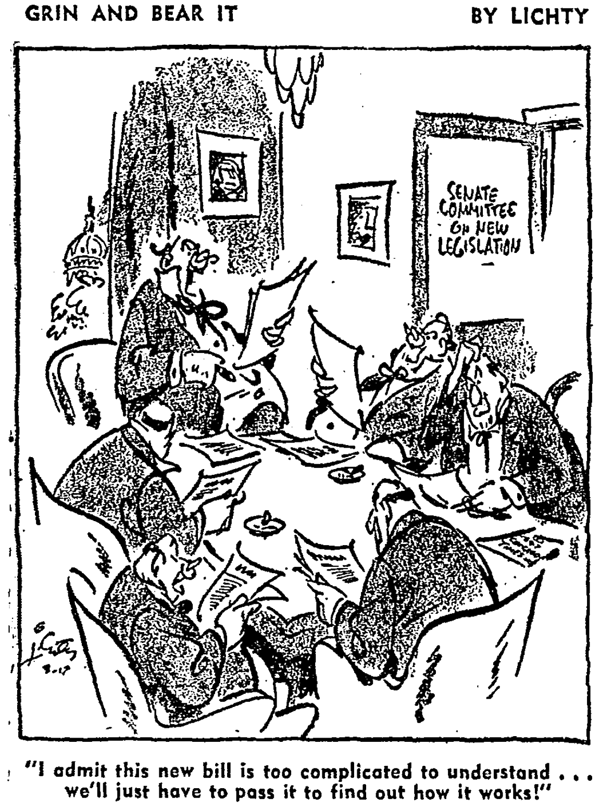
Language Log tracks down the old "Grin and Bear It" cartoon that Chief Justice Roberts quoted Justice Frankfurter misquoting.

I mentioned this in my earlier post on the Obamacare case:
In a sly reference to Nancy Pelosi's "we have to pass the bill so that you can find out what is in it," Chief Justice Roberts quotes an old Felix Frankfurter article — "Some Reflections on the Reading of Statutes, "47 Colum. L. Rev. 527, 545 (1947) — that described a cartoon "in which a senator tells his colleagues 'I admit this new bill is too complicated to understand. We’ll just have to pass it to find out what it means.'").
But Language Log has the original Frankfurter passage...
Loose judicial reading makes for loose legislative writing. It encourages the practice illustrated in a recent cartoon in which a senator tells his colleagues "I admit this new bill is too complicated to understand. We'll just have to pass it to find out what it means." —Felix Frankfurter, "Some Reflections on the Reading of Statutes," 47 Columbia Law Review 527, 545 (1947)
... and the original 1947 cartoon (showing the misquoted "what it means" for "how it works"):


ADDED: When I was a kid I liked to read the funny pages and "Grin and Bear It" was the one cartoon that was not accessible to me. I read all the cartoons and I read that, but I had to just trust that whatever the humor was, some day I would get it. Today is that day.

Healthcare!

Roberts writes.

Subsidies are available!

Big sigh of relief.

Chaos avoided.

"This means that individuals who get their health insurance through an exchange established by the federal government will be eligible for tax subsidies."

The government wins. The Chief is joined by Kennedy, Ginsburg, Breyer, Sotomayor, and Kagan. Scalia has a dissenting opinion.

And now this means that only another opinion by Roberts can come out today. But no, that's it for today. The rest, including same-sex marriage, will come tomorrow.

Here's the PDF of the opinion.

ADDED: The majority says that Chevron deference — which asks only "whether the agency’s interpretation is reasonable" — has never applied applied "in extraordinary cases," where there's reason to "hesitate before concluding that Congress has intended" to delegate to the agency the authority to "fill in the statutory gaps." Here, the tax credits are "key reforms, involving billions of dollars," with big "economic and political significance," and the agency making the decision is the IRS, which "no expertise in crafting health insurance policy."

Without Chevron deference, it's the Court's job to say for itself what the statute means.

The losing side in this case rested heavily on the argument that the statute was clear (that there were no subsidies for states that didn't set up their own exchanges and left it to the feds to set up exchanges), but the majority found ambiguity. It blamed Congress for "inartful drafting," for writing "key parts of the Act behind closed doors, rather than through 'the traditional legislative process,'" and for using "reconcilation" instead of leaving the bill open to debate and amendment.  In a sly reference to Nancy Pelosi's "we have to pass the bill so that you can find out what is in it," Chief Justice Roberts quotes an old Felix Frankfurter article — "Some Reflections on the Reading of Statutes, "47 Colum. L. Rev. 527, 545 (1947) — that described a cartoon "in which a senator tells his colleagues 'I admit this new bill is too complicated to understand. We’ll just have to pass it to find out what it means.'").

Since the text is ambiguous, the Court looks at the statute's "broader structure" for meaning, and the need to prevent the "death spiral" determines the outcome. The Court rejects the idea that Congress intended dire consequences, that it wanted to make an offer the states couldn't refuse, because Congress "expressly addressed what would happen if a State did refuse the deal."

AND: Justice Scalia dissents, joined by Justices Thomas and Alito. He finds clarity in the key phrase and proclaims: "Words no longer have meaning if an Exchange that is not established by a State is 'established by the State.'" He accuses the majority of "interpretive jiggery-pokery" in pursuit of "the overriding principle": "The Affordable Care Act must be saved."
The Court’s decision reflects the philosophy that judges should endure whatever interpretive distortions it takes in order to correct a supposed flaw in the statutory machinery.... We lack the prerogative to repair laws that do not work out in practice, just as the people lack the ability to throw us out of office if they dislike the solutions we concoct....

It is not our place to judge the quality of the care and deliberation that went into this or any other law. A law enacted by voice vote with no deliberation whatever is fully as binding upon us as one enacted after years of study, months of committee hearings, and weeks of debate. Much less is it our place to make everything come out right when Congress does not do its job properly. It is up to Congress to design its laws with care, and it is up to the people to hold them to account if they fail to carry out that responsibility....

Nobyembre 29, 2014

"The very idea of cooking up opinions in conclave begets suspicions," said President Thomas Jefferson, criticizing the Supreme Court.

Quoted in a New Yorker article (by Jill Lepore) about the theft of 1000+ pages of the Felix Frankfurter papers from the Library of Congress. Context:
The secrecy surrounding the U.S. Supreme Court derives from a policy set by the fourth Chief Justice, John Marshall, who wanted the Court to issue single, unanimous decisions and to conceal all evidence of disagreement. His critics considered this policy to be incompatible with a government accountable to the people. "The very idea of cooking up opinions in conclave begets suspicions," Thomas Jefferson complained. This criticism has never entirely quieted, but every time things get noisy the Court simply brazens it out. To historians and journalists who are keen to have the Court’s papers saved and unsealed, advocates of judicial secrecy insist that the ordinary claims of history and of public interest do not apply to the papers of U.S. Supreme Court Justices; the only claim on the Justices is justice itself.
Jefferson is suspicious of the very device that makes the Court look politically neutral and bound by the strictures of legal analysis.

By the way, I like Lepore's use of the verb "to brazen it out." "Brazen" means "Made of brass" — literally or figuratively — including "Hardened in effrontery; shameless." The OED has, among its quotes for the adjective "brazen," the Jonathan Swift poem "An Epistle to Mr. Gay" (1731)
I knew a brazen minister of state,
Who bore for twice ten years the public hate.
In every mouth the question most in vogue
Was, when will they turn out this odious rogue? 
The verb "to brazen out" means "to face impudently or as with a face of brass." We see this usage in John Arbuthnot's 1712 work: "Lewis Baboon turned honest, and John Bull politician. Being the fourth part of Law is a bottomless-pit":
"When I us'd to reprimand him for his Tricks, he would talk saucily, lye, and brazen it out, as if he had done nothing amiss. Will nothing cure thee of thy Pranks Nic. (quoth I?) I shall be forced, some time or another, to chastise thee... After I have beggar'd myself with his troublesome Law-Suit..."
This is a book about a lawsuit, presented as a metaphor for war. "Lewis Baboon" = the king of France, Louis Bourbon. John Bull = England:


Looks a little like Scalia, no?

Nobyembre 21, 2014

A few thoughts on reading the transcript of the President's immigration speech.

1. What, if anything, is really changing? Here's the deal:
If you’ve been in America for more than five years; if you have children who are American citizens or legal residents; if you register, pass a criminal background check, and you’re willing to pay your fair share of taxes – you’ll be able to apply to stay in this country temporarily...
You have to register and the protection from deportation is only temporary? Who even wants this deal? The alternative is to continue as before, knowing that the government lacks the resources and will to deport you as long as you don't commit a crime other than the violation of immigration law. We, the citizens of the United States of America, are urged to picture this as "living in the shadows." But that "shadows" rhetoric — which appears 4 times in the speech — is aimed at us citizens. And I'm trying to think of a comparably dramatic replacement for "if you register." The word "register" appears in the speech once. Isn't there something ominous and oppressive about a government registry?

2. Overstated reactions to Obama's announcement of his pragmatic continuation of immigration enforcement make his opponents look extreme, and I think that was the idea. Didn't his party lose the elections earlier this month because the GOP had managed to mute its immoderate voices? The Democratic Party needs the Tea Party/Ted Cruz element to speak up, and Obama's speech built a nice stage upon which they can strut, declaim, and chew scenery.

3. Obama got to sound elevated and aspirational: "[O]ur tradition of welcoming immigrants... [has] kept us youthful, dynamic, and entrepreneurial... And whether our forebears were strangers who crossed the Atlantic, or the Pacific, or the Rio Grande, we are here only because this country welcomed them in, and taught them that to be an American is about something more than what we look like..."

4. The speech is studded with conservative themes — not rewarding bad behavior, requiring people to take responsibility, keeping families together: Give people who want to "play by the rules" a way to "embrace... responsibilities."

5. On mentioning law, Obama proceeds to a double sleight of hand. Obama presents his independent action as a last resort, a temporary fix, while he waits on needed congressional action:
But until that happens, there are actions I have the legal authority to take as President – the same kinds of actions taken by Democratic and Republican Presidents before me.
Almost immediately after that statement, he intones the big generality "we are... a nation of laws," but that does not come in the context of explaining how he himself is following law that binds him. It's about the problem that "Undocumented workers broke our immigration laws, and I believe that they must be held accountable – especially those who may be dangerous." See the 2 moves in that sleight of hand? First, he shifted away from presidential power to the law that the "undocumented workers" are violating, and second, he broke that group in two, separating the whole law-violating category into those who are only violating immigration law and those who are "dangerous" for some other reason. The next bit is:
That’s why, over the past six years, deportations of criminals are up 80 percent. And that’s why we’re going to keep focusing enforcement resources on actual threats to our security. Felons, not families. Criminals, not children. Gang members, not a mother who’s working hard to provide for her kids. We’ll prioritize, just like law enforcement does every day. 
So, those law-violating people who are not "dangerous" are completely good people who deserve our compassion. How does that fit with the idea that "they must be held accountable"? We're supposed to lose track of who's supposed to be held accountable and think that only the dangerous subgroup needs to be held to account.

6. Does the President ever return to the topic of his legal authority? No, but he does seem to refer back to the (nonexistent!) place in the speech that maybe listeners will blame themselves for forgetting:
The actions I’m taking are not only lawful, they’re the kinds of actions taken by every single Republican President and every single Democratic President for the past half century. 
Now, there is a legal argument for presidential power that is premised on "a systematic, unbroken, executive practice, long pursued to the knowledge of the Congress and never before questioned, engaged in by Presidents who have also sworn to uphold the Constitution." (That's a quote — from the famous steel seizure case — that I discussed here a few days ago). But Obama doesn't say he's using that argument. He doesn't say "The actions I’m taking are lawful because they’re the kinds of actions taken by every single Republican President and every single Democratic President for the past half century." He says "not only" are his actions lawful, but they are also the kinds of actions that other Presidents have taken. The past practice of other Presidents comes as a reason to be persuaded that it's a good, practical, not immoderate policy.

7. Do past presidential actions establish either the legal authority or the good politics and policy of the President's proposed actions? I don't know! Obama only states a conclusion that there are all these other examples of the same kind of thing, but to assess any legal/political argument he might intend to be making, we'd need to study each example and make a sound judgment about whether it's parallel to what Obama is doing now. Let's say you buy into the proposition in that quote (in point #6) from the steel seizure case. That quote is from Felix Frankfurter's concurring opinion, and he took the trouble to examine past actions and decided that — other than 3 things FDR did in 1941 — they were not comparable.

8. Obama seems to claim a power to do what must be done even in a nonemergency.
And to those Members of Congress who question my authority to make our immigration system work better, or question the wisdom of me acting where Congress has failed, I have one answer: Pass a bill.
First, we — and he — should always question a government official's authority, and it's absurd to accept the idea that Congress's only way to object to the abuse of power is through the passage of a law. Second, Obama's claim of power doesn't include the premise that we are in a position where it is necessary for action to be taken. He just wants "to make our immigration system work better"! That doesn't sound like an emergency, just a policy tweaking. And, as I said in point #1, I don't see how what he's doing changes things that much, not enough to be characterized as a fix to get us through an emergency until Congress gets its gears in motion. If I'm wrong, and Obama is doing a lot, creating a substantial new policy, that weakens his argument for legal power. But if I'm right, and he's not doing much, then what's all the prime-time to-do about? For an answer to that question, please refer to point #2.

9. He acknowledges the objections of some Americans, then insults them: "... I understand the disagreements held by many of you at home," but this is "about who we are as a country." You people are not who we are.

10. Religion! "Scripture tells us that we shall not oppress a stranger, for we know the heart of a stranger – we were strangers once, too." What scripture is that? I assume it's Matthew 25:35-40.

Nobyembre 18, 2014

"Defining constitutional deviancy down."

From the new David Brooks column titled "Obama in Winter":
Usually presidents at the end of their terms get less partisan, not more... Usually presidents with a new Congressional majority try to figure out if there is anything that the two branches can do together... But the White House has not privately engaged with Congress on the legislative areas where there could be agreement. Instead, the president has been superaggressive on the one topic sure to blow everything up: the executive order to rewrite the nation’s immigration laws.... Instead of a nation of laws, we could slowly devolve into a nation of diktats, with each president relying on and revoking different measures on the basis of unilateral power — creating unstable swings from one presidency to the next. If President Obama enacts this order on the transparently flimsy basis of 'prosecutorial discretion,' he’s inviting future presidents to use similarly flimsy criteria. Talk about defining constitutional deviancy down.
"Defining deviancy down" is a famous alliterative phrase — less alliterative with Brooks's extra word "constitutional" thrown in. It was coined by Daniel Patrick Moynihan in a 1993 article titled "Defining deviancy down," which, as Mickey Kaus once put it, "blames the left for treating mental illness and single motherhood as acceptable 'life styles.'" The deviancy in question was the private citizen's deviancy from social norms. It's a catchy way to decry the lowering of standards (similar to Bush's "soft bigotry of low expectations").

It's interesting to transfer "defining deviancy down" to the context of the behavior of Presidents within a constitutional system, and in fact the behavior of Presidents does influence the way courts later interpret the power of the President. As Justice Felix Frankfurter wrote long ago in a very significant case:
The Constitution is a framework for government. Therefore, the way the framework has consistently operated fairly establishes that it has operated according to its true nature. Deeply embedded traditional ways of conducting government cannot supplant the Constitution or legislation, but they give meaning to the words of a text or supply them. It is an inadmissibly narrow conception of American constitutional law to confine it to the words of the Constitution and to disregard the gloss which life has written upon them. In short, a systematic, unbroken, executive practice, long pursued to the knowledge of the Congress and never before questioned, engaged in by Presidents who have also sworn to uphold the Constitution, making as it were such exercise of power part of the structure of our government, may be treated as a gloss on "executive Power" vested in the President by § 1 of Art. II.
That proposition was warmly embraced in Justice Breyer's opinion for a majority of the Supreme Court in last term's case about the President's power to make recess appointments:
[T]e longstanding “practice of the government”...  can inform our determination of “what the law is”...

That principle is neither new nor controversial. As James Madison wrote, it “was foreseen at the birth of the Constitution, that difficulties and differences of opinion might occasionally arise in expounding terms & phrases necessarily used in such a charter . . . and that it might require a regular course of practice to liquidate & settle the meaning of some of them.” Letter to Spencer Roane (Sept. 2, 1819), in 8 Writings of James Madison 450 (G. Hunt ed. 1908). And our cases... show that this Court has treated practice as an important interpretive factor even when the nature or longevity of that practice is subject to dispute, and even when that practice began after the founding era. See Mistretta, supra, 400–401 (“While these [practices] spawned spirited discussion and frequent criticism, . . . ‘traditional ways of conducting government . . . give meaning’ to the Constitution” (quoting Youngstown, supra, at 610) (Frankfurter, J., concurring)); Regan, supra, at 684 (“[E]ven if the pre-1952 [practice] should be disregarded, congressional acquiescence in [a practice] since that time supports the President’s power to act here”); The Pocket Veto Case, supra, at 689–690 (postfounding practice is entitled to “great weight”); Grossman, supra, at 118–119 (postfounding practice “strongly sustains” a “construction” of the Constitution).
So Presidents really can define constitutional deviancy down. They can acquire power by claiming and using it, especially if Congress doesn't put up much of a fight.

Mayo 1, 2013

Is "real" sarcasm or is "real" real?

The latest food article in the NYT stimulate, in me, a hunger for an understanding of "real" — not like some what-is-reality? philosophy/stoner college student, but as a connoisseur of language and humor. In 2 different articles, the modifier "real" is appended to a noun, first "milk" and then "vegetables."

1. "Pots and Pans, but Little Pain/Making Lunch With Michael Pollan and Michael Moss," written by Emily Weinstein, has the Pollan (author of books like "In Defense of Food: An Eater's Manifesto") and Moss (author of "Salt Sugar Fat: How the Food Giants Hooked Us") wandering judgmentally through the kind of crowded grocery store that people in NYC call a "supermarket."
Mr. Moss and Mr. Pollan considered the mozzarella choices, skipping the pre-shredded kind in favor of a cheese that advertised itself as a product of Amish country and that cost the same as the more generic ball beside it.

“Real milk, no hormones, no antibiotics,” Mr. Pollan said, reading aloud from the label. “I love the term ‘real milk.’ I wonder if we can get fake milk anywhere here.”
2. "The Frankfurter Diaries," by Mark Bittman was about Bittman eating a hot dog. (Somehow, when I clicked on the link, I was hoping for something about Felix Frankfurter, even though I know Bittman is a food writer. I love his cookbook, "How to Cook Everything."). Bittman — like Pollan and Moss in the grocery store — comes across as an elitist out of his normal environment. He's on "a drive to the Jersey Shore" and looking for something to eat at a parkway restaurant.

Abril 2, 2013

Long-headed.

Long-headed?! Meade questions my word use in a previous post. It came to mind because I was just law-professing the famous Supreme Court case Youngstown Sheet & Tube Co. v. Sawyer, within which the long-headed lawprof-turned-justice Felix Frankfurter — explaining that the Constitution's Framers "were not inexperienced doctrinaires" — wrote:
These long-headed statesmen had no illusion that our people enjoyed biological or psychological or sociological immunities from the hazards of concentrated power. It is absurd to see a dictator in a representative product of the sturdy democratic traditions of the Mississippi Valley. The accretion of dangerous power does not come in a day. It does come, however slowly, from the generative force of unchecked disregard of the restrictions that fence in even the most disinterested assertion of authority.
The "representative product of the sturdy democratic traditions of the Mississippi Valley" was Harry Truman, who had accreted a little too much power.

The (unlinkable) OED defines "long-headed" — definition #2 — as "Of great discernment or foresight; discerning, shrewd, far-seeing." The historical examples include:
1711   R. Steele Spectator No. 52. ⁋3   Being a long-headed Gentlewoman, I am apt to imagine she has some further Design than you have yet penetrated....
1841   Dickens Old Curiosity Shop ii. lxvii. 178   Men of the world, long-headed customers, knowing dogs.
1864   J. R. Lowell McClellan or Lincoln? in Prose Wks. (1890) V. 173   Mr. Lincoln is a long-headed and long-purposed man.
Searching my own files, I see this in Henry David Thoreau's "Walden":
Or on a Sunday afternoon, if I chanced to be at home, I heard the cronching of the snow made by the step of a long-headed farmer, who from far through the woods sought my house, to have a social "crack"; one of the few of his vocation who are "men on their farms"; who donned a frock instead of a professor's gown, and is as ready to extract the moral out of church or state as to haul a load of manure from his barn-yard. We talked of rude and simple times, when men sat about large fires in cold, bracing weather, with clear heads; and when other dessert failed, we tried our teeth on many a nut which wise squirrels have long since abandoned, for those which have the thickest shells are commonly empty.
Now, don your frock, cronch on in to the comments section, and have a social crack with the long-headed squirrels of Althouse. Extract morals, haul a load of manure, talk of rude and simple times, or try your teeth on the toughest empty nuts. You know who they are!

Mayo 7, 2012

"Ponchos and sombreros: Partygoers don ‘insensitive’ attire despite student efforts."

Imagine! Student efforts failing to sear prick the conscience of the Mifflin Street Block Party people.

The student group that wants respectful seriousness and no horsing around on the subject of Cinco de Mayo calls itself Badgers Against Racism... or "BAR."

IN THE COMMENTS: pduggie said:
"sear the conscience" is the opposite of what you mean.

To have a seared conscience is to have one that is locked out from all claims of injustice.

I think you mean wound or prick.
He refers me to the New Testament, 1 Timothy:
1The Spirit clearly says that in later times some will abandon the faith and follow deceiving spirits and things taught by demons. 2Such teachings come through hypocritical liars, whose consciences have been seared as with a hot iron. 3They forbid people to marry and order them to abstain from certain foods, which God created to be received with thanksgiving by those who believe and who know the truth. 4For everything God created is good, and nothing is to be rejected if it is received with thanksgiving, 5because it is consecrated by the word of God and prayer.
I stand corrected. Prick is a much better word.

And by the way — I'm sure I'm not the first person to notice — there's a nice biblical argument for same sex marriage. St. Paul contemned the bad religionists who "forbid people to marry," and — right at that point — said "For everything God created is good, and nothing is to be rejected if it is received with thanksgiving." Did God not create gay people?

Here we are "in later times." Is your conscience seared or pricked?

AND: Though I've read the New Testament many times (though mostly the Gospels), my experience with searing the conscience is overwhelmingly from something written by Felix Frankfurter, in a passage I've used repeated in my constitutional law classes. The case is Baker v. Carr — a great Warren Court landmark — and Justice Frankfurter articulates what is, to me, the most memorable statement of judicial restraint in the Supreme Court reporters:
We were soothingly told at the bar of this Court that we need not worry about the kind of remedy a court could effectively fashion once the abstract constitutional right to have courts pass on a statewide system of electoral districting is recognized as a matter of judicial rhetoric, because legislatures would heed the Court's admonition. This is not only a euphoric hope. It implies a sorry confession of judicial impotence in place of a frank acknowledgment that there is not under our Constitution a judicial remedy for every political mischief, for every undesirable exercise of legislative power. The Framers, carefully and with deliberate forethought, refused so to enthrone the judiciary. In this situation, as in others of like nature, appeal for relief does not belong here. Appeal must be to an informed, civically militant electorate. In a democratic society like ours, relief must come through an aroused popular conscience that sears the conscience of the people's representatives. In any event, there is nothing judicially more unseemly nor more self-defeating than for this Court to make in terrorem pronouncements, to indulge in merely empty rhetoric, sounding a word of promise to the ear sure to be disappointing to the hope.
I'm quite shocked to discover Frankfurter misused the phrase! But then — did you know? — English was a second language for Felix Frankfurter, who was born in Vienna.

Marso 14, 2011

Indoctrinating children.

I'm working on editing some video I took at the Capitol today, showing the political indoctrination of children. It pains me to see children taught to intone or chant things that should be understood first. When you think of things like that, what comes to mind? Maybe you think of the schoolkids taught to sing "Mmm mmm mmm/Barack Hussein Obama." Maybe you think about making kids say the Pledge of Allegiance, about which Justice Frankfurter wrote:
The wisdom of training children in patriotic impulses by those compulsions which necessarily pervade so much of the educational process is not for our independent judgment. Even were we convinced of the folly of such a measure, such belief would be no proof of its unconstitutionality. For ourselves, we might be tempted to say that the deepest patriotism is best engendered by giving unfettered scope to the most crochety beliefs.... But the courtroom is not the arena for debating issues of educational policy. It is not our province to choose among competing considerations in the subtle process of securing effective loyalty to the traditional ideals of democracy, while respecting at the same time individual idiosyncracies among a people so diversified in racial origins and religious allegiances. So to hold would, in effect, make us the school board for the country. That authority has not been given to this Court, nor should we assume it....
(Details on that case, Gobitis, here.)

I'll have my video up in a separate post soon.

UPDATE: Here.

IN THE COMMENTS: What Irene thinks of is "The old country."

Marso 18, 2010

Bret Baier can't get Barack Obama to take a position on the "deem and pass."

Let's read the transcript:
BAIER: You have said at least four times in the past two weeks: "the United States Congress owes the American people a final up or down vote on health care." So do you support the use of this Slaughter rule? The deem and pass rule, so that Democrats avoid a straight up or down vote on the Senate bill?

OBAMA: Here's what I think is going to happen and what should happen. You now have a proposal from me that will be in legislation, that has the toughest insurance reforms in history, makes sure that people are able to get insurance even if they've got preexisting conditions, makes sure that we are reducing costs for families and small businesses, by allowing them to buy into a pool, the same kind of pool that members of Congress have.
So far, nothing but nonresponsive filler.
We know that this is going to reduce the deficit by over a trillion dollars. So you've got a good package, in terms of substance. I don't spend a lot of time worrying about what the procedural rules are in the House or the Senate.
I don't care how much time he spends on it or whether the time he spends is spent worrying (or dithering or fretting or musing or calmly analyzing). The question is: Does he support it? If he means to say I have no position on the proposed procedural moves, then that's the answer. Say it!
(CROSS TALK)

OBAMA: What I can tell you is that the vote that's taken in the House will be a vote for health care reform. And if people vote yes, whatever form that takes, that is going to be a vote for health care reform. And I don't think we should pretend otherwise.

(CROSS TALK)

OBAMA: Bret, let me finish. 
Let you finish obfuscating? This is all very Anne Elk ("Well, you may well ask what is my theory... you may well ask what it is, this theory of mine, well, this theory, that I have, that is to say, which is mine,... is mine.") So there will be a vote, but what kind of vote? Obama falls back on assertions that the bill will pass. Based on the current whip count, it looks like it won't, but he boldly characterizes those who are predicting failure as the pretenders. (He is The Great Pretender.)
If they don't, if they vote against, then they're going to be voting against health care reform and they're going to be voting in favor of the status quo. So Washington gets very concerned about these procedural issues in Congress. This is always an issue that's — whether Republicans are in charge or Democrats in charge — when Republicans are in charge, Democrats constantly complain that the majority was not giving them an opportunity, et cetera.
Yeah. Et cetera, indeed. As if procedure is a frivolous sidetrack that only trivial or devious people care about. Barack Obama was a constitutional law professor. Much of constitutional law is about procedural rights and structural safeguards that check power. Justice Felix Frankfurter famously wrote: "The history of American freedom is, in no small measure, the history of procedure." Law professors are seriously engaging with the constitutionality of the "deem and pass," and our erstwhile law professor Barack Obama would imperiously wave procedure aside as a distraction not worthy of his time. Let's concentrate on the end and pay no attention to the means. When the most powerful man in the world says that, we should feel revulsion and alarm.
BAIER: Let me insert this. We asked our viewers to e-mail in suggested questions. More than 18,000 people took time to e-mail us questions. These are regular people from all over the country. Lee Johnson, from Spring Valley, California: "If the bill is so good for all of us, why all the intimidation, arm twisting, seedy deals, and parliamentary trickery necessary to pass a bill, when you have an overwhelming majority in both houses and the presidency?"

Sandy Moody in Chesterfield, Missouri: "If the health care bill is so wonderful, why do you have to bribe Congress to pass it?"

OBAMA: Bret, I get 40,000 letters or e-mails a day.
Ha! He won't answer the people's questions, because there are just so darned many people, and the questions they ask are so annoying. And Bret got 18,000 emails but Obama got 40,000 pieces of mail a day, so Obama's male mail is bigger than Bret's.
BAIER: I know.

OBAMA: I could read the exact same e-mail —

BAIER: These are people. It's not just Washington punditry.
Good short jab by Baier.
OBAMA: I've got the exact same e-mails, that I could show you, that talk about why haven't we done something to make sure that I, a small business person, am getting as good a deal as members of Congress are getting, and don't have my insurance rates jacked up 40 percent? Why is it that I, a mother with a child with a preexisting condition, still can't get insurance?

So the issue that I'm concerned about is whether not we're fixing a broken system.

BAIER: OK, back to the original question.
Yes, the question is the procedural device (and why you need it if the bill is as good as you say).
OBAMA: The key is to make sure that we vote — we have a vote on whether or not we're going to maintain the status quo, or whether we're going to reform the system.
Why not a straight vote — a normal vote — a transparent vote — a vote people can understand? Why make it seem that you are pulling a fast one? And right now, in this interview, you seem to be pulling a fast one about pulling a fast one.
BAIER: So you support the deem and pass rule?

OBAMA: I am not —

BAIER: You're saying that's that vote.

OBAMA: What I'm saying is whatever they end up voting on — and I hope it's going to be sometime this week — that it is going to be a vote for or against my health care proposal. That's what matters. That's what ultimately people are going to judge this on.
And so Bret Baier never gets an answer to that question. Barack Obama — who acted like he didn't want to waste his time on the deem and pass — wasted our time evading the questions about the deem and pass. His aim is to put us to sleep. We may be asking questions about the procedure now, but eventually we'll let it go and ultimately we will look at the substance what we got and decide whether we like it. So quiet down and wait, the most powerful man in the world tells us. He knows what's good for us. Don't look while he prepares the medicine that will make you very very happy.