લેબલ Edward Hopper સાથે પોસ્ટ્સ બતાવી રહ્યું છે. બધી પોસ્ટ્સ બતાવો
લેબલ Edward Hopper સાથે પોસ્ટ્સ બતાવી રહ્યું છે. બધી પોસ્ટ્સ બતાવો


4 ઑગસ્ટ, 2025
Clutching the lunch cloche.
I'm just reading the New Yorker article, by Lauren Collins, called "The Case for Lunch/Notes on an underappreciated meal." I'm not going to appreciate or fail to appreciate the meal called "lunch." I just want to snip out 2 things that stirred my love for language:
Per Samuel Johnson’s dictionary, the word “lunch” likely derives from “clunch” or “clutch,” meaning “as much food as one’s hand can hold.”...
It was lunch, so there was sunshine, streaming into the dining room, backlighting the cursive lettering on the plate-glass windows. I felt as though I had just put on a cloche and pulled up a seat in the cafeteria of a Hopper painting....
"Cloche" — which means "bell" in French — is a bell-shaped hat:

30 જાન્યુઆરી, 2023
"There’s something about this haunting insomniac aesthetic that seems to live on in videos like the Waffle House melee."
"[Like the Edward Hopper paintings at the Whitney Museum, t]hey contain something awkward about labor and racial binaries, and even those shot in daylight have a kind of existential darkness, an anarchy associated with late nights. Their collisions are physical. Hopper’s isolated figures hunch quietly while raucous modern diners have to be held back from the staff, but in looking at both you can see an essential American estrangement, the same quality of noirish alienation under jaundiced light...."
Writes Niela Orr in "The Waffle House Brawl Belongs in a Museum/In video after viral video, fast-food employees keep being forced to punch above their weight. You can find the disquieting energy of these clips in classic art, too" (NYT).
Writes Niela Orr in "The Waffle House Brawl Belongs in a Museum/In video after viral video, fast-food employees keep being forced to punch above their weight. You can find the disquieting energy of these clips in classic art, too" (NYT).
Here's the Waffle House melée Orr is writing about:
13 મે, 2022
"I stole it — I would have paid a lot more. For certain segments of America, it’s more famous than the 'Mona Lisa.'"
Said Bill Perkins, quoted in "Ernie Barnes’s ‘Sugar Shack’ Painting Brings Big Price at Auction/An iconic image sells for $15.3 million at Christie’s to Bill Perkins, an energy trader, who says he’s been waiting his whole life to buy that work of art" (NYT).
Ernie Barnes’s most famous painting, “The Sugar Shack,” an exultant dancing scene that was featured on the cover of Marvin Gaye’s album “I Want You” and during the closing credits of the TV sitcom “Good Times,” sold for a whopping $15.3 million at Christie’s 20th Century auction on Thursday evening to the energy trader Bill Perkins. It was 76 times its high estimate of $200,000....
“What if Oprah shows up? What if P. Diddy shows up?” he recalled thinking. “I’m not going to be able to buy this piece.... I’ve been waiting like 40 years for this moment,” he said. “I’m not going to let it pass.”
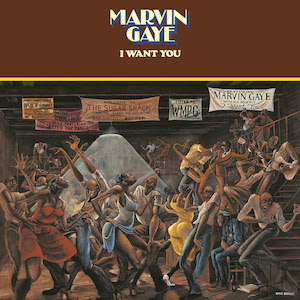
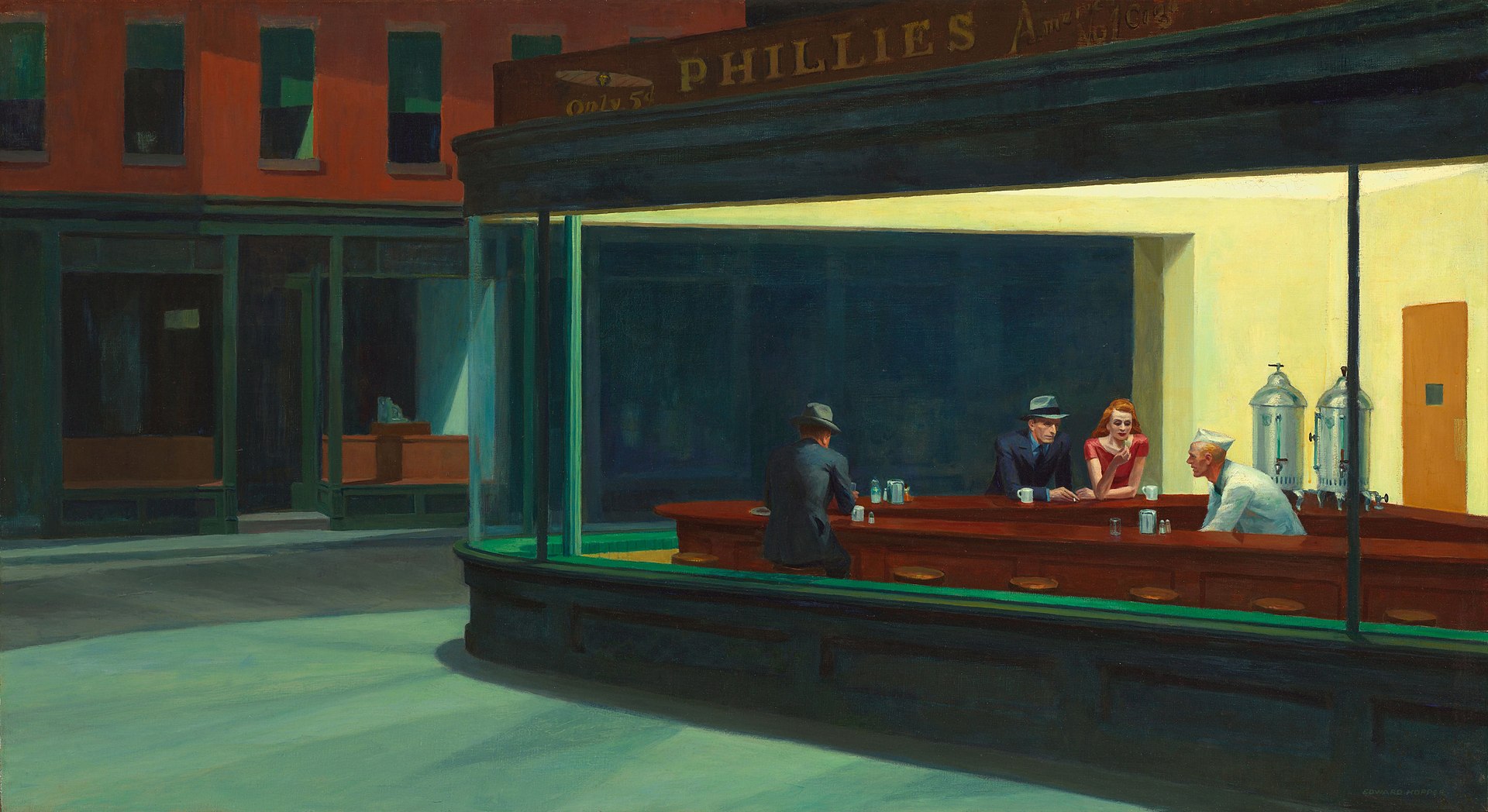
ADDED: "Sugar Shack" is the dream of a great night out — everyone is dancing and transported by the music. When you go out at night, you can only hope to find a place like that, or, no, you probably cannot even hope!
It made think of the Edward Hopper painting, "Nighthawks," which is also like a dream, but of an iconically bad night out — nowhere to go, no one to relate to at all:
1 ડિસેમ્બર, 2020
Is the new New Yorker cover shockingly depressing?
Simonson also tweets: "This woman is alone, living in squalor and drinking." Prescription drugs too. (Click on the image to see the full cover. There's lots of stuff on the floor.)Is this cover intentionally dark? Christ pic.twitter.com/2CryDhwTAd
— Joe Gabriel Simonson (@SaysSimonson) December 1, 2020
Simonson adds: "People say it’s meant to be dark but this interview with the artist doesn’t make that clear." And he links to this piece in The New Yorker, an interview with the artist Adrian Tomine.
And I must say that before I read the interview, I went to Amazon and bought a hardcover book of his, "The Loneliness of the Long-Distance Cartoonist." That's how much I love that beautifully drawn cover.
I think the cover is about the built-up effects of the lockdown on a young person in a small apartment and how it remains nonetheless possible to present a pulled-together image within the frame of a video call. The woman is struggling with the long ordeal of isolation but still looking out into the world for social interaction. She has a pretty cocktail in her hand, so it must be a social, not a business call. She's got her polished looks — lipstick, ruffled blouse, earrings. She's ready to move forward, optimistic. Outside of the frame of the call, the place is a mess, but it's a homey mess, with kitty cats and snack containers. She's comfortable, in shorts and fluffy slippers. And now that I'm looking closely, unshaved legs. The expression on her face is a serene smile.
Now, I'm reading the interview. The book on the floor — lower right — is the book I just bought. Nice. The artist was influenced by Edward Hopper. Here's the closest thing to a statement about the darkness/nondarkness of the cover:
29 સપ્ટેમ્બર, 2020
When the great painter Edward Hopper was a teenager, he painted copies of paintings by other artists — an utterly ordinary approach to learning how to paint.
But the NYT is making a weird huge deal out of this insignificant discovery: "Early Works by Edward Hopper Found to Be Copies of Other Artists/A grad student’s discovery 'cuts straight through the widely held perception of Hopper as an American original,' without a debt to others, a Whitney curator said."
Give me a break! These paintings by the teenager are not the Hopper paintings we've known and loved over the years. They're not the basis of any arguments about his Americanness and originality.
Let's look more closely at this article — by Blake Gopnik — and see what's really going on, why this inconsequential information is inflating into an exposé. Now, it is pretty cool that a scholar was able to find the exact images — the rather bad paintings — that teenaged Hopper used in his fumbling early efforts to manipulate oil paint.
Buried in the NYT article is the concession from the scholar (Louis Shadwick) that in those days "artists almost always got their start by copying." The article is marked as "updated," and I suspect that this is the updating. So let's continue:
Give me a break! These paintings by the teenager are not the Hopper paintings we've known and loved over the years. They're not the basis of any arguments about his Americanness and originality.
Let's look more closely at this article — by Blake Gopnik — and see what's really going on, why this inconsequential information is inflating into an exposé. Now, it is pretty cool that a scholar was able to find the exact images — the rather bad paintings — that teenaged Hopper used in his fumbling early efforts to manipulate oil paint.
Buried in the NYT article is the concession from the scholar (Louis Shadwick) that in those days "artists almost always got their start by copying." The article is marked as "updated," and I suspect that this is the updating. So let's continue:
A Londoner, [Shadwick] especially wants to understand the notion of “Americanness” that Hopper grew up around, and that then grew up around Hopper as his reputation matured; it still rules much of the talk about him....So this story is important because it fits the MAGA-versus-BLM theme of 2020?! Hopper embodies sentiments and modes of thinking that need interrogating.
In our new century, when the country’s place in the world seems less sure by the day and when even Americans are split on the state of their nation — does it need to be made great again or does it need to face up to past failures? — a “national” treasure like Hopper seems to beg for a fresh approach.
15 નવેમ્બર, 2018

Chop Suey sells for $91.9 million.

"The 1929 'Chop Suey,' described by Christie’s as 'the most iconic Hopper left in private hands,' depicts two women sitting across the table from each other in a Chinese eatery" (Bloomberg).
“‘Chop Suey’ is an icon and it belongs in a museum,” said Heinrich zu Hohenlohe, a dealer based in Berlin who attended the auction. “As a dealer I see this as an opportunity, of course. As a citizen of the world, I see it as a cop-out.”Yes. Truly. I agree.
16 ઑગસ્ટ, 2017
At the Late-Night Questionable Artwork Café...
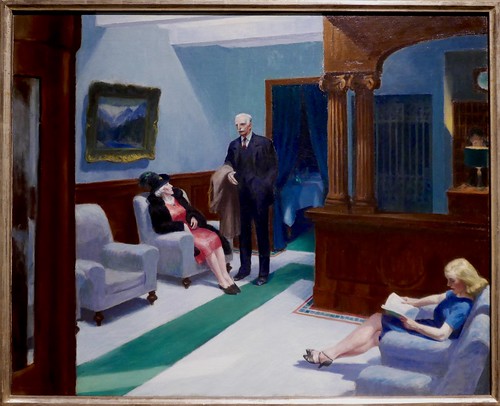
... I'm soliciting opinion on the possibly deplorable politics of this image. I think there are a lot of suspicious details here, and we may need to raise an outcry.
Or talk about anything you want. It's a café post.
More on the artwork later. I just thought opining on the political correctness of artwork was the order of the day.
Consider supporting my inquiry into questionable artwork by using The Althouse Amazon Portal.
ADDED: Here's the card (from the wall at the Indianapolis Museum of Art):

What a manipulative card! Eerily... disquieting... detached... separation... loneliness... transience... anonymity... Can't I have my own feelings? Are the older couple really so alienated from each other? Is the older woman not looking at the man? They don't look happy, but to me, they seem engaged.
Perhaps they're in town for a funeral. They've got their coats. They're going somewhere or they just got back. Something's up, something related to the world beyond this weird room. The young woman with the book is engaged with reading. Reading entails connection to another human being, the writer. Perhaps the young woman represents the youth the older couple have lost. Now, the older couple seem poised, tarrying, at the edge of the grave, represented vertically by the doorway to the dark restaurant. They're on the menu, food for worms.
The lobby is the antechamber of death. Outdoors is only a picture on the wall. There's no going back. The green line of life leads in from the left corner. The old lady has plopped into the chair and planted her prim little toes on the line. She looks with anxiety at the man who, one foot on the green line, lamely explains that they've got to keep going. The line turns a sharp corner, into the coffin/desk and the undertaker/desk clerk waits almost invisibly under the half-shown clock where their time is running out.
BUT: What is the argument that there is something politically objectionable here? Does the white man in the business suit dominate? Is he lording it over his wife? She looks intimidated. Is the other woman failing to notice, absorbed in the distracting delusion of her presumably nonfeminist reading material? The man and various phallic objects block progress toward the exits. One doorway (the entrance to a security room?) even has a cage-like door. The mountains (breastlike, signifying the female) are contained within a wooden picture frame. The alarmed woman's path to liberation is obstructed all around. The other woman doesn't even realize she needs to go. The green path mocks the idea of a path to freedom. It's not outdoors, like green grass, but an ugly stripe in the carpeting that ends in a sharp right turn into a dark corner. The older woman's toes extend into the path — a meek request — but the man is saying no. The other woman is far from the path, lost in a pre-printed dream. But this is not politically objectionable because we the viewers see it all and know we don't want to be there. Thus it works as critique and an inspiration to freedom and personal fulfillment. Judgment: Politically correct.
27 જાન્યુઆરી, 2017
The NYT detects a "budding bromance" between Elon Musk and Donald Trump.
The article, by James B. Stewart, is "Elon Musk Has Trump’s Ear, and Wall Street Takes Note." Musk had been anti-Trump before the election — or so he said in his public statements (who can know what is in a man's head?).
I absolutely adore the photograph — by Sasha Maslov — that accompanies this article. The unusual color, composition, and mood made me think of Edward Hopper paintings. Musk looks so alone and so pensive. I'd like to give this painting the title "The Man Who Is Not Smoking" (because of the hand positions and the smoke-like reflection in the background).
Now, back to Stewart's article.
I absolutely adore the photograph — by Sasha Maslov — that accompanies this article. The unusual color, composition, and mood made me think of Edward Hopper paintings. Musk looks so alone and so pensive. I'd like to give this painting the title "The Man Who Is Not Smoking" (because of the hand positions and the smoke-like reflection in the background).
Now, back to Stewart's article.
[Musk, at a White House meeting,] broached the subject of a carbon tax. Surprisingly, Mr. Trump didn’t reject it out of hand....Trump lets Musk broach. Fine.
Mr. Musk has broached the subject of the nation’s aging electricity transmission grid in conversations with Mr. Trump, according to an insider with knowledge of the discussions.
It’s still early in the Trump administration, and some (or all) of this may turn out to be wishful thinking by fans of Mr. Musk, Tesla investors, environmentalists and hopeful space colonists.Hmm. Seems to me Trump is gathering people in. He lets people approach. Approach and broach. Then what?
30 ઑગસ્ટ, 2012
Email from John Kerry: "I have one message burned into my memory..."
What?! I can't believe Kerry would evoke his old "memory which is seared — seared — in me" line. If you don't have that seared in your memory, here's a 2004 WaPo article, "Kerry's Cambodia Whopper."
It's weird to get email from a character from the past and have it begin with, essentially, remember me, the big liar. The email reads:
It's weird to get email from a character from the past and have it begin with, essentially, remember me, the big liar. The email reads:
I have one message burned into my memory for everyone who cares about the outcome of this year's presidential election:Meanwhile, over on Rush Limbaugh's show, the complaint is that the Republicans are afraid to attack Obama. After the first night of the convention, he quotes Fox News commentator Ed Rollins, who said: "Not hitting on Obama was a perfect way to go. We all know the Obama record and don't need to have it reinforced." That exasperates Rush:
Respond quickly and powerfully to attacks from the other side...
If you tune in to the convention, you'll see that Mitt Romney and his allies have no qualms about misleading voters if it means defeating President Obama.
But their attacks won't work if enough people step up to protect the President's record.
3 માર્ચ, 2010
"Small men feel... that the world belongs to big men. Seeing men you know to be small playing big on the silver screen is comforting...."
So says the small Fish — small fry — Stanley, who loves the short — under 5'9" — actors who play tough guys in the movies:
Ah, yes! I remember laughing out loud in the theater when she comes down the stairs and a man exclaims "Fanny! You look beautiful!" And check out that death-bed dialogue: "A woman is beautiful only when she is loved." That's what the plain women in the audience — next to the hubbies they dragged to the chick flick — long to believe.
The pattern was set in the 1930s and ’40s by Edward G. Robinson (“Little Caesar”), James Cagney, George Raft, Humphrey Bogart and Paul Muni — all small men who usually played tough and cruel. Sometimes camera angles obscured the physical facts — Robinson looked absolutely huge as Wolf Larsen in “The Sea Wolf” in what can be called, without irony, a towering performance — and sometimes the camera just didn’t care as when, for example, Cagney regularly beat up men obviously twice his size.Is there something comparable for women? Maybe we could make a list of women who have fairly average looks who play beautiful women on screen. My favorite example of this is Bette Davis in "Mr. Skeffington," where the raving over Bette's beauty occasionally crosses the line into the laughable. No man could resist her:
Slightly later came John Garfield, and the smallest of them all, Alan Ladd who played big in “The Blue Dahlia,” “The Glass Key,” “The Badlanders” and who more than holds his own against Ben Johnson and a tree-like Van Heflin in “Shane.”...
Famously slight Paul Newman displayed his chest and pugilistic abilities in movies like “Somebody Up There Likes Me,” “Hud,” “The Long, Hot Summer” and “Cool Hand Luke.” James Dean would have made the list had he lived longer. Now aging tough guy-short guys (by short I mean under 5-foot-9) include Jack Nicholson, Dennis Hopper, Robert DeNiro, Harvey Keitel, Al Pacino, Mel Gibson, Jean Claude Van Damme and Sylvester Stallone, who created not one but two iconic American males, Rocky and Rambo.
And these days we have a bumper crop of undersized super heroes — Tom Cruise, Tobey Maguire, Mark Wahlberg and Robert Downey Jr., along with the occasionally macho Johnny Depp and Sean Penn.
Ah, yes! I remember laughing out loud in the theater when she comes down the stairs and a man exclaims "Fanny! You look beautiful!" And check out that death-bed dialogue: "A woman is beautiful only when she is loved." That's what the plain women in the audience — next to the hubbies they dragged to the chick flick — long to believe.
9 જૂન, 2008
What is American about American art? John Updike says it's lininess.
Lininess!
The liney/painterly dichotomy persists to this day, and in the century since [Winslow] Homer's last works it has taken many forms. The dry, burnished literalism of Grant Wood and Charles Sheeler followed the ebullient impressionism of Childe Hassam and William Merritt Chase. Thomas Eakins is liney, John Singer Sargent is not; Andrew Wyeth is liney and Edward Hopper not. Among the Abstract Expressionists, Jackson Pollock achieves his signature effects with a welter of lines, and Mark Rothko achieves his by blurring all edges. Among Pop artists, Roy Lichtenstein takes the comic-strip lines and Benday to a majestic scale, while Andy Warhol remains a colorist above all. All, it might be said, employ highly personal techniques to confront the viewer with something vitally actual, beyond illusion.From the same issue of NYRB, the theme of perception, order, and chaos continues:
Two centuries after Jonathan Edwards sought a link with the divine in the beautiful clarity of things, William Carlos Williams wrote, in introducing his long poem Paterson, that "for the poet there are no ideas but in things." No ideas but in things. The American artist, first born into a continent without museums and art schools, took Nature as his only instructor, and things as his principle study. A bias toward the empirical, toward the evidential object in the numinous fullness of its being, leads to a certain lininess, as the artist intently maps the visible in a New World that feels surrounded by chaos and emptiness.
In fact, "external reality" is a construction of the brain. Our senses are confronted by a chaotic, constantly changing world that has no labels, and the brain must make sense of that chaos. It is the brain's correlations of sensory information that create the knowledge we have about our surroundings, such as the sounds of words and music, the images we see in paintings and photographs, the colors we perceive: "perception is not merely a reflection of immediate input," Edelman and Tononi write, "but involves a construction or a comparison by the brain."Draw lines.
29 જૂન, 2006
"A rush of generalized nostalgia, a soft-centered melancholy."
Holland Cotter opines on Edward Hopper:
To me he's a period illustrator with something extra. Like most effective graphic design, his pictures grab the eye, spark an emotion and get into your system, all in a flash. But too often the first look is the best look, and the first emotion — with Hopper, a rush of generalized nostalgia, a soft-centered melancholy — the only one. It's an experience; it's not nothing. I just wish it were more.That's a well-inserted dagger.
13 માર્ચ, 2004
Art, commerce, anomie and the high-tech lifestyle. Here's something I bought. I needed something to carry my laptop around in, so why not a handbag with an Edward Hopper painting of a woman reading on a train? I'll be a woman reading the internet on my laptop while traveling about, and somewhere in the past, there's that Hopper woman, on an old passenger train, reading a book.

I got that Hopper image from this page, which isn't in English, but it has a very lovely collection of paintings of women reading. Here, I'll copy another, which I find especially appealing. It's by Jan Sluijters.

I got that Hopper image from this page, which isn't in English, but it has a very lovely collection of paintings of women reading. Here, I'll copy another, which I find especially appealing. It's by Jan Sluijters.

આના પર સબ્સ્ક્રાઇબ કરો:
પોસ્ટ્સ (Atom)


 પોસ્ટ્સ


