"Well, given the malignant chaos of a purposeless universe, what’s one little false allegation in the scheme of things? Second, being a misanthropist has its saving grace — people can never disappoint you."
From Woody Allen's new memoir "Apropos of Nothing," quoted at Madison.com.
Also: "One of the saddest things of my life was that I was deprived of the years of raising Dylan and could only dream about showing her Manhattan and the joys of Paris and Rome. To this day, Soon-Yi and I would welcome Dylan with open arms if she’d ever want to reach out to us as Moses (Farrow) did, but so far that’s still only a dream."
I read the first few pages (at the Amazon link) and loved the writing style — full of vivid images and quick observations that are serious and comical. So I put it in my Kindle.
Dylan Farrow लेबलों वाले संदेश दिखाए जा रहे हैं. सभी संदेश दिखाएं
Dylan Farrow लेबलों वाले संदेश दिखाए जा रहे हैं. सभी संदेश दिखाएं
24 मार्च 2020


6 मार्च 2020
"Woody Allen Memoir Dropped by Hachette After Staff Walkout."
The Hollywood Reporter reports.
A source tells THR that following the announcement, HBG staff were surprised yet also relieved, clapping and cheering over the news.By the way, here's a critical review of "Catch and Kill" by Anne Diebel (in The New York Review of Books). Unfortunately, you need a subscription, and I can't excerpt anything because I consumed it by ear via Audm.
Thursday's walkout included employees from imprints Little, Brown and Company, which released Ronan Farrow's Catch and Kill, and Grand Central Publishing, which announced Monday that it would be releasing Allen's memoir April 7. Following the announcement, Farrow stated he would be ending his relationship with Hachette. Farrow, Allen's son, has repeatedly stated he believes his sister Dylan Farrow's allegations that the filmmaker sexually abused her as a child.
Dylan tweeted about HBG's decision to no longer publish Allen's memoir, writing "I'm in awe and so very grateful." Ronan also shared on social media that he was "grateful to all the Hachette employees who spoke up and to the company for listening."...
4 मार्च 2020
"Hachette’s publishing of Woody Allen’s memoir is deeply upsetting to me personally and an utter betrayal of my brother..."
"... whose brave reporting, capitalized on by Hachette, gave voice to numerous survivors of sexual assault by powerful men... This provides yet another example of the profound privilege that power, money and notoriety affords. Hachette's complicity in this should be called out for what it is and they should have to answer for it."
Said Dylan Farrow, quoted by AP.
Her brother, Ronan Farrow commented on Twitter. Hachette — his publisher too — was "wildly unprofessional," he says:
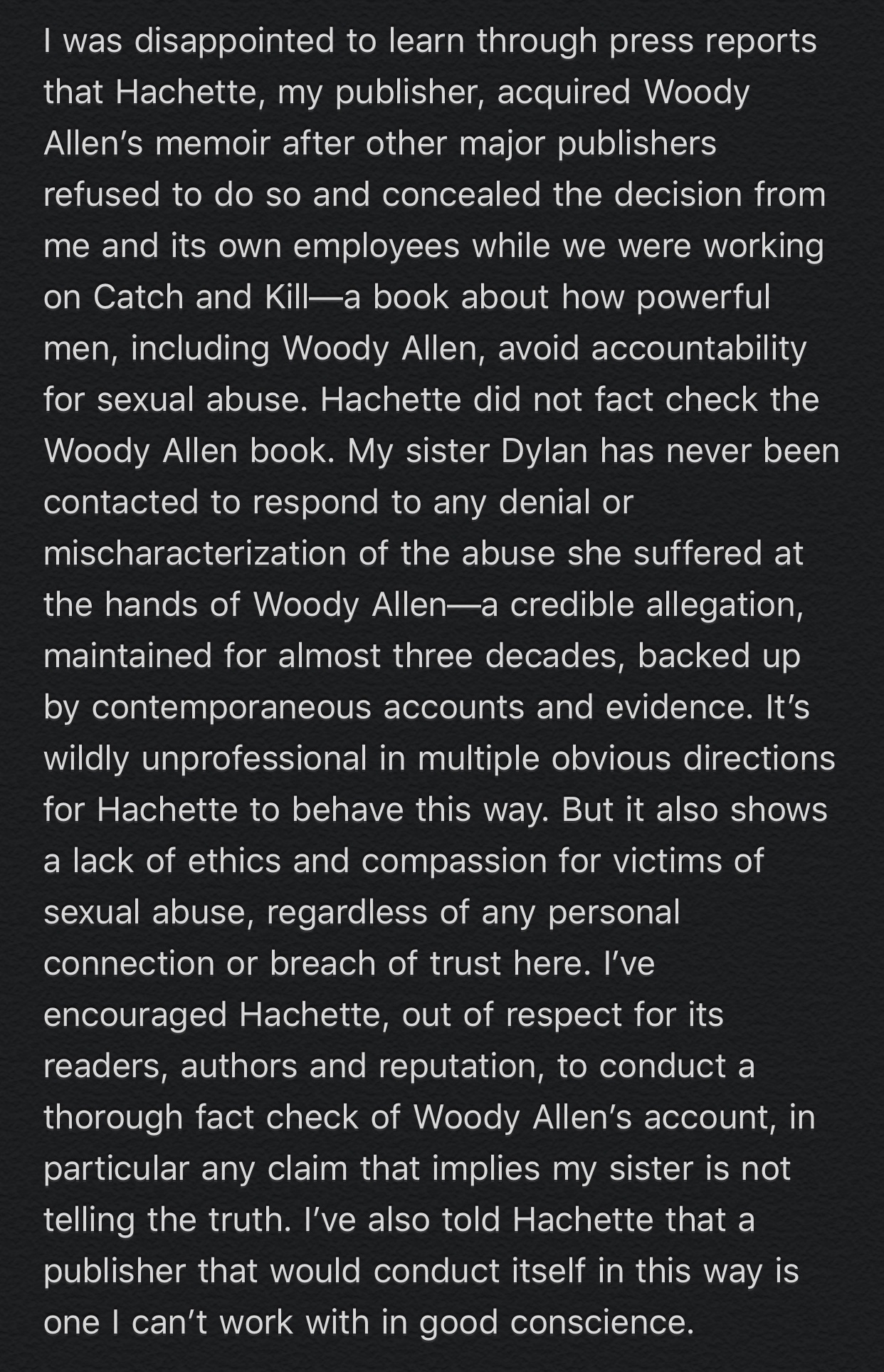
AND: "They’re all connected through the democratic party."
Said Dylan Farrow, quoted by AP.
Her brother, Ronan Farrow commented on Twitter. Hachette — his publisher too — was "wildly unprofessional," he says:
AND: "They’re all connected through the democratic party."
“They’re all connected through the democratic party.” @rosemcgowan on the long history of officials, including @ManhattanDA Cyrus Vance Jr, dropping efforts to charge Harvey Weinstein despite considerable evidence. Listen on the latest #CatchAndKill Pod: https://t.co/KhQ5XF3hb1 pic.twitter.com/kf8C4DayDH
— Ronan Farrow (@RonanFarrow) March 3, 2020
17 सितंबर 2018
Everyone seems to be telling her story at long last, so here — after "decades of silence" — comes Soon-Yi Previn.
New York Magazine has the big story. The author is Daphne Merkin (her name has been commented on many times, so spare me) who has been friends with Woody Allen for 40+ years and pronounces herself "mystified" by his "almost Aspergian aloneness" and "genuine diffidence." Here's some material from the second half of the article, about the relationship between Woody and Soon-Yi. I'll get to
ADDED: Maybe I'll stick with my original skipping of the get-Mia stuff. I'm seeing this:
Both of them are vague on how and when their friendship turned sexual — “It was 25 years ago,” she says... "and to the best of my memory I came in from college on some holiday and he showed me a Bergman movie, which I believe was The Seventh Seal, but I’m not positive. We chatted about it, and I must have been impressive because he kissed me and I think that started it. We were like two magnets, very attracted to each other.”....
“I know this is no justification,” she goes on, sitting across from me, her back ramrod straight. (“Posture,” she says quietly to Allen whenever he begins to slump. “I married her for her posture,” he quips.) “But Mia was never kind to me, never civil. And here was a chance for someone showing me affection and being nice to me, so of course I was thrilled and ran for it. I’d be a moron and an idiot, retarded” — she pauses here, mindful that this is one of her mother’s words for her — “if I’d stayed with Mia.” She adds, as if to set the record straight, “I wasn’t the one who went after Woody — where would I get the nerve? He pursued me. That’s why the relationship has worked: I felt valued. It’s quite flattering for me. He’s usually a meek person, and he took a big leap.”....
“I was madly in love with him,” she announces. It sounds completely heartfelt and as though it just happened yesterday. “Completely attracted to him, physically and sexually. I know he’d said that I’d meet someone in college, but I’d already decided. I came to realize how understanding he was and what a sweet person he was. He grew on me.” In an email she sends me, she slightly revises the scenario, showing a different side of herself, one in which she comes across less as the vulnerable, virginal girl she was than as a charming flirt: “I think Woody liked the fact that I had chutzpah when he first kissed me and I said, ‘I wondered how long it was going to take you to make a move.’ From the first kiss I was a goner and loved him.”...
The couple have two adopted children (two judges investigated each adoption, as is routinely done, and okayed them) because of Soon-Yi’s strong convictions about the narcissism inherent in having biological children. “I could definitely have children,” she says, “but I was never interested. I find it the height of vanity and very egocentric. I don’t need kids out there who have similar traits to me and look similar to me and Woody. Why is one’s DNA so special? Why would one keep on breeding when there are so many kids out there who need a loving home?”...
Now that the girls are grown... the couple are more close-knit — you might call it symbiotic — than ever. Allen describes how they spend their time together as “parallel play,” which makes Soon-Yi laugh. “Parallel play,” she repeats. “Yes, I think you’re right..."Lots more in the article. I've skipped most of it. I'll go back to the get-Mia things later.
... I ask Soon-Yi whether she thinks she’s been reshaped by her husband. “Reshaped?” she asks. “I mean, he’s given me a whole world, a whole world that I wouldn’t have had access to. So if you mean that way, then yes.”...
ADDED: Maybe I'll stick with my original skipping of the get-Mia stuff. I'm seeing this:
My statement on New York Magazine: pic.twitter.com/xml6pdaZqb
— Dylan Farrow (@RealDylanFarrow) September 17, 2018
23 मई 2018
"One summer day, Mia accused me of leaving the curtains closed in the TV room."
"They had been drawn the day before when Dylan and Satchel were watching a movie. She insisted that I had closed them and left them that way. Her friend Casey had come over to visit and while they were in the kitchen, my mother insisted I had shut the curtains. At that point, I couldn’t take it anymore and I lost it, yelling, 'You’re lying!' She shot me a look and took me into the bathroom next to the TV room. She hit me uncontrollably all over my body. She slapped me, pushed me backwards and hit me on my chest, shouting, 'How dare you say I’m a liar in front of my friend. You’re the pathological liar.' I was defeated, deflated, beaten and beaten down. Mia had stripped me of my voice and my sense of self. It was clear that if I stepped even slightly outside her carefully crafted reality, she would not tolerate it. It was an upbringing that made me, paradoxically, both fiercely loyal and obedient to her, as well as deeply afraid...."
Moses Farrow tells his story in a blog post titled "A Son Speaks Out."
"Satchel" = Ronan Farrow.
Moses Farrow tells his story in a blog post titled "A Son Speaks Out."
"Satchel" = Ronan Farrow.
10 फ़रवरी 2018
"But I’m being asked to give up on Charlie Rose, Kevin Spacey, Al Franken, Louis CK and Garrison Keillor, just to name a few. In a way, I’m starting to feel violated."
From the top-rated comment on "The Smearing of Woody Allen" (NYT):
(By the way, you strike a chord, not a cord.)
Dylan Farrow’s memory could plausibly have been altered by the intense atmosphere surrounding the charges, and she may have a perfectly sincere but false memory of the events. It’s telling that her story changed during the initial investigation, but that she’s absolutely certain now, many years later.From the op-ed itself, which is by Bret Stephens:
Or maybe I’m wrong. If so, I’m deeply sorry. But I’m being asked to give up on Charlie Rose, Kevin Spacey, Al Franken, Louis CK and Garrison Keillor, just to name a few. In a way, I’m starting to feel violated. I don’t want to give up on Woody Allen, and it will take more than an unsubstantiated accusation to make me do so.
Soon after Rolling Stone published a sensational — and, as it turned out, false — account of a gang rape at a University of Virginia fraternity, Richard Bradley, the editor of Worth magazine, suspected that something was amiss.... [W]hat most stirred Bradley’s doubt was how perfectly the story played “into existing biases,” especially the sorts of biases Rolling Stone readers might harbor about fraternity life at Southern universities. Since the account of the rape “felt” true, it was easy to assume it was....That makes me think of Michael Wolff. Remember him?
Michael Wolff asked on MSNBC about the factual errors in his Trump book.
— Benny (@bennyjohnson) January 8, 2018
His actual response: "If it makes sense to you, if it strikes a cord, if it rings true, it is true."
Katy Tur response: "I read it, I -- a lot of the did feel true"
This is Journalisming. pic.twitter.com/IOowlxWNvV
(By the way, you strike a chord, not a cord.)
19 जनवरी 2018
Dylan Farrow gives an emotional interview to "CBS This Morning."
Here's the transcript. Here's Woody Allen's response.
It's an old story made new by the "Time's Up" movement in Hollywood and Farrow's going on camera (asking us to see and believe).
KING: Are you angry with the people, with the celebrities that are starring in his movies, that hold him in high regard and continue to compliment him?
FARROW: I'm not angry with them. I hope that, you know, especially since so many of them have been vocal advocates of this Me Too and Time's Up movement that, um, they can acknowledge their complicity and maybe hold themselves accountable to how they have perpetuated this culture of – of silence in their industry.
9 दिसंबर 2017
Dylan Farrow attacks Kate Winslet for playing being dumb about Woody Allen... or maybe attacks men for causing Kate Winslet to be dumb about Woody Allen.
I'm watching to see if and when women are going to attack other women for their role in facilitating and covering for men and their sexual violations.
In an L.A. Times op-ed titled "Why has the #MeToo revolution spared Woody Allen?," Dylan Farrow writes:
Speaking of creating fog! This op-ed is also fog.
In an L.A. Times op-ed titled "Why has the #MeToo revolution spared Woody Allen?," Dylan Farrow writes:
It is a testament to Allen's public relations team and his lawyers that few know these simple facts. It also speaks to the forces that have historically protected men like Allen: the money and power deployed to make the simple complicated, to massage the story.I'd say that is very carefully written to protect Kate Winslet. Woody Allen continues his movie-making and movie-promoting, despite allegations that would utterly ruin other men, because... not because actresses — great actresses — love to work with him, but because "forces" of "money and power" have "created fog."
In this deliberately created fog, A-list actors agree to appear in Allen's films and journalists tend to avoid the subject.
Discussing Weinstein, "Wonder Wheel" star Kate Winslet said, "The fact that these women are starting to speak out about the gross misconduct of one of our most important and well-regarded film producers, is incredibly brave and has been deeply shocking to hear." Of Allen, she said "I didn't know Woody and I don't know anything about that family. As the actor in the film, you just have to step away and say, I don't know anything, really, and whether any of it is true or false. Having thought it all through, you put it to one side and just work with the person. Woody Allen is an incredible director."
Speaking of creating fog! This op-ed is also fog.
2 दिसंबर 2017
"When writing about [Woody] Allen’s recent movies, I haven’t addressed the over-all question of whether we can (or should) separate the artist from the art."
"I’ve always considered that idea absurd" — writes Richard Brody (at The New Yorker) — "because the very quality that makes movies worthwhile is how they express the personality, the character, the ideas, the experiences of their makers. The problem with learning about the artist from the art is that artists sometimes reveal themselves to be troubled, troubling people, and bring to light their ugly traits, ideas, or even actions. The depth of a complex work that deals with horrific but authentic aspects of life is sometimes found in the artists’ personal implications in those parts of life. There has always been something sexually sordid in Allen’s work...."
There has always been something sexually sordid about sex. Woody Allen famously asked and answered: "Is sex dirty? Only when it's being done right."
But Brody is tasked to review the latest Woody Allen movie. The ancient Allen — he's 82 — keeps cranking out a movie every year, with the help of the very best actresses — this time it's Kate Winslet — who don't shun him, presumably because the roles are luscious. The actresses must play the parts as written, but Brody can deviate from the usual movie reviewer stance, and this New Yorker piece is titled "Watching Myself Watch Woody Allen Films." So I find myself watching Brody watching. It's about Brody's feeling, his virtue, his being on the correct side of history, now that we're so obviously in the midst of The Reckoning.
Brody says he doesn't "remember reading about the accusations" that Allen had molested his daughter Dylan until he read Dylan's 2014 op-ed in the NYT. He concedes:
In The Reckoning, you must show that you care, not just now, but in the past, when you thought it was okay to ignore what happened in private — who really knows? it's "he said, she said" (as people used to say all the time in the old days). So Brody knows to say it would have been wrong at the time to dismiss the allegations if he heard them, but he doesn't remember hearing them. But he must have heard them. There were dozens of articles in the NYT in 1993. He had to have actively looked away. Brody is still seeking cover for his past callousness. How severe is this Reckoning? Does Brody have cover enough?
Brody has written an awful lot about Woody Allen. Just last year, he published "The Existential Genius of Late Woody Allen" (New Yorker). How much pressure does he feel to disaggregate himself — at this late hour — from Woody Allen? In his new article, Brody looks back on many Woody Allen films and notes the various sexual themes. He then makes an important — but really very obvious — point about art:
But Brody is a film reviewer. He has to see these movies, and he must believe that the job is to write about the thing that appears on the screen, not your moral judgments on the people who caused the thing to exist.
The new thing is "Wonder Wheel," and it has its anguished woman crying out for help:
Like a movie, an article about movies needs and ending an here's what Brody gives us:
There has always been something sexually sordid about sex. Woody Allen famously asked and answered: "Is sex dirty? Only when it's being done right."
But Brody is tasked to review the latest Woody Allen movie. The ancient Allen — he's 82 — keeps cranking out a movie every year, with the help of the very best actresses — this time it's Kate Winslet — who don't shun him, presumably because the roles are luscious. The actresses must play the parts as written, but Brody can deviate from the usual movie reviewer stance, and this New Yorker piece is titled "Watching Myself Watch Woody Allen Films." So I find myself watching Brody watching. It's about Brody's feeling, his virtue, his being on the correct side of history, now that we're so obviously in the midst of The Reckoning.
Brody says he doesn't "remember reading about the accusations" that Allen had molested his daughter Dylan until he read Dylan's 2014 op-ed in the NYT. He concedes:
It’s entirely possible that I had seen a headline or heard news back then but wrongly dismissed the allegations as the sort of rumor that’s spread during a bitter custody dispute.I'm searching the NYT archive, and there were dozens of articles back in 1993, but yes, if you kept your distance, it looked like a bitter custody dispute. Notice how Brody inserts the word "wrongly." It was wrong to think, I will look away from this messy divorce, because now, in The Reckoning, you are supposed to care about what took place in private and respond when anguished women cry out for help.
Mia Farrow testified yesterday that her 7-year-old daughter, Dylan, was so distraught over the relentless attention of her adoptive father, Woody Allen, that she frequently screamed, "Hide me! Hide me!" when he came to visit her, and twice locked herself in the bathroom to keep away from him....That's from "Farrow Says Daughter Became Distraught Over Allen's Relentless Attention," a NYT report from 1993.
"He would creep up in the morning and lay beside her bed and wait for her to wake up," Ms. Farrow testified, as Mr. Allen sat a few feet away in the courtroom, scribbling notes and tearing pages from a legal pad. "I thought it was excessive. I was uncomfortable all along."
In The Reckoning, you must show that you care, not just now, but in the past, when you thought it was okay to ignore what happened in private — who really knows? it's "he said, she said" (as people used to say all the time in the old days). So Brody knows to say it would have been wrong at the time to dismiss the allegations if he heard them, but he doesn't remember hearing them. But he must have heard them. There were dozens of articles in the NYT in 1993. He had to have actively looked away. Brody is still seeking cover for his past callousness. How severe is this Reckoning? Does Brody have cover enough?
Brody has written an awful lot about Woody Allen. Just last year, he published "The Existential Genius of Late Woody Allen" (New Yorker). How much pressure does he feel to disaggregate himself — at this late hour — from Woody Allen? In his new article, Brody looks back on many Woody Allen films and notes the various sexual themes. He then makes an important — but really very obvious — point about art:
Of course, the recognition of evil feelings and impulses isn’t the sole dominion of criminals, and guilt isn’t solely the torment of gross offenders; the virtuous are all the more likely to feel guilt on the basis of ordinary personal failings, the inherent tensions and conflicts of even constructive family relationships, romances, and friendships, ordinary compromises at work, a sense of responsibility for mere day-to-day passivity, willed indifference, self-delusion. An artist who can illuminate those powerful, ubiquitous, destructive, morally complex feelings and dramatize them in a range of public and private contexts, from professional to artistic to domestic, is one whose work is worth experiencing.And then Brody expresses his annoyance that the artist who's doing the best work might not be fully innocent or even a very good person:
It’s a horrible paradox that the modern filmmaker who explores those emotions most relentlessly, most painfully, and most compellingly is one who is accused of doing things that would give him good reason to feel them.Paradox?! It's not a paradox. I agree that it's horrible though. The person whose art you want to consume is bad. That's not at all surprising. That tends to be the way it goes with artists. You'll have to swear off art, if you want to keep yourself pure.
But Brody is a film reviewer. He has to see these movies, and he must believe that the job is to write about the thing that appears on the screen, not your moral judgments on the people who caused the thing to exist.
The new thing is "Wonder Wheel," and it has its anguished woman crying out for help:
Scattered throughout the film are hints of torments, as when Ginny suggests that Humpty has an “unnatural attachment” to Carolina; when Ginny, in a crisis of jealousy, berates Carolina with angry and frantic questions: “Did he try anything? Did he touch you? Did he take your hand? Did he do anything? Did he kiss you?”... “Wonder Wheel” virtually shrieks with confessional anguish and is scarred with indelible regret.How to listen to these women crying out from inside a work of art? Brody might want to say: I'm an art critic and this is art and it's my role to watch movies and tell you about them. But like a character in a Woody Allen movie, I've got a conscience, and I'm watching me watching Woody.
Like a movie, an article about movies needs and ending an here's what Brody gives us:
The world that [Woody Allen] depicts in his films is one in which the powerful abuse their power to prey upon the vulnerable and, until now, have, for the most part, gotten away with it. It’s also a world that, because of the courageous testimony of women including, crucially, Dylan Farrow, is now coming to light and, perhaps, to change.Is that a satisfying ending for "Watching Myself Watch Woody Allen Films." No! The character, Richard Brody, absents himself from his own story. He endorses the "courageous... women" and retreats back into the dark, as if now, he's done enough, and he can get back to watching those movies without having to watch himself.
14 फ़रवरी 2014
"Or maybe our attempts to get at the truth of an imbroglio, like that involving Farrow and Allen, reflect a frustrated aspiration to retrieve some kind of shared, collective truth, period."
That's one sentence in a belabored essay by Lee Siegel titled "Is the News Replacing Literature?" Subheading that appears at the top of my browser but not on the page: "Woody Allen and Dylan Farrow v. Proust and Kafka."
Of course, Woody Allen has written innumerable screenplays in the 20 years that have gone by since we first heard the accusations about what he might have done to Dylan. We still consume those things. We (some of us) endeavor to fathom "Blue Jasmine" or whatever his movie of the year is.
But Siegel insists: "Instantaneous news of what happened, or might have happened, has become our art, and, like the chorus in ancient Greek tragedy, we are all part of the swelling roar." If so, is this bad? In novels, the characters are fictional, so our inferences from the evidence don't pass judgment on anyone real. If we can't see all the facts, it's because the author created ambiguity or didn't foresee all the various ideas we'd have, reading, and the additional things we might think we need to know.
It's a mental exercise, reading fiction, and the author may be a despicable person, like Woody Allen, if Woody Allen really did the things he's accused of, so maybe it is better to stretch our minds over the framework of some news story, like the story of Woody and Dylan. There, the facts are incomplete for a different reason, but the incompleteness is reality-based: Reporters can't get any deeper into the truth of the past. If we judge, we judge real people, and that isn't merely a mental exercise. We risk our own morality.
Siegel observes "a backlash of fanatical certainty and malevolent personal projection" in much of the "swelling roar" about Woody and Dylan, but people say foolish things about art too. High art is a filter. Who has opinions about Proust and Kafka? Maybe what's really eating Siegel is that those who used to consume high art and exchange their fanatical certainties and malevolent personal projections amongst themselves have joined the mob blabbering about news stories, and where can you find the truly excellent people anymore?
Of course, Woody Allen has written innumerable screenplays in the 20 years that have gone by since we first heard the accusations about what he might have done to Dylan. We still consume those things. We (some of us) endeavor to fathom "Blue Jasmine" or whatever his movie of the year is.
But Siegel insists: "Instantaneous news of what happened, or might have happened, has become our art, and, like the chorus in ancient Greek tragedy, we are all part of the swelling roar." If so, is this bad? In novels, the characters are fictional, so our inferences from the evidence don't pass judgment on anyone real. If we can't see all the facts, it's because the author created ambiguity or didn't foresee all the various ideas we'd have, reading, and the additional things we might think we need to know.
It's a mental exercise, reading fiction, and the author may be a despicable person, like Woody Allen, if Woody Allen really did the things he's accused of, so maybe it is better to stretch our minds over the framework of some news story, like the story of Woody and Dylan. There, the facts are incomplete for a different reason, but the incompleteness is reality-based: Reporters can't get any deeper into the truth of the past. If we judge, we judge real people, and that isn't merely a mental exercise. We risk our own morality.
Siegel observes "a backlash of fanatical certainty and malevolent personal projection" in much of the "swelling roar" about Woody and Dylan, but people say foolish things about art too. High art is a filter. Who has opinions about Proust and Kafka? Maybe what's really eating Siegel is that those who used to consume high art and exchange their fanatical certainties and malevolent personal projections amongst themselves have joined the mob blabbering about news stories, and where can you find the truly excellent people anymore?
10 फ़रवरी 2014
"The Woody Allen Debate Belongs in the Public Sphere."
"When an alleged victim of abuse tells her story to the world, it's not any more virtuous to ignore the controversy than it is to take a side," writes Noah Berlatsky in The Atlantic.
ADDED: No, no, I take that back. The inference isn't locked in. You could accept that there should be public debate and still not take a side. And you could certainly have that debate and side with Woody (although that feels, in some circles, like a position that would induce social shunning). And I don't even accept Berlatsky's spoken inference, that if you refrain from debate, you're furthering Allen's cause. You might think that Dylan's open letter forced Allen to publish his statement and that attention to his detailed arguments is undermining her already-well-known position, and this new debate further distances her from decisive victory.
If we all just stay above the fray, and insist that the existence of abuse here is unknowable — that, de facto, means that Allen wins. If no one is judging, if no one will discuss his family life, he can go on as he always has, and, presumably, keep collecting those lifetime achievement awards. [Dylan] Farrow is asking you to take a side and to see this as a public issue. If you don't, you should at least be aware whose wishes you are honoring, and whose you are not.You can infer from that that Berlatsky has taken a side and which one.
ADDED: No, no, I take that back. The inference isn't locked in. You could accept that there should be public debate and still not take a side. And you could certainly have that debate and side with Woody (although that feels, in some circles, like a position that would induce social shunning). And I don't even accept Berlatsky's spoken inference, that if you refrain from debate, you're furthering Allen's cause. You might think that Dylan's open letter forced Allen to publish his statement and that attention to his detailed arguments is undermining her already-well-known position, and this new debate further distances her from decisive victory.
6 फ़रवरी 2014
Stephen King weighs in on Dylan Farrow's statement: "There’s an element of palpable bitchery there."
Full quote: "Boy, I’m stumped on that one. I don’t like to think it’s true, and there’s an element of palpable bitchery there, but...."
Palpate any bitches lately, Steve?
What does "palpable" add? Is it just verbiage — meaningless padding — or is it a way to say that he feels it — he senses it? (It's his truth.) Or does it mean there's some substantial bitchery?
And what's with "bitchery" and "element... of bitchery"? That seems like a way to avoid saying that the woman is a bitch. There's some bitchery in the letter she wrote.
Palpate any bitches lately, Steve?
What does "palpable" add? Is it just verbiage — meaningless padding — or is it a way to say that he feels it — he senses it? (It's his truth.) Or does it mean there's some substantial bitchery?
And what's with "bitchery" and "element... of bitchery"? That seems like a way to avoid saying that the woman is a bitch. There's some bitchery in the letter she wrote.
5 फ़रवरी 2014
"I think my sister is missing a great deal in life in not reconnecting with her father, who had always adored her."
"It’s important that she assert her independence from our mother and not go through life with the false impression that she has been molested by my father. I am very happy I have come into my own power, separating from my mother, which has led to a positive reunion with my father."
Says Moses Farrow, defending Woody Allen. Moses is, we're told, a family therapist. He has some things to say about his mother: "From an early age, my mother demanded obedience and I was often hit as a child. She went into unbridled rages if we angered her, which was intimidating at the very least and often horrifying, leaving us not knowing what she would do."
Meanwhile, Mia is tweeting: "A lot of ugliness is going to be aimed at me. But this is not about me, it's about her truth."
I feel like shutting the door on this session of family therapy, but I'll just say "her truth" is a strange expression. The usual concept of truth is that it is simply the truth. When you put a possessive in from of it — this is my truth — it is ordinarily to concede that you are talking about the way things look or feel from your perspective. And it's odd to direct your audience to another individual's truth, as though you need people to think about the question at hand through the eyes of this other person over there. This is her truth. That's what's important. This is not about me. How do I know it's not about you or that "her truth" isn't really your truth? Do we even know that Dylan Farrow wrote her own letter?
Says Moses Farrow, defending Woody Allen. Moses is, we're told, a family therapist. He has some things to say about his mother: "From an early age, my mother demanded obedience and I was often hit as a child. She went into unbridled rages if we angered her, which was intimidating at the very least and often horrifying, leaving us not knowing what she would do."
Meanwhile, Mia is tweeting: "A lot of ugliness is going to be aimed at me. But this is not about me, it's about her truth."
I feel like shutting the door on this session of family therapy, but I'll just say "her truth" is a strange expression. The usual concept of truth is that it is simply the truth. When you put a possessive in from of it — this is my truth — it is ordinarily to concede that you are talking about the way things look or feel from your perspective. And it's odd to direct your audience to another individual's truth, as though you need people to think about the question at hand through the eyes of this other person over there. This is her truth. That's what's important. This is not about me. How do I know it's not about you or that "her truth" isn't really your truth? Do we even know that Dylan Farrow wrote her own letter?
4 फ़रवरी 2014
"I think it's part of Mia Farrow's desire to hurt Woody Allen."
"His reaction is one of overwhelming sadness because of what has happened to Dylan. She was a pawn in a huge fight between him and Mia years ago. The idea that she was molested was implanted in her mind by her mother."
Said Woody Allen's lawyer Elkan Abramowitz, on TV today.
Said Woody Allen's lawyer Elkan Abramowitz, on TV today.
The NYT public editor registers 2 polite objections (where strong criticism would make more sense).
1. "As the Latest Christie Story Evolved, The Times Should Have Noted a Change."
2. "On Kristof’s Column About Dylan Farrow and Woody Allen..." Sullivan says that she's "troubled by the same questions raised" in email sent to her by a professor named Chris Rasmussen, whom she quotes:
Come on, Sullivan, be there for us. Yes, yes, I know. You're all going to say that of course the "public editor" position is NYT PR and a fraud.
“We made dozens of changes to this story, and it’s all happening live in front of the reader,” he said. “The story probably went through two dozen versions.” Editors can’t be expected to describe each one of those changes, [the Metro editor, Wendell Jamieson said].What an outrageous move! Defining something as "the essential truth" so that the thing that did change appears inconsequential: What really matters was that Christie was getting attacked, not the assertion that the attacker was in possession of "evidence" against Christie. But it was that evidence that got everyone excited, which was the point of the big scoop that Jamieson seeks to defend. The public editor, Margaret Sullivan, mildly chides him. There should have been "some sort of notice" of this edit.
And he added that no change, including the one I mention above, “alters the essential truth of the story, which is that a former Christie ally has opened fire on him in a big way.”
2. "On Kristof’s Column About Dylan Farrow and Woody Allen..." Sullivan says that she's "troubled by the same questions raised" in email sent to her by a professor named Chris Rasmussen, whom she quotes:
The writers who are permitted to “columnize” for The Times have a tremendously influential platform, and I wonder whether they should use that platform to advocate on behalf of personal friends, as Mr. Kristof did yesterday....Personal friends? Sullivan does not provide any detail about this personal friendship. I clicked the link to see Kristof's own disclosure, which specifies who the friendship is with, but not the degree of warmth and interaction: "I am a friend of her mother, Mia, and brother Ronan, and that’s how Dylan got in touch with me." That disclosure appears only at the column, not at the blog post, which is where Dylan's open letter appears in full and thus the page most people are reading. Can't Sullivan do more than say she's "troubled" and that there are "questions"? I had to Google "what is nicholas kristof's friendship with mia farrow" in an effort to get details. I found this at a website the credibility of which I don't know:
But Kristof and Farrow aren’t just ‘friends.’ They are close friends. Romantic? I’m not suggesting that. They travel together, Kristof writes about Farrow often, he Tweets and re-Tweets her.Why couldn't Sullivan extract details from Kristof?
Come on, Sullivan, be there for us. Yes, yes, I know. You're all going to say that of course the "public editor" position is NYT PR and a fraud.
2 फ़रवरी 2014
"What's your favorite Woody Allen movie? Before you answer, you should know..."
Dylan Farrow puts her sad face between you and whatever Woody Allen movie you might have been hoping to enjoy.
Over at Reason, Nick Gillespie looks like he's working up to a response, a reasonable response, to the questions he frames — "Did Woody Allen Molest His Daughter, Dylan Farrow? And If So, Should You Disavow His Films?"
Gillespie reveals that he doesn't even like Woody Allen. He says Allen "ceased to produce consistently interesting movies decades ago," which either means that he hasn't noticed "Blue Jasmine" or that he really meant to write "ceased the consistent production of interesting movies decades ago." "Blue Jasmine" (2013) is certainly consistently interesting. So was "Midnight in Paris" (2011). Maybe "To Rome With Love" (2012) was only interesting in parts. But, good lord, Woody Allen has consistently made interesting movies. Look at the IMDB list. He has made at least one movie in every year since 1977, which is probably when Gillespie imagines that he stopped being interesting.
Gillespie shifts the topic to the more general question — "When — if ever — does the biography of a creator mean that you cannot or should not in good conscience patronize an artist?" — and he doesn't even answer that. He throws it over to the readers: "What do you think readers?"
But I want to get back to Woody Allen. Dylan Farrow writes: he "sexually assaulted" her. I'm putting that in quotes not to express disbelief, but to observe the generality of the term. We're told that she was playing with an electric train but not what body part of his came into what sort of contact with what body part of hers. We're told "what he did to me in the attic felt different" from other things he did that she also did not like. Those other things are specified: He had her under the covers in bed with him when he was "in his underwear." He put his thumb in her mouth. He put "his head in [her] naked lap."
These charges are not new. I read the 1992 Vanity Fair article that had all of this material, and I've seen maybe 15 Woody Allen movies since then, some more than once. "Blue Jasmine" is, I think, the only movie I saw this year in the theater, and I returned to the theater to see it a second time. So, through my own actions, I've obviously answered Gillespie's question yes, in the case of Woody Allen movies. I can in good conscience go to see his movies. For one thing — unlike Gillespie — I like Woody Allen. It's fine to have your "good conscience" about avoiding things you don't even want to do. The morality test only applies when — to useWoody Allen's Emily Dickinson's expression — "The Heart wants what it wants."
I feel empathy for Dylan Farrow, but I think we are living in a fallen world, and we are surrounded by human beings all of whom have their sins, known and unknown. To purport to know what cannot be truly known is also a sin. To punish and shun one person out of preference for another when the truth is not known is surely not an exalted virtue, if it is a virtue at all. The works of art exist and are real and apart from the artist. And when someone chooses — as Woody Allen has — to remain silent all these years, to keep to himself, producing good work, incurring no further charges of harming anyone, I think we are not doing something morally wrong to receive that work for whatever value it has, independently, as art.
That said, it appears that the celebration of Woody Allen, the man, on the Golden Globes TV show is what provoked Dylan Farrow to come forward. But Woody Allen was thousands of miles away from that event. He was not soaking up the adulation. The art/artist separation remains, and yet we can reframe Gillespie's question to focus on a more particular consumer-end moral problem: At what point do accusations of wrongdoing against an artist make it wrong to enjoy a staged celebration of the man?
Woody Allen himself seems to loathe all staged celebrations of artists. Has he ever appeared at any awards show? Perhaps he's got a personal awareness of guilt that shames him away. But we are all sinners, and it might be best if we all had an aversion to the celebration of celebrities.
To paraphrase Jesus: Let him who is without sin among you be the first to watch the Golden Globes.
UPDATE: "Mr. Allen has read the article and found it untrue and disgraceful. He will be responding very soon."
Over at Reason, Nick Gillespie looks like he's working up to a response, a reasonable response, to the questions he frames — "Did Woody Allen Molest His Daughter, Dylan Farrow? And If So, Should You Disavow His Films?"
Gillespie reveals that he doesn't even like Woody Allen. He says Allen "ceased to produce consistently interesting movies decades ago," which either means that he hasn't noticed "Blue Jasmine" or that he really meant to write "ceased the consistent production of interesting movies decades ago." "Blue Jasmine" (2013) is certainly consistently interesting. So was "Midnight in Paris" (2011). Maybe "To Rome With Love" (2012) was only interesting in parts. But, good lord, Woody Allen has consistently made interesting movies. Look at the IMDB list. He has made at least one movie in every year since 1977, which is probably when Gillespie imagines that he stopped being interesting.
Gillespie shifts the topic to the more general question — "When — if ever — does the biography of a creator mean that you cannot or should not in good conscience patronize an artist?" — and he doesn't even answer that. He throws it over to the readers: "What do you think readers?"
But I want to get back to Woody Allen. Dylan Farrow writes: he "sexually assaulted" her. I'm putting that in quotes not to express disbelief, but to observe the generality of the term. We're told that she was playing with an electric train but not what body part of his came into what sort of contact with what body part of hers. We're told "what he did to me in the attic felt different" from other things he did that she also did not like. Those other things are specified: He had her under the covers in bed with him when he was "in his underwear." He put his thumb in her mouth. He put "his head in [her] naked lap."
After a custody hearing denied my father visitation rights, my mother declined to pursue criminal charges, despite findings of probable cause by the State of Connecticut – due to, in the words of the prosecutor, the fragility of the "child victim."So there will always be a cloud on Woody Allen's reputation, but it's not as though he could have removed the cloud if only he'd been prosecuted and had his day in court. He'd have enjoyed the presumption of innocence, and that means suspicion would remain even if there were a not guilty verdict.
These charges are not new. I read the 1992 Vanity Fair article that had all of this material, and I've seen maybe 15 Woody Allen movies since then, some more than once. "Blue Jasmine" is, I think, the only movie I saw this year in the theater, and I returned to the theater to see it a second time. So, through my own actions, I've obviously answered Gillespie's question yes, in the case of Woody Allen movies. I can in good conscience go to see his movies. For one thing — unlike Gillespie — I like Woody Allen. It's fine to have your "good conscience" about avoiding things you don't even want to do. The morality test only applies when — to use
I feel empathy for Dylan Farrow, but I think we are living in a fallen world, and we are surrounded by human beings all of whom have their sins, known and unknown. To purport to know what cannot be truly known is also a sin. To punish and shun one person out of preference for another when the truth is not known is surely not an exalted virtue, if it is a virtue at all. The works of art exist and are real and apart from the artist. And when someone chooses — as Woody Allen has — to remain silent all these years, to keep to himself, producing good work, incurring no further charges of harming anyone, I think we are not doing something morally wrong to receive that work for whatever value it has, independently, as art.
That said, it appears that the celebration of Woody Allen, the man, on the Golden Globes TV show is what provoked Dylan Farrow to come forward. But Woody Allen was thousands of miles away from that event. He was not soaking up the adulation. The art/artist separation remains, and yet we can reframe Gillespie's question to focus on a more particular consumer-end moral problem: At what point do accusations of wrongdoing against an artist make it wrong to enjoy a staged celebration of the man?
Woody Allen himself seems to loathe all staged celebrations of artists. Has he ever appeared at any awards show? Perhaps he's got a personal awareness of guilt that shames him away. But we are all sinners, and it might be best if we all had an aversion to the celebration of celebrities.
To paraphrase Jesus: Let him who is without sin among you be the first to watch the Golden Globes.
UPDATE: "Mr. Allen has read the article and found it untrue and disgraceful. He will be responding very soon."
सदस्यता लें
संदेश (Atom)


 संदेश
संदेश


