From the Wikipedia article, "Flattery."
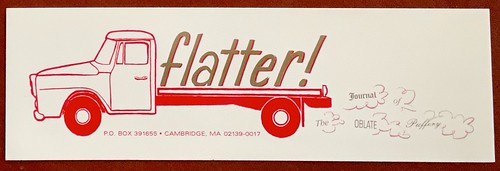
I'm reading that because I was looking up "Flatter!," which I'm doing because I'm getting rid of the piano, and, emptying out the piano bench, I found this:
Said restaurant owner Nisha Katona, quoted in a London Times article about the calorie counts that have been required in the U.K. since last month.
The article cites a study of American restaurants with calorie counts that "in the first month, diners opted for dishes with an average of 60 fewer calories but after a year, the average reduction had fallen to 23 calories." And, we're told, the main difference is that people are taking more time to figure out what to order.
And here's another article on fatness in the London Times today: "Ancients believed in survival of the fattest/For most of human history food was precious and plumpness was something to be proud of, but then fashions changed" by Ben Macintyre:
Thrifty genotypes among the hunter-gatherers, who could store fat efficiently, were favoured by evolution.... The traditional desirability of excess flesh was reflected in social habits, politics, literature and arts, from Rubens to Shakespeare to Dickens. Scrooge is thin, in contrast to Joe in The Pickwick Papers, “a wonderfully fat boy”.
“Let me have men about me that are fat,” Shakespeare’s Caesar declares, while the dangerous Cassius “has a lean and hungry look”. Falstaff, the most famous fat man in literature, is loveable and trustworthy because he is stout....
There were exceptions: the Spartans ostracised fat men; Socrates danced every morning to keep himself trim; Hippocrates correctly warned that “Corpulence is not only a disease itself, but the harbinger of others”...
So! Socrates danced every morning?

But what dance did he do?


 Posts
Posts


